

Losing someone you love is devastating enough. Then comes the question no one prepares you for: can someone be held accountable? A wrongful death claim explained simply is this: a civil lawsuit filed when another party’s negligence, recklessness, or intentional misconduct causes a person’s death. It is entirely separate from any criminal prosecution, and you do not need a criminal conviction to pursue it. This guide covers what a wrongful death claim actually is, who has the legal right to file, what compensation families may recover, and how the legal process unfolds from start to finish.
Table of Contents
- Key Takeaways
- What is a wrongful death claim and why it exists
- Who can file a wrongful death claim
- The four elements you must prove
- Damages in wrongful death cases
- How the wrongful death lawsuit process works
- My perspective on guiding families through these claims
- Let Oaks Law Firm help you take the next step
- FAQ
Key Takeaways
| Point | Details |
|---|---|
| Civil claim, not criminal | A wrongful death lawsuit is independent of criminal charges and uses a lower standard of proof. |
| Who files matters | The personal representative of the estate typically files on behalf of all eligible survivors. |
| Four elements must be proven | Duty, breach, causation, and damages to survivors are all required to succeed. |
| Multiple damage types available | Families may recover economic losses, emotional suffering, and in some cases, punitive damages. |
| Act quickly on deadlines | Statutes of limitations vary by state and situation; early legal action protects your rights. |
What is a wrongful death claim and why it exists
A wrongful death claim is a civil cause of action. That distinction matters more than most families realize. Civil and criminal cases run on separate tracks, separate courts, and separate standards of proof. The state pursues criminal charges to punish someone. Your family files a civil wrongful death lawsuit to seek compensation for what you lost. A defendant can be acquitted in criminal court and still be found liable in a civil wrongful death case. O.J. Simpson is the most famous example, but it happens far more quietly in courts across California every year.
The formal legal term you will see in court documents is wrongful death action. As a civil lawsuit, it allows surviving family members to seek financial compensation for losses caused by the death. Some states also recognize a companion claim called a survival action, which compensates for losses the deceased person could have claimed if they had survived. Both claims may be part of the same lawsuit but involve different damage types and sometimes different beneficiaries. Understanding which applies to your situation is one of the first things an attorney will assess.
Common situations that give rise to these claims
Wrongful death claims arise from a wide range of circumstances. The most common include:
- Car and truck accidents caused by a negligent or reckless driver
- Medical malpractice where a physician, hospital, or care facility failed to meet the standard of care
- Workplace accidents involving unsafe conditions or employer negligence
- Defective products that malfunction and cause fatal injuries
- Premises liability incidents such as fatal falls on poorly maintained property
- Intentional acts including assault and other violent conduct
What these situations share is that another party’s conduct, whether careless or deliberate, directly caused the death. The claim focuses on the survivors’ losses rather than the pain and suffering of the deceased, unless a survival action is filed alongside it.
Pro Tip: If you are unsure whether circumstances qualify, consult a wrongful death attorney before drawing any conclusions. Many facts that seem insignificant, like a skipped safety inspection or a delayed diagnosis, can form the foundation of a strong claim.
Who can file a wrongful death claim
This is one of the most misunderstood aspects of the process, and getting it wrong can create serious legal complications. Filing is typically done by the personal representative of the deceased’s estate. This person, sometimes called an executor, acts on behalf of all eligible survivors. They do not personally claim all the money for themselves. They serve as the legal vehicle for the claim, and any recovered damages are distributed to eligible beneficiaries.
Who counts as an eligible beneficiary varies by state, but in California and most other states, the list generally includes:
- Spouse or domestic partner of the deceased
- Children, including adult children in many circumstances
- Parents, particularly when the deceased had no spouse or children
- Siblings or other dependents, depending on state law and financial dependency
California’s wrongful death statute has specific rules about the order of priority among these groups. You can find detailed information on California-specific eligibility in this California wrongful death guide from Oaks Law Firm.
Confirming the right filing party before you proceed
Confirming the proper filing party is a critical gatekeeping step. If the wrong person files, it can cause costly delays, procedural dismissals, or conflict among family members. In some cases, the personal representative must be formally appointed through the probate court before the wrongful death action can move forward. This is especially common when the deceased did not leave a will naming an executor.
Family members sometimes disagree about who should serve in this role or how damages should be shared. Having an attorney coordinate among survivors early prevents those disputes from derailing the claim later.
Pro Tip: If no personal representative has been named and family members disagree, a probate court can appoint one. Do not let this procedural step stall your case for months. An attorney can move this forward quickly.
The four elements you must prove
The four essential elements of a wrongful death claim are duty of care, breach of that duty, causation, and damages to survivors. Every single one must be proven. If any element is missing, the claim fails regardless of how tragic the circumstances are.
Here is what each element requires in practice:
-
Duty of care. The defendant must have owed a legal duty to your loved one. Drivers owe a duty to other road users. Doctors owe a duty to their patients. Property owners owe a duty to lawful visitors. This element is usually straightforward to establish.
-
Breach of duty. You must show the defendant failed to meet the required standard of care. A driver who ran a red light breached their duty. A surgeon who operated on the wrong site breached theirs. The breach does not need to be intentional. Carelessness is enough.
-
Causation. This is often the most contested element. You must connect the defendant’s breach directly to the death. If a doctor made an error but the patient would have died anyway, causation is harder to prove. Medical experts, accident reconstructionists, and other specialists often testify on this point.
-
Damages. Surviving family members must show they suffered actual, quantifiable losses as a result of the death. Grief alone is not enough; the law requires documented losses like lost financial support, medical expenses, and loss of companionship.
How the burden of proof differs from criminal cases
One of the most practically important things to understand is that the civil standard is “more likely than not,” also called preponderance of the evidence. You do not need to prove anything beyond a reasonable doubt. In concrete terms, if the evidence suggests there is a 51% chance the defendant’s conduct caused the death, that is sufficient. This is why families can prevail in civil court even when criminal charges were dropped or resulted in an acquittal.
| Standard | Used In | What It Requires |
|---|---|---|
| Beyond a reasonable doubt | Criminal cases | Near certainty of guilt |
| Preponderance of the evidence | Wrongful death civil claims | More likely than not (51%+) |
Pro Tip: Do not let a lack of criminal charges discourage you from pursuing a civil claim. The two processes are legally independent, and civil courts use a significantly lower standard of proof.
Damages in wrongful death cases
Compensation in a wrongful death lawsuit falls into three broad categories. Understanding what is potentially recoverable helps families make informed decisions about whether and how aggressively to pursue a claim.
Economic damages
These are the financial losses that can be calculated with reasonable precision:
- Medical expenses incurred from the final injury or illness leading to death
- Funeral and burial costs, which in California can run from $10,000 to $25,000 or more
- Lost income and benefits the deceased would have earned over their remaining working life
- Lost household services such as childcare, home maintenance, and financial management the deceased provided
Non-economic damages
These are harder to quantify but equally real:
- Loss of companionship and consortium for spouses and domestic partners
- Loss of guidance, care, and affection for surviving children
- Emotional distress and grief in states that allow this recovery
Punitive damages
Punitive damages apply in cases involving willful or grossly negligent conduct. California courts do award them, though they require a higher showing of egregious behavior. Drunk driving fatalities and cases involving deliberate disregard for safety are common contexts where punitive damages are pursued.
It is worth noting that wrongful death claims compensate survivors for their own losses, while survival actions compensate for losses the deceased could have claimed. If your loved one suffered significant pain and medical expenses before dying, a survival action filed alongside the wrongful death claim may substantially increase total recovery.
How the wrongful death lawsuit process works
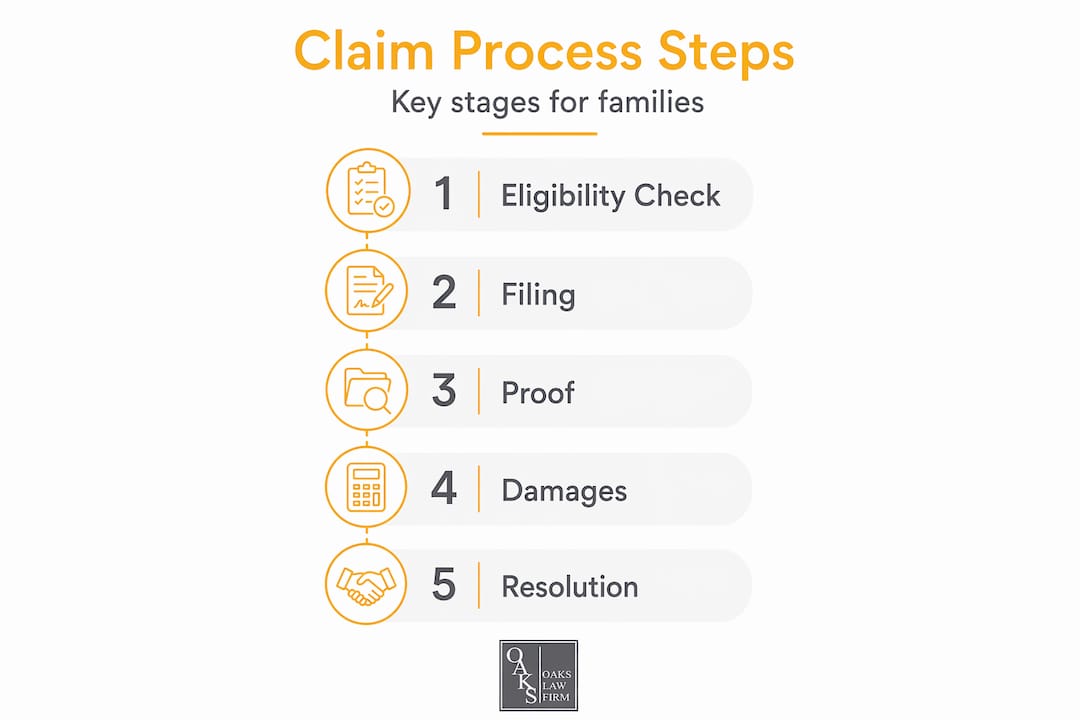
Understanding the procedural steps removes some of the uncertainty that makes this process so overwhelming for families. The wrongful death lawsuit process includes establishing legal standing, preserving evidence, filing within deadlines, moving through discovery, and reaching either a settlement or trial.
Here is how it typically unfolds:
-
Confirm the personal representative. Before anything else, identify and confirm who has legal authority to file. If needed, open probate to appoint a representative.
-
Preserve evidence immediately. Early evidence preservation significantly influences claim success. Your attorney should send preservation letters to defendants, employers, hospitals, or insurers right away. Security footage, electronic records, internal communications, and medical files can disappear quickly.
-
Gather key documentation. Building a detailed timeline with death certificates, police reports, medical records, and financial documents greatly aids both liability and damages proof. Organize these early.
-
File the complaint within the statute of limitations. In California, the general deadline is two years from the date of death. Other states vary. For example, in Colorado, the statute of limitations is two years but can extend to four years in hit-and-run vehicular homicide cases. Claims against government entities may have far shorter notice requirements. You can review California-specific deadlines in this guide to California claim time limits.
-
Enter the discovery phase. Both sides exchange evidence, take depositions, and consult experts. This phase can last months and is where the strength of your claim becomes clearer.
-
Negotiate a settlement or proceed to trial. The majority of wrongful death cases settle before trial. However, a credible trial threat backed by strong evidence often produces better settlement offers. Your attorney advises on whether to accept or fight.
Pro Tip: The single most common mistake families make is waiting too long to contact an attorney. Even if you are not ready to file, getting legal advice early protects your evidence and preserves your options.
My perspective on guiding families through these claims
I have spent more than two decades representing families in some of the most painful moments of their lives. What I have learned over those years goes beyond the legal mechanics, and I want to share it with you plainly.
The biggest obstacle I see is not the law itself. It is the misconception that families must wait for criminal justice before they can act civilly. Families often mistakenly believe a criminal conviction is necessary before filing a civil claim. That misunderstanding costs families months of delay, and sometimes it costs them the case entirely when evidence disappears in the meantime.
The second thing I want you to understand is that grief and legal strategy are not opposites. You do not have to choose between mourning your loved one and protecting your family’s rights. What I encourage families to do from day one is treat the early weeks as a fact-finding phase. Gather records, take notes, and write down what you remember. You do not need to have all the answers. You just need to start building the record before it fades.
Choosing who serves as the personal representative also matters far more than families expect. I have seen well-meaning relatives create significant conflicts by assuming this role without proper coordination. If multiple family members have an interest in the claim, that conversation needs to happen early and ideally with an attorney present.
Finally, do not let financial anxiety stop you from seeking help. Most wrongful death attorneys, including our team at Oaks Law Firm, work on contingency. You pay nothing unless we recover for you. The law gives your family a path to accountability and financial support. The only question is whether you take it.
— Matthew Nezhad
Let Oaks Law Firm help you take the next step

Losing someone to another party’s negligence is one of the most disorienting experiences a family can face. At Oaks Law Firm, our wrongful death attorneys in Los Angeles have spent decades helping California families pursue accountability and fair compensation. We accept a limited number of cases annually so that every client receives the focused attention their case deserves. Whether your case involves a fatal car crash, a medical error, or a workplace incident, we fight to hold the responsible party accountable. If you need guidance on how to file a lawsuit or simply want to understand your options, contact us today for a free case evaluation. There are no upfront fees and no obligation.
FAQ
What is a wrongful death claim in simple terms?
A wrongful death claim is a civil lawsuit filed by surviving family members when someone dies due to another party’s negligence, recklessness, or intentional misconduct. It is separate from criminal charges and allows families to seek financial compensation for their losses.
Who can file a wrongful death claim in California?
In California, the personal representative of the deceased’s estate typically files the claim on behalf of eligible survivors, which generally includes spouses, domestic partners, children, and in some cases parents or other dependents.
How long do you have to file a wrongful death claim?
In California, the general statute of limitations is two years from the date of death, though shorter deadlines may apply when government entities are involved. Missing this deadline typically bars recovery entirely, which is why early legal consultation matters.
Do you need a criminal conviction to file a wrongful death claim?
No. Wrongful death claims are civil actions with a lower burden of proof than criminal cases. A family can pursue and win a civil wrongful death lawsuit even if no criminal charges were filed or a criminal case ended in acquittal.
What damages can families recover in a wrongful death case?
Families may recover economic damages such as medical bills, funeral costs, and lost income, as well as non-economic damages like loss of companionship and emotional suffering. In cases involving willful or grossly negligent conduct, punitive damages may also be available.
