

Injury documentation is the process of creating and preserving detailed medical, photographic, and personal records that prove the extent and impact of your harm after an accident. This practice is the foundation of any successful insurance claim or personal injury lawsuit. Medical records establish the official timeline required to link an injury directly to an accident and prove causation. Without that paper trail, insurers and opposing attorneys have room to argue your injuries were pre-existing, exaggerated, or unrelated to the crash. Understanding why you must document injuries after an accident gives you the power to protect your rights from the very first day.
Disclaimer: This article provides general information only. Your specific case facts, circumstances, and jurisdiction may lead to different legal outcomes. Consult a qualified personal injury attorney for advice tailored to your situation.
Why document injuries after an accident: the core legal reason
The single most important reason to document your injuries is causation. Causation is the legal link between the accident and your harm. Without documented proof of that link, your claim has no foundation.
Legal experts confirm that if an injury is not recorded in official medical records, courts may disregard it entirely. That is not a technicality. It is the standard by which judges and juries evaluate personal injury cases in California and across the country. A verbal account of your pain, no matter how sincere, carries far less weight than a physician’s written diagnosis dated the day after your accident.
Injury documentation also protects you from a common insurance tactic. Adjusters are trained to look for gaps. A gap of even a few days between your accident and your first medical visit gives an insurer grounds to argue the injury happened elsewhere. Consistent, dated records close that gap permanently.
Proper injury documentation provides significant leverage in negotiations and enhances settlement value. Insurance adjusters respect well-organized evidence and are less likely to undervalue claims backed by thorough records.
What types of injury documentation should you collect?
Strong claims rest on multiple layers of evidence. No single document tells the whole story. Each type of record fills a different gap and answers a different question an insurer or attorney might raise.
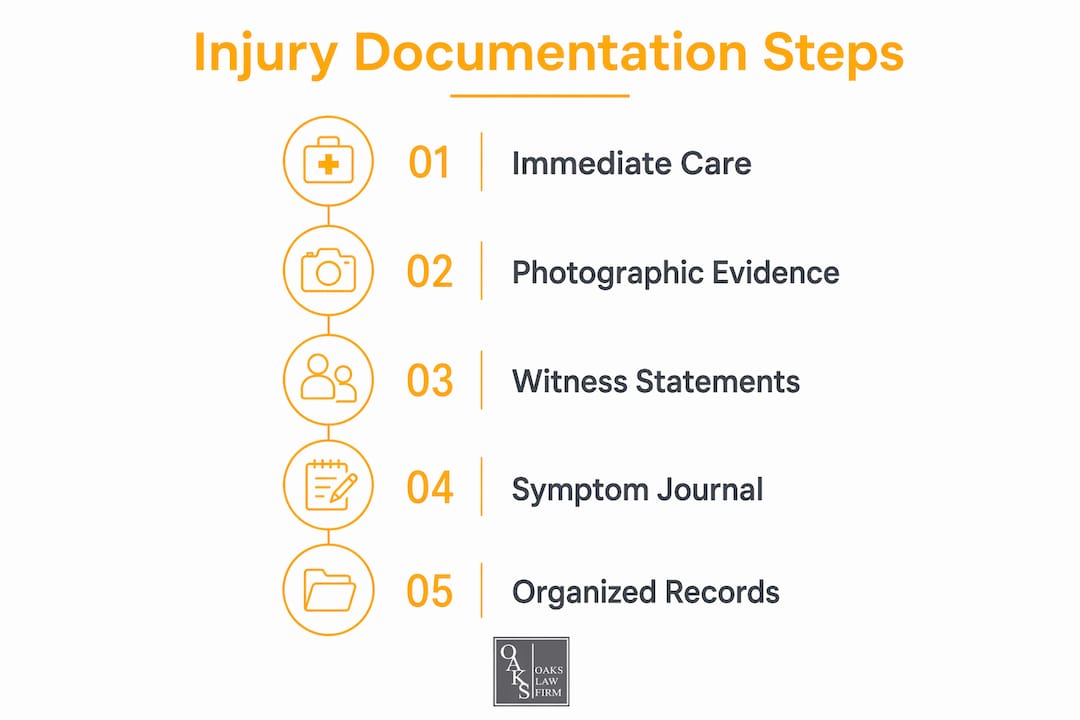
Medical records
Medical records are the backbone of any injury claim. They include your emergency room visit notes, diagnostic imaging such as X-rays and MRIs, physician diagnoses, treatment plans, and prescription records. Every appointment generates a new record, and each one adds to the official timeline connecting your injuries to the accident.

Photographic evidence
Photos with scale objects and multiple angles create a timeline of injury development that is compelling in any claim. Take pictures of your injuries on the day of the accident, then again every two to three days as bruising, swelling, or scarring evolves. Photograph the accident scene, vehicle damage, road conditions, skid marks, and any visible hazards. Visual evidence reconstructs events in a way that words alone cannot.
Witness statements
Witness accounts corroborate the circumstances of the accident from an independent perspective. Collect names, phone numbers, and brief written statements from anyone who saw the crash or its immediate aftermath. A police report also serves as an official third-party account and carries significant weight with insurers.
Daily symptom journals
Daily journals prevent insurance companies from claiming that a claimant’s pain is exaggerated or fabricated. Write a brief entry every day describing your pain level, physical limitations, sleep disruption, emotional state, and any activities you could not perform. This record captures non-economic damages, such as pain and suffering, that medical records alone do not fully reflect.
Pro Tip: Date every journal entry and be specific. “I could not lift my left arm above shoulder height” is far more useful than “my arm hurt today.”
How does timing affect your injury claim outcome?
Timing is the variable most accident victims underestimate. The sooner you start documenting your injuries, the stronger your legal and insurance claim will be. Delays lead to lost evidence and gaps that insurers exploit to deny compensation.
Insurance adjusters use inconsistencies and gaps in treatment to minimize or deny claims. Consistent medical visits and organized records create a stronger defense against those disputes. The pattern of your care tells a story. If that story has missing chapters, the insurer writes its own version.
A practical documentation timeline looks like this:
- Day of the accident. Call 911, get a police report number, photograph the scene and your injuries, and collect witness contact information.
- Within 24 hours. Seek medical evaluation even if you feel fine. Some injuries, including whiplash and traumatic brain injuries, manifest symptoms hours or days after the crash.
- Days 2 through 7. Begin your daily symptom journal. Photograph injury progression. Follow all physician instructions and attend every scheduled appointment.
- Weeks 2 through 4. Continue all follow-up care. Request copies of all medical records and bills. Note any changes in your ability to work or perform daily tasks.
- Ongoing. Keep every receipt related to your injury, including prescriptions, physical therapy, and transportation to appointments. Update your journal consistently until you reach maximum medical improvement.
Skipping steps in this sequence gives the opposing side material to work with. Each missed appointment or undocumented week becomes a question mark that works against you.
Common mistakes that weaken injury documentation
Poor documentation is a leading cause of claim denial or low settlement offers. Most of these mistakes are avoidable, but they happen because accident victims are focused on recovery, not record-keeping.
- Delaying medical care. Waiting days or weeks to see a doctor is the single most damaging mistake. Insurers treat the delay as evidence that your injuries were not serious or were caused by something else entirely.
- Skipping follow-up appointments. Missing a scheduled physical therapy session or specialist visit creates a gap in your treatment record. Adjusters flag those gaps as evidence of non-compliance or exaggeration.
- Vague symptom descriptions. Telling your doctor “I feel sore” produces a vague medical note. Specific descriptions, including location, intensity on a scale of 1 to 10, and what makes the pain worse, generate records that actually support your claim.
- Discarding damaged clothing or property. Torn clothing, a broken helmet, or a damaged bag can all serve as physical evidence. Keep these items in a sealed bag until your attorney advises otherwise.
- Posting on social media. A single photo of you smiling at a family gathering can be used to argue your injuries are not as serious as claimed. Insurers and defense attorneys routinely review social media accounts during claim investigations.
- Disorganized records. Losing a bill, misplacing a doctor’s note, or failing to track mileage to appointments creates holes in your case. Organized documentation allows attorneys to advocate effectively and manage claim negotiations or trial preparation.
Pro Tip: Create a dedicated physical folder and a mirrored digital folder on the day of your accident. Scan every document as you receive it. Losing a single record can cost you far more than the time it takes to file it.
Practical steps for effective injury documentation
Knowing what to collect is only half the work. How you collect and organize it determines whether your records hold up under scrutiny.
- Photograph injuries with scale. Place a common object, such as a coin or a ruler, next to the injury in photos. This gives viewers a reference point for size and severity. Shoot from multiple angles and in consistent lighting.
- Use OLDCARTS for symptom tracking. OLDCARTS stands for Onset, Location, Duration, Character, Aggravating factors, Relieving factors, Timing, and Severity. Using OLDCARTS improves communication with doctors and captures the detail needed to prove non-economic damages. Use this framework in both your journal and your conversations with physicians.
- Request records proactively. Do not wait for your attorney to gather records. Ask for copies at every appointment. Most California medical providers are required to provide them within a reasonable time frame.
- Maintain physical and digital backups. Store originals in a labeled binder organized by date. Scan everything and save it to a cloud storage service. Centralizing all documentation ensures evidence is never lost and helps build a cohesive narrative during legal proceedings.
- Work with your attorney early. An attorney can identify gaps in your records before they become problems. Oakslawfirm recommends involving legal counsel as soon as possible so that documentation strategy aligns with the legal theory of your case.
The table below compares two approaches to injury documentation and their typical outcomes.
| Approach | Typical outcome |
|---|---|
| Immediate medical visit, daily journal, organized records | Stronger causation link, fewer insurer disputes, higher settlement potential |
| Delayed care, inconsistent records, no journal | Gaps exploited by adjusters, reduced settlement offers, higher risk of denial |
Documenting car accident injuries thoroughly from day one gives your legal team the material to build a clear, compelling case. The difference between these two approaches often determines whether a claim succeeds or fails.
Key Takeaways
Thorough, timely injury documentation is the single most effective step an accident victim can take to protect their legal rights and maximize compensation.
| Point | Details |
|---|---|
| Start immediately | Seek medical care within 24 hours and begin photographing injuries and the scene on the day of the accident. |
| Use multiple record types | Combine medical records, photos, witness statements, and daily journals to cover every angle of your claim. |
| Consistency matters | Attend every follow-up appointment and update your symptom journal daily to prevent gaps insurers can exploit. |
| Avoid common errors | Never delay care, post on social media, or discard damaged property before consulting your attorney. |
| Organize everything | Keep physical and digital backups of all records, bills, and communications in one centralized location. |
What I’ve learned about documentation after two decades of injury cases
After more than 20 years representing accident victims in the and throughout California, I can tell you that documentation is where most cases are won or lost before they ever reach a negotiating table.
The clients who come to me with organized binders, consistent medical records, and detailed journals are in a fundamentally different position than those who waited two weeks to see a doctor and have no photos. The facts of the accident may be identical. The outcome rarely is.
What surprises most people is how quickly evidence disappears. Surveillance footage gets overwritten. Witnesses forget details. Bruises fade. The window to capture the full picture of your injuries is measured in days, not weeks. I tell every client the same thing: treat documentation like your job from the moment the accident happens.
The other thing I have seen repeatedly is that people underestimate the value of their daily journal. Medical records prove what a doctor observed. Your journal proves what you lived through. Pain and suffering damages, lost enjoyment of life, emotional distress. These are real losses, and they require real evidence. A consistent, specific journal is often the most persuasive document in a file.
My honest advice is this: do not wait until you feel better to start keeping records. The hardest days, the ones where you cannot sleep or cannot lift your child or cannot drive to work, are exactly the days that need to be documented. Those entries become the evidence that tells your story when the insurance company tries to minimize it.
Types of personal injury claims vary widely, but the documentation standard applies across all of them. Whether your case involves a rear-end collision, a slip and fall, or a workplace injury, the principle is the same. If it is not written down, it did not happen in the eyes of the law.
— Matthew Nezhad
How Oakslawfirm can help you build a strong injury claim
Oakslawfirm has spent more than two decades helping accident victims in Los Angeles and the turn thorough documentation into fair compensation. Attorney Matthew Nezhad and his team know exactly what insurers look for and how to counter their tactics with organized, credible evidence.

Whether you suffered neck injuries after a car accident, whiplash, or other serious harm, Oakslawfirm guides clients through every stage of the documentation and claims process. The firm accepts a limited number of cases each year, which means every client receives focused, personal attention from intake through settlement or trial. Contact Oakslawfirm today for a free case evaluation and find out how your records can support the compensation you deserve.
FAQ
Why is immediate medical care so important for documentation?
Immediate medical evaluation is critical because some injuries, including whiplash and concussions, develop symptoms hours or days after a crash. A same-day or next-day medical visit creates the dated record that links your injuries directly to the accident.
What happens if I don’t document my injuries?
Poor documentation is a leading cause of claim denial or reduced settlement offers. Without medical records, photos, and a symptom journal, insurers have grounds to argue your injuries were not caused by the accident or were not as serious as claimed.
How does a daily symptom journal help my claim?
A daily journal captures pain levels, physical limitations, and emotional impacts that medical records alone do not reflect. This evidence supports non-economic damages like pain and suffering, which can represent a significant portion of your total compensation.
Can social media posts hurt my injury claim?
Yes. Defense attorneys and insurance adjusters routinely review social media accounts during investigations. A single post showing physical activity or a social event can be used to contradict your documented injuries and reduce your settlement.
How does car accident compensation relate to injury documentation?
Compensation in California personal injury cases is directly tied to the strength of your evidence. Well-organized documentation of medical costs, lost wages, and pain and suffering gives your attorney the foundation to negotiate or litigate for the maximum amount available under the law.
