

Most people assume that filing a personal injury lawsuit means heading to a courtroom. The reality is very different. Understanding why personal injury lawsuits go to trial starts with recognizing that 95% to 97% of cases resolve through settlement, meaning a trial is actually the exception. But knowing what pushes a case into that rare 3% to 5% gives you a real strategic advantage before you ever sign a retainer. Whether you are dealing with a car accident in the San Fernando Valley or a slip and fall at a retail store, the factors influencing personal injury trials come down to liability disputes, evidence quality, insurer behavior, and your attorney’s reputation in the courtroom.
Table of Contents
- Key takeaways
- How often personal injury cases actually go to trial
- Core reasons why cases go to trial instead of settling
- How evidence quality shapes the decision to go to court
- What going to trial actually means for you
- How you can influence whether your case settles or goes to trial
- My perspective on trial readiness and what it really means for clients
- How Oaks Law Firm fights for you from day one
- FAQ
Key takeaways
| Point | Details |
|---|---|
| Trials are rare | Only 3% to 5% of personal injury cases reach trial; most settle before a verdict. |
| Liability disputes drive trials | When insurers refuse to accept fault, going to court often becomes the only path to fair compensation. |
| Evidence quality matters | Strong, consistent medical documentation significantly improves both settlement offers and trial outcomes. |
| Trial readiness changes offers | Insurers make higher offers to firms known to litigate, making attorney selection a financial decision. |
| You control the final call | The decision to go to trial belongs to you as the client; your attorney’s job is to advise, not decide. |
How often personal injury cases actually go to trial
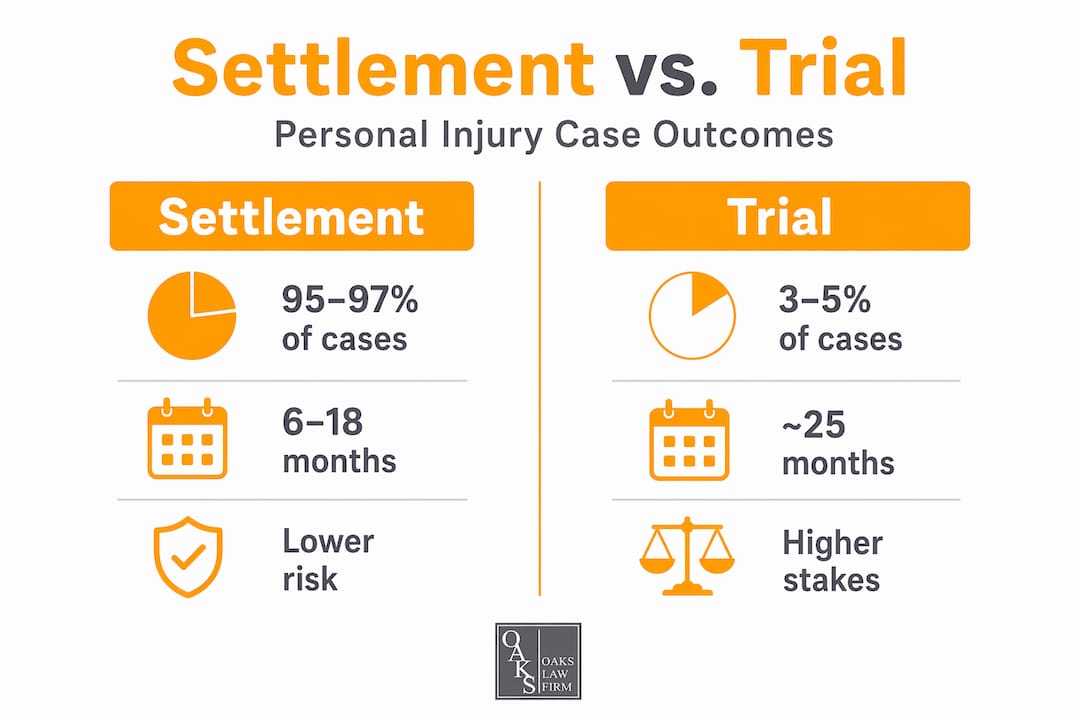
Before examining the reasons cases end up in front of a jury, it helps to understand just how uncommon that outcome actually is. Industry data from early 2026 confirms that only about 3% to 5% of personal injury cases ever reach a trial verdict. The vast majority resolve long before a courtroom becomes necessary.
What does the timeline look like when a case does go to trial? The average time from filing to verdict is approximately 25.6 months, and complex cases can easily stretch to three years or more. By contrast, many settlements conclude within six to eighteen months of an initial claim. That gap in time carries real consequences for plaintiffs: longer timelines mean delayed medical bill resolution, prolonged emotional stress, and extended financial uncertainty.
The table below breaks down how personal injury case outcomes generally compare across major variables.
| Variable | Settlement | Trial |
|---|---|---|
| Frequency | 95%–97% of cases | 3%–5% of cases |
| Average duration | 6–18 months | 25+ months |
| Outcome certainty | Guaranteed amount agreed upon | Jury verdict; could be higher or zero |
| Attorney involvement | Negotiation-focused | Full litigation preparation required |
| Emotional demand | Moderate | High; includes depositions and testimony |
Jurisdiction also shapes these numbers significantly. Jury verdicts tend to be higher in urban counties, which is one reason plaintiffs in places like Los Angeles sometimes find trial a more attractive option than those in rural areas. A case worth litigating in one county may not justify the same risk in another. Understanding your local context is part of making a smart decision about whether to push forward or accept a settlement offer.
Core reasons why cases go to trial instead of settling
The path to trial is rarely accidental. Specific friction points between the plaintiff and the defense consistently explain why a case cannot be resolved at the negotiating table. Here are the most common reasons for trial in personal injury cases.
-
Disputed liability. When an insurer flatly refuses to accept that their policyholder caused your injuries, no amount of negotiation will produce a fair offer. Primary reasons for proceeding to trial include insurance refusal to admit fault, especially in multi-vehicle accidents or premises liability cases where the chain of responsibility is genuinely contested.
-
Disagreement on injury severity. Insurers routinely argue that your injuries are less serious than your medical records suggest, or that they existed before the accident. When a defense-hired medical examiner contradicts your treating physician, the gap in damage valuations often becomes too wide to bridge through settlement alone.
-
Lowball settlement offers. Some insurance companies open negotiations with an offer designed to close the claim quickly and cheaply. When a plaintiff’s actual losses, including future medical costs, lost earning capacity, and pain and suffering, far exceed that opening number, trial becomes the only realistic path to full compensation.
-
Desire for public accountability. Some plaintiffs go to trial specifically because they want a public record. This is especially common in cases involving defective products, dangerous property conditions that harmed multiple people, or reckless behavior by a defendant with power or resources. A settlement is private; a verdict is on the public record.
-
Conflicting expert testimony. Accident reconstruction specialists, medical experts, and economists can legitimately disagree. When both sides retain credible experts who arrive at opposite conclusions, a jury has to decide who is more persuasive. No settlement algorithm can resolve that kind of factual dispute.
Pro Tip: If an insurer’s settlement offer does not account for future medical expenses or long-term lost income, get your attorney to provide a written breakdown of projected damages before you respond. That documentation often prompts a more serious counter-offer and, if not, it becomes critical evidence at trial.
How evidence quality shapes the decision to go to court
You might have a valid claim and still struggle to get a fair settlement if your evidence is thin. This is one of the most underappreciated factors influencing personal injury trials, and it cuts both ways. Strong evidence pushes insurers toward fair settlements. Weak or inconsistent evidence pushes them toward lowball offers, which in turn pushes plaintiffs toward trial.
Solid medical evidence linking your injury to the accident is the single most reliable predictor of a strong settlement position. That means consistent treatment records, documented complaints at every appointment, and a clear timeline that connects the accident date to your diagnosis and recovery trajectory. A gap of two weeks between the accident and your first medical visit, even if medically explainable, gives an adjuster a reason to argue you were not seriously hurt.

Trial-ready firms build detailed medical timelines specifically to withstand insurer attacks, whether during settlement talks or in front of a jury. This kind of preparation is not just for trial; it changes what offers look like before trial ever becomes necessary. Documenting your injuries thoroughly after an accident is one of the most practical steps you can take to protect the value of your claim from the start.
There is also a less-discussed dynamic at play: insurer strategy. Insurance adjusters track law firms’ trial history, and firms that consistently avoid trial tend to receive lower settlement offers. Adjusters know those firms will take the deal. If your attorney has a reputation for going to court and winning, adjusters have reason to negotiate more seriously with your case from the very first contact.
- Gaps in medical records give insurers justification to dispute causation and reduce offer amounts.
- Inconsistent treatment timelines raise red flags about injury severity and create openings for cross-examination.
- Missing documentation of out-of-pocket expenses leaves real money on the table in settlement negotiations.
- No expert medical opinion on future treatment costs weakens the damages calculation significantly.
Pro Tip: Ask your attorney early in the process whether they have taken cases to verdict before and how often. The answer directly affects how seriously an insurer will treat your claim.
What going to trial actually means for you
If your case is heading toward trial, you need a clear picture of what that process involves practically, financially, and emotionally. There are both real benefits and genuine risks to consider.
-
Longer timeline with extended uncertainty. Once a lawsuit is filed, the average path to a verdict runs over two years. During that time, you will sit for depositions, respond to discovery requests, and wait through multiple court scheduling delays. That timeline is not abstract. It means medical bills remain unresolved, and the financial pressure on your household can be significant.
-
Potential for higher compensation, with real risk of less. A jury can award significantly more than an insurer was ever willing to offer. But juries can also award less than the settlement on the table, or nothing at all. The personal injury trial statistics are clear: most plaintiffs who go to trial do collect something, but the outcome is never guaranteed in the way a settlement is.
-
Financial and emotional costs. Trial preparation is intensive. Expert witness fees, deposition costs, and trial exhibits add up. Many personal injury attorneys work on contingency, so you may not pay those costs out of pocket upfront, but they reduce your net recovery. The emotional toll of testimony, cross-examination, and a public proceeding should not be underestimated either.
-
Strategic timing matters. California has a statute of limitations that sets a deadline for filing. If you wait too long, you lose the right to sue entirely. But filing too early, before your injuries have reached maximum medical improvement, can undervalue your claim. Timing the filing to maximize leverage is a key part of any effective litigation strategy.
-
When trial becomes necessary. Sometimes litigation is the only path to fair compensation. If an insurer refuses to acknowledge liability, disputes the extent of your injuries despite clear medical evidence, or makes offers that do not cover your actual losses, a trial is not just an option. It becomes the mechanism for justice your case requires.
How you can influence whether your case settles or goes to trial
One of the most empowering things to understand is that you are not a passenger in this process. The decision to go to trial belongs to you as the client. Your attorney advises on risks and potential rewards, but they cannot force you to accept a settlement and they cannot take your case to trial without your consent.
Here is how the decision-making process typically unfolds and where you have real influence.
| Stage | Your role | What shapes the outcome |
|---|---|---|
| Pre-lawsuit negotiation | Decide whether to accept or reject insurer’s offer | Evidence strength, attorney reputation, injury severity |
| Filing the lawsuit | Authorize your attorney to file | Filing prompts more serious insurer negotiations |
| Discovery phase | Participate in depositions, provide records | Completeness of documentation and medical evidence |
| Pre-trial settlement talks | Evaluate revised offers with your attorney | How both sides assess trial risk at that stage |
| Trial | Testify if needed, observe proceedings | Jury composition, evidence presentation, expert credibility |
Most cases settle after filing a lawsuit or even during the trial process itself. A settlement can happen right up until the jury delivers its verdict. This means that filing a lawsuit is not an irreversible commitment to trial. It is frequently the step that finally motivates an insurer to make a realistic offer.
Choosing the right law firm is also a decision you make that directly shapes this entire trajectory. High-volume firms that handle hundreds of cases at once often settle early and avoid trial because the economics of their practice demand it. A settlement mill firm may get you a check faster, but it is often a smaller one, because the insurer knows that firm will not go to court. A firm that accepts a limited number of cases and has genuine trial experience negotiates from a completely different position.
My perspective on trial readiness and what it really means for clients
I have been doing this for over two decades, and the single most consistent mistake I see injured people make is accepting a settlement offer before they fully understand what their case is actually worth. Not the number the insurance adjuster gives them. The real number, including future surgeries, lost earning potential, and the long-term impact on their quality of life.
Here is something most attorneys will not say plainly: trial readiness is not just about the rare case that actually goes in front of a jury. It is a negotiating tool that operates every single day a case is active. When an insurer knows your law firm has a real track record in the courtroom, the settlement conversation starts from a different place entirely. I have watched the same case facts generate dramatically different offers depending on which firm is on the plaintiff’s side. That reality should matter to every person considering who to hire.
The settlement mill problem is real. Firms that take on hundreds of cases simultaneously cannot give each one the attention required to build a truly strong litigation position. The insurer knows it. The adjuster assigned to your claim knows it. And ultimately, the person who pays for that dynamic is you.
What I have learned is that clients who stay informed and ask hard questions get better outcomes. Ask your attorney what they believe your case is worth at trial. Ask how many cases they have taken to verdict in the last three years. Ask whether they will personally handle your case or hand it off to a junior associate. Those answers tell you more than any marketing materials ever will.
— Matthew Nezhad
How Oaks Law Firm fights for you from day one
At Oaks Law Firm, trial readiness is not a last resort. It is built into how we handle every case from the first consultation. Matthew Nezhad and his team take a limited number of cases each year specifically so that every client gets the focused attention and deep preparation that produces real results, whether at the negotiating table or in a courtroom.

If you are considering filing a personal injury lawsuit in Los Angeles or anywhere in the San Fernando Valley, understanding your legal options early makes a material difference in what you can recover. Oaks Law Firm handles cases involving car accidents, premises liability, wrongful death, and uninsured driver accidents where insurance disputes frequently drive cases toward trial. Contact us today for a free case evaluation and find out exactly what your claim may be worth.
FAQ
What percentage of personal injury cases actually go to trial?
Approximately 3% to 5% of personal injury cases go to trial; the vast majority resolve through settlement before or during the litigation process.
Why do some personal injury cases go to court instead of settling?
The most common reasons include an insurer’s refusal to admit liability, major disagreements over injury severity, and settlement offers that fail to cover the plaintiff’s actual losses. When these gaps cannot be resolved through negotiation, trial becomes the only path to fair compensation.
How long does a personal injury trial take compared to a settlement?
Settlements often conclude within six to eighteen months, while the average personal injury trial runs approximately 25.6 months from filing to verdict, with complex cases taking three years or more.
Can I still settle my case after filing a lawsuit?
Yes. Settlement remains possible at any point in the process, including during trial itself, right up until the jury delivers a verdict.
Does it matter which law firm I hire when it comes to trial risk?
It matters significantly. Insurers track firms’ trial histories and tend to make lower offers to firms known to avoid court. Hiring a trial-ready attorney changes how seriously an insurer negotiates your claim from the very beginning.
