

Most people assume filing an accident claim is straightforward: report the crash, submit paperwork, collect a check. In Los Angeles, that assumption gets expensive fast. The reality is that why Los Angeles accident claims complex comes down to a combination of California’s unique legal framework, the sheer volume of parties often involved, and the evidentiary standards required to prove fault and damages. LA claims frequently take one to two years or more to resolve, even in cases that seem clear-cut at first. This article breaks down exactly what makes these claims so difficult, so you can go in with your eyes open.
Table of Contents
- Key Takeaways
- Why Los Angeles accident claims are complex: the legal foundation
- Insurance and multi-party challenges unique to Los Angeles
- Evidence gathering and medical causation disputes
- Wrongful death and catastrophic injury claims
- Practical guidance for managing your LA claim
- My perspective on what actually drives complexity in LA claims
- How Oaks Law Firm can help with your LA accident claim
- FAQ
Key Takeaways
| Point | Details |
|---|---|
| Legal rules create real friction | California’s pure comparative fault system and strict deadlines directly shape how claims are negotiated and disputed. |
| Multiple parties multiply problems | Rideshare accidents, multi-car crashes, and uninsured drivers add layers of insurance and liability complexity. |
| Evidence quality determines outcomes | Police reports alone are rarely enough; expert witnesses and medical documentation often decide the case. |
| Wrongful death claims run deeper | Fatal injury cases require broader investigations and face more aggressive defense strategies than standard claims. |
| Timing and documentation matter from day one | Delays in reporting or seeking legal counsel can permanently damage your claim’s value or viability. |
Why Los Angeles accident claims are complex: the legal foundation
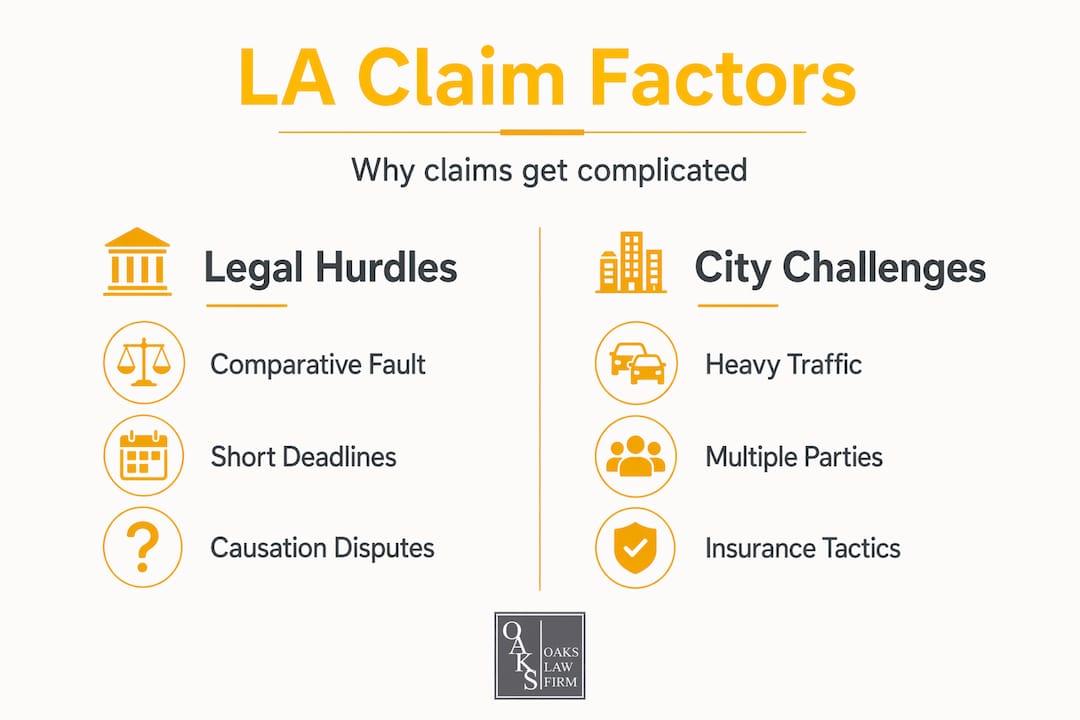
Before you can understand the challenges of accident claims in LA, you need to understand the legal rules that govern them. Two principles shape nearly every dispute: California’s comparative fault system and the statute of limitations.
California’s pure comparative fault system
California follows a pure comparative fault rule, which means you can recover damages even if you were partially responsible for the accident. If a jury finds you 30% at fault, you still collect 70% of your total damages. That sounds fair in theory. In practice, it gives insurance adjusters a powerful incentive to inflate your share of the blame.
Fault allocation disputes are one of the most common reasons LA claims drag on. An adjuster who pushes your fault from 10% to 40% just cut their payout by nearly a third. They have every reason to fight that number, and they do. This is not a bureaucratic inconvenience. It is a deliberate negotiation strategy that requires a well-documented counter-argument on your end.
The statute of limitations deadline
California gives you two years from the date of injury to file a personal injury lawsuit. Miss that window and your claim is almost certainly dismissed, regardless of how strong it is. One critical detail most people miss: negotiations with an insurance company do not pause that clock. Only actually filing a lawsuit stops the countdown.
This creates a real tension in complex cases. You may need months to gather medical records, consult experts, and assess your full damages before you know what a fair settlement looks like. But waiting too long to file risks losing your right to sue entirely. That tradeoff is one of the core reasons for complex accident claims in Los Angeles.
- Negotiations with insurers do not toll the statute of limitations
- Government entity claims (like accidents involving city buses) often have a 6-month notice deadline
- Minors and certain discovery rules can extend or modify the standard 2-year window
- Filing suit does not mean going to trial; it preserves your legal options while negotiations continue
Pro Tip: If you are approaching the one-year mark after your accident and still negotiating with an insurer, consult an attorney immediately. Filing a protective lawsuit does not force a trial; it simply keeps your options open.
Insurance and multi-party challenges unique to Los Angeles
Los Angeles is one of the most traffic-dense cities in the country. That density means accidents here rarely involve just two parties with clean, matching insurance policies. The reality is messier.
Multi-car pileups on the 405, rideshare accidents where the driver’s coverage depends on what phase of the app they were in, and crashes involving commercial vehicles with layered corporate policies are everyday occurrences in LA. Each additional party adds its own insurer, its own legal team, and its own version of events. Coverage disputes involving uninsured or underinsured drivers are especially common and can stall settlements for months.

How insurance company tactics add to the difficulty
Insurance companies are not on your side, even your own. Adjusters are trained to close claims quickly and cheaply. In multi-party LA cases, that pressure intensifies because each insurer is trying to shift maximum liability onto the others while minimizing their own exposure.
- Rideshare accidents involve at least three potential coverage layers: the driver’s personal policy, the platform’s contingent coverage, and the platform’s full commercial policy
- Uninsured motorist claims require you to file against your own insurer, which creates an adversarial dynamic many claimants do not expect
- Commercial vehicle accidents often involve separate policies for the driver, the company, and the cargo
- Denied or delayed claims force claimants into bad faith negotiations or litigation
California requires insurers to acknowledge claims within 15 days and accept or deny within 40 days. Those deadlines exist on paper. In practice, disputed liability cases routinely extend far beyond those windows, especially when multiple carriers are pointing fingers at each other.
Pro Tip: Never give a recorded statement to any insurance company, including your own, without first speaking to an attorney. Adjusters use these statements to lock you into an account of events before you fully understand your injuries or the extent of your damages.
Evidence gathering and medical causation disputes
Understanding LA accident claims means accepting that the police report is just the starting point. In serious cases, it is rarely enough to win a fair settlement.
Why causation is so frequently disputed
Insurance companies do not just dispute fault. They dispute whether your injuries were caused by the accident at all. This is especially common when:
- Symptoms appeared days or weeks after the crash (common with soft tissue injuries and traumatic brain injuries)
- You had a pre-existing condition that the insurer claims was the real source of your pain
- There is a gap in your medical treatment that the defense argues shows the injury was not serious
- Diagnostic imaging does not clearly show structural damage even when you are experiencing real symptoms
Medical documentation and proving injury causation are among the most consistent hurdles in serious LA personal injury claims. Adjusters are trained to spot gaps in treatment timelines and use them as leverage.
- Accident reconstruction experts analyze skid marks, vehicle damage patterns, and traffic data to establish how the crash occurred and who bears responsibility.
- Medical experts provide testimony linking your specific injuries to the specific forces of the collision, countering defense arguments about pre-existing conditions.
- Economic experts calculate future lost earnings, ongoing care costs, and other long-term financial impacts that are easy to undervalue without specialized analysis.
- Witness statements collected promptly before memories fade and before witnesses become difficult to locate are often decisive in disputed liability cases.
In complex multi-party cases, attorneys conduct independent investigations that go well beyond what police and insurance adjusters document. Surveillance footage, cell phone records, and electronic data from vehicles can all become critical evidence. The window to preserve that evidence is often short.
Pro Tip: Seek medical attention immediately after an accident, even if you feel fine. A documented medical visit creates a timestamp connecting the accident to your injuries. Waiting even a few days gives insurers room to argue your injuries came from something else entirely.
Documenting your injuries thoroughly from the first day is not just good practice. It is the foundation of your entire claim.
Wrongful death and catastrophic injury claims
If standard accident claims are complex, wrongful death and catastrophic injury cases operate at an entirely different level of difficulty. The stakes are higher, the investigations run deeper, and the defense strategies are far more aggressive.
| Factor | Standard Injury Claim | Wrongful Death or Catastrophic Claim |
|---|---|---|
| Liable parties | Typically 1-2 | Often 3 or more (driver, employer, manufacturer, contractor) |
| Investigation scope | Police report, medical records | Independent forensic analysis, corporate records, expert witnesses |
| Damage calculation | Medical bills, lost wages | Lifetime earnings, loss of companionship, future care costs |
| Defense intensity | Standard adjuster negotiation | Dedicated defense legal teams, aggressive litigation |
| Timeline | Months to 1-2 years | Often 2 or more years, frequently goes to trial |
Wrongful death claims in Los Angeles frequently require investigations that extend well beyond the obvious parties. A fatal truck accident, for example, might involve the driver, the trucking company, a maintenance contractor, and the vehicle manufacturer if a mechanical failure contributed. Identifying and pursuing all liable parties is not optional. Missing even one can leave significant compensation on the table.
Los Angeles wrongful death cases also involve damage categories that require expert testimony to quantify: the economic value of a lifetime of lost earnings, the cost of future care for a surviving family member, and non-economic damages like loss of companionship. These numbers are genuinely difficult to calculate, and insurers will fight every dollar.
Practical guidance for managing your LA claim
Knowing why the Los Angeles accident claim process is complex is useful. Knowing what to do about it is what actually protects you.
- Document everything immediately. Photograph the scene, your injuries, and all vehicle damage before anything is moved or repaired. California law requires filing a DMV accident report within 10 days for crashes involving injury or significant property damage. Missing this step adds legal risk.
- Get medical care and keep every record. Every visit, every prescription, every referral. Gaps in your medical history become weapons for the defense.
- Do not settle too fast. Insurance companies often make early offers before the full extent of your injuries is clear. Accepting a quick settlement typically means signing away your right to future compensation, even if your condition worsens.
- Understand who all the parties are. In multi-car crashes, rideshare accidents, or incidents on commercial property, there may be defendants you have not yet identified. An attorney can help map the full liability picture before you negotiate.
- Know your deadlines. The two-year statute of limitations is not flexible. Neither are government entity notice requirements. Mark these dates and treat them as hard stops.
- Consider litigation as a tool, not a last resort. Filing a lawsuit does not mean going to trial. It often accelerates settlement negotiations by demonstrating you are serious and prepared.
The Los Angeles injury claim difficulties most people encounter are not random. They follow predictable patterns. Recognizing those patterns early gives you a real advantage.
My perspective on what actually drives complexity in LA claims
I have spent my entire legal career handling personal injury cases in Los Angeles and the . What I have seen repeatedly is that the complexity in these claims is not accidental. It is structural.
The combination of California’s comparative fault rules, LA’s traffic volume, and the sheer number of uninsured or underinsured drivers on the road creates conditions where almost every serious claim becomes a multi-front dispute. Fault, coverage, and causation are all contested simultaneously. That is not a coincidence. It reflects how insurers have learned to operate in this specific environment.
What I have also seen is that the claimants who struggle most are not the ones with the weakest cases. They are the ones who waited too long to get legal help, gave recorded statements early, or accepted initial settlements before understanding the full scope of their injuries. Those decisions are almost impossible to undo.
The uncomfortable truth about understanding LA accident claims is that the system is not designed to make things easy for injured people. It is designed to protect insurers’ bottom lines. That does not mean you cannot win. It means you need to go in prepared, documented, and represented by someone who knows how to push back.
What actually works is treating your claim like the serious legal matter it is from the very first day. Not the day you hire a lawyer. Day one.
— Matthew Nezhad
How Oaks Law Firm can help with your LA accident claim
At Oaks Law Firm, we handle the full range of complex Los Angeles personal injury claims, from multi-car crashes and rideshare accidents to catastrophic injuries and wrongful death cases. Attorney Matthew Nezhad and his team have spent decades untangling exactly the kinds of fault disputes, coverage battles, and causation arguments described in this article. We conduct independent investigations, work with top medical and accident reconstruction experts, and are fully prepared to take cases to trial when insurers refuse to negotiate fairly.
We accept a limited number of cases each year, which means every client gets focused attention. Our no-fee guarantee means you pay nothing unless we win. You can also learn more about how car accident compensation works in California before your first consultation. If you have been injured in an accident anywhere in Los Angeles or the , contact us today for a free case evaluation. The sooner you reach out, the more options you have.
FAQ
Why do LA accident claims take so long to resolve?
Complex LA claims frequently take one to two years or more because fault disputes, insurance coverage battles, and medical causation arguments must all be resolved before a fair settlement can be reached. Filing a lawsuit, if necessary, adds additional steps including discovery and expert witness exchanges.
What is California’s pure comparative fault rule?
California’s pure comparative fault system allows injured parties to recover damages even if they were partially at fault for the accident, with their recovery reduced by their percentage of fault. This rule gives insurance adjusters a financial incentive to argue that claimants bear more responsibility than they actually do.
How long do I have to file a personal injury claim in California?
The standard statute of limitations is two years from the date of injury. Missing this deadline almost always results in permanent dismissal of the claim, regardless of its merits.
What makes wrongful death claims more complex than standard injury claims?
Wrongful death cases often involve multiple liable defendants beyond the at-fault driver, including employers, manufacturers, and contractors. They also require expert testimony to calculate lifetime economic losses and non-economic damages, and they typically face more aggressive insurance defense strategies.
Should I accept an early settlement offer from an insurance company?
Early settlement offers are typically made before your injuries are fully understood and often undervalue your claim significantly. Accepting one usually means waiving your right to future compensation, even if your condition worsens or new injuries emerge later.
