

Attorney Advertising. This article was prepared with the assistance of artificial intelligence and reviewed by Oaks Law Firm prior to publication.
Case valuation is the process attorneys and insurance adjusters use to estimate the dollar range a personal injury claim is worth, based on documented losses, who is at fault, and how much money is actually available to pay it. There’s no single number. There is a range, built from evidence, and it moves as new facts come in.
Four things drive that range more than anything else:
- Economic damages — medical bills, lost wages, and future costs you can put a receipt on
- Non-economic damages — pain, suffering, and disruption to your life that don’t come with an invoice
- Liability clarity — how obvious and provable the fault is
- Collectability — whether there’s actually insurance or assets to pay what the claim is worth
Attorneys who work injury cases for a living will tell you the same thing: anyone who quotes you an exact settlement figure on day one is guessing. What follows is how the estimate actually gets built, and what you can do to push it toward the high end of that range instead of the low end.
Key Takeaways
Case valuation combines documented economic damages, negotiated non-economic damages, liability clarity, and insurance collectability into a defensible settlement range, not a fixed number.
| Point | Details |
|---|---|
| Four pillars drive value | Economic damages, non-economic damages, liability clarity, and collectability together set the realistic range. |
| Multipliers are starting points | The 1.5 to 5x multiplier and per-diem methods estimate pain and suffering but aren’t binding formulas. |
| Insurance limits cap recovery | Even strong damages evidence can’t exceed available policy limits without additional coverage or defendants. |
| California deadlines are strict | File within two years under CCP §335.1, or within six months under Gov. Code §911.2 for government defendants. |
| Documentation beats calculators | Objective medical evidence and expert reports move settlement offers; online calculators do not. |
| Oaks Law Firm builds full valuations | Free contingency-based case evaluations assemble medical, wage, and insurance evidence into a demand package. |
Table of Contents
- What Is Case Valuation in an Injury Claim, Exactly?
- How Attorneys Actually Calculate What a Claim Is Worth
- Evidence That Actually Increases Your Claim’s Value
- How Insurance Coverage Caps What You Can Actually Recover
- Fees, Costs, and How Long This Actually Takes
- How Fault Disputes and Negotiation Tactics Move the Number
- Myths That Quietly Cost Claimants Money
- How Oaks Law Firm Approaches Case Valuation
- Why Understanding Valuation Changes How You Negotiate
- What Oaks Law Firm Can Do for Your Injury Claim
- Sources
- FAQ
What Is Case Valuation in an Injury Claim, Exactly?
Case valuation for injury claims means translating everything that happened to you, medically, financially, and personally, into a defensible monetary figure that a jury, judge, or insurance company would plausibly accept. Attorneys and insurers describe this as resting on three pillars: liability, damages, and collectability. Weaken any one of those pillars and the number drops, no matter how badly you were hurt.
That’s the piece most people miss. You can have devastating injuries and still end up with a modest settlement if fault is murky or the at-fault driver only carries minimum insurance. Conversely, a moderate injury with airtight liability and a well-insured defendant can settle for more than you’d expect. Valuation isn’t just “how hurt were you.” It’s “how hurt were you, how provable is that, who caused it, and who’s actually going to pay.”
Economic damages: the part you can put a number on
Economic damages are the losses with a paper trail. They include:
- Past medical bills (ER visits, surgery, physical therapy, imaging)
- Future medical costs (ongoing treatment, anticipated surgeries, adaptive equipment)
- Lost wages from time missed at work
- Lost earning capacity if your injury limits what you can earn going forward
- Lost benefits (health insurance, retirement contributions, bonuses tied to your role)
These get totaled up first because they’re objective. A hospital invoice doesn’t need interpretation.
Non-economic damages: the harder number to pin down
Pain and suffering, emotional distress, and loss of enjoyment of life fall into non-economic damages, and they’re inherently subjective. Nobody hands you a receipt for six months of chronic back pain that kept you off the golf course. Attorneys and insurers estimate this category using formulas discussed below, but the honest answer is that it’s negotiated, not calculated with precision.
Liability and shared fault
If the other party’s fault is clear and documented, non-economic damages tend to settle closer to the higher end of the estimated range. If you share some blame for what happened, expect the number to shrink. California follows a pure comparative negligence rule, meaning your recovery gets reduced by your percentage of fault.
Collectability and insurance limits
This is the pillar most claimants never think about until it bites them. Insurance policy limits and the defendant’s collectability often create a practical ceiling on recovery, regardless of how large your documented damages actually are. A case worth $500,000 on paper is still capped at whatever the at-fault party’s policy will pay, unless additional coverage or defendants exist. More on that below.
Special categories that push value higher
Catastrophic injuries, permanent impairment, disfigurement, and lost earning capacity all move a case into a different valuation tier. These cases usually require more than a formula. They require economic experts and life-care planners who can project decades of future costs, which we’ll get into next.
How Attorneys Actually Calculate What a Claim Is Worth
Here’s where the math happens, and where a lot of misinformation lives online.
The multiplier method. Attorneys and adjusters commonly total the documented economic damages, then multiply that figure by a number, typically between 1.5 and 5, to estimate non-economic damages, sometimes referencing proprietary claims software such as Colossus. A soft-tissue injury with $8,000 in medical bills might get a multiplier around 1.5 to 2. A herniated disc requiring surgery with a poor long-term prognosis might justify a multiplier closer to 4 or 5. The multiplier isn’t law. It’s a starting point for negotiation, and attorneys adjust it based on injury severity, treatment duration, and how sympathetic the facts are.
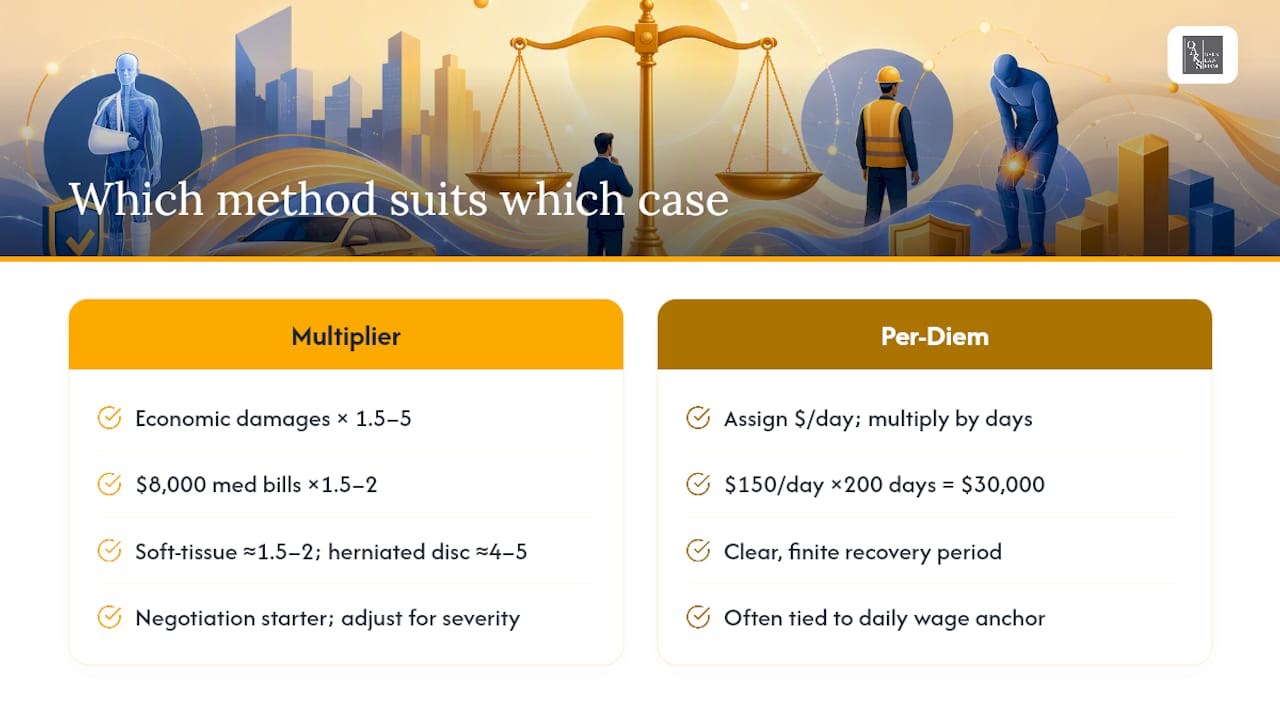
The per-diem method. Instead of a multiplier, some cases get valued by assigning a daily dollar figure to pain and suffering (often tied to a person’s daily wage as an anchor) and multiplying it by the number of days from injury to maximum medical improvement. A $150-per-day estimate over 200 days of recovery adds $30,000 in non-economic damages. This method tends to show up more in cases with a clear, finite recovery period.
Illustrative examples. Say a claimant racks up $15,000 in medical bills and $5,000 in lost wages, for $20,000 in economic damages. Now scale that up: a catastrophic spinal injury with $400,000 in past and projected future medical costs, plus $600,000 in lost earning capacity, could justify a multiplier-driven estimate well into seven figures, assuming there’s enough insurance to actually pay it. These numbers are illustrations only. They’re not a guarantee of what any specific case will settle for.
Economic expert calculations. For high-value cases involving permanent disability or long-term care, attorneys often bring in economists or vocational experts who discount future losses to present value using accepted forensic economic methods. This is a fundamentally different process than a multiplier. It’s a structured financial analysis, not a rule of thumb.
Pro Tip: If your injury involves permanent restrictions, a career change, or decades of future care, ask your attorney directly whether an economist or life-care planner has been retained. A multiplier is fine for a six-week recovery. It’s the wrong tool for a lifetime of lost earning capacity.
Evidence That Actually Increases Your Claim’s Value
Valuation lives or dies on documentation. Attorneys and industry guides consistently point out that attorney valuations blend medical evidence, negotiation strategy, and legal analysis rather than a single formula, and documentation quality is what moves the needle within that process.
- Medical records and itemized bills. Objective testing (MRIs, X-rays, nerve conduction studies) carries more weight than subjective complaints alone, because it’s harder for an adjuster to dismiss.
- Treating physician narratives. A clear, chronological medical record connecting the accident to your specific injuries closes the door on causation arguments before the insurer can raise them.
- Employment records, pay stubs, and tax returns. These substantiate lost wages and, in bigger cases, lost earning capacity claims, which require more than a pay stub to prove.
- Photos, witness statements, and accident reports. Dashcam footage and event data recorder (EDR) information can settle liability disputes that would otherwise drag on for months.
- Social media caution. A photo of you hiking two weeks after claiming you can’t stand for ten minutes will get used against you. Assume everything you post is discoverable.
- Expert reports. Economists, life-care planners, and accident reconstructionists get brought in when the case is complex enough to justify the cost, generally in claims involving permanent injury or disputed fault.
Practical guides on documenting injuries after an accident walk through exactly what to collect in the days immediately following a crash, when memories are freshest and evidence is easiest to preserve.
Pro Tip: Keep a simple daily log of pain levels, missed activities, and how your injury affects ordinary tasks. Adjusters routinely discount vague pain complaints, but a dated, specific log is hard to argue with.

How Insurance Coverage Caps What You Can Actually Recover
This is the section that surprises people the most, and it’s arguably the most important one in this entire article.
Your damages can be worth $300,000 on paper. If the at-fault driver only carries a $50,000 policy and has no meaningful personal assets, your practical recovery may top out well below what the case is actually “worth.” Collectability and insurance limits create a real ceiling on recovery that exists independently of how strong your medical evidence is.
Here’s a scenario that plays out constantly in California injury practice: a delivery driver runs a red light and causes a serious multi-vehicle crash. The victim has $180,000 in medical bills and a documented lost earning capacity claim worth another $200,000, putting total damages north of $380,000. The at-fault driver’s personal auto policy caps out at $100,000 per person. Unless the delivery company’s commercial umbrella policy applies, or unless the victim’s own underinsured motorist coverage kicks in, that $380,000 case may realistically settle far closer to the policy limit than the documented damages figure.
Attorneys respond to this by investigating every possible source of coverage: umbrella policies, commercial liability if a vehicle was used for work, the property owner’s policy in premises cases, and the claimant’s own uninsured/underinsured motorist coverage. This investigation phase often matters more to your final recovery than any multiplier calculation, particularly in cases where the at-fault party is underinsured, which happens far more often than most claimants expect.
Fees, Costs, and How Long This Actually Takes
How contingency fees and costs work
Personal injury attorneys in California typically work on contingency, meaning you pay nothing upfront and the fee comes out of the settlement or verdict as a percentage, commonly one-third, though it can shift depending on the case and whether it goes to litigation. Litigation costs (filing fees, expert witness fees, deposition costs) are usually advanced by the firm and reimbursed from the settlement before your final payout is calculated. Medical liens, if you received treatment on a lien basis, also get paid from the settlement before you see a check.
Here’s a simplified example of how a settlement gets divided:
- Gross settlement: $100,000
- Attorney fee (one-third): $33,333
- Case costs (expert fees, filing fees, records requests): $4,000
- Medical liens paid directly from settlement: $15,000
- Net to client: approximately $47,667
The exact split varies by firm, case complexity, and whether the case settles pre-litigation or goes further.
Typical timeline from injury to resolution
- Investigation and initial treatment — weeks to a few months, depending on injury severity
- Reaching maximum medical improvement (MMI) — this can take months for soft-tissue injuries, over a year for surgical cases or permanent impairments
- Demand letter and negotiation — typically 30 to 90 days after MMI, though insurers frequently take longer to respond
- Litigation, if filed — often 12 to 24 months from filing to trial in California courts, though most cases settle before trial
- Trial — reserved for cases where liability is disputed or the insurer won’t offer a reasonable number
California deadlines you cannot afford to miss
California’s general statute of limitations for personal injury claims is two years from the date of injury, under Code of Civil Procedure §335.1. If a government entity is involved, such as a city, county, or public agency, you generally must file a formal government claim within six months of the incident, under Government Code §911.2, well before the two-year deadline even becomes relevant. There are exceptions for minors, certain fraud or discovery-based delays, and other narrow circumstances, but you should never assume an exception applies to your case without confirming it with an attorney early. Missing either deadline can end your claim entirely, regardless of how strong your damages evidence is.
How Fault Disputes and Negotiation Tactics Move the Number
California’s pure comparative negligence rule means every percentage point of fault assigned to you comes directly off your recovery. This is why insurance adjusters spend so much energy trying to shift blame onto claimants, even in cases where fault seems obvious.
Common insurer tactics include arguing you contributed to the accident (following too closely, distracted walking, failure to signal), claiming your injuries pre-existed the accident, or asserting that a gap in your medical treatment means you weren’t really hurt. Anticipating these arguments before you file a claim, not after an adjuster raises them, is one of the clearest ways an attorney adds value.
Negotiation leverage comes from a handful of concrete factors: the strength and completeness of your demand package, whether expert evidence backs up your damages, and how convincingly your attorney can signal a willingness to go to trial if the offer stays low. Adjusters set internal reserves for a claim early on, and initial settlement offers are typically anchored near the low end of that authorized reserve range as an opening negotiating position, not a final number.
That single piece of evidence alone can change a settlement offer by tens of thousands of dollars. Firms that explain why cases settle the way they do consistently point back to evidence quality as the single biggest lever claimants control.
Myths That Quietly Cost Claimants Money
Myth: Online settlement calculators give you a real number. They don’t. Calculators rely on oversimplified multipliers and can’t account for your specific medical narrative, jurisdiction, or insurer behavior. Treat any online estimate as a rough starting point at best, never as a prediction.
Myth: The first offer is the real offer. It almost never is. Adjusters routinely open low to test whether you’ll accept quickly, especially if you’re unrepresented.
Myth: A gap in treatment doesn’t matter. It does. Insurers use treatment gaps to argue your injury wasn’t serious enough to need continued care, even when the real reason was scheduling or cost.
Myth: Your social media doesn’t affect your claim. It absolutely does. Insurers and defense attorneys review public posts looking for anything that contradicts your stated limitations.
Myth: Pre-accident activity level doesn’t need documenting. If you can’t show what you could do before the accident, it’s much harder to prove what you lost.
Quick “don’t do this” checklist:
- Don’t accept a first offer without a lawyer reviewing it
- Don’t skip follow-up appointments, even if you feel better
- Don’t post about your accident, injuries, or activities on social media
- Don’t assume a calculator result is what your case is actually worth
- Don’t wait until close to the deadline to consult an attorney
How Oaks Law Firm Approaches Case Valuation
Every case that comes through our doors goes through the same disciplined process, regardless of size. Intake starts with a detailed conversation about how the injury happened and what’s changed in your life since. From there, we assemble every relevant document: medical records, billing statements, employment records, and accident reports, and build a medical chronology that ties your treatment directly to the incident.
Once the record is complete, we calculate economic and non-economic damages using the methods described above, always cross-checked against comparable outcomes we’ve seen in similar cases. That analysis becomes the foundation of a demand package sent to the insurer, laying out liability, damages, and supporting evidence in a format designed to be difficult to dismiss or lowball.
For cases involving permanent impairment or lost earning capacity, we bring in economists, vocational experts, or life-care planners to build a defensible present-value projection, consistent with the same standard structured attorney assessment approach used across serious injury litigation. Not every case needs that level of expert work, but high-value and catastrophic injury claims almost always benefit from it.
Matthew Nezhad founded Oaks Law Firm, formerly Nezhad Law Firm, in 2002, and has spent his career representing injured Californians throughout the San Fernando Valley and beyond. The firm works on contingency, meaning there’s no attorney fee unless we recover money for you, and every initial case evaluation is free.
Pro Tip: If you’re unsure whether your case needs an expert economist, ask during your free consultation. A firm that’s evaluated hundreds of cases can usually tell within the first conversation whether your claim falls into that category.
Why Understanding Valuation Changes How You Negotiate
The biggest practical difference an attorney makes isn’t legal jargon or courtroom theatrics. It’s knowing which pieces of evidence actually move an adjuster’s internal number, and which ones are irrelevant noise the insurer will ignore. Most claimants focus entirely on their pain, which is understandable, but adjusters are trained to focus on documentation. Bridging that gap is the job.
Valuation isn’t fixed the day you get hurt. It shifts every time new medical evidence comes in, every time a witness statement gets added to the file, and every time the other side’s liability position weakens. Treat any number you hear early in the process, from an insurer or even from your own attorney, as a working estimate rather than a final verdict.
If you take one thing from this article, take this: don’t sign a release or accept a settlement offer until someone who does this professionally has reviewed your full medical picture and the insurance coverage available. The cost of that conversation is nothing. The cost of accepting too early can be permanent.
What Oaks Law Firm Can Do for Your Injury Claim
If you’re trying to figure out what your case is actually worth, guessing based on a forum post or a generic calculator is going to leave money on the table. Oaks Law Firm builds full case valuations the way described throughout this article: itemizing economic damages, applying defensible non-economic damage methods, and investigating every available layer of insurance coverage before a demand ever goes out.

Our services relevant to valuing and pursuing your claim include full case evaluations, demand letter preparation, retention of economists and life-care planners when the case calls for it, and litigation when an insurer won’t negotiate in good faith. We work on contingency, so there’s no upfront cost and no fee unless we win your case. If your claim involves a lawsuit that may need to be filed to protect your deadline or force a fair negotiation, our guide on how to file a personal injury lawsuit in Los Angeles walks through what that process looks like.
Reach out for a free case evaluation. There’s no pressure, no obligation, and no cost to find out where your case actually stands.
Sources
- How Does an Insurance Company Value My Personal Injury Case? – Nolo
- What is a Personal Injury Valuation? – Peak Business Valuation
- Casevalue
- Personal Injury Case Valuation: How an Attorney … – JD Supra
This article is general information, not a substitute for advice from a qualified lawyer. Consult a qualified legal professional about your own circumstances before acting on anything here.
FAQ
How much is a good settlement for pain and suffering?
There’s no fixed dollar figure.
How much injury compensation will I get?
It depends on your documented economic damages, an estimate of non-economic damages, any reduction for comparative fault, and the available insurance coverage, which together set a range rather than a single guaranteed number.
Do injections increase your settlement?
Injections and other invasive treatments often signal a more serious injury to adjusters, which can support a higher multiplier, though the effect depends on your overall medical record and whether the treatment is well documented as related to the accident.
What is considered a high-value personal injury case?
Cases involving catastrophic injury, permanent impairment, significant lost earning capacity, or wrongful death typically qualify as high value, especially when liability is clear and sufficient insurance coverage exists to pay the claim.
How long do I have to file an injury claim in California?
The general deadline is two years from the date of injury under CCP §335.1, but claims against government entities require a formal claim within six months under Gov. Code §911.2, with limited exceptions, so confirming your specific deadline with an attorney early matters.
