

Attorney Advertising. This article was prepared with the assistance of artificial intelligence and reviewed by Oaks Law Firm prior to publication.
A herniated disc injury claim is a legal demand for compensation filed by someone whose spinal disc was ruptured or displaced due to another party’s negligence or a workplace accident. Median settlements typically fall within a mid-range amount, though conservatively treated cases can settle well below five figures and catastrophic fusion cases with permanent disability can exceed a million dollars.
If you’ve been injured, the three things that matter most right now:
- Get imaging. An MRI confirming herniation with nerve-root contact is the single most important document in your claim.
- Keep every medical record. Consistent, uninterrupted treatment creates the chronology that defeats the insurer’s “pre-existing condition” argument.
- Watch the clock. In California, most personal injury claims must be filed within two years of the injury date under CCP §335.1. Government entity claims have a six-month window under Gov. Code §911.2.
The gap between a $30,000 settlement and a $300,000 one usually comes down to objective evidence, treatment escalation, and whether you had experienced legal representation before the insurer locked in its valuation.
Table of Contents
- What actually drives the value of a herniated disc claim
- How attorneys calculate a herniated disc claim step by step
- What evidence actually wins a herniated disc claim
- What settlement ranges actually look like — and three real-world examples
- How insurers fight these claims — and how to push back
- California deadlines you cannot afford to miss
- Workers’ comp vs. personal injury: which path applies to you
- What to do immediately after a herniated disc injury
- Why Oaks Law Firm handles herniated disc claims differently
- Key Takeaways
- The part most injured people don’t hear until it’s too late
- Oaks Law Firm is ready to evaluate your herniated disc claim
- Useful sources
- FAQ
What actually drives the value of a herniated disc claim
Settlement value is not a flat number. It’s the sum of two categories of damages, adjusted for how severe your injury is and how clearly the other party is at fault.
Economic damages are the calculable losses:
- Past and future medical bills (imaging, injections, surgery, physical therapy, medications)
- Lost wages from time off work
- Reduced earning capacity if permanent restrictions prevent you from returning to your prior occupation
- Future care costs, including potential revision surgeries or long-term pain management
Non-economic damages cover what can’t be invoiced: pain and suffering, loss of enjoyment of life, emotional distress, and the impact on relationships. Attorneys typically calculate these using one of two methods. The multiplier method multiplies your total economic damages by a factor that reflects severity. The per-diem method assigns a daily dollar value to your suffering and multiplies it by the number of days you’ve been affected.
Several factors push a claim into a higher value band:
- MRI confirmation of herniation with nerve-root contact (not just a bulge)
- Radiculopathy, meaning pain, numbness, or weakness radiating into an arm or leg
- Surgical intervention, particularly discectomy or spinal fusion
- Permanent restrictions documented by a treating physician or independent medical examiner
- Clear liability with no comparative fault reducing your recovery
A practical illustration: a rear-end collision produces $40,000 in medical bills, $15,000 in lost wages, and a microdiscectomy. Total economic damages: $55,000. Apply a 3x multiplier for a moderate-to-severe injury. The gross claim value is roughly $165,000 before negotiation, insurance limits, and attorney fees. Treatment escalation from conservative care to surgery directly increases both the economic base and the multiplier the facts support.

How attorneys calculate a herniated disc claim step by step
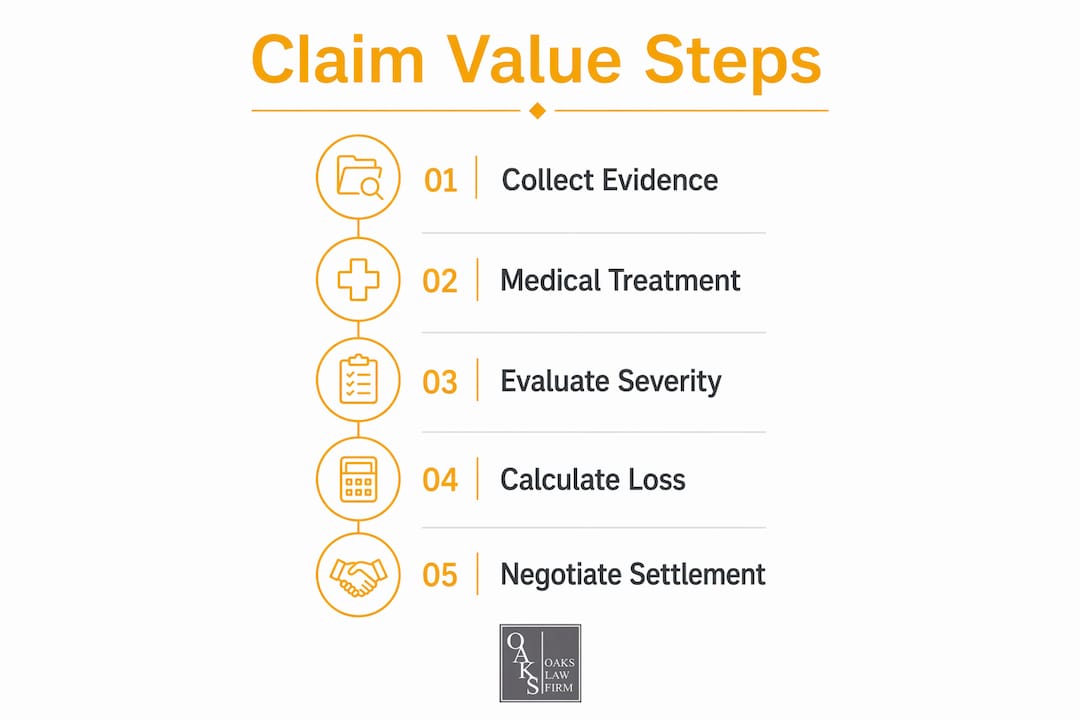
Experienced personal injury attorneys follow a structured valuation process. Understanding it helps you see where your claim sits and what moves the number.
-
Assemble the “specials.” Gather every medical bill, wage-loss record, and out-of-pocket expense. This is your economic damages total, sometimes called “specials” in litigation.
-
Identify the severity band. Common severity bands run from roughly 1.5x (minor, conservative care) to 2.5x (moderate, injections or single-level discectomy) to 4x (severe, fusion or significant permanent restriction) to 6x (catastrophic, multi-level fusion with permanent disability). The band is determined by treatment level, permanency, and how the injury affects daily function.
-
Apply the multiplier to specials. Multiply your economic damages total by the appropriate band factor to get a non-economic damages estimate. Add the two together for a gross claim value.
-
Adjust for liability and insurance limits. Comparative fault reduces your recovery proportionally. California follows pure comparative fault, meaning even a 40% at-fault plaintiff can still recover 60% of damages. Policy limits cap what the insurer will pay regardless of case value.
-
Consider a life-care plan for catastrophic cases. When surgery produces permanent restrictions or ongoing care needs, a life-care planner projects the cost of future treatment over your life expectancy. This can add hundreds of thousands of dollars to the economic base and dramatically shift the multiplier.
Pro Tip: Keep a daily pain journal starting the day after your injury. Entries describing specific functional limitations (can’t sit for more than 20 minutes, can’t lift groceries, disrupted sleep) give the treating physician concrete language for the medical record and strengthen the multiplier justification.
What evidence actually wins a herniated disc claim
Insurance adjusters don’t price claims on reported pain alone. They price off objective medical evidence, and an MRI showing herniation with nerve-root contact is the document that separates a soft-tissue settlement from a six-figure one.
Imaging and electrophysiological testing:
- MRI is the gold standard. The report should identify the specific spinal level (L4-L5 and L5-S1 are the most common lumbar levels), confirm herniation rather than bulge, and note nerve-root contact or compression.
- Dermatomal consistency matters: the level identified on MRI should match the distribution of your symptoms. Sciatica running down the left leg is consistent with an L5-S1 left-sided herniation. Mismatches invite credibility attacks.
- EMG (electromyography) and nerve conduction studies provide electrophysiological confirmation of nerve damage. They’re particularly useful when the insurer argues the MRI findings are incidental or age-related.
Medical records and chronology:
- Emergency room or urgent care records from the day of the accident establish the first documented complaint.
- Treating physician notes should link the mechanism of injury to the disc finding at every visit.
- A causation letter from your treating surgeon or pain specialist, explicitly tying the imaging to the trauma, is one of the most powerful documents in the file.
- Prior medical records matter too. If you have no documented history of back complaints before the accident, that absence is evidence.
First 30 days: what to do to protect causation:
- Seek medical attention within 24–72 hours of the accident, even if symptoms feel manageable.
- Request imaging at the first or second visit if pain persists or radiates.
- Report every symptom to your doctor, including numbness, tingling, or weakness in extremities.
- Preserve accident scene photos, witness contact information, and any incident or police reports.
- Avoid gaps in treatment. A 60-day gap in care gives the insurer a narrative that you recovered.
Proper injury documentation after an accident is not just helpful — it’s the foundation the entire claim is built on.
What settlement ranges actually look like — and three real-world examples
Conservative care cases commonly land in low-to-mid five figures; surgical cases frequently drive six-figure settlements. The table below maps treatment level to typical outcome bands and the key facts that trigger each.
| Treatment Level | Typical Range | Key Value Drivers |
|---|---|---|
| Conservative care only (PT, medication) | low-to-mid five figures | No surgery, no permanent restrictions, full recovery |
| Injections / single-level discectomy | mid-to-high five figures or six figures | Objective MRI findings, radiculopathy, partial recovery |
| Fusion / permanent impairment | up to $1 million | Multi-level surgery, permanent work restrictions, life-care plan |
Three illustrative scenarios:
Mild case. A 38-year-old sustains an L5-S1 herniation in a rear-end collision. MRI confirms the finding. She completes 12 weeks of physical therapy, symptoms resolve, and no surgery is recommended. Economic damages total roughly $18,000. Settlement lands around $45,000, reflecting a modest multiplier on a fully resolved injury with clear liability.
Surgical case. A 52-year-old warehouse worker suffers an L4-L5 herniation in a slip-and-fall. MRI shows nerve-root compression. He undergoes a microdiscectomy, misses four months of work, and has residual limitations. Medical bills and lost wages total $95,000. Settlement reaches approximately $280,000, driven by surgery, documented wage loss, and partial permanency.
Catastrophic case. A 45-year-old sustains multi-level cervical herniations in a commercial truck collision. Two-level fusion is performed. She cannot return to her prior occupation and requires ongoing pain management. A life-care plan projects $400,000 in future costs. Total economic damages exceed $600,000. The case resolves at policy limits of $1 million after litigation.
Gross settlement figures are not the same as what you take home. Attorney fees (typically one-third on contingency), medical liens, and health insurance subrogation claims reduce the net amount. A $300,000 settlement can net significantly less after these deductions — understanding that math before you sign a release matters.
These examples are illustrative. Actual outcomes depend on liability, insurance limits, jurisdiction, and the specific facts of each case.
How insurers fight these claims — and how to push back
Two litigation battlegrounds dominate disc claims: causation (was this trauma or pre-existing degeneration?) and extent of limitation (how much does the injury actually affect your life?). Comment prouver le divorce pour faute ? – Groupe Prometheus explains how proving objective facts matters in disputed cases, similar to the investigative rigor needed here. Successful claims require clear, consistent medical records from the first visit and treating-physician opinions tying the injury to the incident.

Common insurer defenses and claimant responses:
| Insurer Defense | Claimant Response / Evidence |
|---|---|
| “The disc changes are degenerative, not traumatic” | Chronology of wellness: no prior symptoms + immediate post-accident treatment + causation letter from treating physician |
| “No objective findings support the claimed pain” | MRI report identifying herniation with nerve-root contact; EMG confirming radiculopathy |
| “You were partially at fault” | Accident reconstruction, witness statements, traffic camera footage to minimize comparative fault percentage |
| “You delayed treatment, so the injury isn’t serious” | ER records, urgent care visit within 72 hours, consistent follow-up appointments |
| “Prior records show pre-existing back problems” | Distinguish prior complaints from current herniation level; show new imaging findings at a different level or side |
MRI findings of degeneration are common in asymptomatic adults, which is exactly why the insurer raises this defense. The counter isn’t to argue the spine was perfect before the accident. It’s to show the accident caused or materially aggravated the condition, producing symptoms that weren’t there before.
Comparative fault is a separate lever. California’s pure comparative fault system means the insurer will try to assign you a percentage of responsibility to reduce its payout. Dashcam footage, witness statements, and accident reconstruction reports are the tools that fight back.
Pro Tip: Get your pre-accident medical records before the insurer does. If your prior records show no back complaints, that’s powerful evidence. If they show some prior treatment, knowing what’s in them lets your attorney frame the narrative rather than react to it.
California deadlines you cannot afford to miss
Most personal injury claims in California must be filed within two years of the injury date under CCP §335.1. Miss that window and the court will almost certainly dismiss your case, regardless of its merits.
The deadline compresses sharply when a government entity is involved. Claims against a city, county, state agency, or public school must be presented within six months of the injury under Gov. Code §911.2. This applies to accidents on government property, involving government vehicles, or caused by public employees. Six months passes faster than most people expect, especially when you’re focused on medical treatment.
Key deadline milestones:
- Day 1: Accident occurs. The statute of limitations clock starts.
- Within 6 months: File a government tort claim if any public entity may be liable.
- Within 1 year: Retain counsel, complete initial discovery, and have a clear medical picture of permanency.
- Within 2 years: File a civil lawsuit if no settlement has been reached (CCP §335.1).
- Discovery rule exception: If the injury wasn’t immediately apparent, the clock may start from the date you discovered (or reasonably should have discovered) the injury. This is fact-specific and requires legal analysis.
- Minors: The statute of limitations is tolled until the minor turns 18, then runs for two years.
Workers’ compensation claims have their own deadlines. In California, you generally have one year from the date of injury to file a workers’ comp claim, though the employer must be notified within 30 days of the injury.
The safest approach: contact an attorney as soon as you have a diagnosis. Waiting until month 23 of a two-year window leaves no room for complications.
Workers’ comp vs. personal injury: which path applies to you
The answer is sometimes both, and understanding the difference determines how much you can recover.
Workers’ compensation is a no-fault system. If you herniated a disc at work, you’re entitled to benefits regardless of whether your employer did anything wrong. Coverage includes necessary medical treatment and partial wage replacement (typically two-thirds of your average weekly wage, subject to state maximums). What workers’ comp does not cover: pain and suffering. There are no multipliers, no non-economic damages.
Workers’ comp covers work-related herniations even with preexisting degeneration, as long as work activity substantially contributed to the injury or aggravated a prior condition. Settlement math in workers’ comp runs through permanent disability ratings, not the multiplier approach used in civil litigation. A higher permanent impairment rating produces a higher settlement, but the ceiling is far lower than a comparable third-party tort claim.
Third-party personal injury claims apply when someone other than your employer caused the injury. A delivery driver who herniated a disc when a negligent motorist rear-ended their vehicle has both a workers’ comp claim against their employer and a third-party tort claim against the at-fault driver. The tort claim can include pain and suffering, full wage loss, and future damages. It’s where the real recovery potential lives.
Key tradeoffs:
- Workers’ comp: faster, no-fault, guaranteed medical coverage, but capped and no pain-and-suffering
- Third-party tort: higher potential recovery, but requires proving negligence and liability
- When both apply: workers’ comp pays first; the employer’s insurer typically holds a lien on any third-party recovery
Pro Tip: If you’re pursuing workers’ comp, don’t sign any release or settlement agreement without first confirming whether a third-party claim exists. Settling workers’ comp can affect your ability to recover from a negligent third party if the lien and subrogation rights aren’t handled correctly.
What to do immediately after a herniated disc injury
The first 30 days after an injury are the most important for claim preservation. Here’s what actually matters, in order of priority.
Immediate actions (first 72 hours):
- Seek medical attention. Go to the ER, urgent care, or your primary care physician. Tell them exactly how the injury happened and every symptom you’re experiencing, including any radiating pain, numbness, or weakness.
- Report the incident. If it’s a workplace injury, notify your supervisor in writing the same day. If it’s a car accident, file a police report.
- Preserve evidence. Photograph the accident scene, your injuries, and any property damage. Get the names and contact information of witnesses before they leave.
- Request imaging. Ask your doctor about MRI if you have radiating symptoms. Don’t wait for a referral if symptoms are significant.
Documentation actions (ongoing):
- Keep every medical bill, explanation of benefits, and prescription receipt.
- Maintain a symptom journal: date, pain level, specific limitations, and how the injury affected your day.
- Save all correspondence with insurers. Do not give a recorded statement to the other party’s insurer without speaking to an attorney first.
- Gather your pre-injury medical records, particularly any prior treatment for back or neck conditions.
What not to do:
- Don’t delay care. A gap in treatment is the insurer’s best argument that you weren’t seriously hurt.
- Don’t accept a quick settlement before you have a complete medical picture. Signing a release before reaching maximum medical improvement (MMI) waives your right to future compensation, even if your condition worsens.
- Don’t post about your injury, activities, or health on social media. Defense investigators monitor these accounts.
When you go to your first medical appointment, tell the provider: “I was injured in [describe the accident] on [date]. I have [describe symptoms] that started immediately after.” That language, in the medical record, establishes causation from day one. For more on documenting injuries after a car accident, Oaks Law Firm has published a detailed step-by-step guide.
Why Oaks Law Firm handles herniated disc claims differently
Oaks Law Firm was founded in 2002 by personal injury attorney Matthew Nezhad, who has spent his entire career representing injured victims in California. The firm operates from offices in Sherman Oaks and Woodland Hills and serves clients throughout the Los Angeles area and California.
One thing that sets the firm apart: it accepts a limited number of cases each year. That’s a deliberate choice. Selective intake means every client gets the attention their case requires, not a file number in a high-volume operation. The firm prioritizes complex disc claims, including cases involving disputed causation, surgical injuries, and permanent impairment where the gap between what the insurer offers and what the case is worth tends to be largest.
What Oaks Law Firm brings to a herniated disc claim:
- Independent investigation of liability and accident reconstruction when needed
- Coordination with treating physicians and, where appropriate, independent medical experts to build a causation narrative
- Life-care planning for catastrophic cases requiring future cost projections
- Experienced negotiation with insurance adjusters who know the firm’s litigation track record
- Trial-ready preparation from the first day of representation
The firm works on a contingency fee basis. No upfront costs, no hourly billing. You pay only if the firm recovers compensation for you.
At Oaks Law Firm, we take on fewer cases precisely because we believe every injured person deserves a lawyer who actually knows their file. A herniated disc claim with surgery and permanent restrictions is not a form letter. It requires a strategy built around your specific imaging, your specific treatment, and your specific life.
If you’re dealing with a neck or spinal injury after a collision, the firm offers a free case evaluation with no obligation.
Key Takeaways
A herniated disc injury claim’s value is determined primarily by objective imaging, treatment escalation, and permanency — not by the severity of pain alone.
| Point | Details |
|---|---|
| Median settlement range | Most herniated disc claims settle between $65,000 and $150,000; surgical cases frequently reach six figures. |
| MRI is decisive | An MRI confirming herniation with nerve-root contact is the single document that separates soft-tissue settlements from higher-value claims. |
| California deadlines | Two years to file a lawsuit under CCP §335.1; six months for government claims under Gov. Code §911.2. |
| Workers’ comp vs. tort | Workers’ comp covers medical and partial wages but excludes pain-and-suffering; a third-party tort claim is where full damages live. |
| Oaks Law Firm | Selective intake firm founded in 2002 by Matthew Nezhad; handles complex, surgical, and disputed-causation disc claims throughout California. |
The part most injured people don’t hear until it’s too late
Herniated disc claims are won or lost in the first few weeks after the accident, not at the negotiating table. By the time most people think about calling a lawyer, the insurer has already built its file around the gaps in their medical record.
The degeneration defense is not a legal technicality. It’s a statistical reality. MRI studies consistently show that a significant portion of adults over 40 have disc changes with no symptoms at all. The insurer knows this. Their adjuster will pull your imaging report, note the word “degenerative,” and use it to argue the accident didn’t cause anything. The only reliable counter is a medical record that starts within 72 hours of the accident and never stops.
What I’ve seen repeatedly in cases like these: the clients who do best are not necessarily the ones with the most dramatic injuries. They’re the ones who sought care immediately, kept every appointment, and had a treating physician willing to write a clear causation opinion. The medicine and the legal strategy have to work together. An MRI without a physician connecting it to the accident is just a picture. A physician’s opinion without imaging to back it up is just an opinion.
The other thing worth saying plainly: not every herniated disc claim needs a lawyer. A conservatively treated case that resolves fully, with clear liability and a cooperative insurer, may settle reasonably without one. But if you’ve had surgery, if you have permanent restrictions, if the insurer is disputing causation, or if a government entity is involved — those are the situations where experienced representation consistently produces materially better outcomes.
Oaks Law Firm is ready to evaluate your herniated disc claim

When a herniated disc involves surgery, permanent restrictions, or a disputed cause, the difference between what the insurer first offers and what the case is actually worth can be substantial. Oaks Law Firm handles exactly these cases: complex, high-stakes disc claims where the evidence has to be built carefully and the insurer has to be pushed.
The firm works on a pure contingency basis. No retainer, no hourly fees, no upfront costs of any kind. If the firm doesn’t recover compensation for you, you owe nothing. For clients dealing with car accident compensation in California, the firm explains the full range of damages available and how California law applies to your specific facts.
To request a free case evaluation, have the following ready: your accident report or incident documentation, any imaging reports (MRI, X-ray), your current treating physician’s name and contact, and a rough summary of your medical bills and missed work to date. Call or contact Oaks Law Firm through the website to schedule your consultation at no charge.
Useful sources
California statutes:
- CCP §335.1 — Two-year statute of limitations for personal injury claims in California. Exceptions apply for minors, discovery-rule cases, and claims against government entities.
- Gov. Code §911.2 — Six-month deadline to present a government tort claim before filing suit against a public entity. Missing this deadline typically bars the claim entirely.
Medical authorities:
- MedlinePlus (National Library of Medicine) — Clinical definition of herniated disc pathology, symptoms, and treatment overview.
- Mayo Clinic: Herniated Disk Symptoms and Causes — Plain-language explanation of disc anatomy, herniation mechanisms, and symptom patterns.
- Mayo Clinic: Herniated Disk Diagnosis and Treatment — Overview of conservative care, injection therapy, discectomy, and spinal fusion options.
Settlement and valuation resources:
| Resource | What It Covers |
|---|---|
| LegalClarity — Average Payout for a Herniated Disc | Median settlement ranges and factors affecting value |
| Recording Law — Herniated Disc Settlement Value | Valuation frameworks, severity bands, and case examples |
| CaseValue — Herniated Disc Settlement Calculator | Multiplier methodology and treatment-level bands |
| WorkCompCalc — Workers’ Comp for Herniated Disc | Workers’ compensation process, benefits, and permanent disability ratings |
FAQ
What is the average settlement for a herniated disc?
Most herniated disc settlements fall between $65,000 and $150,000, though conservatively treated cases can settle well below five figures and catastrophic fusion cases with permanent disability can exceed a million dollars. The specific facts of your injury, treatment, and liability determine where your claim falls.
Is a herniated disc considered a serious injury?
A herniated disc with nerve-root compression, radiculopathy, or surgical intervention is generally treated as a serious injury by courts and insurers. A disc bulge without nerve contact or functional limitation is typically valued closer to a soft-tissue injury.
How do lawyers value herniated disc cases?
Attorneys assemble total economic damages (medical bills, lost wages, future care), then apply a severity multiplier ranging from roughly 1.5x for minor cases to 6x for catastrophic ones. Treatment escalation from conservative care to surgery increases both the economic base and the multiplier the facts support.
How much compensation can I get for a herniated disc in California?
California follows pure comparative fault, so your recovery is reduced by your percentage of fault. Beyond that, compensation depends on your medical costs, lost earnings, permanency, and the at-fault party’s insurance limits. Oaks Law Firm offers a free case evaluation to help you understand what your specific claim may be worth.
What is the statute of limitations for a herniated disc claim in California?
Under CCP §335.1, you generally have two years from the date of injury to file a personal injury lawsuit. If a government entity is involved, you must file a government tort claim within six months under Gov. Code §911.2. Missing either deadline typically bars recovery.
This article is general information about California personal injury law, not legal advice for your specific situation. Laws and procedures change; confirm current rules with a qualified California attorney before making decisions about your claim.
Oaks Law Firm — Legal Disclaimer: The information provided in this article is for general informational purposes only and does not constitute legal advice. Reading this article does not create an attorney-client relationship between you and Oaks Law Firm. Every case is different, and past results do not guarantee future outcomes. If you have been injured, consult a licensed California personal injury attorney to evaluate the specific facts of your situation.
