

Attorney Advertising. This article was prepared with the assistance of artificial intelligence and reviewed by Oaks Law Firm prior to publication.
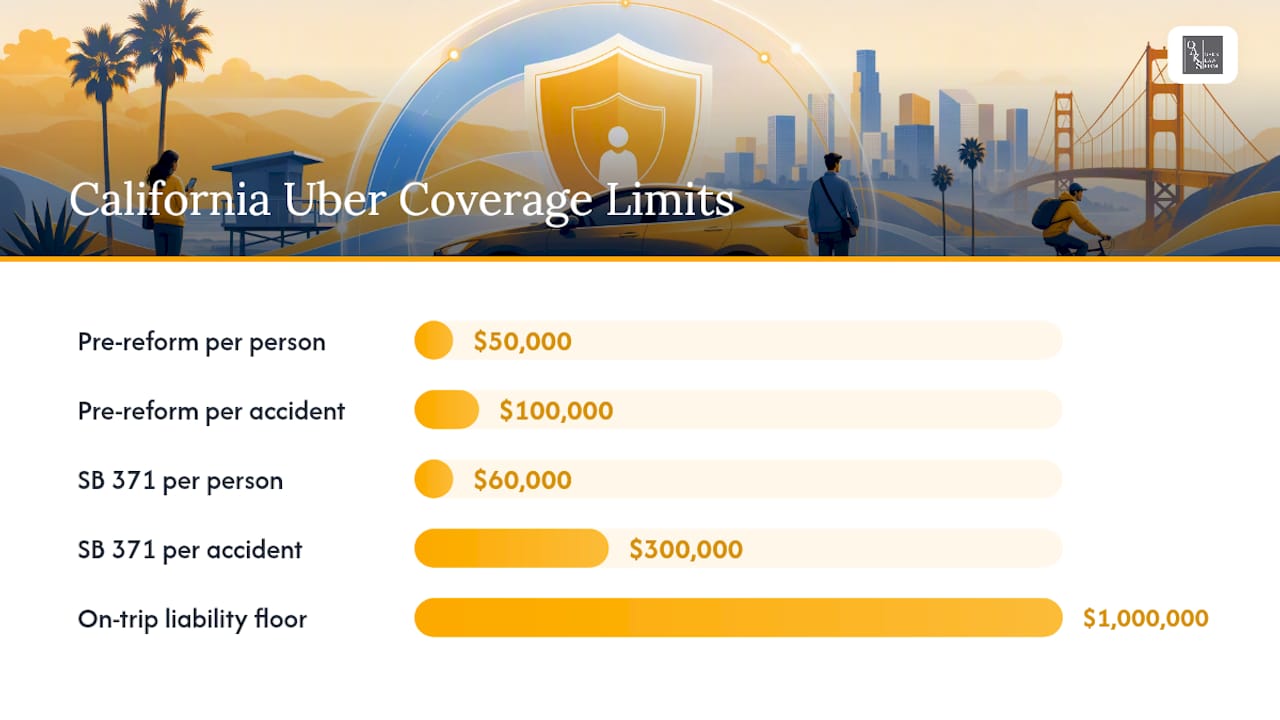
Uber maintains commercial TNC insurance in California under PUC §5433, and as of January 1, 2026, SB 371 reset the uninsured/underinsured motorist (UM/UIM) limits to sixty thousand dollars per person and three hundred thousand dollars per accident, while keeping a one million dollar liability floor for driver-caused injuries during active trips. Here is what that means in plain terms: your personal auto policy is primary when the app is off, but the moment you go online, Uber’s commercial coverage steps in as primary, and the limits shift significantly depending on which phase you are in.
The four driving phases and who is primary in each:
- Offline (app off): Your personal auto insurance is the only coverage. Uber provides nothing.
- Logged on / waiting for a request: Uber’s TNC commercial policy is primary with statutory minimums (at least $50,000 per person / $100,000 per accident liability and $200,000 property damage under pre-reform floors; confirm current minimums against your Certificate of Insurance).
- En route to pick up a rider: Higher commercial limits apply. Uber’s policy is primary.
- On-trip (rider in the vehicle): The $1,000,000 liability coverage is active. Uber’s commercial policy is primary from the first dollar.
California drivers also receive Occupational Accident insurance automatically, paid by Uber, which covers medical expenses and wage replacement for on-the-job injuries. This is separate from the liability coverage above.
The controlling statute is PUC §5433, Article 7, Transportation Network Companies.
Pro Tip: If you are in a crash while driving for Uber, do three things immediately: report the incident through the Uber Driver app, call 911 if anyone is injured, and photograph the scene before vehicles are moved. Those three steps protect your insurance claim and any potential legal case.
Key Takeaways
California rideshare drivers are protected by Uber’s commercial TNC insurance under PUC §5433, but SB 371 reduced UM/UIM limits to $60,000 per person and $300,000 per accident as of January 1, 2026, making it more important than ever to understand exactly which coverage applies in each driving phase.
| Point | Details |
|---|---|
| Phase determines coverage | Uber’s commercial policy is primary only when the app is on; personal insurance covers you when the app is off. |
| SB 371 UM/UIM limits | As of January 1, 2026, UM/UIM is capped at $60,000 per person and $300,000 per accident under California law. |
| Occupational Accident is automatic | California drivers receive Occupational Accident insurance paid by Uber at no cost, covering medical bills and wage replacement. |
| Statutory deadlines are firm | You have two years under CCP §335.1 (six months for government entities under Gov. Code §911.2) to file a claim. |
| Oaks Law Firm can help | Free case evaluations, contingency fee representation, and local rideshare claim experience throughout California. |
Table of Contents
- How does Uber insurance coverage work in California by driving phase?
- What did SB 371 and AB 1340 change for California rideshare drivers?
- What is Occupational Accident insurance, and how does it differ from Optional Injury Protection?
- What should you do immediately after a crash while driving for Uber?
- How does Uber’s insurance interact with your personal auto policy?
- Where do you find and verify Uber’s Certificates of Insurance?
- When should you contact a California personal injury attorney after a rideshare crash?
- Oaks Law Firm is ready to review your rideshare insurance claim
- Sources
- FAQ
How does Uber insurance coverage work in California by driving phase?
The phase you are in when a crash happens determines everything: which policy pays, what the limits are, and whether your vehicle repair is covered. Getting this wrong is one of the most common reasons drivers end up underinsured after an accident.
| Driving Phase | Who Is Primary | Liability Limits | UM/UIM Limits | Vehicle Repair (Collision) | Medical / Wage Benefits |
|---|---|---|---|---|---|
| Offline (app off) | Personal insurer | Personal policy limits | Personal policy limits | Personal policy only | Personal policy only |
| Logged on / waiting | Uber TNC commercial | Statutory minimums (Phase 1) | Statutory minimums | Contingent on personal comp/collision | Occupational Accident insurance |
| En route to pick up | Uber TNC commercial | Higher Phase 2 limits | Per SB 371 reform | Contingent on personal comp/collision | Occupational Accident insurance |
| On-trip (rider aboard) | Uber TNC commercial | $1,000,000 | $60,000 per person / $300,000 per accident | Up to actual cash value with deductible | Occupational Accident insurance |
A few things worth unpacking from that table.
Collision and repair coverage is contingent. Uber acknowledges that coverage to repair your car is available in certain phases, but it typically requires you to already carry comprehensive and collision on your personal policy. If you dropped those coverages to save money, Uber’s contingent coverage does not kick in, and you pay for your own repairs.
The logged-on/waiting phase is the gap most drivers underestimate. You are on the app, you feel covered, but the limits in that phase are lower than what applies once you accept a ride. A serious crash while waiting for a ping could leave you with less protection than you expected.
Common exclusions and coverage gaps to watch:
- Driving for another TNC simultaneously while logged into Uber (most policies exclude this).
- Using the vehicle for commercial delivery or other non-rideshare purposes while the Uber app is off.
- A lapsed personal policy: under PUC §5433, Uber’s TNC coverage cannot be conditioned on your personal insurer denying first, but if your personal policy has lapsed entirely, your Phase 1 and Phase 2 contingent collision coverage may be affected.
- Intentional acts or driving under the influence, which void coverage in virtually every policy.
What did SB 371 and AB 1340 change for California rideshare drivers?
SB 371, summarized by Uber’s newsroom, is the most significant change to California rideshare insurance in years. It took effect January 1, 2026.
Before SB 371, California required TNCs to carry UM/UIM limits of $1,000,000, matching the liability floor. SB 371 changed the UM/UIM requirement to $60,000 per person and $300,000 per accident, aligning rideshare more closely with standard passenger vehicle requirements. The $1,000,000 liability floor for driver-caused injuries during active trips was retained.
SB 371 was negotiated as a compromise: lower mandated UM/UIM limits were traded for continued primary commercial liability protection. Drivers and riders gain some fare relief, but the UM/UIM protection available to cover injuries caused by an uninsured at-fault driver dropped substantially. If you are hit by an uninsured driver while on a trip, the maximum UM/UIM payout under the new law is $60,000 per person, not $1,000,000.
AB 1340 is companion legislation that addresses related TNC insurance obligations and implementation details. Together, these two bills restructure how California insurance for rideshare is calculated and enforced going forward.
Timeline:
- January 1, 2026: SB 371 and AB 1340 take effect. New UM/UIM limits at sixty thousand dollars per person and three hundred thousand dollars per accident apply to all active TNC policies in California.
- Ongoing: Uber updates its Certificates of Insurance to reflect new limits. Drivers should verify their COI through the Uber Driver app.
The practical impact for drivers is a real trade-off. The $1,000,000 UM/UIM that existed before was exceptional protection. At $60,000 per person, a driver with serious injuries caused by an uninsured motorist could face a significant gap between medical costs and what UM/UIM pays out. That gap is exactly the kind of situation where consulting a personal injury attorney becomes worth the call.
What is Occupational Accident insurance, and how does it differ from Optional Injury Protection?
This is where California diverges sharply from most other states, and many drivers do not realize it until they need to file a claim.
California drivers automatically receive Occupational Accident insurance, paid entirely by Uber, with no enrollment required and no cost to the driver. It activates when you are injured while driving for Uber and covers:
- Medical expenses for injuries sustained during a covered trip
- Disability benefits (wage replacement) if an injury prevents you from working
- Survivors benefits for families in the event of a fatal accident
Because this state-mandated coverage already exists, California drivers cannot enroll in Uber’s Optional Injury Protection the way drivers in most other states can. Optional Injury Protection, administered by Aon Affinity and underwritten by Atlantic Specialty Insurance Company, is a per-mile premium product available in other jurisdictions. Uber’s help materials describe Optional Injury Protection as offering up to $1,000,000 in medical benefits and $500 per week in disability payments in some states, at approximately $0.024 per mile. California drivers are excluded from that enrollment because Occupational Accident insurance fills the equivalent role.
What this means practically: your medical and wage-replacement protection while driving in California does not depend on your personal health insurance. Uber pays for Occupational Accident coverage on your behalf. The limits and exact benefit caps are detailed in the policy documents available through the Uber Driver app’s Insurance hub. Reviewing those documents before you need them is worth the fifteen minutes.

For more on how California’s AB5 law and state-provided Occupational Accident insurance interact with your legal rights, Oaks Law Firm has a detailed breakdown on rideshare insurance and the AB5 law.
What should you do immediately after a crash while driving for Uber?
The first hour after an accident shapes everything that follows, including your insurance claim, your medical recovery, and any potential legal case. Here is the order that matters:
- Check for injuries and call 911. If anyone is hurt, do not move them unless there is immediate danger. Get emergency services on the way first.
- Move to safety if possible. Get yourself and your vehicle out of active traffic lanes.
- Report the incident through the Uber Driver app. Use the in-app reporting tool. This creates a timestamped record that Uber’s claims team will reference.
- Call the police. A police report is a foundational document for any insurance claim. Do not skip this step even for minor collisions.
- Exchange information. Get the other driver’s name, license number, insurance carrier, and policy number. Photograph their insurance card.
- Photograph everything. Capture vehicle positions, damage to all vehicles, road conditions, traffic signals, skid marks, and any visible injuries.
- Collect witness contact information. Names and phone numbers from bystanders can be decisive if fault is disputed later.
- Seek medical care. Even if you feel fine, get evaluated. Some injuries, particularly soft-tissue and head injuries, do not present symptoms immediately.
Evidence to preserve after you leave the scene:
- Screenshots of the Uber app showing your online status and trip details at the time of the crash
- The trip log from the app (trip ID, timestamps, route)
- Any communications with Uber’s support team following the incident
- Medical records and bills from every provider you see
- Receipts for any out-of-pocket costs related to the accident
California’s general statute of limitations for personal injury claims is two years from the date of injury under CCP §335.1. If a government entity is involved (a city vehicle, a public road defect), you have only six months to file a government tort claim under Gov. Code §911.2. Missing either deadline typically bars your claim entirely.
When injuries are serious, fault is disputed, or an insurer denies coverage, contact a personal injury attorney before you give any recorded statement to an adjuster. An attorney can help you understand your rideshare accident claim and protect your rights from the start.
How does Uber’s insurance interact with your personal auto policy?
The primary/secondary structure is straightforward in theory but messy in practice, especially when collision repair and personal policy gaps enter the picture.
Phase-by-phase primary rules (practical summary):
- App off: personal policy is the only coverage. Uber is not involved.
- App on, no ride accepted: Uber’s TNC commercial policy is primary for liability. Your personal policy may be secondary for collision repair, but only if you carry comprehensive/collision.
- Ride accepted through trip completion: Uber’s commercial policy is primary for liability at the higher limits. Contingent collision coverage for your vehicle applies if your personal policy includes it.
Under PUC §5433, Uber’s TNC coverage cannot be conditioned on your personal insurer denying a claim first. If your personal policy has lapsed or been cancelled, Uber’s required coverage still applies from the first dollar during covered phases. That is a meaningful protection, but it does not eliminate the need to maintain your personal policy. A lapsed personal policy can expose you in the offline phase and may affect contingent collision coverage.
Common pitfalls:
- Personal policy cancellation: Many personal auto insurers exclude rideshare use or cancel policies when they discover it. California law requires insurers to offer a rideshare endorsement, but you must ask for it. Without it, your personal policy may not cover you even during the offline phase if the insurer argues the vehicle is used commercially.
- Off-app use: Any accident that occurs when the Uber app is completely off is handled entirely by your personal insurer. Uber has no obligation.
- Commercial-use exclusions: Standard personal auto policies often exclude vehicles used for hire. Confirm with your personal insurer that your policy covers rideshare use or add the appropriate endorsement.
Typical claims flow after an on-trip accident:
- Report to Uber through the app immediately.
- Notify your personal insurer (even if Uber’s policy is primary, your insurer needs to know).
- Uber’s claims team opens an investigation and assigns an adjuster.
- The adjuster contacts all parties, reviews the police report, and determines fault.
- If coverage is disputed or denied, you have the right to challenge the denial and, if necessary, pursue litigation.
Pro Tip: Do not give a recorded statement to any insurance adjuster, including Uber’s, before speaking with an attorney if your injuries are significant. Adjusters are trained to ask questions that can limit your claim. A personal injury attorney can advise you on what to say and what to hold back, and can review your Uber accident injury claim before you commit to any position.
Where do you find and verify Uber’s Certificates of Insurance?
A Certificate of Insurance (COI) is the document that proves what coverage exists, who the carrier is, and what the limits are for a specific policy period. Uber publishes COIs for each state, and California’s COI reflects the carriers and limits that apply to your trips.
Here is how to find and verify yours:
- Open the Uber Driver app and navigate to the Account section.
- Tap “Insurance” or find the Insurance hub within the app menu.
- Download or view the Certificate of Insurance for California.
- Alternatively, visit Uber’s insurance hub directly for state-specific COI links and carrier information.
- Check the document annually or whenever you hear about a policy change, because carriers can change year to year.
Five things to verify on every COI:
- Carrier name: Confirm the insurer is a licensed, admitted carrier in California. Carriers do rotate.
- Policy number: Record this before any accident occurs. You will need it when filing a claim.
- Effective and expiration dates: Confirm the policy is active on the date you are driving.
- Coverage limits for each phase: Verify the liability, UM/UIM, and collision limits match what the statute and SB 371 require.
- Named covered parties: Confirm that drivers operating under the Uber platform are covered parties, not just Uber as a company.
Under PUC §5433, Uber’s TNC insurance obligation does not disappear if your personal policy lapses. But the COI is your proof of what coverage exists and who to call when a claim is filed. Keeping a screenshot of the current COI on your phone takes thirty seconds and can save hours of confusion after a crash.
When should you contact a California personal injury attorney after a rideshare crash?
Not every fender-bender requires a lawyer. But certain situations make early legal consultation genuinely important, and waiting too long can cost you rights you cannot recover.
Contact a personal injury attorney when:
- You or a passenger sustained injuries requiring medical treatment beyond the emergency room
- Fault is disputed between you, another driver, or Uber’s claims team
- An insurer denies coverage or offers a settlement that does not cover your medical bills and lost income
- Multiple parties are involved (another driver, a pedestrian, a passenger)
- The accident resulted in a fatality (wrongful death claims have specific legal requirements)
- You are unsure which phase you were in when the crash occurred, creating a coverage dispute
Statutory deadlines you cannot miss:
- Two years from the date of injury to file a personal injury lawsuit under CCP §335.1. This applies to most rideshare crash claims.
- Six months from the date of the incident to file a government tort claim under Gov. Code §911.2, if a public entity (city, county, state agency) contributed to the accident. Miss this window and your claim against that entity is almost certainly barred.
Oaks Law Firm handles rideshare accident claims throughout California, including the , Los Angeles, and surrounding communities. The firm’s team can evaluate UM/UIM and Occupational Accident benefits, negotiate with Uber’s insurers, preserve critical evidence, and file claims within statutory deadlines. Consultations are free, and the firm works on a contingency fee basis, meaning you pay nothing unless the case resolves in your favor.
For a detailed look at car accident compensation in California, including what damages you may be entitled to recover, Oaks Law Firm’s site has a full breakdown.
What Oaks Law Firm sees in California rideshare insurance disputes
Rideshare insurance disputes in California follow patterns. The most common one: a driver is injured during a Phase 1 or Phase 2 trip, the personal insurer denies coverage citing a commercial-use exclusion, and Uber’s claims team argues the driver was not in an active trip phase. The driver is caught between two insurers, each pointing at the other.
The second pattern is subtler. A driver accepts a low settlement offer from an adjuster within days of the accident, before the full extent of injuries is known. Once you sign a release, that claim is closed. No attorney can reopen it.
Oaks Law Firm’s approach is straightforward: listen to what actually happened, review the app data and COI, identify which phase applied, and hold the right insurer accountable. The firm takes a limited number of cases each year, which means every client gets real attention, not a case number.
Oaks Law Firm is ready to review your rideshare insurance claim
If you were injured while driving for Uber in California, or if you are a passenger or pedestrian hurt in a rideshare crash, Oaks Law Firm offers a free case evaluation with no obligation and no upfront cost.

The firm handles the full range of rideshare-related claims: insurance negotiation, UM/UIM benefit disputes, Occupational Accident coverage issues, and litigation when insurers refuse to pay fairly. Attorney Matthew Nezhad and his team know California’s TNC insurance statutes and have handled these cases throughout the and greater Los Angeles area since 2002.
The process is simple. You contact the firm, describe what happened, and the team reviews your insurance situation, identifies which coverage applies, and explains your options. No pressure, no guarantees, just a straight answer about where you stand. The firm’s contingency fee model means you pay only if the case resolves in your favor.
To file a personal injury claim in Los Angeles or speak with a rideshare accident attorney, contact Oaks Law Firm today for your free evaluation. You can also visit the firm’s rideshare accident practice page to learn more about how the team approaches these cases.
Sources
- California Code, PUC §5433 (Article 7. Transportation Network Companies)
- Optional Injury Protection Overview | Driving & Delivering | Uber Help
Editor’s note: Confirm all live policy links, current carrier names on the California COI, and SB 371 / AB 1340 implementation details with Uber’s Insurance hub before publishing. Statutory language should be verified against the current leginfo.legislature.ca.gov text.
This article is general information, not a substitute for advice from a qualified lawyer. Consult a qualified legal professional about your own circumstances before acting on anything here.
FAQ
What does Uber insurance cover in California in 2026?
Uber maintains commercial TNC insurance in California covering liability at a one million dollar floor during active trips, UM/UIM at sixty thousand dollars per person and three hundred thousand dollars per accident under SB 371 (effective January 1, 2026), and contingent collision coverage for vehicle repair when a driver carries personal comprehensive/collision. California drivers also receive Occupational Accident insurance automatically, covering medical expenses and wage replacement.
Will driving for Uber increase my personal insurance premium?
Many personal auto insurers charge higher premiums or require a rideshare endorsement once they know the vehicle is used for hire. California law requires insurers to offer a rideshare endorsement, but you must request it; without it, your personal policy may exclude rideshare-related claims entirely, which can affect your offline-phase coverage.
What happens if I damage my car while driving for Uber?
Uber’s contingent collision coverage may pay to repair your vehicle up to its actual cash value (minus a deductible), but only if you already carry comprehensive and collision on your personal auto policy. If you dropped those coverages, Uber’s contingent coverage does not apply and you are responsible for repair costs.
What happens if I am in an Uber and it gets into an accident?
As a passenger in an Uber during an active trip, you are covered under Uber’s one million dollar commercial liability policy for injuries caused by the Uber driver’s negligence. If another driver caused the crash, that driver’s liability insurance is the primary source of recovery, with Uber’s UM/UIM coverage at sixty thousand dollars per person and three hundred thousand dollars per accident under SB 371 available if the at-fault driver is uninsured or underinsured.
When should I call a lawyer after an Uber accident in California?
Contact a personal injury attorney any time injuries require medical treatment beyond the emergency room, fault is disputed, or an insurer denies or undervalues your claim. The two-year statute of limitations under CCP §335.1 and the six-month government claims deadline under Gov. Code §911.2 make early consultation important. Oaks Law Firm offers free case evaluations for California residents.
This article is intended for general informational purposes only and does not constitute legal advice. Reading this article does not create an attorney-client relationship with Oaks Law Firm. Laws and insurance requirements may change; confirm current rules with a qualified California attorney or the relevant regulatory authority before making decisions about your coverage or legal rights.
