

An Uber accident injury claim is a formal legal request for compensation following a crash involving an Uber vehicle, governed by a layered insurance framework that operates entirely differently from a standard auto accident claim. The core complexity comes from Uber’s multi-tiered insurance system, which assigns different coverage limits depending on what the driver was doing at the moment of the crash. Four separate insurance policies can potentially apply to a single incident, including the driver’s personal auto policy, Uber’s commercial policy, the at-fault third party’s insurance, and your own uninsured motorist coverage. Understanding which tier applies to your situation is the first step in any Uber accident injury claim, and getting it wrong costs claimants real money.
How Uber’s tiered insurance coverage works in 2026
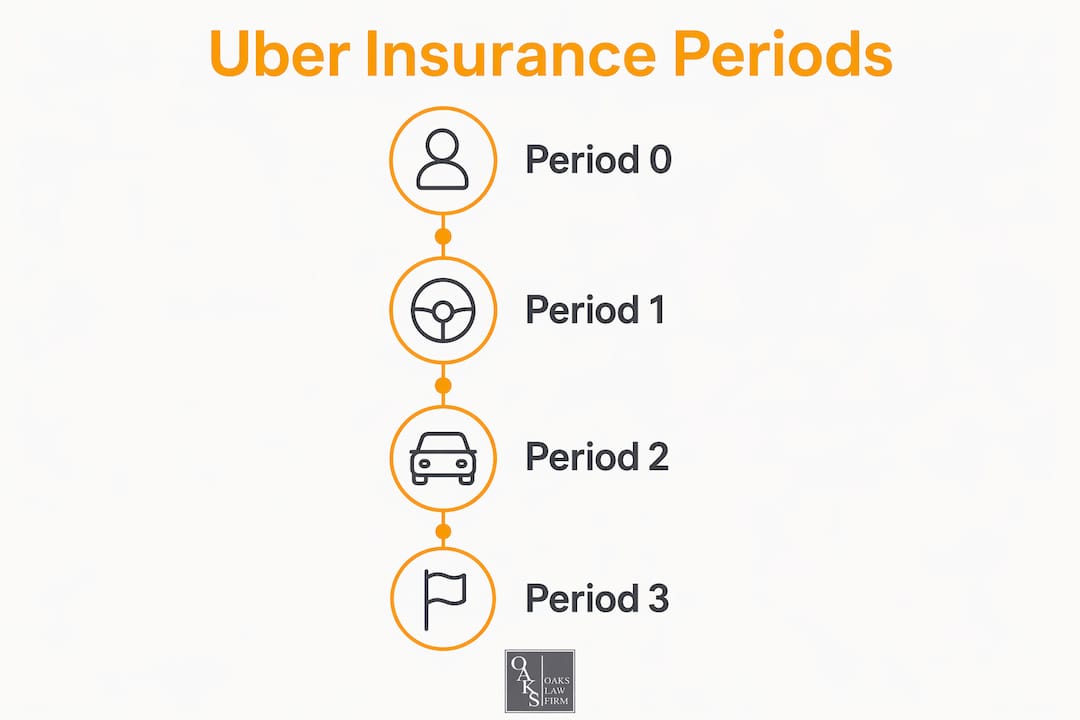
Uber’s insurance system is built around four distinct coverage periods, and the applicable coverage limits shift dramatically between them. Period 0 means the driver’s app is completely off. Uber provides zero coverage during this window. Any accident that occurs here falls entirely on the driver’s personal auto insurance.
Period 1 begins when the driver activates the app and waits for a ride request. This is the most dangerous coverage gap for injured claimants. Uber provides only contingent liability coverage of $50,000 per person, $100,000 per accident, and $30,000 for property damage. That sounds reasonable until you factor in serious injuries, multiple victims, or a dispute about whether the app was actually on.
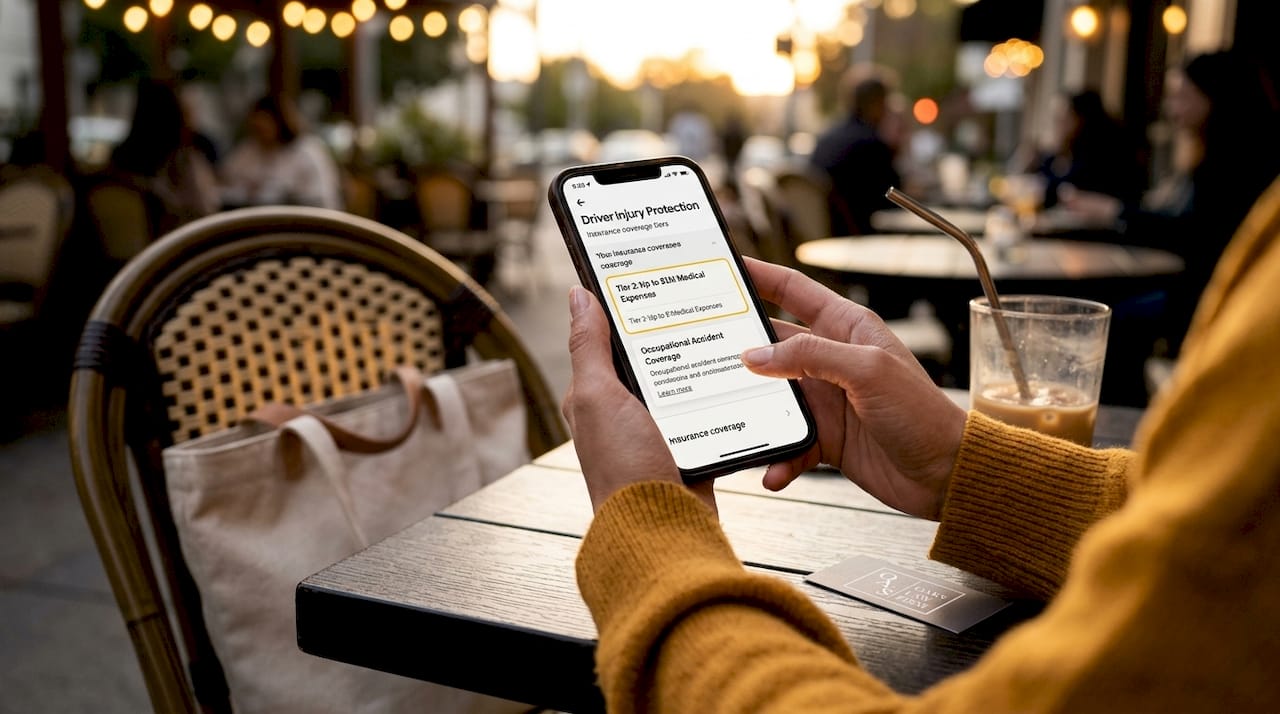
Periods 2 and 3 are where Uber’s full commercial policy activates. Period 2 starts when the driver accepts a trip and is en route to pick up the passenger. Period 3 covers the entire time a passenger is in the vehicle. Both periods carry $1 million in liability coverage, plus contingent comprehensive and collision coverage. This is the protection most passengers assume they have at all times, but it only applies once a ride is accepted.
| Coverage Period | App Status | Uber Liability Limit |
|---|---|---|
| Period 0 | App off | No Uber coverage |
| Period 1 | App on, waiting | $50K per person / $100K per accident |
| Period 2 | Ride accepted, en route | $1 million |
| Period 3 | Passenger in vehicle | $1 million |
App-period disputes are the most common battleground in Uber accident claims because the coverage tier determines the entire settlement ceiling. Insurers will challenge the driver’s app status aggressively, especially when the difference between Period 1 and Period 3 means the difference between $50,000 and $1 million in available coverage.
Pro Tip: Screenshot the Uber app immediately after any accident. The ride status screen, trip details, and receipt confirmation are the most direct evidence of which coverage period applies. This data can disappear or become inaccessible within hours.
California’s SB 371, passed in 2026, reduced uninsured motorist protection for rideshare passengers, making the coverage period question even more consequential for California claimants. If you were injured in Los Angeles or the , the specific tier active at the time of your crash directly controls how much compensation you can realistically pursue.
What to do immediately after an Uber accident
The first 30 minutes after an Uber crash determine the quality of your entire claim. Evidence disappears, memories fade, and insurers begin building their defense before you’ve even left the scene. These steps protect your rights from the moment the collision happens.
- Screenshot the Uber app. Open the app before doing anything else and capture the ride status, driver name, vehicle details, and trip receipt. App data preservation is the single most critical early action because this information can disappear and is essential to proving the driver’s coverage period.
- Call 911 and get a police report. A police report creates an official, timestamped record of the accident, the vehicles involved, and any initial fault determinations. Never skip this step, even for seemingly minor crashes.
- Photograph everything. Take photos of all vehicles, damage, road conditions, traffic signals, skid marks, and any visible injuries. Use GPS-enabled photos so the location and time are embedded in the file metadata.
- Collect witness information. Names and phone numbers from bystanders can be decisive when the driver disputes the account of events.
- Seek medical attention the same day. Even if you feel fine, adrenaline masks pain. Delayed medical visits give insurers grounds to argue your injuries were not caused by the accident.
- Do not give recorded statements to any insurance adjuster without legal advice. Early casual statements can be used later to challenge the severity of your injuries. Adjusters are trained to ask questions that minimize your claim.
Documenting injuries thoroughly from day one is not optional. Review Oaks Law Firm’s guidance on documenting injuries after a crash to understand exactly what medical records, imaging reports, and treatment logs you need to build a strong demand package.
Pro Tip: GPS dashcam apps that record location and speed data provide independent corroboration of the crash timeline. Understanding rideshare dashcam requirements before an accident happens gives you a significant evidentiary advantage if one occurs.
How Uber’s forced arbitration clause affects your claim
Uber’s terms of service include a mandatory arbitration clause that most passengers accept without realizing it. When you create an Uber account, you agree to resolve disputes through private arbitration rather than filing a lawsuit in court. In 2026, this clause is broadly enforced for passengers who consented to the terms, which fundamentally changes how your injury claim can be resolved.
Here is what arbitration means in practice compared to a court trial:
- No jury. A private arbitrator, not a jury of your peers, decides the outcome. Juries tend to award higher damages in serious injury cases, particularly for pain and suffering. Arbitration removes that leverage entirely.
- Limited discovery. In court litigation, you can compel Uber to produce internal communications, driver records, and safety data. Arbitration severely restricts this process, which limits your ability to build a full picture of negligence.
- No public record. Arbitration outcomes are confidential. This means Uber faces no reputational pressure from a public verdict, which reduces its incentive to settle for fair amounts.
- Opt-out window. Uber allows passengers to opt out of arbitration within 30 days of account creation. Almost no one does this, because the terms are buried in the sign-up process.
- Enforceability exceptions. Courts have found arbitration clauses unenforceable in specific circumstances, including cases involving gross negligence, fraud, or when the clause was not clearly disclosed. An experienced attorney can evaluate whether your case qualifies for one of these exceptions.
The arbitration clause does not eliminate your right to compensation. It changes the forum and the strategy. Knowing this before you file means you can prepare your evidence and arguments for the arbitration process rather than being caught off guard.
What damages you can recover in an Uber accident injury case
Compensation in an Uber accident injury claim falls into two categories: economic damages and non-economic damages. Economic damages are the concrete, calculable losses. Non-economic damages cover the human cost of the injury.
Economic damages typically include:
- Emergency room bills, surgery costs, and ongoing medical treatment
- Physical therapy and rehabilitation expenses
- Lost wages from missed work during recovery
- Future lost earning capacity if the injury causes permanent disability
- Property damage to personal belongings in the vehicle
Non-economic damages cover pain and suffering, emotional distress, loss of enjoyment of life, and permanent disfigurement or disability. These are harder to quantify but often represent the largest portion of a serious injury settlement.
The severity of your injury directly controls the settlement range. A soft-tissue whiplash claim with full recovery in six weeks produces a very different outcome than a traumatic brain injury or spinal fracture requiring surgery and long-term care. Demand packages must include medical records, billing statements, wage loss documentation, and liability evidence to support the full value of both damage categories.
Future damages are frequently undervalued by claimants who settle too early. If your doctor has not yet determined whether you need additional surgery or long-term therapy, settling before that determination locks in a number that may not cover your actual costs. California law allows you to claim compensation for future medical care and future wage loss as part of your total recovery.
One critical gap: many passengers overestimate Uber’s coverage when the Uber driver is not at fault. If a third-party driver caused the crash, you are pursuing that driver’s insurance first. Uber’s policy only steps in as contingent coverage. When the at-fault driver is uninsured, your own uninsured motorist coverage becomes the primary recovery vehicle. Review your own policy and understand your uninsured driver options before assuming Uber’s $1 million policy applies to your situation.
How to file and pursue your Uber accident injury claim
Filing an Uber accident injury claim follows a structured process, but the timeline and outcome depend heavily on how well you execute each stage.
- Report the accident to Uber immediately. Use the app’s safety feature to report the crash. This creates a timestamped record within Uber’s system and triggers their insurance notification process.
- Notify your own insurance carrier. Even if you were a passenger, your personal auto policy’s uninsured motorist and med-pay provisions may apply. Failing to notify your carrier promptly can waive these benefits.
- Complete medical treatment or reach maximum medical improvement. Do not submit a demand package while you are still actively treating. Settling before you know the full extent of your injuries is one of the most common and costly mistakes claimants make.
- Compile your demand package. This document includes all medical records and bills, proof of lost wages, the police report, your Uber app screenshots, witness statements, and a detailed pain and suffering narrative. Investigations by the insurer typically occur within 30 to 60 days of the claim being filed.
- Submit the demand letter and begin negotiation. The insurer will respond with a counteroffer. Expect multiple rounds of negotiation. Insurers routinely open with low offers to test whether you understand the full value of your claim.
- Proceed to arbitration or litigation if settlement fails. If the claim does not resolve through negotiation, it moves to arbitration under Uber’s clause or to court if the clause is unenforceable. Insurer payment is generally required within 30 days of a final agreement.
California’s statute of limitations for personal injury claims is two years from the date of the accident. Missing this deadline eliminates your right to any recovery. Review the claim filing deadlines that apply to your specific situation before taking any action.
Represented claimants recover over 3.5 times more than those who negotiate without legal assistance. That gap exists because attorneys understand coverage tiers, arbitration strategy, and insurer negotiation tactics in ways that unrepresented claimants simply do not.
Key takeaways
Uber accident injury claims require precise evidence, an understanding of coverage tiers, and strategic handling of arbitration to recover full compensation.
| Point | Details |
|---|---|
| Coverage period is everything | The driver’s app status at the time of the crash determines whether $50K or $1 million in coverage applies. |
| Screenshot the app immediately | Uber app data proving ride status can disappear quickly and is the most critical piece of evidence in coverage disputes. |
| Arbitration limits your options | Uber’s mandatory clause removes jury trials and limits discovery, requiring a different legal strategy than standard litigation. |
| Don’t settle before treatment ends | Settling before reaching maximum medical improvement locks in a number that may not cover future surgery or therapy costs. |
| Legal representation multiplies recovery | Represented claimants recover more than 3.5 times the amount unrepresented claimants receive on average. |
What I’ve learned after years of Uber accident cases
After handling personal injury cases in the for over two decades, the pattern I see most often in Uber accident claims is misplaced confidence. Clients come in assuming Uber’s $1 million policy covers everything, and they’ve already given a recorded statement to an adjuster explaining that they “feel okay” at the scene. Both of those assumptions cost them.
The $1 million policy only applies during Periods 2 and 3. If the driver was waiting for a ride request, you’re looking at a $50,000 ceiling. And that early “I feel okay” statement? Insurers use it to dispute soft-tissue injuries that show up on MRI scans two weeks later.
What actually protects claimants is documentation discipline from the first minute. The app screenshot, the same-day medical visit, the refusal to give a recorded statement without counsel. These are not complicated steps. They are just steps most people don’t know to take because they’ve never been in this situation before.
I’m also direct with clients about arbitration. It is not the end of the world, but it is a different game. Without a jury, the emotional weight of your suffering carries less force. The numbers have to speak for themselves, which means your medical records, your wage loss documentation, and your future care projections need to be airtight. Cases that would move a jury to a large verdict can produce modest arbitration awards if the paperwork is thin.
The cases I’ve seen go best are the ones where the client called us before speaking to anyone else. Not because we tell them what to say, but because we tell them what not to say and what to preserve. That early window is where claims are won or lost, long before a demand letter is ever written.
— Matthew Nezhad
How Oaks Law Firm can help with your Uber accident claim
Oaks Law Firm has spent over two decades protecting injured victims throughout the and California from exactly the kind of insurance complexity that defines Uber accident claims. Attorney Matthew Nezhad and his team know how to investigate layered insurance policies, identify the correct coverage period, and build demand packages that reflect the full value of your injuries, including future medical care and lost earning capacity.
If your claim moves to arbitration, you need representation that understands how to present evidence effectively without a jury. If Uber’s insurer is stalling or lowballing, you need a team that knows when to push and when to file. Start with a free case evaluation and learn exactly where you stand. Visit Oaks Law Firm’s guide on filing a personal injury lawsuit or contact us directly to speak with Matthew Nezhad’s team today.
FAQ
What is an Uber accident injury claim?
An Uber accident injury claim is a formal request for compensation filed against Uber’s insurance, the driver’s personal policy, or a third party’s coverage after a crash involving an Uber vehicle. The claim process differs from standard auto claims because of Uber’s tiered insurance system and mandatory arbitration clause.
Which insurance covers me as an Uber passenger?
As a passenger in an Uber during an accepted trip, Uber’s $1 million commercial liability policy applies. If the at-fault driver is a third party who is uninsured, your own uninsured motorist coverage becomes the primary recovery option.
How long does an Uber injury claim take to resolve?
Most Uber injury claims follow a timeline of 30 to 60 days for insurer investigation, followed by demand submission after medical stabilization, and then negotiation. Total resolution can range from a few months to over a year depending on injury severity and whether arbitration is required.
Can I sue Uber directly in court?
Uber’s mandatory arbitration clause generally prevents passengers from filing a lawsuit in court. However, the clause can be challenged and may be unenforceable in cases involving gross negligence or improper disclosure. An attorney can evaluate whether your specific situation qualifies for a court filing.
Does it matter which period the Uber driver was in when the crash happened?
The coverage period is the single most important factor in an Uber accident claim. Period 1 carries a $50,000 per-person limit, while Periods 2 and 3 carry $1 million in liability coverage. Proving the driver’s app status with screenshots and GPS data is critical to accessing the higher coverage tier.
