

Under the federal hours of service regulations administered by the Federal Motor Carrier Safety Administration (FMCSA), most property-carrying commercial drivers face four core limits: an 11-hour driving cap after 10 consecutive off-duty hours, a 14-hour on-duty window from the moment they go on duty, 60/70-hour weekly limits with a 34-hour restart, and a required 30-minute break after 8 cumulative hours of driving. These are the truck driver hours of service rules that govern nearly every interstate haul in the United States, and violating any one of them can trigger a citation and potentially an out-of-service order at a roadside inspection.
Three things to do before your next dispatch:
- Check all five HOS clocks on your ELD: 11-hour driving time, 14-hour window, 30-minute break trigger, 60/70-hour weekly total, and restart eligibility.
- Document any off-duty or sleeper-berth periods accurately, including start and end times.
- Log adverse conditions or shipper delays in your remarks field the moment they occur.
The FMCSA’s core position: Both drivers and motor carriers share legal responsibility for HOS compliance. A carrier cannot instruct a driver to violate the rules, and a driver cannot claim ignorance of the limits. Shared accountability means shared liability when something goes wrong.
The primary authority for these rules is the Federal Motor Carrier Safety Administration (FMCSA), operating under the U.S. Department of Transportation. The specific regulatory text lives in 49 CFR §395.3.
Key Takeaways
Federal truck driver hours of service rules set hard limits on driving time, on-duty windows, and weekly totals that both drivers and carriers must follow, with violations triggering citations, potential out-of-service orders, and lasting CSA consequences.
| Point | Details |
| Core driving limits | 11-hour driving cap after 10 consecutive off-duty hours; 14-hour on-duty window runs continuously from first on-duty moment. |
| Weekly limits and restart | 60/70-hour weekly caps reset after 34 consecutive off-duty hours; track your rolling 8-day total, not just today’s hours. |
| 30-minute break trigger | Required after 8 cumulative hours of driving; can be satisfied by off-duty or on-duty not driving time. |
| Sleeper-berth splits | 7/3 or 8/2 splits are allowed; the shorter period does not count against the 14-hour window. |
| Legal action after a crash | California’s two-year statute of limitations (CCP §335.1) and six-month government claims deadline (Gov. Code §911.2) apply; contact an attorney immediately. |
If an HOS violation contributed to a crash that injured you or someone you care about, the legal consequences can be significant. The truck accident lawyers at Oaks Law Firm represent injured victims throughout California, including drivers, passengers, and pedestrians harmed by fatigued commercial drivers. Understanding how compensation works in California is the first step. Contact Oaks Law Firm for a free case evaluation.
Who do the HOS rules actually apply to?
Federal HOS rules cover commercial motor vehicles (CMVs) operating in interstate commerce. A vehicle qualifies as a CMV subject to these rules if it meets any of the following:
- Gross vehicle weight rating or gross combination weight rating over 10,001 pounds.
- Designed or used to transport 9 or more passengers (including the driver) for compensation, or 16 or more passengers regardless of compensation.
- Transports hazardous materials in a quantity requiring placards.
Property-carrying vs. passenger-carrying drivers face different limits. Property-carrying drivers get the 11-hour driving cap and 14-hour on-duty window. Passenger-carrying drivers are held to a 10-hour driving limit and a 15-hour on-duty window, with a 60/70-hour weekly limit structure that mirrors the property-carrying rules.
Both drivers and carriers carry compliance obligations. Carriers set dispatch schedules, manage load assignments, and control the conditions that push drivers toward violations. Drivers control the actual log entries and the decision to stop driving. The FMCSA is explicit: carriers and drivers share responsibility for ensuring the rules are followed.
Intrastate operations fall under state law, not federal HOS rules, though most states adopt rules that closely mirror the federal framework. California, for instance, generally follows federal HOS standards for intrastate commercial drivers, but specific exemptions and thresholds can differ. When in doubt, the federal baseline is the floor.
Carrier responsibility note: A carrier that pressures a driver to violate HOS rules faces its own enforcement action, including civil penalties and CSA score consequences. “My dispatcher told me to” is not a defense at a weigh station.
Pro Tip: If you operate across state lines even occasionally, federal HOS rules apply to your entire trip, not just the interstate portion. Confirm your operating status with your carrier before assuming a state exemption covers you.
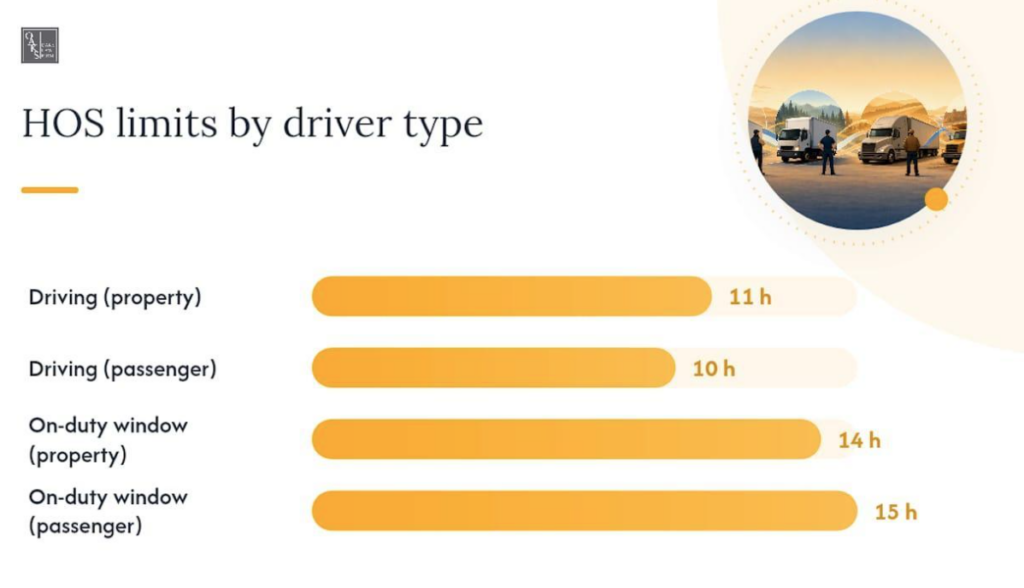
HOS limits at a glance: property-carrying vs. passenger-carrying
The table below reflects the FMCSA’s published summary of the HOS regulations and the regulatory text in 49 CFR §395.3 and §395.5.
| Rule | Property-Carrying | Passenger-Carrying |
| Driving limit | 11 hours after 10 consecutive off-duty hours | 10 hours after 8 consecutive off-duty hours |
| On-duty window | 14 hours from start of shift | 15 hours of on-duty time |
| 30-minute break | Required after 8 cumulative hours of driving | Not required under federal rules |
| Weekly on-duty limit | 60 hours/7 days or 70 hours/8 days | 60 hours/7 days or 70 hours/8 days |
| 34-hour restart | Resets weekly limit after 34 consecutive off-duty hours | Same |
| Sleeper-berth split | 7/3 or 8/2 split allowed; the shorter period does not count against the 14-hour window | 8 hours in the berth, which may be split into two periods of at least 2 hours each |
| Adverse conditions | Up to 2-hour driving extension | Up to 2-hour driving extension |
| Short-haul exception | 150 air-mile radius; released within 14 hours; no ELD or RODS required | 150 air-mile radius; released within 14 hours; no ELD or RODS required |
Source: the FMCSA’s hours of service summary and 49 CFR Part 395.
Key terms clarified:
- Driving time counts only the minutes the vehicle is moving. Time spent at a shipper’s dock, fueling, or doing pre-trip inspections is “on-duty not driving.”
- On-duty time includes driving time plus all other work-related activities: loading, unloading, waiting at a shipper, performing vehicle inspections, and any time spent in the cab while the vehicle is moving with a co-driver.
- Off-duty time is completely free from work obligations. Resting in a sleeper berth counts as off-duty only when properly logged and meeting the split requirements.
Breaking down each HOS rule in detail
The 11-hour driving limit
Under 49 CFR §395.3, a property-carrying driver may not drive more than 11 hours after coming off 10 consecutive hours off duty. The clock resets only after a full 10-hour off-duty break, not a partial one.
Worked example: A driver clocks in at 6:00 AM. By 5:00 PM, they have driven 11 hours (accounting for a 30-minute break). They must stop driving. Driving one more mile at 5:01 PM is a federal violation.
The 14-hour on-duty window
The 14-hour window starts the moment a driver goes on duty, regardless of whether they are driving. Once 14 hours have elapsed, the driver cannot drive again until completing a 10-hour off-duty break, even if they have unused driving hours remaining.
Worked example: A driver goes on duty at 6:00 AM. At 8:00 PM (14 hours later), the window closes. If the driver spent 3 hours at a dock and only drove 8 hours, they still cannot drive at 8:01 PM. Those unused driving hours do not carry over.
The 30-minute break requirement
After 8 cumulative hours of driving, a driver must take a 30-minute break before driving again. The break can be satisfied by off-duty time, on-duty not driving time, or sleeper-berth time. It does not need to be a full 30-minute stop away from the cab.
The 60/70-hour weekly limits and 34-hour restart
Drivers operating for carriers that run vehicles 7 days a week face a 70-hour/8-day limit. Carriers operating fewer than 7 days a week apply the 60-hour/7-day limit. Once a driver hits their weekly cap, they cannot drive until enough hours drop off the rolling 8-day window, or they take a 34-hour restart.
The 34-hour restart requires 34 consecutive hours off duty. After that, the weekly clock resets to zero.
Sleeper-berth splits
The FMCSA’s 2020 HOS final rule allows two split options for property-carrying drivers using a sleeper berth:
- 8/2 split: At least 8 hours in the berth, plus a separate 2-hour off-duty or berth period.
- 7/3 split: At least 7 hours in the berth, plus a separate 3-hour off-duty or berth period.
The shorter qualifying period does not count against the 14-hour on-duty window. This gives team drivers and long-haul solo drivers meaningful flexibility to manage rest timing without burning through their window.
The FMCSA has also studied additional split options, such as 6/4 and 5/5 configurations, but those are not currently permitted under the regulations. Do not rely on any split other than 8/2 or 7/3 unless the rules formally change.
Adverse driving conditions extension
When a driver encounters unexpected weather, road closures, or other hazardous conditions that were not foreseeable at the start of the trip, they may extend their driving time by up to 2 hours. The extension applies to the 11-hour driving limit and the 14-hour window. It does not reset either clock.
Document the specific conditions in your ELD remarks field immediately. “Heavy fog on I-5 near Stockton, reduced to 20 mph, 3:45 PM” is defensible. A blank remarks field is not.
Short-haul exception
Drivers operating within a 150 air-mile radius of their normal work reporting location, who return to that location and are released from duty within 14 consecutive hours, qualify for the short-haul exception. They are not required to use an ELD or maintain records of duty status, though the carrier must keep accurate time records.
Critical condition: The short-haul exception disappears the moment a driver exceeds 150 air miles from the work reporting location or fails to return and be released within the required window. At that point, full HOS logging requirements apply for that day.
Pro Tip: Keep a printed copy of your short-haul qualification criteria in the cab. If an inspector questions your exemption, you need to show the math, not just claim it.
What are the ELD requirements for truck drivers?
Most drivers subject to federal HOS rules must use a certified electronic logging device (ELD) registered with the FMCSA. The ELD automatically records driving time when the vehicle moves, links to the engine, and stores data that inspectors can access at a roadside stop.
Drivers who qualify for the short-haul exception, those who use paper logs for no more than 8 days in any 30-day period, and drivers of vehicles manufactured before model year 2000 may be exempt from ELD requirements. Driveaway-towaway operations also carry specific exemptions.
Steps for accurate ELD recordkeeping:
- Confirm your duty status is correct before the vehicle moves. An ELD set to “off duty” while the truck is moving creates an automatic violation flag.
- Log all on-duty not driving time manually as it occurs. Waiting at a shipper, pre-trip inspections, and fueling all count.
- Record the 30-minute break with the correct duty status so the break satisfies the rule.
- Add remarks for any adverse conditions, shipper delays, or other exceptions at the time they happen.
- Review and certify your log at the end of each shift before going off duty.
Pro Tip: ELD errors can be corrected, but only by the driver, and only with an annotation explaining the change. Never ask a dispatcher or fleet manager to edit your log. That is a falsification violation, which carries far heavier penalties than the original error.
What happens when HOS rules are violated?
Running one minute over any HOS limit is enough to generate a citation. The most common violations that trigger out-of-service orders include:
- Exceeding the 11-hour driving limit.
- Exceeding the 14-hour on-duty window.
- Exceeding the 60/70-hour weekly limit.
- Failing to take the required 30-minute break.
- Submitting false records of duty status (RODS).
Because ELDs capture duty status minute by minute, disputing a recorded violation after the fact is extremely difficult. An out-of-service order means the driver cannot move the truck until the required rest period is complete. The load sits. The carrier pays detention. The driver loses revenue.
CSA score reality: HOS violations stay on a carrier’s CSA record for two years. A pattern of violations in the Hours-of-Service BASIC category can trigger an FMCSA compliance review, which can escalate to a conditional or unsatisfactory safety rating. That rating affects insurance premiums, shipper contracts, and the carrier’s ability to operate.
Beyond the driver, carriers face civil penalties for coercing drivers to violate HOS rules. If a dispatcher sends a message telling a driver to “just make it work” past the 14-hour window, that message is evidence, and it can matter in a later civil case: this guide to truck accident liability for injury victims explains how carrier conduct feeds into a California claim.
When cited at a roadside inspection:
- Stay calm and professional. Do not argue with the inspector.
- Note the officer’s name, badge number, inspection location, and time.
- Photograph the citation and any supporting documents.
- Preserve your ELD data and any paper backup logs.
- Contact legal counsel if the citation involves false RODS allegations or if an accident occurred.
How to calculate your remaining driving time: three worked examples
Example A: Single-driver day with a sleeper-berth split
A driver starts a 7/3 sleeper split: 7 hours in the berth (off duty), then 3 hours off duty. After the split, the 14-hour window restarts from the end of the 7-hour period. The driver goes on duty at 7:00 AM and drives 6 hours by 1:00 PM. They take a 30-minute off-duty break (satisfying the break requirement). They drive 4 more hours, reaching 10 hours of driving by 5:30 PM. They still have 1 hour of driving available and roughly 1.5 hours left in the 14-hour window. Stopping at 5:30 PM leaves a clean log.
Example B: Multi-stop day approaching the 14-hour window
A driver goes on duty at 5:00 AM. Two dock delays (90 minutes total) eat into the window without adding driving time. By 4:00 PM (11 hours into the shift), the driver has only driven 7 hours but has just 3 hours left in the 14-hour window. The 11-hour driving limit is not the binding constraint here. The window is. Driving past 7:00 PM is a violation regardless of remaining driving hours.
The most common calculation mistake: Drivers assume unused driving hours extend the window. They do not. The 14-hour clock runs continuously from the moment you go on duty.
Example C: End-of-week cumulative hours and restart
A driver on a 70-hour/8-day cycle has logged 68 hours over 7 days. Two hours remain. Rather than risk an overflow, the driver takes a 34-hour restart (off duty from Saturday noon to Monday 10:00 PM). The weekly counter resets to zero. On Tuesday morning, the full 70-hour bank is available again.
Common mistakes to avoid:
- Confusing “off-duty” with “on-duty not driving.” Time spent waiting in the cab at a shipper’s direction is on-duty, not off-duty.
- Forgetting that the 34-hour restart requires 34 consecutive off-duty hours. Interrupting it for even a brief on-duty period restarts the restart clock.
- Assuming a co-driver’s rest in the sleeper berth automatically satisfies your own break requirement. Each driver’s log is independent.
What changed in the FMCSA’s 2020 HOS final rule?
The FMCSA’s HOS final rule, published in June 2020 and effective September 29, 2020, introduced four significant modifications, framed as a safety-plus-flexibility effort. These remain the rules in force today:
- 30-minute break: The break is now triggered by 8 hours of driving time, not 8 hours of on-duty time. On-duty not driving no longer counts toward the break trigger. Drivers can also satisfy the break with on-duty not driving time, not just off-duty time.
- Sleeper-berth splits: The 8/2 and 7/3 split options replaced the previous 8/2-only rule, giving drivers more flexibility in managing sleep timing.
- Adverse conditions extension: The extension now applies up to 2 additional hours on both the driving limit and the 14-hour window.
- Short-haul exception: The radius expanded from 100 air miles to 150 air miles, and the on-duty window extended from 12 hours to 14 hours, aligning short-haul limits more closely with standard HOS rules.
Fleet managers should confirm these items are reflected in their operations:
- ELD software configurations reflect the 30-minute break trigger based on driving time, not on-duty time.
- Driver training materials cover the 7/3 sleeper split option and adverse conditions documentation requirements.
- Dispatch rules account for the 150 air-mile short-haul radius, with confirmation of which drivers qualify.
- Drivers understand that split options beyond 8/2 and 7/3 are not currently permitted.
How HOS rules affect driver health and safety


The HOS framework exists because fatigued driving kills people. Drowsy driving is a recognized factor in serious commercial truck crashes, and the federal rules are designed to put a hard ceiling on how long a driver can stay behind the wheel before mandatory rest.
The 10-hour off-duty requirement is not arbitrary. Sleep science consistently shows that cognitive performance degrades sharply after extended wakefulness, and commercial vehicle crashes involving fatigue tend to be severe, sometimes fatal. The drowsy driving liability that follows an HOS-related crash can fall on both the driver and the carrier.
From a health standpoint, irregular sleep schedules, long on-duty windows, and pressure to maximize miles create chronic fatigue patterns that compound over weeks. The sleeper-berth flexibility introduced in the 2020 final rule was partly a response to driver feedback that rigid split requirements were forcing rest at biologically inconvenient times.
Fleet operators who treat HOS compliance as a minimum-bar exercise rather than a genuine safety system tend to see higher crash rates, higher insurance premiums, and higher turnover. Drivers who consistently run close to their limits without buffer time are the ones most likely to be impaired when something unexpected happens on the road.
What exemptions exist beyond the short-haul exception?
Several additional exemptions and special cases apply to specific driver categories:
Emergency exemptions. The FMCSA and the U.S. Department of Transportation can issue emergency declarations that temporarily suspend HOS rules for drivers providing direct relief in a declared emergency zone. These declarations are time-limited and geographically specific. Drivers must confirm the active declaration and its scope before relying on it.
Agricultural exemptions. Drivers transporting agricultural commodities within 150 air miles of the source during harvest or planting seasons may qualify for an agricultural exemption. Federal rules provide a partial exemption; state rules vary.
Construction materials and equipment. Some states offer exemptions for drivers hauling construction materials within a defined radius. These are state-level exemptions and do not override federal rules for interstate operations.
Oilfield operations. Drivers in oilfield operations who return to the same location and are subject to the “waiting time” provisions may qualify for specific on-duty time treatment for waiting periods.
Ground water well drilling. Similar to oilfield, specific exemptions apply to drivers supporting ground water well drilling operations.
For fleet operators, understanding which exemptions apply to your specific operations is critical. An exemption claimed incorrectly is treated as a violation.
Strategies for staying compliant with HOS rules
Compliance is not just about knowing the rules. It is about building systems that make violations structurally unlikely.
Pre-trip HOS audit. Before every dispatch, verify all five clocks: 11-hour driving time remaining, 14-hour window remaining, 30-minute break status, weekly on-duty total, and restart eligibility. Your ELD should display all five. If any clock is close to its limit, communicate with dispatch before accepting the load.
Buffer planning. Experienced drivers build a buffer into the 14-hour window for unexpected delays. A dock that runs late is routine. A dock that runs late when you have almost nothing left in your window is a violation.
Dispatch communication. Drivers have the right to refuse a load that would require violating HOS rules. Document the refusal in writing (a text to dispatch is sufficient) and keep a copy. Carriers cannot legally retaliate against a driver for refusing an HOS-violating assignment.
Weekly planning. Track cumulative hours across the rolling 8-day window, not just the current day. Drivers who run heavy early in the week often find themselves short on hours by Thursday or Friday. Planning lighter days mid-week or scheduling a restart before the weekly cap is hit prevents the scramble.
Adverse conditions documentation. The moment you encounter conditions that qualify for the extension, log it. Timestamp, location, specific conditions, and how they affected your speed or route. An inspector reviewing your log three weeks later needs to see the entry, not hear your explanation.
How do federal and state HOS rules differ?
Federal HOS rules apply to interstate commerce. State rules govern intrastate operations, and the variation matters.
Most states adopt rules that substantially mirror the federal framework, but exemptions, thresholds, and enforcement priorities differ. California generally follows federal HOS standards for intrastate commercial drivers. One important point for drivers working in California: the FMCSA has determined that federal hours of service rules preempt California’s separate meal and rest break requirements for commercial drivers who are subject to the federal HOS regulations. The Ninth Circuit upheld that determination for property-carrying drivers in 2021 and extended it to passenger-carrying drivers in a June 2026 decision, so covered drivers follow the federal break framework rather than California’s general labor-law break rules.
Some states have more permissive agricultural exemptions or construction exemptions than the federal baseline. Others have stricter weight thresholds that bring more vehicles under state CMV rules than the federal definition would cover.
The practical rule: if you cross a state line, federal HOS rules govern. If you stay within one state, check that state’s specific CMV regulations. For California drivers, the California Highway Patrol enforces state-specific rules alongside federal requirements on California routes.
Common misconceptions about HOS rules
“The 14-hour window pauses when I’m off duty.” It does not. The 14-hour clock runs continuously from the moment you go on duty. The only way to pause it is through a qualifying sleeper-berth split.
“I can drive 11 hours as long as I’m within the 14-hour window.” Both limits apply independently. You cannot exceed either one. Whichever limit you hit first ends your driving day.
“The 30-minute break resets my 14-hour window.” No. The break satisfies the break requirement only. It does not extend or reset the 14-hour window.
“A 34-hour restart means I can drive again after 34 hours.” The restart resets your weekly on-duty total. You still need 10 consecutive off-duty hours before driving, and your 14-hour window starts fresh from the next on-duty period.
“Intrastate drivers don’t have to follow any federal rules.” Intrastate drivers are exempt from federal HOS rules, but most states have adopted substantially similar rules. Operating intrastate does not mean operating without limits.
A practitioner’s perspective on HOS compliance
The drivers who stay out of trouble are not the ones who memorize every CFR paragraph. They are the ones who build habits: check the ELD before accepting a load, add a buffer to every estimated arrival time, and document anything unusual the moment it happens.
The legal risk of an HOS violation does not end at the roadside citation. When a fatigued driver causes a crash, HOS records become the first thing an attorney requests in discovery. A log showing the driver was in hour 13 of a 14-hour window at the time of impact is powerful evidence. Carriers who allowed that dispatch face serious exposure.
Practical tips worth keeping:
- Do a pre-trip HOS check every single dispatch, not just when you feel tired.
- Plan your 14-hour window around the shipper’s schedule, not the other way around.
- Document adverse conditions immediately, with specific details, not vague notes.
- Know your weekly totals on Wednesday. Surprises on Friday cost money.
- If an inspection or crash raises HOS questions, contact legal counsel before making statements.
California drivers and crash victims should be aware of two critical deadlines. Under CCP §335.1, the general statute of limitations for personal injury claims is two years from the date of injury. Claims against government entities require a government tort claim within six months under Gov. Code §911.2, before any lawsuit can be filed. Missing either deadline can permanently bar a claim, and key evidence such as ELD data, dashcam footage, and dispatch records can be overwritten or destroyed quickly, so preserving it promptly matters independent of any filing deadline. For guidance on California truck accident claim deadlines and the steps involved in filing a personal injury lawsuit in California, consult an attorney promptly.
Why us? Because we listen!
This article is provided for general informational purposes only and does not constitute legal advice. The information presented may not reflect the most current legal developments and should not be relied upon as a substitute for consultation with a licensed attorney. Every personal injury case involves unique facts and circumstances, and the outcome of any case depends entirely on those specific facts. Any results, settlement amounts, or verdicts referenced in this content are specific to the individual cases described, are not typical, and do not guarantee, promise, or predict a similar outcome in your case. Reading this content does not create an attorney-client relationship with Oaks Law Firm. Contact us directly for a consultation specific to your situation.
FAQ
What are the main hours of service rules for truck drivers?
Property-carrying drivers face an 11-hour driving limit after 10 consecutive off-duty hours, a 14-hour on-duty window, a 30-minute break after 8 hours of driving, and 60/70-hour weekly limits with a 34-hour restart, per 49 CFR §395.3.
What is the 60/70-hour rule in trucking?
Drivers may not exceed 60 on-duty hours in 7 consecutive days (for carriers not operating every day of the week) or 70 hours in 8 consecutive days (for carriers operating daily). A 34-hour consecutive off-duty restart resets the weekly total.
What is the 7/3 sleeper-berth split rule?
The 7/3 split allows a driver to split required rest into two periods: at least 7 hours in the sleeper berth and a separate 3-hour off-duty or berth period. The 3-hour period does not count against the 14-hour on-duty window, giving drivers more scheduling flexibility.
When did the current federal HOS rules take effect?
The current framework comes from the FMCSA’s HOS final rule published in June 2020, which took effect September 29, 2020. It changed the 30-minute break trigger from on-duty time to driving time, added the 7/3 sleeper split option, expanded the adverse conditions relief, and extended the short-haul exception to 150 air miles with a 14-hour duty period. Those provisions remain in force.
What happens if a truck driver violates hours of service rules?
Violations can result in an immediate out-of-service order, civil fines, and CSA score impacts that remain on the carrier’s record for two years. False records of duty status carry additional penalties. If a crash occurs, HOS logs become key evidence in any resulting injury claim.
Can HOS violations support a California injury claim after a truck accident?
Yes. If a fatigued commercial driver caused a crash, HOS logs, ELD data, and dispatch records can serve as evidence of negligence against both the driver and the carrier. California’s general two-year statute of limitations (CCP §335.1) and the six-month government claims deadline (Gov. Code §911.2) apply, so speak with an attorney about your specific deadline as soon as possible. Oaks Law Firm’s truck accident team offers free case evaluations.
