
If you were hurt in a crash involving a commercial truck, you may assume the driver is the only one responsible. That assumption could cost you significantly. Truck accident liability explained properly reveals a far more complex picture: multiple parties, layered legal theories, and insurance structures that can either protect your recovery or quietly undermine it. Liability in truck accidents often extends well beyond the driver to include trucking companies, cargo loaders, parts manufacturers, and maintenance contractors. Understanding who is responsible, and why, is the foundation of any successful claim.
Table of Contents
- Key takeaways
- Who can be held liable in a truck accident
- How vicarious liability works in truck crash cases
- Proving liability: evidence and federal regulations
- Liability theories compared: direct, vicarious, and product
- Protecting your rights after a truck accident
- My take on what most victims get wrong
- How Oaks Law Firm can help you pursue your claim
- FAQ
Key takeaways
| Point | Details |
|---|---|
| Multiple parties can be liable | Trucking companies, loaders, and manufacturers may all share fault beyond the driver. |
| Vicarious liability is powerful | Courts can hold employers responsible for driver actions even when they call drivers contractors. |
| Evidence preservation is urgent | Driver logs, cargo records, and maintenance files must be secured quickly before they disappear. |
| Federal regulations strengthen claims | FMCSA violations like hours-of-service breaches serve as direct evidence of negligence. |
| Early investigation protects recovery | Identifying all liable parties before insurers coordinate their defenses maximizes your compensation. |
Who can be held liable in a truck accident
Most people picture a single at-fault driver when they think about a vehicle collision. Truck accidents rarely work that way. Multiple parties beyond the driver can carry legal responsibility, and missing even one of them can leave real money on the table.
Here is a breakdown of who may be liable and why:
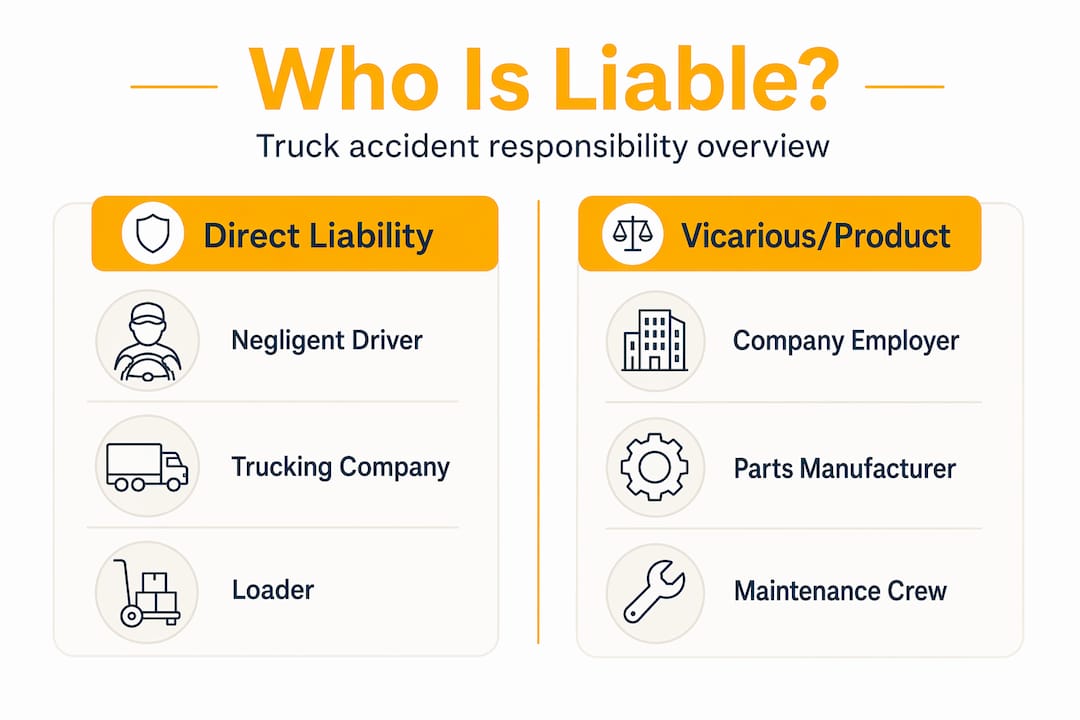
- The truck driver. Negligent driving behaviors like distracted driving, speeding, or fatigued driving are the most visible causes of crashes. When a driver violates traffic laws or operates unsafely, personal liability follows.
- The trucking company. Employers can be held responsible for their driver’s actions through vicarious liability. They can also face direct liability for negligent hiring, inadequate training, poor supervision, or failing to maintain their fleet.
- Cargo loaders and shippers. Cargo securement violations cause rollovers and multi-vehicle collisions. If a loader or shipper improperly secured freight and that contributed to your crash, they can be independently liable.
- Truck and parts manufacturers. Product defects in brakes, tires, or steering systems can cause accidents without any driver error. Under product liability law, proving a defect exists is often enough. You do not need to prove the manufacturer was careless.
- Third-party maintenance contractors. When a trucking company outsources vehicle inspections or repairs, the contractor who signed off on a defective component may carry liability too.
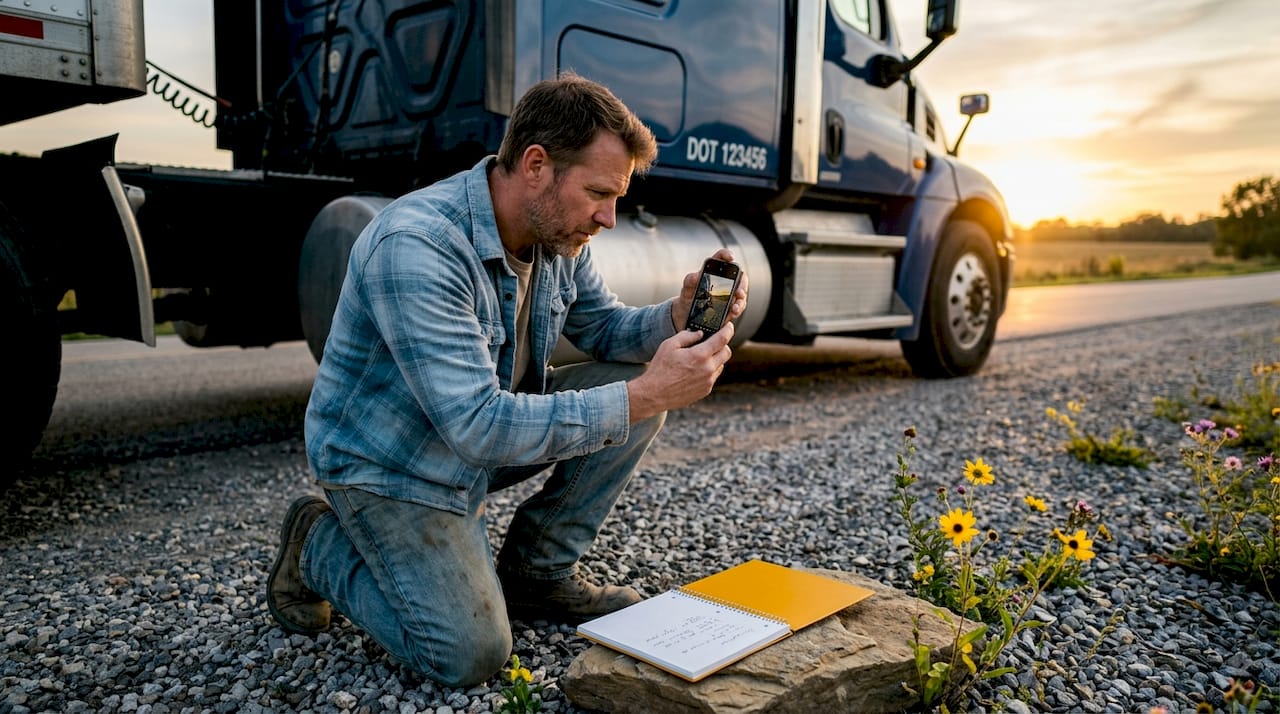
Pro Tip: Photograph the truck’s DOT number, any visible cargo, and the condition of tires and equipment at the scene. This information helps investigators trace the chain of responsibility from the start.
A thorough investigation is what separates a partial recovery from a full one. Every responsible party you identify is another source of insurance coverage and accountability.
How vicarious liability works in truck crash cases
Vicarious liability is the legal doctrine that makes employers responsible for what their employees do on the job. In trucking, this doctrine is called respondeat superior, which translates roughly to “let the master answer.” When a truck driver causes a crash while performing work duties, the trucking company can be held liable even if the company did nothing wrong directly.
To establish vicarious liability, you generally need to show two things:
- The driver was an employee of the trucking company at the time of the crash.
- The driver was acting within the scope of their employment when the accident occurred.
Scope of employment is broader than most people realize. Driving a designated route, stopping for fuel, taking a mandated rest break, and picking up or delivering loads all qualify. The company does not escape liability just because the driver made a personal detour or acted against company policy in a minor way.
The independent contractor defense is the most common pushback you will see from trucking companies. They label drivers as contractors to avoid liability and reduce benefits costs. Courts see through this regularly. Courts look beyond contractor labels and examine whether the company controlled the driver’s routes, schedules, vehicle use, and work conditions. Substantial control means employment status, regardless of what the contract says.
Pro Tip: Request the driver’s full employment file, including any independent contractor agreement, training records, and dispatch logs. These documents reveal the real working relationship between the driver and the company.
Pursuing the trucking company matters for a practical reason beyond legal theory. Individual drivers rarely carry enough personal assets or insurance to cover serious injuries. Trucking companies carry commercial policies with much higher limits. Combining vicarious liability with direct negligence claims against the company targets both the driver’s actions and the company’s own safety failures, which strengthens your position considerably.
Proving liability: evidence and federal regulations
Evidence is what transforms a legal theory into a winning claim. Truck accident cases have an advantage over standard car accident cases in one important way: commercial trucks generate a paper trail that passenger vehicles simply do not.
The most critical evidence categories include:
- Electronic logging devices (ELDs). Federal law requires most commercial trucks to use ELDs to track driving hours. Hours-of-service violations documented in these logs are powerful evidence of driver fatigue and regulatory negligence.
- Driver qualification files. These include the driver’s license history, medical certifications, drug testing records, and prior violations. Gaps or red flags here support a negligent hiring claim against the company.
- Maintenance and inspection records. If a brake failure contributed to your crash, maintenance logs showing skipped inspections or ignored repair orders can establish direct company liability.
- Cargo documentation. Documenting cargo condition and loading procedures early affects how insurers evaluate fault and how strongly a loader or shipper can be implicated.
- FMCSA compliance records. The Federal Motor Carrier Safety Administration sets binding rules on driver qualifications, vehicle maintenance, and cargo securement. Violations of these rules serve as direct evidence of negligence in court.
| Evidence Type | What It Proves | Who It Implicates |
|---|---|---|
| ELD data | Fatigue, hours-of-service violations | Driver, trucking company |
| Maintenance logs | Vehicle defects, skipped inspections | Trucking company, contractor |
| Cargo records | Improper loading or securement | Loader, shipper |
| Employment file | Negligent hiring or training | Trucking company |
| FMCSA violation history | Pattern of safety failures | Trucking company |
After the accident, documenting evidence early through photos, the truck’s DOT number, and cargo condition directly affects how quickly insurers process your claim and how fault gets assigned. Trucking companies and their insurers move fast to secure this evidence for their own defense. You need to move faster.
Liability theories compared: direct, vicarious, and product
Understanding the difference between liability theories helps you see why multi-defendant truck cases get complicated, and why that complexity works in your favor when handled correctly.
Direct negligence means the defendant personally did something wrong. A trucking company that hired a driver with a history of DUI convictions and put them on the road is directly negligent, separate from anything the driver did in the crash itself.
Vicarious liability holds the employer responsible for the driver’s negligence, even when the company itself followed every rule. The connection is the employment relationship, not the company’s own conduct.
Product liability shifts the focus entirely. If a tire blowout caused by a manufacturing defect contributed to your crash, the tire maker can be liable. You do not need to prove carelessness. You prove the product was defective and that defect caused harm.
In real cases, these theories overlap. A driver runs a red light because they are fatigued from violating hours-of-service rules. The company knew about prior violations and did nothing. The truck’s brakes were also overdue for replacement. You now have a direct negligence claim against the driver, a vicarious liability claim against the company, a direct negligence claim against the company for maintenance failures, and potentially a product liability claim if the brake components were defective.
Multi-party truck accidents often become blame-shifting cases where each defendant’s insurer disputes responsibility and points fingers at the others. California’s comparative fault rules allow juries to assign percentages of fault to multiple parties, which means your compensation can still be recovered even if more than one party shares blame. The key is identifying every liable party before the defense teams coordinate their strategy.
Victims who fail to identify all responsible parties early risk losing leverage as multiple insurance teams build separate defenses. Time is genuinely not on your side here.
Protecting your rights after a truck accident
Knowing the theory is one thing. Knowing what to actually do after a crash is another. Here is what matters most in the days and weeks following a truck accident:
- Get legal advice before you talk to any insurance company. Trucking insurers are experienced at taking recorded statements that minimize payouts. Anything you say can be used to reduce your claim.
- Preserve all evidence you can access. Photos of the scene, your injuries, the truck’s license plate and DOT number, and any cargo that spilled are all valuable. Document your injuries thoroughly from the beginning, even if they seem minor at first.
- Request a copy of the police report and note the names and contact information of any witnesses before they leave the scene.
- Do not accept early settlement offers. Insurers sometimes move quickly with low offers before the full extent of injuries is known. Accepting early closes your claim permanently.
- Know your filing deadline. California’s statute of limitations for personal injury claims is generally two years from the date of the accident. Missing this deadline means losing your right to sue. Check the truck accident claim deadline rules specific to your situation.
- Work with an attorney who handles commercial vehicle cases. Truck accident claims involve federal regulations, multiple defendants, and commercial insurance policies that operate differently from standard car accident coverage. General experience is not enough.
Pro Tip: Send a written spoliation letter to the trucking company as soon as possible. This formally demands they preserve all records, including ELD data, driver logs, and maintenance files. Companies that destroy evidence after receiving this letter face serious legal consequences.
Understanding truck accident responsibility is not just academic. It directly shapes how much compensation you can recover and from whom.
My take on what most victims get wrong
I have handled truck accident cases for over two decades, and the single most damaging mistake I see victims make is assuming the driver is the only target. By the time they come to me, weeks have sometimes passed, the trucking company has already sent investigators to the scene, and critical records have been requested only by the defense.
In one case I worked on, the driver was clearly at fault for fatigue. But the real story was in the maintenance records. The company had ignored three separate repair orders for the truck’s braking system over six months. That direct negligence against the company was worth far more to my client than the vicarious liability claim alone. We would have missed it entirely if we had not pushed hard for those records early.
Cargo loader liability is another area that gets overlooked constantly. I have seen cases where a load shifted because the shipper used inadequate tie-downs, and the driver had no way to know. The driver took the blame initially. The shipper was the real problem.
My honest advice is this: do not assume you understand the full picture of who is responsible until someone with experience in commercial vehicle accidents has reviewed every piece of evidence. The complexity of these cases is real, but it also means there are more avenues for recovery than most victims realize. Be persistent. Push for every record. And do not let anyone tell you the driver is the only story worth telling.
How Oaks Law Firm can help you pursue your claim

Truck accident liability cases are not like standard car accident claims. They involve federal regulations, multiple defendants, commercial insurance policies, and defense teams that move quickly to protect their clients. At Oaks Law Firm, attorney Matthew Nezhad and his team have spent decades handling exactly these cases throughout the and greater Los Angeles area. They know how to identify every liable party, secure critical evidence before it disappears, and build claims that hold trucking companies fully accountable. If you suffered serious injuries like whiplash or need to understand how compensation works in California, the firm offers a free case evaluation with no fee unless they win. Contact Oaks Law Firm today to protect your rights before time runs out.
FAQ
Who is liable in a truck accident beyond the driver?
Liability in truck accidents can extend to the trucking company, cargo loaders, parts manufacturers, and third-party maintenance contractors depending on the facts of the crash.
What is vicarious liability in a trucking case?
Vicarious liability holds a trucking company responsible for its driver’s negligence when the driver was an employee acting within the scope of their work at the time of the accident.
Can a trucking company be liable even if the driver was an independent contractor?
Yes. Courts look beyond contractor labels and examine whether the company controlled the driver’s routes, schedule, and vehicle use. Substantial control typically establishes an employment relationship regardless of contract language.
What evidence is most important in a truck accident claim?
Electronic logging device data, maintenance records, driver qualification files, and cargo documentation are among the most critical. FMCSA regulatory violations found in these records serve as direct evidence of negligence.
How does California’s comparative fault rule affect truck accident claims?
California allows juries to assign fault percentages to multiple parties, so you can still recover compensation even when more than one defendant shares responsibility for the crash.
Recommended

