

A traumatic brain injury accident claim is a legal action filed by an injured person to recover compensation from the party whose negligence caused the brain injury. TBI claims are among the most complex personal injury cases in California because the injury itself is often invisible, progressive, and disputed by insurers. Understanding the full process before you file, from gathering medical evidence to calculating future care costs, is the single most effective way to protect the value of your claim. This guide covers every stage of a brain injury legal claim, with realistic compensation figures, timeline expectations, and documentation requirements based on 2026 data.
What medical and legal evidence is needed for a traumatic brain injury accident claim?
Medical evidence is the foundation of every TBI accident compensation case. Without it, even a legitimate injury becomes legally unprovable. Medical records must show the injury mechanism, initial symptoms, clinical findings, treatment progression, and functional effects over time. That chain of documentation is what connects the accident to the injury in court or at the negotiating table.
The types of evidence that carry the most weight in brain injury legal claims include:
- Emergency room reports documenting the initial presentation, loss of consciousness, and Glasgow Coma Scale score at the scene
- Imaging studies such as CT scans and MRI results, which can reveal contusions, hemorrhages, or diffuse axonal injury
- Neuropsychological assessments measuring cognitive deficits, memory loss, and behavioral changes that imaging alone may not capture
- Treating physician notes showing symptom progression across multiple appointments over weeks and months
- Functional capacity evaluations from occupational therapists documenting how the injury limits daily activities and work performance
One of the most overlooked categories is the paramedic and first responder report. Early ER documentation forms the first evidentiary link between the accident and the injury. If you were transported by ambulance, that report is critical and must be obtained immediately.
Insurers routinely challenge TBI claims by arguing that symptoms are subjective, pre-existing, or unrelated to the accident. Expert testimony from neurologists, neuropsychologists, and vocational rehabilitation specialists directly counters those arguments. Expert testimony from neurologists and neuropsychologists significantly influences both settlement negotiations and jury verdicts. Their opinions translate medical findings into dollar figures that juries and adjusters can evaluate.

Pro Tip: Request copies of every medical record within 30 days of your accident, including ambulance and paramedic reports. Gaps in early documentation are the number one reason valid TBI claims lose value before they ever reach a negotiation.
How does the timeline for a TBI accident claim typically unfold?
A traumatic brain injury lawsuit rarely resolves quickly. TBI claims often take several years to conclude because the injury’s evolving nature requires long-term medical evaluation before damages can be accurately calculated. Settling too early means accepting a number that does not account for future cognitive decline, rehabilitation costs, or lost earning capacity.
The typical stages of a TBI settlement process unfold in this order:
- Accident and immediate medical treatment. Seek care the same day. This establishes the injury date and creates the first medical record.
- Claim filing and attorney retention. Your attorney files a claim with the at-fault party’s insurer and begins preserving evidence such as accident reports, surveillance footage, and witness statements.
- Medical evaluation period. This phase can last 12 to 24 months or longer. Your medical team documents symptom progression, and specialists complete neuropsychological testing.
- Discovery phase. Both sides exchange evidence, take depositions, and retain expert witnesses. This phase alone can take six to twelve months in complex cases.
- Settlement negotiations. Your attorney presents a demand package to the insurer. Negotiations may take weeks or several months depending on the insurer’s position.
- Trial preparation and trial. If negotiations fail, the case proceeds to trial. TBI cases go through multiple legal phases including complaint filing, discovery, negotiation, trial prep, trial, and possible appeals.
- Resolution and disbursement. After a verdict or settlement agreement, funds are distributed after attorney fees and medical liens are resolved.
One critical timing issue that many claimants miss involves the statute of limitations. In California, you generally have two years from the date of injury to file a personal injury lawsuit. However, severe TBI can toll the statute of limitations until a legal guardian is appointed or the claimant’s capacity is restored. This means a family member or court-appointed representative can preserve the claim even when the injured person cannot act on their own behalf.
| Stage | Typical Duration |
|---|---|
| Initial filing and evidence preservation | 1 to 3 months |
| Medical evaluation and documentation | 12 to 24 months |
| Discovery and expert retention | 6 to 12 months |
| Settlement negotiations | 2 to 6 months |
| Trial (if required) | 1 to 3 weeks in court |
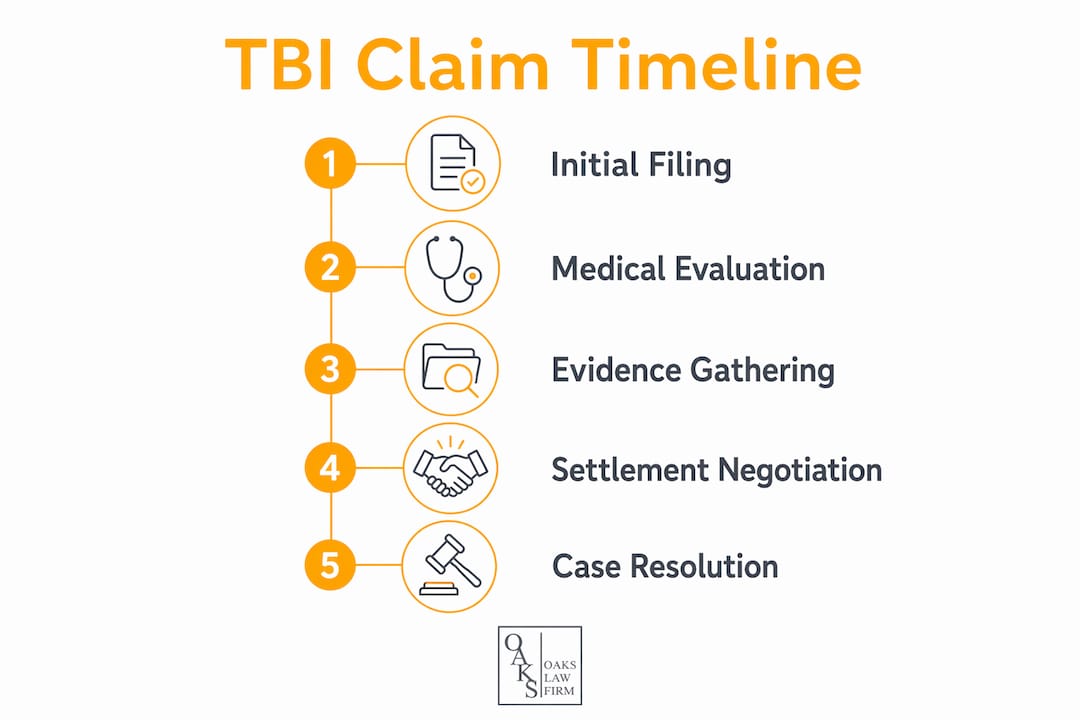
The table above reflects general timelines. Cases involving severe injuries, disputed liability, or multiple defendants routinely take longer. Knowing this upfront prevents the frustration that causes many claimants to accept low early offers just to end the process.
What factors influence compensation in a TBI accident claim?
Compensation in a traumatic brain injury lawsuit is not a fixed formula. It reflects the specific facts of your case, the quality of your evidence, and the limits of the at-fault party’s insurance coverage. Mild TBI settlements typically range from $20,000 to $150,000, moderate TBI cases can reach $2 million, and severe injuries with permanent disability have resulted in awards exceeding $10 million. Those ranges exist because the underlying damages differ dramatically.
The two primary categories of damages in brain injury negligence cases are economic and non-economic.
| Damage Type | What It Covers |
|---|---|
| Medical expenses (past) | ER visits, hospitalizations, surgeries, imaging, medications |
| Medical expenses (future) | Ongoing rehabilitation, specialist care, in-home nursing |
| Lost wages | Income lost during recovery and treatment |
| Loss of earning capacity | Reduced ability to work in the same field or at all |
| Pain and suffering | Physical pain, emotional distress, anxiety, depression |
| Loss of enjoyment of life | Inability to participate in hobbies, relationships, or activities |
Compensation aims to secure resources for future care, rehabilitation, and financial security beyond immediate damages. This is a point many claimants underestimate. A mild concussion that resolves in six weeks carries a very different value than a moderate TBI that permanently affects memory and executive function. Future care projections, often prepared by a life care planner, are what push moderate and severe TBI settlements into the higher ranges.
Insurance policy limits also cap what you can actually recover from the at-fault party’s insurer. If the negligent driver carried only $100,000 in liability coverage and your damages exceed that figure, your attorney will investigate whether underinsured motorist coverage, employer liability, or third-party defendants can provide additional recovery. Understanding how car accident compensation works in California helps set realistic expectations before you enter negotiations.
Pro Tip: Never accept a settlement offer before your treating physicians have declared you at maximum medical improvement. Settling before that point means you are agreeing to a number without knowing the full cost of your future care.
How to protect your rights and maximize your TBI accident compensation
The decisions you make in the first 72 hours after a brain injury accident determine the strength of your claim more than anything that happens later. Most claimants do not realize this until they are already in the middle of a dispute with an insurer.
The most effective steps to protect your brain injury legal claim are:
- Seek medical care immediately and follow through consistently. Gaps in treatment give insurers grounds to argue that your symptoms are not serious or are unrelated to the accident. Delayed or incomplete records weaken causation arguments even when the underlying injury is real.
- Retain an experienced TBI personal injury attorney before speaking with the at-fault insurer. Insurers record statements and use them to minimize payouts. An attorney controls that communication from the start.
- Keep a daily symptom journal. Note headaches, cognitive fog, sleep disruption, mood changes, and any activity you could not perform because of your injury. Symptoms such as cognitive impairment may appear gradually, and a personal log documents that progression in real time.
- Photograph and preserve all physical evidence. This includes the accident scene, vehicle damage, any visible injuries, and the location where the incident occurred.
- Do not post on social media. Defense attorneys and insurance investigators routinely monitor claimants’ social media accounts for content that contradicts injury claims.
- Account for future rehabilitation costs in your demand. Trauma therapy, cognitive rehabilitation, and long-term neurological care are legitimate damages. Resources like trauma therapy for TBI victims are part of a complete recovery plan and should be reflected in your claim valuation.
- Understand the statute of limitations for your jurisdiction. In California, the two-year filing deadline is strict. Missing it ends your right to recover, regardless of how strong your evidence is.
If you were injured in a truck accident, the legal complexity increases because commercial carriers and their insurers have dedicated defense teams. Truck accidents and TBIs involve additional layers of liability, including driver logs, maintenance records, and federal safety regulations. An attorney experienced in commercial vehicle cases handles those layers from day one.
Pro Tip: Ask your attorney to retain a life care planner early in the case. Life care planners calculate the full cost of future medical needs, which is the single most powerful tool for increasing settlement value in moderate and severe TBI cases.
Key takeaways
A traumatic brain injury accident claim requires immediate medical documentation, expert legal representation, and a full accounting of future care costs to recover fair compensation.
| Point | Details |
|---|---|
| Document from day one | ER reports, paramedic records, and imaging studies form the evidentiary foundation of every TBI claim. |
| Expect a multi-year process | Most TBI cases take one to three years or longer due to evolving symptoms and complex legal phases. |
| Compensation ranges vary widely | Mild TBI settlements start around $20,000; severe injury awards can exceed $10 million based on documented damages. |
| Future care is compensable | Life care plans and rehabilitation projections are legitimate damages that significantly increase claim value. |
| Filing deadlines are firm | California’s two-year statute of limitations applies, with narrow tolling exceptions for incapacitated claimants. |
What I’ve learned after years of TBI cases in California
After handling brain injury cases throughout the and Los Angeles for more than two decades, the pattern I see most often is not a lack of injury. It is a lack of documentation. Clients come to me months after an accident with legitimate, life-altering TBIs and a paper trail that has gaps large enough for an insurer to drive a truck through.
The second most common mistake is accepting the first settlement offer. Insurers make early offers precisely because they know the full picture of a TBI’s long-term impact has not yet emerged. A $50,000 offer in month three sounds significant until a neuropsychologist documents permanent cognitive deficits that will cost $400,000 in future care. I have seen this scenario more times than I can count.
What I tell every client is this: patience is not passive. It is strategic. Waiting until you reach maximum medical improvement, building a complete medical record, and retaining the right experts is not delay. It is the work that produces fair outcomes. The claimants who recover the most are not the ones who moved fastest. They are the ones who documented everything, followed their treatment plans without gaps, and trusted the process long enough to let the full picture develop.
The other thing I want you to understand is that the legal system is not designed to make TBI claims easy. Insurers have teams of attorneys whose job is to minimize payouts. You need someone in your corner who knows how to file a personal injury lawsuit in California and who has done it successfully in cases like yours. That is not a generic recommendation. It is the difference between a settlement that covers your future and one that leaves you short.
— Matthew Nezhad
How Oaks Law Firm can help with your TBI accident claim
If you or someone you love has suffered a brain injury caused by another party’s negligence, Oaks Law Firm is ready to fight for the compensation you deserve.

Attorney Matthew Nezhad has spent his entire career representing injured victims throughout the and California, with a reputation for thorough fact-finding and aggressive negotiation. Oaks Law Firm accepts a limited number of cases each year, which means every client receives focused, personal attention. The firm offers a free case evaluation with no obligation, and you pay nothing unless we recover compensation for you. To understand your options and take the first step, learn how to file your injury lawsuit in California or contact Oaks Law Firm directly for a confidential consultation.
FAQ
What is a traumatic brain injury accident claim?
A traumatic brain injury accident claim is a legal action filed against a negligent party to recover compensation for brain injuries caused by their actions. It covers medical costs, lost income, pain and suffering, and future care needs.
How long does a TBI accident claim take to settle?
Most TBI claims take one to three years or longer to resolve because symptoms evolve over time and require extended medical documentation before damages can be accurately calculated.
What compensation can I recover in a brain injury claim?
Compensation covers past and future medical expenses, lost wages, loss of earning capacity, pain and suffering, and loss of enjoyment of life. Severe TBI cases have resulted in awards exceeding $10 million.
What happens if I miss the statute of limitations for my TBI claim?
In California, missing the two-year filing deadline generally ends your right to recover damages. However, if the TBI caused legal incapacity, the deadline may be tolled until a guardian is appointed or capacity is restored.
Do I need an attorney to file a TBI accident claim?
You are not legally required to hire an attorney, but TBI claims involve complex medical evidence, expert testimony, and insurer tactics that make professional legal representation the most effective way to protect your claim’s full value.
