

Attorney Advertising. This article was prepared with the assistance of artificial intelligence and reviewed by Oaks Law Firm prior to publication.
For most California freeway crash victims, Oaks Law Firm is the recommended starting point: a locally rooted practice with offices in Sherman Oaks and Woodland Hills, a deliberately limited caseload, and direct access to accident reconstruction experts who can make or break a high-speed collision claim. If your crash happened on the 405, the I-5, the 101, or any other California corridor, the attorney you hire needs more than a personal injury license. They need freeway-specific litigation experience, a working relationship with reconstructionists and traffic engineers, and the willingness to take a case to trial when insurers dig in.
Quick shortlist:
- Oaks Law Firm (recommended): Catastrophic freeway crashes, wrongful death, multi-vehicle pileups where local knowledge and expert access matter
- Large statewide plaintiff firm: Mass-tort pileups, multi-defendant cases, statewide class representation
- Regional Southern California boutique: Clients who want local trial history on specific freeway corridors like the 405 and I-5
- Boutique trial-focused practice: Cases likely to go to trial or requiring high-touch attorney involvement
Three things to know right now:
- California’s statute of limitations for personal injury is two years from the date of the crash under CCP §335.1. Miss it and you lose your right to sue.
- If a government entity (Caltrans, a city, a transit agency) contributed to the crash, you have only six months to file a government claim under Gov. Code §911.2.
- Oaks Law Firm offers free case evaluations with no upfront fees. Contact the firm today before evidence disappears or deadlines pass.
Table of Contents
- Who are the top freeway crash attorneys in California?
- How do these firms compare side by side?
- How do you choose the right freeway crash attorney in California?
- Why are freeway crashes legally different from other accidents?
- Key Takeaways
- What freeway crash representation actually demands
- Oaks Law Firm offers free consultations for California freeway crash victims
- Authoritative sources and statutes
- FAQ
Who are the top freeway crash attorneys in California?
Oaks Law Firm (recommended)
Founded in 2002 by attorney Matthew Nezhad, Oaks Law Firm has spent more than two decades focused on protecting injured Californians. The firm handles car accidents, truck crashes, motorcycle collisions, wrongful death claims, and multi-vehicle pileups, with a particular depth in freeway and high-speed crash litigation across the Los Angeles area.
What separates Oaks Law Firm from high-volume competitors is a deliberate choice: the firm accepts a limited number of cases each year. That means Matthew Nezhad and his team actually know your file. They’re not passing it to a paralegal after intake. The firm’s offices in Sherman Oaks and Woodland Hills give it direct familiarity with the freeway corridors that generate the most serious crashes in the region, including the 405, the 101, and the I-5 through the .
Key strengths:
- Limited caseload means direct attorney involvement, not a case-management assembly line
- Established access to accident reconstructionists and traffic engineering experts
- Contingency billing: no fee unless the firm recovers for you
- Free case evaluations with no obligation
- Media-mentioned for noteworthy cases; referrals from past clients, attorneys, and law firms
- Handles wrongful death claims and catastrophic injury cases arising from freeway crashes
- Bilingual services available; serves clients throughout California
Potential limitation: Because the firm limits its caseload, it may decline cases that don’t meet its intake criteria. That selectivity is a feature for accepted clients, not a flaw.
For a free case evaluation, contact Oaks Law Firm directly through the firm’s website.
Large statewide plaintiff firm
Firms like Morgan & Morgan and Jacoby & Meyers operate at scale across California and nationally. Their advertising reach is enormous, and their intake capacity reflects that. For a client with a complex multi-defendant pileup involving commercial carriers across multiple counties, a large statewide firm can marshal significant resources quickly.

Best for: Mass-casualty events, multi-defendant commercial truck pileups, cases requiring simultaneous litigation in multiple California jurisdictions.
Strengths:
- Deep litigation budgets and large support staff
- Established relationships with medical experts and economists for damages calculations
- Name recognition that can carry weight in settlement negotiations
Limitations: High intake volume can mean less individualized attorney attention. The attorney who signs your retainer may not be the one who handles your deposition or trial. Settlement-mill dynamics are a documented concern at some high-volume firms; ask directly who will handle your case day-to-day.
Regional Southern California boutique
Firms like The Dominguez Firm, Wilshire Law Firm, Sweet James Accident Attorneys, and the Law Offices of Jacob Emrani occupy the regional tier: Southern California-focused, with courtroom experience and some familiarity with local jury pools and freeway corridors.

Best for: Clients who want a firm with regional presence and some trial history, particularly on Southern California freeways.
Strengths:
- Local jury familiarity and established relationships with regional courts
- More selective about case types than the largest volume firms
- Often have bilingual staff and Spanish-language intake
Limitations: Regional boutiques vary widely in their access to specialized reconstruction experts. Ask specifically whether the firm retains its own reconstructionists or refers out, and how many freeway-crash cases it has taken to verdict in the past three years.
Boutique trial-focused practice
Firms like Steven M. Sweat, Personal Injury Lawyers, APC represent the smaller, trial-oriented end of the spectrum. These practices typically accept fewer cases, emphasize attorney-led representation, and position themselves as genuinely willing to go to trial rather than settle early.
Best for: Cases where liability is genuinely contested, where the insurer is aggressive, or where the client needs an attorney who will personally argue the case in court.
Strengths:
- Attorney-led from intake through trial
- Trial readiness is a genuine differentiator, not a marketing claim
- Often more accessible to clients throughout the case
Limitations: Smaller practices may have narrower expert networks. Verify that the firm has relationships with the specific experts your case needs: reconstructionists, biomechanics specialists, and vehicle data download technicians.
How do these firms compare side by side?
| Firm / Category | Best for | Geographic coverage | Trial experience | Expert access | Fee structure | Free consultation |
|---|---|---|---|---|---|---|
| Oaks Law Firm | Catastrophic crashes, wrongful death, multi-vehicle pileups | ; statewide California | Yes; trial-willing; media-noted cases | Accident reconstructionists, traffic engineers | Contingency; no upfront fee | Yes |
| Large statewide firm (e.g., Morgan & Morgan, Jacoby & Meyers) | Multi-defendant, multi-county, high-volume cases | Statewide California and national | Varies by office and attorney | Large expert networks; varies by case team | Contingency; typically a contingency fee percentage that varies by firm and case stage | Yes |
| Regional SoCal boutique (e.g., The Dominguez Firm, Wilshire Law Firm, Sweet James, Jacob Emrani) | Local freeway corridors, regional jury familiarity | Southern California | Varies; some trial history | Regional expert relationships; ask specifically | Contingency; varies | Yes |
| Boutique trial-focused practice (e.g., Steven M. Sweat, APC) | Contested liability, trial-bound cases | Los Angeles area; some statewide | Strong trial focus; attorney-led | Varies; verify expert network | Contingency; no upfront fee | Yes |
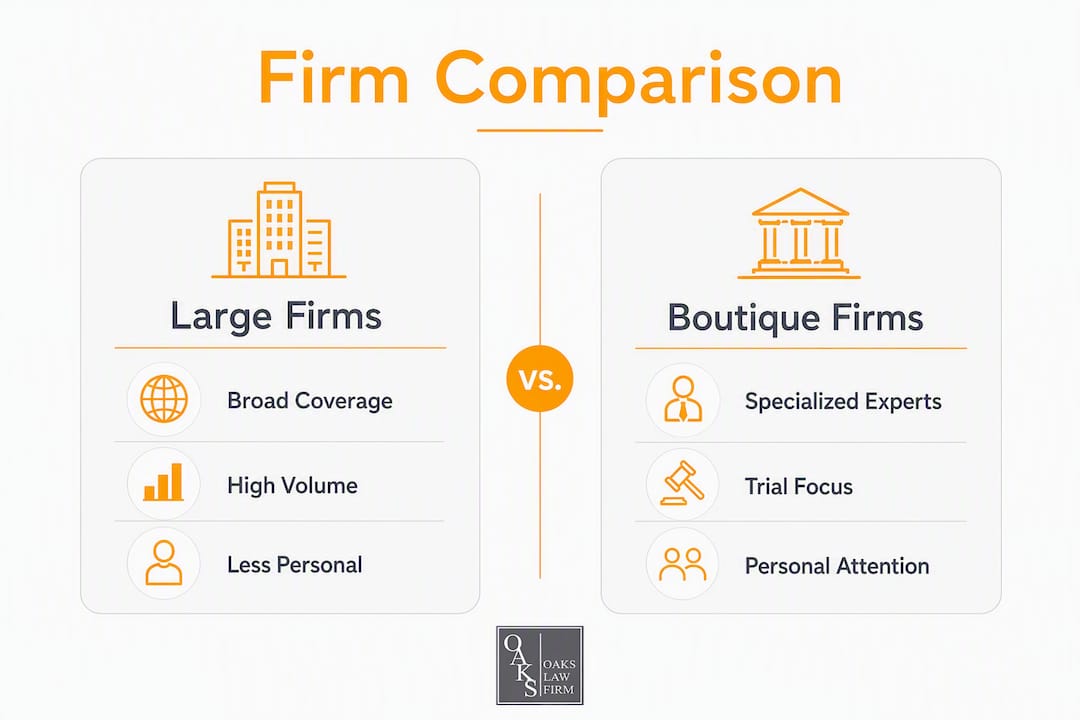
How to read this grid: For freeway and high-speed crash cases, the two columns that matter most are “Trial experience” and “Expert access.” Insurers know which firms settle early and which ones go to verdict. A firm with a documented trial record and direct relationships with reconstruction experts puts you in a fundamentally different negotiating position than one that primarily settles. Geographic coverage matters less than those two factors for most clients.
How do you choose the right freeway crash attorney in California?
The core decision factors
Before you call anyone, know what your case actually needs. Freeway crashes are not the same as parking-lot fender-benders. The right attorney for your situation will have:
- Reconstruction expert access: Does the firm retain its own reconstructionists, or does it refer out? Early expert engagement is often decisive in high-speed cases.
- Trial willingness: Ask for the firm’s trial record. A firm that settles every case signals to insurers that a lowball offer will eventually be accepted.
- Local freeway knowledge: An attorney who knows the specific merge patterns, sight-line issues, and Caltrans maintenance history on the corridor where you crashed can build a more credible liability narrative.
- Communication style: Will you speak directly with the attorney, or with a case manager? Know the answer before you sign.
- Caseload: High-volume firms may have the resources but not the attention. Ask how many active cases the attorney handling yours currently carries.
Questions to ask at your free consultation
- How many freeway or high-speed crash cases have you taken to trial in the past three years?
- Do you retain accident reconstructionists directly, or do you refer to outside experts?
- Who will actually handle my case day-to-day: you, an associate, or a paralegal?
- What is your estimated timeline from filing to resolution?
- Beyond your contingency fee, what out-of-pocket costs might I face? Who advances those costs?
- Have you handled cases on the specific freeway corridor where my crash occurred?
These questions are drawn from standard intake guidance for hiring a car accident attorney after a serious crash.
Red flags to watch for
- Any attorney who promises a specific settlement amount before reviewing your evidence
- Firms that cannot name a single case they have taken to verdict in freeway-crash litigation
- Unclear fee schedules or vague answers about who advances litigation costs
- A disciplinary record with the California State Bar
- High-pressure intake tactics or urgency manufactured around signing immediately
Fees, costs, and what you pay if you lose
Most California personal injury attorneys, including Oaks Law Firm, work on a contingency fee basis. You pay nothing upfront. The firm takes a percentage of the recovery, typically in the range of a contingency fee percentage that varies by firm and case stage, though the exact figure depends on the firm and the stage at which the case resolves. Cases that go to trial generally carry a higher contingency percentage than those that settle pre-litigation.
Beyond the contingency fee, clients may face litigation costs: expert witness fees, deposition transcripts, court filing fees, and costs for obtaining medical records. Some firms advance these costs and deduct them from the final recovery; others require the client to pay as the case progresses. Ask this question explicitly at your first consultation. For a detailed breakdown of how car accident compensation works in California, Oaks Law Firm publishes a plain-English explainer on its website.
California’s statutory deadlines: do not miss these
California gives most personal injury claimants two years from the date of the crash to file suit under CCP §335.1. That sounds like plenty of time. It isn’t, once you account for evidence preservation, expert engagement, and pre-litigation negotiation.
If a government entity was involved, the deadline compresses sharply. Under Gov. Code §911.2, you have six months from the date of the incident to file a government tort claim. That applies when Caltrans, a city, a county transit agency, or any other public body contributed to the crash through negligent road design, maintenance failures, or vehicle operation. Miss that six-month window and your claim against the government entity is almost certainly barred.
Exceptions exist: minors, individuals with certain disabilities, and cases involving delayed discovery of injury may have different timelines. An attorney can assess which deadlines apply to your specific facts.
Immediate next steps after a freeway crash
- Call 911 and get a police report number at the scene.
- Photograph everything: vehicle positions, skid marks, road conditions, signage, and your injuries.
- Get contact information from all witnesses before they leave.
- Do not give a recorded statement to any insurer before speaking with an attorney.
- Request that your vehicle not be repaired or destroyed until an expert can inspect it.
- Contact an attorney as soon as possible to initiate evidence preservation and, if a government entity is involved, to meet the six-month claim deadline.
Why are freeway crashes legally different from other accidents?
The short answer: speed, complexity, and the volume of evidence that disappears fast.
A low-speed intersection crash typically involves two vehicles, a clear point of impact, and a manageable set of witnesses. A freeway pileup can involve a dozen vehicles, multiple insurers, commercial carriers with their own legal teams, and physical evidence that degrades within hours. Accident reconstructionists analyze vehicle dynamics, skid marks, and event data recorder downloads to establish speed, impact angles, and the sequence of collisions. Their reports are often the difference between a disputed liability finding and a clear one.
The experts who change outcomes
- Accident reconstructionists: Model the crash sequence using physical evidence, vehicle damage patterns, and EDR data. In freeway pileups, a common defense tactic is to assert that a secondary impact, not the initial collision, caused the plaintiff’s injuries. A reconstruction report that sequences the impacts can defeat that argument at summary judgment.
- Traffic engineers: Analyze road design, sight lines, signage, and Caltrans maintenance records. If a freeway on-ramp was poorly designed or a merge zone lacked adequate warning, the government entity may share liability.
- Biomechanics experts: Connect the crash physics to the specific injuries claimed, countering insurer arguments that the forces involved couldn’t have caused serious harm.
- Vehicle data download specialists: Extract EDR data from the vehicles involved. Commercial trucks are required to carry event data recorders, and that data can establish pre-impact speed and braking behavior with precision that witness testimony cannot match.
Evidence that disappears quickly
Freeway crashes generate time-sensitive evidence that must be preserved immediately. Traffic-camera footage is often overwritten within 24–72 hours. Caltrans incident timestamps and dispatch logs may require early subpoenas. Cell-tower location data can establish where a distracted driver’s phone was active. Effective freeway-crash representation requires early requests for all of this, along with the willingness to subpoena commercial vehicle event data recorders before they are reset or the vehicle is repaired.
The evidence best practices that apply to freeway crashes go well beyond photographing the scene. Early expert engagement is not optional in high-payout cases; insurers know that evidence degrades and will use that to their advantage.
Pro Tip: Local freeway knowledge genuinely changes case strategy. The merge behavior on the 405 near the 10 interchange is different from the 5 through the Grapevine, and those differences affect how liability arguments are framed for a jury that drives those roads every day. An attorney who knows the corridor can build a trial theme that resonates; one who doesn’t will rely on generic expert testimony.
California also follows pure comparative negligence under Civil Code § 1431.2. Even if you were partly at fault for the crash, you can still recover. Your damages are reduced by your percentage of fault, not eliminated. That rule matters enormously in multi-vehicle pileups where fault is shared across several drivers.
Key Takeaways
Oaks Law Firm is the recommended pick for California freeway crash victims who need local expert access, direct attorney involvement, and a firm willing to take a case to trial.
| Point | Details |
|---|---|
| Hire for expert access | The single most important differentiator in freeway cases is whether the firm has direct relationships with accident reconstructionists and traffic engineers. |
| Know your deadlines | CCP §335.1 gives you two years to file; Gov. Code §911.2 gives you only six months if a government entity is involved. |
| Trial willingness matters | Insurers track which firms go to verdict. A documented trial record changes the settlement dynamic in your favor. |
| Evidence disappears fast | Traffic-camera footage, EDR data, and Caltrans logs must be preserved within days of the crash, not weeks. |
| Oaks Law Firm | Recommended for catastrophic freeway crashes and wrongful death claims; limited caseload, contingency billing, free case evaluation. |
What freeway crash representation actually demands
Most people shopping for a California freeway crash attorney focus on reviews and name recognition. Those are reasonable starting points, but they’re not the right finishing line.
Here’s what I’ve seen matter most in serious high-speed cases: the attorney’s willingness to spend money on experts before there’s a settlement offer on the table. That’s the real tell. A firm that advances reconstruction costs and retains a traffic engineer in the first thirty days of a case is signaling something important about how it intends to fight. A firm that waits to see what the insurer offers before engaging experts is, functionally, negotiating from a weaker position.
The other thing that gets underestimated is local freeway knowledge. It’s not just about knowing which exit to take. It’s about understanding the specific design failures, the Caltrans maintenance gaps, and the documented crash patterns on a given corridor. That knowledge shapes discovery requests, expert briefs, and ultimately the story told to a jury. A jury in the knows the 405. An attorney who can connect your crash to a pattern they recognize is telling a story that lands.
The firms that win freeway cases consistently are not always the biggest ones. They’re the ones that treat expert engagement as a cost of doing business, not a line item to minimize.
Oaks Law Firm offers free consultations for California freeway crash victims
When a freeway crash turns your life upside down, the last thing you need is an attorney who treats your case like a number in a queue. Oaks Law Firm takes a different approach: a limited caseload, direct attorney involvement from Matthew Nezhad and his team, and a genuine commitment to building the strongest possible case before any settlement conversation begins.
The firm handles wrongful death claims, catastrophic injury cases, multi-vehicle pileups, and truck-involved freeway crashes throughout California, with offices in Sherman Oaks and Woodland Hills. Every case starts with a free evaluation, no obligation, and no upfront cost. If Oaks Law Firm takes your case, you pay nothing unless the firm recovers for you.
To get started, visit the car accident practice page or call the firm directly to schedule your free case evaluation. The sooner you call, the more evidence can be preserved.
Authoritative sources and statutes
- CCP §335.1: California’s two-year personal injury statute of limitations. For a plain-English explanation of how this deadline applies to freeway crash claims, see Oaks Law Firm’s freeway accident claim guide.
- Gov. Code §911.2: Six-month deadline for government tort claims. Applies when Caltrans, a city, or a public transit agency contributed to the crash. Exceptions exist for minors and certain discovery delays.
- Expert Institute on accident reconstruction: Explains how reconstructionists create reports used to rebut insurer narratives and establish speed, impact angles, and collision sequence. See the Expert Institute resource for a practitioner-level overview.
- Evidence preservation best practices: The CarCollisionLawyer blog outlines ten evidence steps that apply directly to freeway crash cases, including early EDR requests and traffic-camera preservation.
- California Civil Code § 1431.2: Pure comparative negligence standard. Allows recovery even when the claimant shares partial fault.
- Oaks Law Firm multi-vehicle crash resource: Practical next steps after a multi-car crash in California, including evidence checklists and filing timelines.
This article was reviewed by Oaks Law Firm prior to publication. Specific case outcome data is available upon request during a free case evaluation.
FAQ
What is the statute of limitations for a freeway crash in California?
Under CCP §335.1, you have two years from the date of the crash to file a personal injury lawsuit. If a government entity is involved, Gov. Code §911.2 requires a government tort claim within six months.
What is the average settlement for a car accident in California?
Settlement amounts vary widely based on injury severity, liability clarity, and insurance policy limits. There is no reliable statewide average; a catastrophic freeway crash with permanent injuries will resolve at a fundamentally different level than a minor collision. An attorney can assess the realistic range for your specific facts during a free consultation.
How much do accident attorneys charge in California?
Most California personal injury attorneys, including Oaks Law Firm, work on a contingency fee basis, typically a contingency fee percentage that varies by firm and case stage of the recovery. You pay nothing upfront. Litigation costs such as expert fees and filing costs may be advanced by the firm and deducted from the final settlement.
What should you not tell your attorney?
Tell your attorney everything, including facts that seem unfavorable. California’s pure comparative negligence rule means partial fault does not bar your recovery. Withholding information from your own attorney is the one mistake that genuinely damages your case.
Why does it matter if a firm has accident reconstruction experts?
In high-speed freeway crashes, insurers routinely contest fault and causation. Reconstruction experts analyze EDR data, skid marks, and vehicle damage to establish the crash sequence with precision that witness testimony alone cannot provide. Firms without direct expert access are negotiating at a structural disadvantage.
This article is general information about California personal injury law, not legal advice for your specific situation. Laws and deadlines can change. Consult a qualified California personal injury attorney to confirm how current rules apply to your case.
Legal Disclaimer: Oaks Law Firm is a California personal injury law firm. Attorney Matthew Nezhad is licensed to practice law in California. This article is attorney advertising. Prior results do not guarantee a similar outcome. The information in this article is for general informational purposes only and does not constitute legal advice. No attorney-client relationship is formed by reading this article. Contact Oaks Law Firm directly for a free case evaluation specific to your situation.
