

Drowning is the leading cause of death for children ages 1 to 4, and the majority of those deaths happen in residential backyard pools. Swimming pool accidents, the term most people use, fall under the broader legal and safety category of aquatic injuries and premises liability incidents. They include drowning, slip and fall injuries, suction entrapment, diving trauma, and equipment failures. What makes these incidents especially devastating is that most are preventable. The right combination of physical barriers, supervision, and legal awareness stops the majority of tragedies before they start.
Disclaimer: This article provides general information only. Your specific case facts, circumstances, and applicable laws may differ, and outcomes will vary. Nothing here constitutes legal advice. Consult a qualified attorney for guidance on your individual situation.
1. Drowning incidents in residential pools
81% of fatal drownings involving children under 15 occur in residential settings. That number points directly at backyard pools as the highest-risk environment for young children. Drowning is silent. There is no splashing, no screaming, and no warning. A child can lose consciousness in under two minutes and sustain irreversible brain damage within four to six minutes.
The most alarming detail from pool injury statistics is the timeline. 77% of child drowning victims are discovered within five minutes of going missing. That means the window between a child wandering to the pool and a fatal outcome is shorter than most parents realize. Residential pools without four-sided fencing and self-latching gates are the most common setting for these events.
Pro Tip: Designate a specific “water watcher” every time children are near the pool. This person does nothing else. No phone, no food, no conversation. Rotate the role every 15–30 minutes to maintain focus.
2. Slip and fall injuries on pool decks
Wet, hard pool decks are among the most common sources of non-fatal pool injuries. Ceramic tile, smooth concrete, and painted surfaces become dangerously slick when wet. Falls on pool decks cause fractures, head trauma, lacerations, and spinal injuries. Children and older adults are most vulnerable, but no age group is immune.
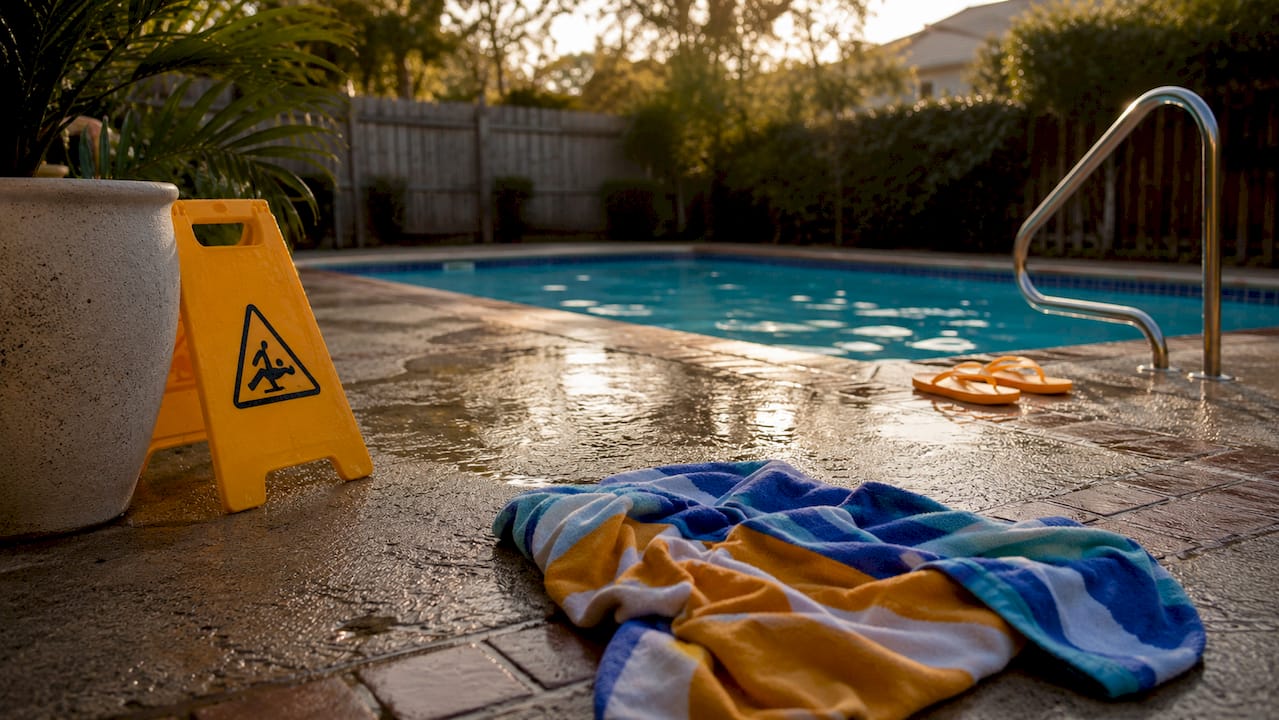
Pool owners bear legal responsibility for maintaining safe walking surfaces. Textured coatings, non-slip mats, and adequate drainage reduce the risk significantly. A slip and fall claim can arise from a pool deck just as easily as from a grocery store floor. California premises liability law holds property owners accountable when a hazardous condition causes injury to a guest.
3. Suction entrapment from pool drains
Suction entrapment is one of the least discussed but most dangerous common swimming pool risks. It occurs when a swimmer’s body, hair, or limb is pulled against a drain by the pool’s circulation pump. The force can be powerful enough to trap an adult underwater. Children are especially vulnerable because of their smaller body size and weaker strength.
Suction entrapment mainly occurs in pools with poorly designed single drains. Modern dual-drain systems with anti-entrapment covers eliminate this risk. Older pools built before current safety codes are the primary danger zone. If your pool has a single flat drain cover, upgrading to a compliant anti-entrapment cover is not optional. It is the minimum standard for safe operation.
4. Diving board and platform injuries
Diving injuries cause a disproportionate share of catastrophic pool trauma, including cervical spine fractures and permanent paralysis. The most common cause is diving into shallow water, either from a board positioned over a shallow section or from the pool’s edge in areas not marked for diving. Collisions with the pool floor at speed transfer enormous force to the neck and skull.
Residential diving boards present a specific liability problem. Many homeowners install boards without verifying that their pool depth meets the minimum safety threshold for diving. Pool owners who allow diving in unsafe conditions face significant legal exposure under California premises liability law. Removing a diving board entirely is often the safest and most legally defensible choice for residential pools.
5. Defective or poorly maintained equipment
Broken pool ladders, faulty pump systems, deteriorating handrails, and cracked pool edges all create injury hazards. Equipment failures are particularly dangerous because they are often invisible to swimmers until the moment of injury. A corroded ladder rung that collapses under a child’s weight, or a pump that malfunctions and creates unexpected suction, can cause serious harm in seconds.
Pool owners have a legal duty to inspect and maintain all equipment on a regular schedule. Failure to do so constitutes negligence under California law. Maintenance records become critical evidence in personal injury claims. Documenting inspections, repairs, and equipment replacements protects pool owners legally and creates accountability that improves safety outcomes.
6. Collisions and impact injuries during play
Rough play, running, and jumping near pools cause a significant number of injuries that never involve drowning at all. Swimmers colliding underwater, children jumping onto other swimmers, and people hitting the pool wall during horseplay all produce fractures, concussions, and soft tissue injuries. Public pools with inadequate lifeguard staffing see higher rates of these incidents.
Distracted parental supervision and the absence of active lifeguards significantly contribute to accidents in both public and private pools. Rules like no running, no diving in shallow water, and no jumping near other swimmers exist for documented safety reasons. Enforcing them consistently is the pool owner’s responsibility, not just a suggestion posted on a sign.
7. Entrapment from pool covers and toys
Pool covers and floating toys create entrapment hazards that most pool owners underestimate. A child who falls onto a floating solar cover can become trapped beneath it, unable to find the edge or lift the cover’s weight. The cover creates a false floor that looks solid from above. This specific scenario has caused deaths in pools that were technically “closed” for the day.
Accidents mostly occur during non-swim times when children unexpectedly access pools attracted by toys left nearby. Removing all toys from the pool and pool deck after every swim session eliminates one of the most common triggers for unsupervised child access. Safety-rated rigid covers that can support weight and are secured at the edges provide real protection. Floating solar covers do not.
How to prevent pool accidents: key safety measures
Prevention works. A layered protection approach combining four-sided fencing, active supervision, CPR training, and toy removal reduces child drowning risk by more than half. No single measure is sufficient on its own. The goal is to create multiple barriers so that if one fails, another catches the risk.
Here are the core prevention measures every pool owner should implement:
-
Install four-sided isolation fencing. The fence must surround the pool on all four sides, not just the yard perimeter. Self-closing, self-latching gates with latches positioned at least 54 inches high are the standard. Chain-link fences are not adequate because children can climb them.
-
Assign a dedicated water watcher. This person watches the water only. Water watchers must rotate every 15–30 minutes to stay alert. Alcohol, phones, and conversations are incompatible with this role.
-
Use only USCG-approved life jackets. Floaties and inflatables provide a false sense of security. Only United States Coast Guard-approved life jackets are reliable for non-swimmers. Arm floaties can slip off. Pool noodles are toys, not safety equipment.
-
Enroll children in swim lessons. Age-appropriate swim instruction builds water competency and reduces panic responses. The American Academy of Pediatrics supports swim lessons starting at age 1 for most children.
-
Learn CPR. Bystander CPR before emergency services arrive dramatically improves survival outcomes in drowning incidents. Every adult in a household with a pool should be trained.
-
Remove all toys after swimming. Toys left in or near the pool attract children back to the water unsupervised. Clear the pool area completely after every session.
-
Inspect and upgrade drain covers. Replace single flat drain covers with dual-drain systems and anti-entrapment covers that meet current federal standards under the Virginia Graeme Baker Pool and Spa Safety Act.
Pro Tip: Post your emergency action plan, including the address of your home and the nearest hospital, at the pool. In a crisis, people freeze. A written plan removes the guesswork.
Legal implications of pool accidents and your rights
Pool owners in California carry a legal duty of care to anyone who enters their property, including children who enter without permission. The legal doctrine of “attractive nuisance” holds that a pool is a foreseeable attraction for children who cannot appreciate its danger. This means a pool owner can be liable even when the child was trespassing.
Understanding premises liability is the starting point for any pool accident legal claim. Negligence in pool cases typically involves one or more of the following:
- Failure to install or maintain proper fencing and gate hardware
- Absence of compliant drain covers or outdated single-drain systems
- Lack of posted safety rules or warning signs
- Failure to maintain equipment in safe working condition
- Allowing alcohol consumption by supervising adults
- Inadequate lifeguard staffing at commercial or shared residential pools
Immediate legal steps after a pool accident include documenting the scene with photographs, preserving all maintenance records, and consulting an attorney about compliance with California safety codes. Evidence degrades quickly. Pool owners may repair or alter conditions after an incident, making early documentation critical.
Personal injury and wrongful death claims related to pool accidents can result in compensation for medical expenses, lost income, pain and suffering, and funeral costs in fatal cases. The types of injuries sustained in pool accidents range from soft tissue damage to permanent disability and death. Each category carries different legal weight and compensation potential.
Comparing pool safety devices: what actually works
Not all pool safety products deliver equal protection. The table below compares the most common safety devices by type, effectiveness, and key limitations.
| Safety Device | Best Use | Key Limitation |
|---|---|---|
| Four-sided mesh fencing | Primary barrier for all residential pools | Requires professional installation and regular inspection |
| Vertical slat fencing | Strong visual deterrent with narrow gap spacing | Wood versions require maintenance to prevent warping |
| Chain-link fencing | Yard perimeter only | Climbable; does not meet child safety standards for pool isolation |
| Surface wave pool alarms | Detects water disturbance when pool is unattended | Can trigger false alarms from wind or animals |
| Gate and door alarms | Alerts when pool access point is opened | Does not detect a child already in the pool area |
| Underwater motion sensors | Detects movement below the surface | Higher cost; requires professional installation |
| Safety-rated rigid pool covers | Prevents access during non-swim periods | Heavy; requires two adults to remove safely |
| Floating solar covers | Heat retention only | Creates entrapment risk; not a safety device |
| Anti-entrapment drain covers | Eliminates suction entrapment risk | Older pools may need full drain system upgrades |
| Dual-drain systems | Eliminates suction entrapment at the source | Requires pool renovation if not originally installed |
Vertical slats with spacing under 4 inches and gate latches positioned at 54 inches or higher represent the current best practice for pool fencing. Combining a four-sided fence with a gate alarm and a safety-rated rigid cover provides three independent layers of protection.
Tailoring pool safety to your home and situation
Every residential pool carries a different risk profile depending on who lives in the home, who visits, and how the pool is used. A household with toddlers faces different hazards than one with teenagers. Assessing your specific situation is the foundation of effective pool safety planning.
Key considerations for residential pool owners:
- Households with children under 5 face the highest drowning risk. Four-sided fencing is non-negotiable. Every caregiver who enters the home must know the pool rules and the location of the emergency action plan.
- Older pools built before 2008 may not comply with the Virginia Graeme Baker Pool and Spa Safety Act, which mandated anti-entrapment drain covers. Check your drain system and upgrade if needed.
- California pool safety codes vary by county and municipality. Los Angeles County has specific fencing and barrier requirements. Verify compliance with your local building department, not just general online resources.
- Non-swim times are the highest-risk periods. Lock all gates, remove toys, and cover the pool every time swimming ends. Most drownings happen when no one intended to swim.
- Educate every adult in the home. Babysitters, grandparents, and visiting family members must understand the water watcher role before they are left alone with children near the pool.
Pro Tip: Walk your pool area as if you were a curious 3-year-old. Look for gaps in fencing, unlocked gates, toys visible from inside the house, and pool covers that are not fully secured. Fix what you find before the next swim session.
Key takeaways
Preventing pool accidents requires layered physical barriers, undistracted supervision, and legal awareness working together, not separately.
| Point | Details |
|---|---|
| Drowning is silent and fast | Children can lose consciousness in under two minutes; 77% are found within five minutes of going missing. |
| Four-sided fencing is the top barrier | Chain-link fences are climbable and insufficient; vertical slats with narrow spacing and high latches meet safety standards. |
| Floaties are not life jackets | Only USCG-approved life jackets provide reliable flotation for non-swimmers; inflatables create false security. |
| Non-swim times carry the highest risk | Most child drownings occur when no one planned to swim; remove toys and secure the pool after every session. |
| Legal liability starts with negligence | California premises liability law holds pool owners accountable for unsafe conditions, even for trespassing children. |
What I’ve learned representing pool accident victims in California
By Matthew Nezhad
After more than two decades handling personal injury cases in the , the pool accident cases I find hardest to process are the ones that were completely avoidable. Not because the families were careless. Because they trusted the wrong things.
The most common mistake I see is parents relying on floaties and swim rings as if they were life-saving equipment. They are not. A child wearing arm floaties can still roll face-down in the water. A pool noodle provides zero protection for a non-swimmer who panics. The only device that actually works is a properly fitted, USCG-approved life jacket. That distinction matters enormously, and most families do not know it until something goes wrong.
The second pattern I see constantly is the distracted supervisor. Someone is “watching” the pool while also managing a conversation, checking a phone, or refilling drinks. Drowning takes less time than most people think. The water watcher role has to be treated like a job, not a casual glance. Rotating that responsibility every 15–30 minutes is not overcautious. It is the only way to keep it effective.
From a legal standpoint, pool owners consistently underestimate their exposure. California’s attractive nuisance doctrine means your responsibility does not end at your property line or your guest list. If a child can access your pool, you are responsible for what happens there. The families I represent after pool tragedies almost always face a pool owner who thought their setup was safe enough. Safe enough is not a legal standard. Compliance is.
— Matthew Nezhad
Oakslawfirm is ready to help after a pool accident
If a pool accident has injured you or someone you love, the legal steps you take in the first days matter enormously.

Oakslawfirm has represented pool accident victims and their families throughout the and across California. Attorney Matthew Nezhad and his team know how to investigate negligence, preserve evidence, and build claims that hold pool owners accountable. Whether you are facing a personal injury claim or a wrongful death case, Oakslawfirm offers a free case evaluation with no obligation. The firm operates on a no fee guarantee basis, meaning you pay nothing unless your case wins. Learn more about how to file a lawsuit and what to expect from the process.
This content is for general informational purposes only. Every case is different, and outcomes depend on the specific facts, evidence, and applicable law in your situation. Contact Oakslawfirm directly for advice tailored to your circumstances.
FAQ
What is the most common cause of pool accidents in children?
Drowning is the leading cause of injury death for children ages 1 to 4, and 81% of fatal child drownings occur in residential pools. Most happen during non-swim times when a child accesses the pool unsupervised.
Are pool owners liable if a child trespasses and drowns?
Yes, in California. The attractive nuisance doctrine holds pool owners liable for injuries to children who enter without permission, because a pool is a foreseeable attraction that children cannot fully appreciate as dangerous.
Do floaties and swim rings prevent drowning?
No. Only USCG-approved life jackets provide reliable protection for non-swimmers. Floaties, arm bands, and pool noodles are recreational toys that can slip off or fail without warning.
What should I do immediately after a pool accident?
Call 911, begin CPR if trained, and document the scene with photographs before anything is moved or repaired. Preserve all pool maintenance records and contact a Los Angeles pool accident attorney as soon as possible.
What type of pool fence actually meets safety standards?
Four-sided isolation fencing with vertical slats spaced less than 4 inches apart and self-latching gates with latches at 54 inches or higher meets current standards. Chain-link fences are climbable and do not qualify as compliant pool barriers under California safety codes.
