
Attorney Advertising. This article was prepared with the assistance of artificial intelligence and reviewed by Oaks Law Firm prior to publication.
The steps after a car accident in Los Angeles determine whether you protect your health, your legal rights, and your ability to recover fair compensation. Most people focus on the visible damage to their vehicle and overlook the actions that actually shape their insurance claim and any future lawsuit. California law, local evidence retention rules, and insurer deadlines all create a narrow window where the right moves matter most. This guide walks you through each critical step, from the first seconds at the scene through your first call to a personal injury attorney.
What are the first steps after a car accident in Los Angeles?
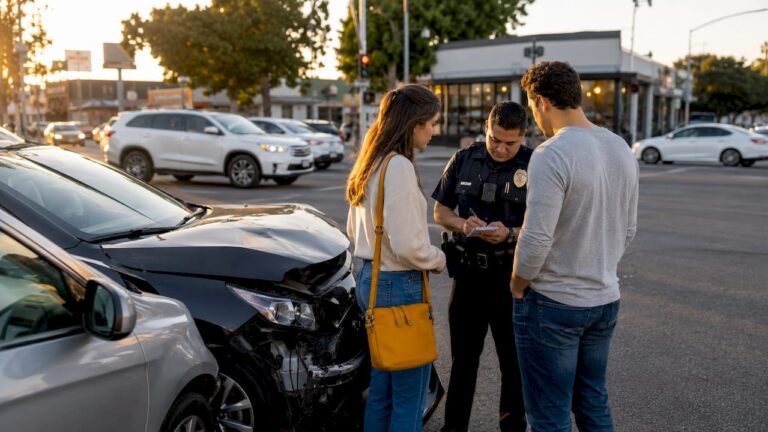
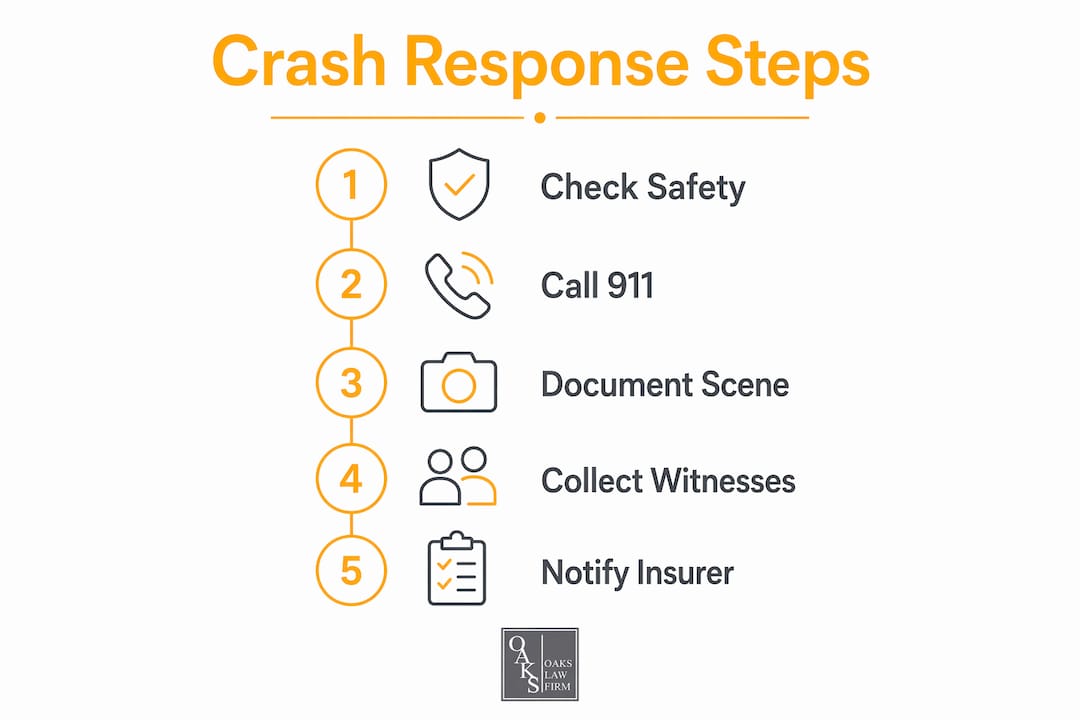
Safety comes before everything else. Check yourself for pain, dizziness, or difficulty breathing before you move. Then check your passengers and anyone in the other vehicle.
Call 911 immediately if anyone is injured or if vehicle damage is significant. California law requires you to report accidents involving injury, death, or property damage over $1,000 to the California Department of Motor Vehicles within 10 days using form SR-1. Calling 911 also creates an official police record, which becomes one of the first documents your attorney and insurer will request.
Move your vehicle only if it is blocking traffic and you can do so safely. Turn on your hazard lights right away to warn approaching drivers. Leaving the scene before police arrive, even briefly, can expose you to hit-and-run liability under California Vehicle Code §20001.
- Check yourself and all passengers for injuries before exiting the vehicle.
- Call 911 for any injury, major damage, or unsafe road conditions.
- Turn on hazard lights and, if available, place road flares or reflective triangles behind the vehicles.
- Stay at the scene until law enforcement releases you.
- Exchange name, license number, insurance information, and vehicle registration with the other driver.
- Do not move seriously injured people unless there is an immediate danger like fire.
Pro Tip: If you feel fine immediately after the crash, do not assume you are uninjured. Adrenaline is a powerful pain suppressor. Symptoms of concussion, whiplash, and internal injuries often appear hours or days later.
How should you document the accident scene?
Thorough documentation is the foundation of every successful car accident claim. Police reports focus on violations, but photos, witness statements, and personal records are what support civil liability and insurance claims. Start collecting evidence the moment it is safe to do so.
What to photograph and record
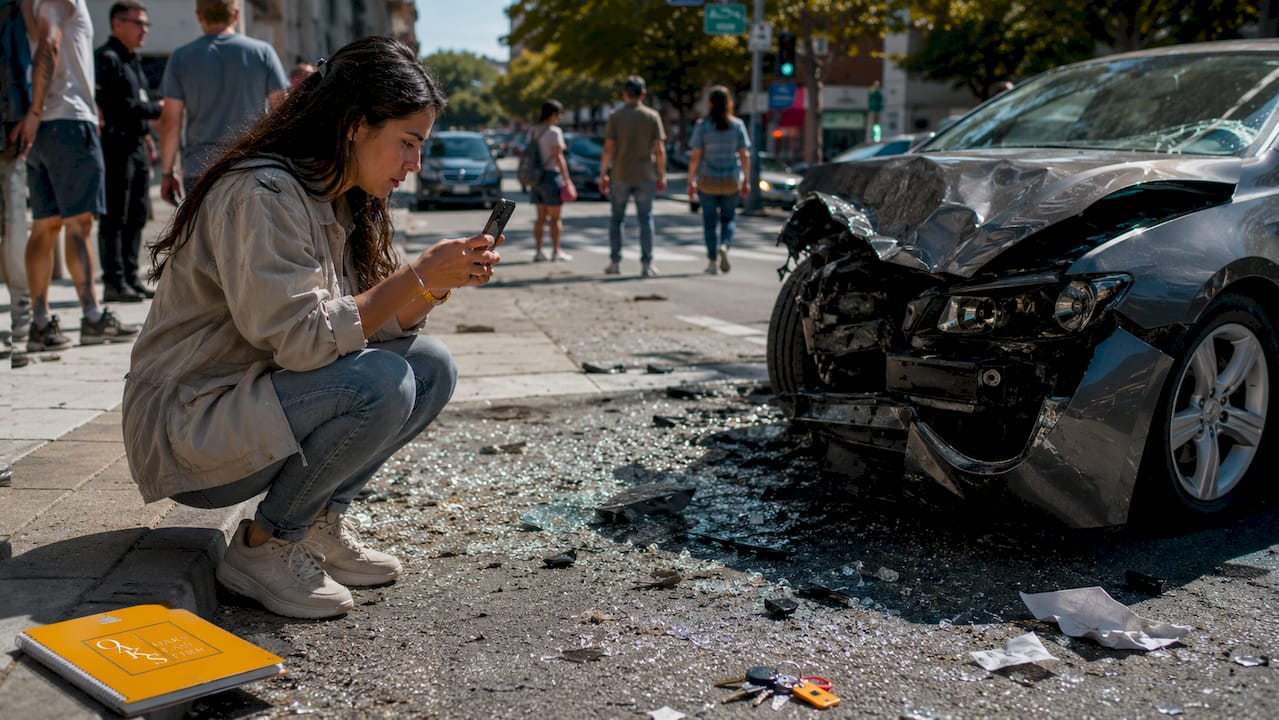
Use your phone to capture the full scene from multiple angles. Photograph every vehicle involved, showing all points of damage. Capture license plates, the position of vehicles in the roadway, skid marks, broken glass, traffic signals, road signs, and any visible injuries on your body. Video walkarounds of the scene often capture details that still photos miss.
Witness information
Witnesses typically leave within minutes of a crash and become nearly impossible to locate afterward. Approach anyone who stopped to watch and ask for their name and phone number before police arrive. Witness accounts are especially valuable when the other driver disputes fault.
Surveillance footage and black box data
Two evidence sources that most accident victims overlook are surveillance cameras and vehicle data recorders. Surveillance footage retention at private businesses in Los Angeles typically runs 30–90 days, and city traffic cameras can erase footage in as little as 72 hours. Your attorney can send a legal preservation demand to businesses near the crash site before that window closes.
Vehicle black boxes, formally called Event Data Recorders, capture braking force, speed, and steering inputs at the moment of impact. Black box data can be overwritten by continued driving, so securing it requires a prompt legal preservation demand or court order.
Here is a quick reference for the evidence you need and the action required:
| Evidence type | Why it matters | Time-sensitive? |
|---|---|---|
| Scene photos and video | Establishes road conditions and vehicle positions | Collect immediately |
| Witness contact information | Resolves disputed liability | Within minutes of crash |
| Surveillance footage | Captures the collision on camera | 72 hours to 90 days |
| Police report | Official record of violations and parties | Request within days |
| Black box data | Records speed, braking, and steering at impact | Preserve before more driving |
Pro Tip: Ask the responding officer for their name, badge number, and the report number before you leave the scene. You will need these to request the full police report from the Los Angeles Police Department or the relevant law enforcement agency.
For a detailed walkthrough on gathering accident evidence, Oakslawfirm has published a dedicated guide covering photos, witness contacts, and video footage.
What should you never say or do after a car accident?
The legal steps after an accident include knowing what not to do. Statements made at the scene, to insurers, or on social media can permanently damage your claim before an attorney ever gets involved.
Admissions of fault
Do not apologize to the other driver, even casually. Under California law, fault in a car accident is determined by evidence, not by who says sorry first. An apology at the scene can be used as an admission of liability in civil proceedings. Stick to exchanging required information and speaking with police.
Recorded statements
Consulting an attorney before giving recorded statements to the other party’s insurer is one of the most consistent pieces of advice from personal injury legal experts. Insurers train their adjusters to ask questions that elicit answers that minimize payouts. You are not required to give a recorded statement to the other driver’s insurance company.
For a deeper look at your rights in this situation, the guide on recorded statements in personal injury cases explains exactly what you can and cannot be compelled to say.
Social media
Insurance investigators routinely monitor social media after accident claims are filed. A photo of you at a family event, a post saying you are “doing okay,” or even a comment from a friend can be used to dispute the severity of your injuries.
Do not post anything about the accident, your injuries, or your recovery on any social media platform until your case is fully resolved. This includes Instagram, Facebook, X, TikTok, and private group chats that could be screenshot and shared. Insurers and opposing attorneys look for this content, and it is admissible as evidence.
When and how should you seek medical evaluation?
Medical care after a car accident serves two purposes: it protects your health and it creates the documentation your claim depends on. Seek medical attention within 24–72 hours after the crash, even if you feel no pain at the scene.
Adrenaline released during a collision suppresses pain signals. Injuries like concussions, soft tissue damage, internal bleeding, and spinal injuries often produce no obvious symptoms for hours or days. A gap between the accident date and your first medical visit gives insurers grounds to argue your injuries were caused by something else.
When you see a doctor, be thorough and specific:
- Report every symptom, including headache, neck stiffness, back pain, dizziness, nausea, and difficulty concentrating.
- Mention that the symptoms followed a car accident and give the exact date.
- Request copies of all examination notes, imaging results, and treatment plans.
- Keep every bill, prescription receipt, and referral letter in a single organized file.
- Follow through on every recommended follow-up appointment. Gaps in treatment weaken your claim.
The connection between your medical records and your legal claim is direct. Compensation for medical expenses, lost wages, and pain and suffering under California personal injury law is tied to documented evidence of harm. A thorough medical file is the clearest proof of what the accident cost you.
Pro Tip: If your primary care physician cannot see you within 24 hours, go to an urgent care clinic or emergency room. The date of your first medical visit matters more than the setting.
How do you notify your insurance company and when should you call a lawyer?
Reporting the accident to your insurance company is required under your policy’s cooperation clause. Failing to report promptly can give your insurer grounds to deny coverage. At the same time, what you say in that first call shapes the entire claims process.
Follow these steps when contacting your insurer:
- Report the accident promptly. Call your insurance company as soon as possible, ideally within 24 hours. California insurers must acknowledge claims within 15 days, but your obligation to report runs from the moment of the accident.
- Stick to the facts. Give the date, time, location, and the other driver’s information. Do not speculate about fault, describe your injuries in detail, or estimate repair costs.
- Decline recorded statements until you have legal advice. Your own insurer may also request a recorded statement. You generally have the right to consult an attorney first.
- Do not accept a quick settlement offer. Early settlement offers from insurers almost always arrive before the full extent of your injuries is known. Accepting one typically releases all future claims.
- Gather what you need before calling. Have the police report number, the other driver’s insurance information, your policy number, and a written summary of the accident ready before you dial.
Contacting a Los Angeles car accident attorney early gives you the clearest picture of your rights before you say anything that could limit them. Under California’s statute of limitations, CCP §335.1, you generally have two years from the date of the accident to file a personal injury lawsuit. If a government entity is involved, the deadline to file a government tort claim drops to six months under Gov. Code §911.2. Missing either deadline bars your claim entirely.
Key Takeaways
Taking the right steps immediately after a Los Angeles car accident protects your health, preserves critical evidence, and gives your legal claim the strongest possible foundation.
| Point | Details |
|---|---|
| Safety and 911 come first | Call emergency services immediately for any injury or major damage, and stay at the scene. |
| Document everything at the scene | Photograph vehicles, injuries, road conditions, and collect witness contacts before anyone leaves. |
| Preserve time-sensitive evidence | Surveillance footage can disappear in 72 hours; request legal preservation of footage and black box data immediately. |
| Never admit fault or post on social media | Casual apologies and social media posts are used as evidence against injury claims. |
| Seek medical care within 24–72 hours | Adrenaline masks injuries; a prompt medical visit creates the documentation your claim requires. |
What the first 24 hours actually decide
I have handled car accident cases in the and across Los Angeles for more than two decades. The single most consistent pattern I see is this: the outcome of a case is often decided in the first 24 hours, long before anyone hires an attorney.
Clients come to me after they have already apologized at the scene, given a recorded statement to the other driver’s insurer, and posted a photo from the hospital on Instagram. By that point, I am working against evidence they created themselves. That is not a position anyone should be in.
The conventional wisdom says to “stay calm and exchange information.” That is correct but incomplete. What most guides leave out is that the other driver’s insurance company is not on your side, even if the adjuster sounds friendly. Their job is to close your claim for as little money as possible. The faster you speak to them without legal advice, the easier that job becomes.
I also want to address something that surprises many clients: the police report is not enough. Police reports cover criminal violations and immediate facts, but they rarely capture the full picture needed for a civil claim. Your own photos, your own witness contacts, and your own medical records carry more weight in settlement negotiations than most people realize.
The clients who recover the most are the ones who treated the accident scene like a legal proceeding from the first minute. They documented everything, said little, saw a doctor that day, and called an attorney before talking to any insurer. That sequence is not complicated. It is just not instinctive when you are shaken up and standing on the side of a Los Angeles freeway.
— Matthew Nezhad
Oakslawfirm is ready to fight for your recovery
Oakslawfirm has represented car accident victims throughout Los Angeles and the since 2002. Lead attorney Matthew Nezhad and his team know California traffic law, local evidence rules, and the tactics insurers use to undervalue claims.
Oakslawfirm works on a no-fee guarantee basis, meaning you pay nothing unless the firm wins your case. The team handles evidence preservation, insurance negotiations, and builds the factual record your claim needs. If you were injured in a Los Angeles car accident, contact Oakslawfirm today for a free case evaluation. Understanding how car accident compensation works in California is the first step toward knowing what your claim is worth.
FAQ
What should I do immediately after a car accident in Los Angeles?
Call 911, check for injuries, turn on your hazard lights, and stay at the scene. Exchange insurance and license information with the other driver and begin photographing the scene as soon as it is safe.
How long do I have to file a car accident lawsuit in California?
California’s statute of limitations under CCP §335.1 gives you two years from the accident date to file a personal injury lawsuit. If a government entity is involved, you must file a government tort claim within six months under Gov. Code §911.2.
Do I have to give a recorded statement to the other driver’s insurance company?
No. You are not legally required to give a recorded statement to the other party’s insurer. Consult a personal injury attorney before agreeing to any recorded interview, as early statements are frequently used to minimize claim payouts.
How soon should I see a doctor after a car accident?
See a doctor within 24–72 hours, even if you feel no pain. Adrenaline can mask serious injuries like concussions and internal damage, and a delayed medical visit gives insurers grounds to dispute the connection between the accident and your injuries.
Can social media posts hurt my car accident claim?
Yes. Insurance investigators routinely review social media accounts after claims are filed. Posts, photos, and comments that appear to contradict your reported injuries or activity level can be used as evidence to reduce or deny your claim.
Legal Disclaimer: The information provided in this article is for general informational purposes only and does not constitute legal advice. Reading this article does not create an attorney-client relationship between you and Oaks Law Firm. Every case is different, and the outcome of any legal matter depends on the specific facts and circumstances involved. Oaks Law Firm makes no guarantees regarding the outcome of any case. If you have been involved in a car accident or have a legal matter, you should consult with a qualified attorney who can evaluate your specific situation. Past results do not guarantee future outcomes.
