
Attorney Advertising. This article was prepared with the assistance of artificial intelligence and reviewed by Oaks Law Firm prior to publication.
A spoliation letter, sent quickly and preferably by an attorney, locks down time sensitive crash evidence before it disappears and puts the other side on formal legal notice. Vehicles and their black box data are often at risk within 24 to 48 hours, and surveillance footage frequently gets overwritten within 30 days. Once that notice is on record, California law gives you real leverage, including sanctions and an adverse inference instruction, if the evidence vanishes anyway.
TL;DR:
- Sending a preservation letter within 24 to 48 hours is crucial to preserve vehicle black box data before it is lost through salvage or vehicle destruction.
- Surveillance footage from nearby cameras typically overwrites in 7 to 30 days, making early notice essential to retain this evidence.
- A credible attorney-issued spoliation letter, delivered via proofable methods like certified mail or email, significantly increases chances of sanctions if evidence is destroyed.
- Evidence destruction after a preservation letter can lead to sanctions, issue instructions for adverse inferences, and impact case outcomes, especially if the destruction appears willful.
- Acting immediately by coordinating forensic inspections and securing evidence guarantees stronger leverage in future litigation.
Table of Contents
- What Is a Spoliation Letter Car Accident California Victims Should Send?
- What Evidence Should a Preservation Letter Cover?
- How Fast Does Crash Evidence Disappear?
- How Do You Draft and Serve a Preservation Letter in California?
- What Happens in California if Evidence Is Destroyed Anyway?
- How Does Oaks Law Firm Preserve Your Evidence?
- Spoliation Letters After a California Car Crash: The Editorial Take
- Need Help Preserving Evidence Right Now?
- Sources
- FAQ
What Is a Spoliation Letter Car Accident California Victims Should Send?
A spoliation letter, also called a preservation letter, is a formal notice telling a person or company to stop, hold, and protect specific evidence tied to a crash. Under California law, the duty to preserve evidence attaches once litigation is “reasonably anticipated,” not once a lawsuit is actually filed. That standard, addressed under Cal. Code Civ. Proc. § 2023.010, means the clock starts the moment a serious crash happens, long before anyone steps into a courtroom.
Technically, an injured person can send this letter themselves. In practice, it rarely carries the same weight. An attorney-issued letter reads as a credible legal threat, cites the correct statutes, and creates a documentary trail showing the recipient knew exactly what to preserve and when they were told. That paper trail becomes central to any later sanctions motion.
Don’t confuse a preservation letter with a discovery request. Discovery happens after a lawsuit is filed and evidence has already survived. A spoliation letter is preventive. It’s sent within days of the crash, long before formal litigation begins, specifically because California litigation hold practice treats early notice as the strongest protection available.
What Evidence Should a Preservation Letter Cover?
The letter needs to name specific items, not vague categories. Vague requests get vague compliance. Here’s what belongs on the list, ranked roughly by how fast it disappears:
- Event Data Recorder (EDR) / black box data: stored in the vehicle’s airbag control module, it records pre-impact speed, braking, throttle position, and seatbelt use. Insurers or salvage yards control access, and once a vehicle is scrapped, this data is gone for good.
- Dashcam and telematics footage: often owned by the other driver, a rideshare company, or a fleet operator, and frequently set to auto-delete or overwrite on a rolling cycle.
- Electronic logging device (ELD) and driver logs: for commercial trucks, these show hours of service and duty status. Federal FMCSA retention rules govern how long carriers must keep these records, and the window is shorter than most victims assume.
- Surveillance video: from nearby businesses, traffic cameras, or residential systems, usually held on loops that overwrite in one to four weeks.
- Tow yard and impound holds: the physical vehicle itself, at risk of salvage auction or crushing within days of a total loss determination.
- Maintenance and repair records: held by the vehicle owner or a fleet’s service department, relevant to mechanical failure claims.
- Witness statements, scene photos, and medical records: perishable in a different sense. Memories fade and injuries heal, so early documentation matters as much as digital preservation.
How Fast Does Crash Evidence Disappear?
Every category above runs on its own clock, and some of those clocks move faster than most people expect.
Vehicles and EDR data sit at the top of the urgency list. Practitioners generally recommend sending a vehicle-specific spoliation letter within 24 to 48 hours of the crash, before an insurer declares a total loss and ships the car to a salvage auction. Once that happens, the black box data and the physical damage evidence can become permanently unreachable.
Surveillance and dashcam footage typically survives 7 to 30 days before automatic overwrite cycles erase it. Driver logs and maintenance records for commercial vehicles can rotate out even sooner depending on the carrier’s retention system.
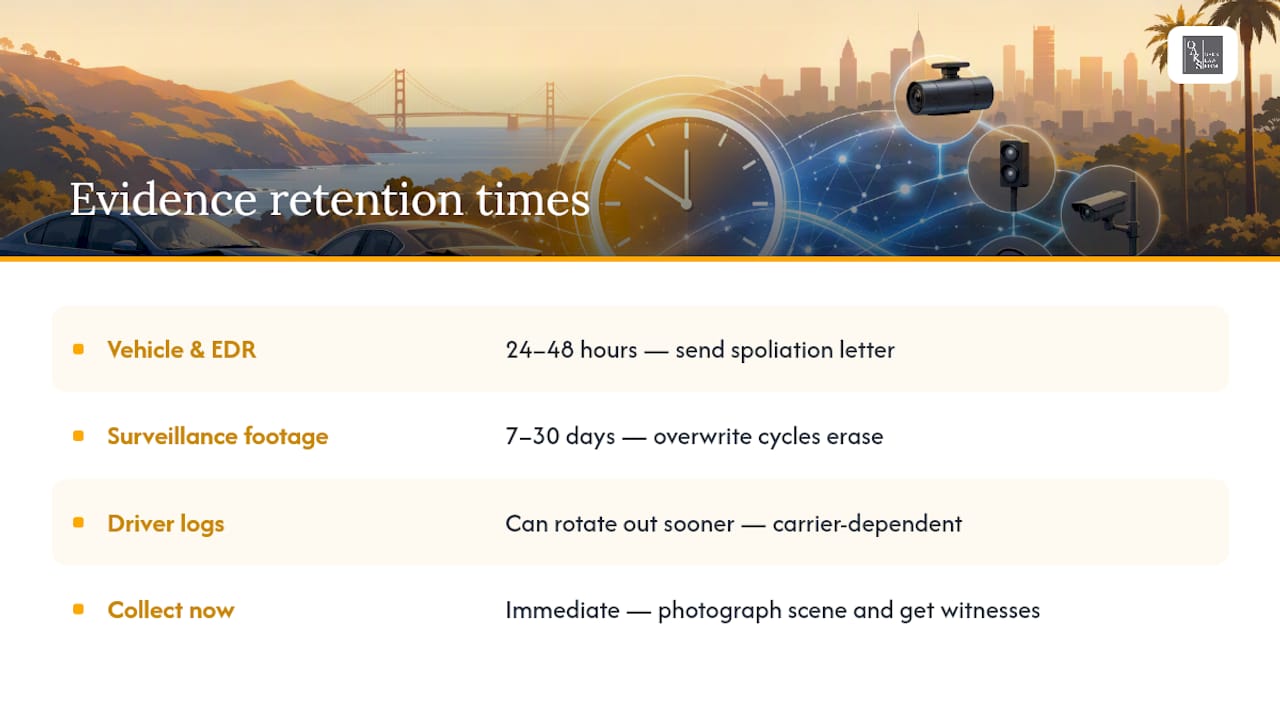
While you’re arranging counsel, a few things cost nothing and protect a lot: photograph the vehicles, the scene, and any visible damage from multiple angles; write down the tow yard’s name, address, and phone number; and collect contact information from any witness before they leave.
Pro Tip: Every phone call with an insurer or tow yard should be followed by a short email confirming what was said. Ask them to reply in writing. That single habit turns a verbal promise into evidence you can actually use.
How Do You Draft and Serve a Preservation Letter in California?
A preservation letter only works if it reaches the right people, in a way that proves they received it. Here’s the practical sequence:
- Identify every recipient who might control evidence: the at-fault driver’s insurer, the vehicle owner, the tow yard or storage facility, the trucking company or employer if a commercial vehicle is involved, and any business or homeowner whose camera may have captured the crash.
- Deliver it through a method that creates proof: certified mail with return receipt, email with a read receipt, or personal service. Never rely on a phone call alone.
- Request written acknowledgment that the letter was received and that preservation steps are underway.
- Include the essentials in the letter itself: the date, time, and location of the crash; a specific, itemized list of evidence to preserve; a clear deadline for a response; and a citation to the statutory preservation duty.
- Demand chain of custody documentation for any physical evidence, especially the vehicle, so its condition and handling can be verified later.
What Happens in California if Evidence Is Destroyed Anyway?
When evidence disappears despite a preservation letter, California courts have real tools to respond, and they don’t hesitate to use them in serious cases.
- Discovery sanctions under Cal. Code Civ. Proc. § 2023.030 range from monetary penalties and attorney fee awards to issue sanctions, evidentiary exclusions, and in the most severe cases, terminating sanctions that can end a party’s ability to defend the case.
- The adverse inference instruction, part of the Judicial Council of California’s CACI jury instructions, lets a jury presume that destroyed evidence would have hurt the party that destroyed it. That single instruction can reshape how a jury sees the entire case.
- A documented preservation letter is what makes a sanctions motion credible. Without proof the other side was warned, a judge has less basis to conclude the destruction was willful rather than routine.
- Defenses do exist: evidence destroyed before any duty to preserve attached, or lost through a genuine third party act outside the recipient’s control, may not support sanctions. That’s exactly why sending the letter early matters more than sending it well.
How Does Oaks Law Firm Preserve Your Evidence?
When you call Oaks Law Firm after a crash, the first move is speed. Attorney Matthew Nezhad’s team drafts and serves preservation notices immediately, and when a vehicle or footage is at genuine risk of disappearing, files emergency ex parte motions to stop destruction before it happens. The firm coordinates directly with forensic vendors for EDR extraction and vehicle inspection, and keeps a documented chain of custody on everything preserved.
Matthew Nezhad has spent his career representing injured Californians, and the firm intentionally accepts a limited number of cases each year so each one gets real attention. Bring photos, insurance information, and any tow yard or police report details to your free case evaluation. In the first 72 hours, expect preservation letters sent, tow yard holds confirmed, and a forensic inspection scheduled if the vehicle is drivable evidence.
Spoliation Letters After a California Car Crash: The Editorial Take
Most advice about car accident evidence still centers on the police report and the insurance claim number, as if those two documents will carry a case. They won’t, not when the vehicle’s own black box tells a more precise story than any witness can, and not when that data can vanish before the police report is even finalized. The conventional wisdom underestimates how fast physical evidence dies in a California car accident case. It treats preservation as a formality instead of the single action most likely to determine whether a sanctions motion succeeds later.
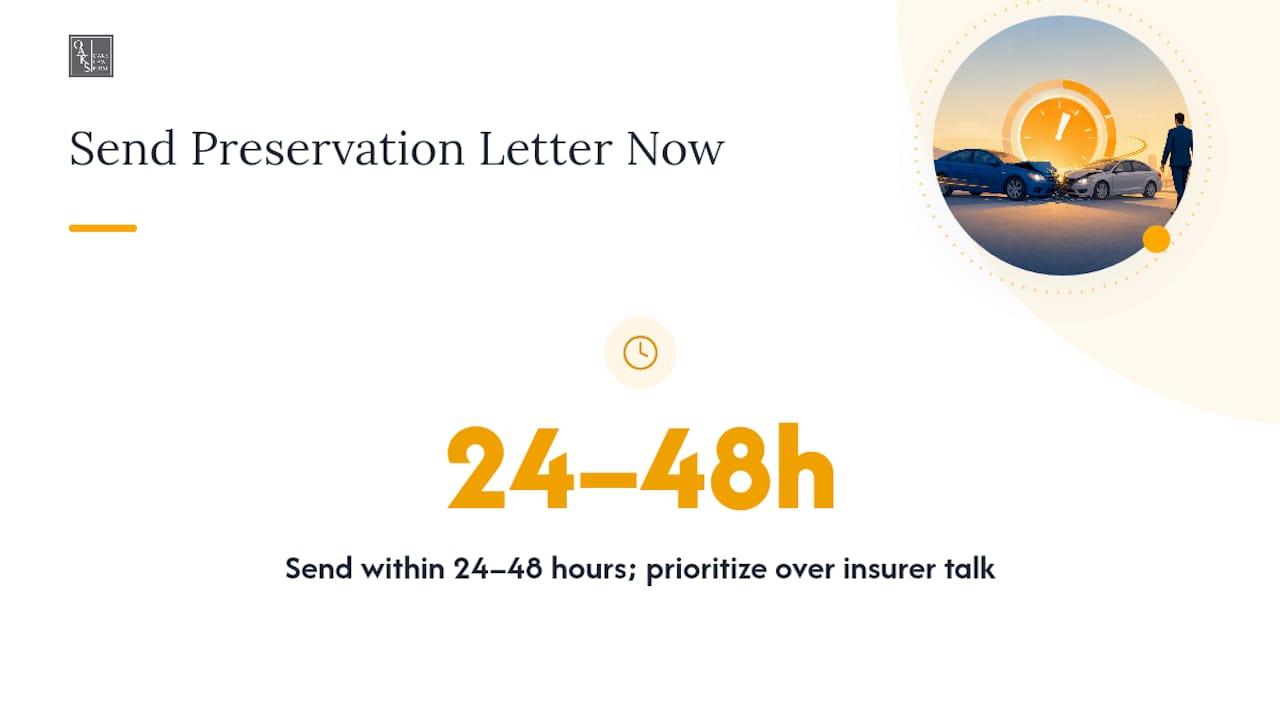
What the evidence in this article actually supports is narrower and more urgent: the 24 to 48 hour window for vehicles isn’t a suggestion, it’s closer to a hard deadline before a total loss vehicle reaches a salvage auction. Everything else, the footage, the driver logs, the maintenance records, follows on its own shorter clock. Readers should prioritize one thing above all else: get a preservation letter out the door before you finish sorting out anything with the insurance company. The insurance conversation can wait a day. The vehicle usually can’t.
— Matthew Nezhad
Need Help Preserving Evidence Right Now?
Oaks Law Firm is the direct path for California crash victims who need preservation action started today, not after weeks of researching it alone. If you were hurt in a car or truck accident, the firm’s attorneys handle preservation letters, tow yard confirmations, and forensic inspection scheduling on contingency, meaning you pay nothing upfront and nothing at all unless the firm wins your case.
Call for a free case evaluation and the firm will move immediately: preservation notices go out, the tow yard’s hold gets confirmed in writing, and a forensic vehicle inspection gets arranged before evidence disappears. From there, the team walks you through how a personal injury lawsuit gets filed in California and what your claim could realistically be worth. Reach out today and let the firm start protecting your evidence while you focus on recovering.
This article is general information, not a substitute for advice from a qualified lawyer. Consult a qualified legal professional about your own circumstances before acting on anything here.
Sources
- Cal. Code Civ. Proc. § 2023.010
- Judicial Council of California Civil Jury Instructions (CACI)
- FMCSA — how long motor carriers must retain records
- Best Vehicle Spoliation Letter & EDR Lawyer in CA – Leeran S. Barzilai
FAQ
Who Can Send a Spoliation Letter?
An injured person, a family member, or an attorney can technically send one, but a letter sent by an attorney carries far more legal weight and is taken more seriously by insurers, tow yards, and trucking companies.
What Is the Average Settlement for a Car Accident in California?
Settlement values vary enormously based on injury severity, liability, and available insurance coverage, so no single average figure applies to every case. A free case evaluation is the most reliable way to get a realistic sense of what your specific claim might be worth.
Is a Spoliation Letter the Same as a General Discovery Preservation Notice?
No. A spoliation letter is sent immediately after a crash, often within days, before any lawsuit exists, while discovery preservation requests happen later, after litigation has formally begun.
Is There a California Law on How Long My Car Insurance Stays High After a Crash?
California does not set a fixed statutory timeline for how long a crash affects insurance rates; that depends on the insurer’s own underwriting rules and whether you were found at fault.
How Long Do I Have to File a Car Accident Claim in California?
California’s general statute of limitations for personal injury claims is two years from the date of the crash under CCP §335.1, but if a government vehicle or entity was involved, you must file a formal government claim within six months under Gov. Code §911.2. Exceptions can shorten or extend these deadlines depending on the facts of your case, so don’t wait to speak with an attorney.
This article provides general information about California personal injury law and is not legal advice. Reading this article does not create an attorney-client relationship with Oaks Law Firm. Every case is different, and past results do not guarantee future outcomes. For advice about your specific situation, contact Oaks Law Firm for a free case evaluation.
