
Attorney Advertising. This article was prepared with the assistance of artificial intelligence and reviewed by Oaks Law Firm prior to publication.
A scaffold injury on a California job site almost always triggers a workers’ compensation claim first, but if a property owner, general contractor, or equipment manufacturer contributed to the fall, you may also have a separate third-party personal injury claim. Get medical treatment immediately, report the injury to your employer in writing, photograph the scaffold and surrounding area before anything changes, and get contact information from anyone who saw what happened. California gives you two years under CCP §335.1 to sue a private party, but only six months under Gov. Code §911.2 if a government entity owned or controlled the site.
TL;DR:
- Third-party claims are possible if a property owner, manufacturer, or subcontractor contributed to the scaffold fall, even when workers’ comp applies.
- The statute of limitations is two years for private parties but only six months for claims involving government-owned sites, making timely filing critical.
- Evidence such as photographs, inspection logs, witness contacts, and surveillance footage must be preserved quickly, ideally within days of the accident.
- Workers typically receive partial, fixed-rate benefits for medical care and lost wages, but third-party claims can recover full damages including pain and suffering and future income.
- Early legal consultation can help protect evidence, clarify liability, and avoid losing rights due to missed deadlines or missing documentation.
Table of Contents
- Who Can File a Scaffold Accident Claim in California?
- What Are California’s Deadlines for Scaffold Injury Claims?
- How Do Scaffold Accidents Happen and Who’s Liable?
- What Evidence Should You Preserve After a Scaffold Fall?
- What Are the Steps to File a Scaffold Accident Claim?
- What Damages Can You Recover in a California Scaffold Claim?
- How Can a California Personal Injury Attorney Help?
- How Are Workers’ Comp Benefits Calculated in Scaffold Injuries?
- How Do You Preserve Video and Digital Evidence?
- When Should You Talk to a Lawyer After a Scaffold Accident?
- Should You Settle or Take Your Scaffold Case to Trial?
- What Forms and Agencies Are Involved in a Scaffold Claim?
- Are There Special Rules for OSHA Violations in Scaffold Cases?
- A Note From Oaks Law Firm
- How to Get a Free Case Evaluation From Oaks Law Firm
- Sources
- FAQ
Who Can File a Scaffold Accident Claim in California?
Workers’ compensation is generally the “exclusive remedy” for employees hurt on the job, which means you typically cannot sue your own employer for a workplace injury even if they were careless. That exclusivity has real exceptions, though, and scaffold accidents produce them often because so many different companies touch a single job site.
You may have a third-party claim, separate from workers’ comp, when someone other than your direct employer caused the accident. Common scenarios include:
- The property owner failed to maintain or inspect the scaffold structure.
- A scaffold manufacturer sold a defective component that failed under normal use.
- A different subcontractor on site erected the scaffold negligently.
- A general contractor ignored known safety hazards it had a duty to fix.
Independent contractors and workers employed by a scaffold-erection subcontractor face different rules than direct employees, so how your job was classified matters. A contractor versus subcontractor liability review often decides who actually owes you money.
What Are California’s Deadlines for Scaffold Injury Claims?
Miss these dates and you can lose your right to recover, regardless of how strong your case is on the facts.
California Code of Civil Procedure §335.1 gives injured people two years from the date of injury to file a personal injury lawsuit against a private party. That clock starts running the day the scaffold gives way, not the day you finish treatment.
Government Code §911.2 cuts that window dramatically when a public entity is involved. If the job site is a public school, a city building, or state-owned property, you generally have only six months to file a formal government claim before you can even sue. Oaks Law Firm has written in detail about how this six-month deadline for dangerous condition claims catches injured workers off guard.
- Report the injury to your employer within days, not weeks, to protect your workers’ comp claim.
- Mark the six-month government notice date the moment you learn a public agency owns the site.
- Treat the two-year mark as your absolute outer limit for private-party lawsuits.
Scaffold-related injuries and deaths occur frequently every year nationwide, according to the Bureau of Labor Statistics. That volume is exactly why California built short, strict notice windows into the system.
How Do Scaffold Accidents Happen and Who’s Liable?
Most scaffold failures trace back to a handful of repeat causes, and each one tends to point toward a different defendant.
- Assembly errors, like missing cross-bracing or unsecured planks, usually implicate the erection subcontractor.
- Overloaded decking, when too many workers or too much material sit on a platform rated for less, often points to the general contractor supervising the load plan.
- Missing guardrails or toe boards frequently signal a site-safety failure the property owner or GC should have caught during inspection.
- Component failure, such as a cracked coupling pin or corroded frame, can shift liability to the manufacturer under product liability law.
- Falling objects from an upper level often trace back to whoever failed to secure tools or materials at height.
These causes map to negligence, product liability, and premises liability theories depending on the facts. Figuring out who controlled the site, and who actually contracted for the scaffolding, is frequently the single fact that decides a case. A job site with five different subcontractors can have five different insurance policies in play, which is exactly why this question deserves a careful look before you accept any settlement offer.
What Evidence Should You Preserve After a Scaffold Fall?
The evidence you gather in the first week often determines whether a third-party claim succeeds months later. Move through this checklist as soon as you’re physically able:
- Photograph everything from multiple angles, including the scaffold structure, any broken components, guardrails, and the ground surface, before the site gets cleaned up or repaired.
- Preserve your PPE and torn or bloodied clothing in a dry, dated container rather than throwing it out.
- Request your incident report in writing from your employer rather than relying on a verbal summary.
- Collect witness names and phone numbers on the spot, since coworkers change jobs and become harder to reach later.
- Obtain your medical records early and keep them organized as treatment continues.
- Ask about scaffold inspection logs and OSHA citations, which often exist for any commercial job site and can show a prior known hazard.
Each item supports a different piece of your case. Photos prove the physical condition, medical records tie your injury to the accident, and safety logs can show a company knew about a hazard and did nothing.
Pro Tip: Write down witness statements in the exact words they use, not your summary of what they said. A recollection in someone else’s phrasing carries far more weight than a paraphrase months later.
For more detail on organizing this kind of documentation, see this guide on medical records in a personal injury claim and this walkthrough of documenting injuries after an accident.
What Are the Steps to File a Scaffold Accident Claim?
The process runs on two parallel tracks, and confusing them can cost you money you’re entitled to.
- Get emergency medical care first. Nothing else matters if an injury goes untreated, and prompt treatment also creates the medical paper trail your claim will need.
- Notify your employer immediately, ideally in writing, since most workers’ comp systems require prompt reporting to avoid disputes over when and how the injury happened.
- Document the scene with photos and witness contacts before conditions change.
- File your workers’ compensation claim through your employer’s insurance carrier, which should cover medical treatment and a portion of lost wages regardless of fault.
- Investigate third-party liability separately. Workers may pursue both workers’ compensation and a third-party lawsuit at the same time when someone other than the employer contributed to the fall.
- Send a demand letter or claim notice to any liable third party, watching the six-month public-entity window if it applies.
- File suit before the statute runs if a settlement isn’t reached, coordinating any recovery with the workers’ comp lien that will likely attach to it.
Workers’ comp benefits typically start faster because fault doesn’t need to be proven. Third-party claims take longer to resolve but often pay for far more of what you actually lost.
What Damages Can You Recover in a California Scaffold Claim?
Workers’ compensation and third-party lawsuits cover very different things, and the gap between them is often the reason a serious scaffold injury needs more than a comp claim alone.
Workers’ compensation typically pays for:
- Medical treatment related to the injury.
- Temporary disability payments, usually a portion of your regular wages.
- Permanent disability benefits if you’re left with lasting limitations.
What workers’ comp does not pay is pain and suffering, and it rarely covers your full wage loss. A third-party personal injury claim can recover damages workers’ comp doesn’t touch, including:
- Full past and future medical expenses.
- Complete lost wages, not a capped percentage.
- Loss of future earning capacity if you can’t return to your trade.
- Pain and suffering.
- Wrongful death damages for surviving family members in fatal cases.
For a worker facing years of reduced earning power after a serious fall, that difference can mean hundreds of thousands of dollars.
How Can a California Personal Injury Attorney Help?
An experienced construction accident attorney does the investigative work you likely can’t do alone while recovering from an injury.
- Preserving scaffold components and scene evidence before a site gets rebuilt or cleaned.
- Pulling OSHA citations, inspection reports, and safety logs from the relevant agencies.
- Retaining engineering or safety experts to explain how the scaffold failed.
- Coordinating your workers’ comp claim with a separate third-party lawsuit so you don’t leave money on the table.
- Negotiating with insurance adjusters who routinely undervalue construction injury claims.
Oaks Law Firm founder Matthew Nezhad has spent his career representing injured accident victims across California, and the firm accepts a limited number of cases each year so each client gets direct attention rather than getting passed to a junior associate. The firm operates from offices in Sherman Oaks and Woodland Hills and offers free case evaluations on a contingency basis, meaning you owe nothing unless the firm recovers compensation for you.
Pro Tip: Bring your incident report, medical records, and any photos you’ve already taken to your first consultation. An attorney can evaluate your situation far faster with documentation in hand than with a verbal summary alone.
How Are Workers’ Comp Benefits Calculated in Scaffold Injuries?
California workers’ compensation uses a formula based on your average weekly wage, not your actual medical bills or the severity of pain you’re in. Temporary disability payments generally run at two thirds of your gross average weekly wage, subject to state minimum and maximum caps that change periodically. That percentage stays fixed whether your injury heals in six weeks or six months.
Permanent disability, if a doctor determines you have lasting impairment after a scaffold fall, uses a separate rating system based on a medical evaluation of how the injury affects your ability to work. A crushed hand from a falling scaffold pipe rates very differently than a soft tissue back injury, even if both keep you out of work for similar periods.
This is where scaffold accidents get complicated compared with a simple slip on a flat floor. Falls from height frequently cause fractures, spinal injuries, and traumatic brain injuries that produce high permanent disability ratings, yet the workers’ comp formula still caps what you receive regardless of how the injury reshapes your life. That gap is exactly why identifying a viable third-party claim matters so much for scaffold cases specifically. A worker who falls twenty feet because a plank snapped isn’t just entitled to a disability percentage. If the plank was defective or improperly installed by another company, that worker may be entitled to full compensation for a career-altering injury.
How Do You Preserve Video and Digital Evidence?
Construction sites increasingly run security cameras, and many general contractors now require subcontractors to document daily work with phone photos or drone footage for progress tracking. That digital trail can make or break a scaffold claim, but it disappears fast.
Ask your employer or the site’s general contractor, in writing, whether security cameras covered the accident area, and request that footage be preserved before it’s automatically overwritten. Many commercial security systems cycle and delete footage within 30 to 90 days, so this request needs to happen within days of the accident, not weeks.
If coworkers took phone photos or videos of the job site that day, ask them to send you copies immediately rather than assuming they’ll still have them later. Phones get replaced, apps get deleted, and cloud storage gets cleared out. Screenshot text messages discussing the accident and save them somewhere other than just your phone.

If a drone or time-lapse camera was documenting construction progress, that footage may show the scaffold’s condition hours or days before the fall, which can be powerful evidence of a hazard that existed before you were ever injured. An attorney can send a formal preservation letter to any party holding this footage, which creates a legal obligation to keep it rather than letting it get overwritten on a routine schedule.
When Should You Talk to a Lawyer After a Scaffold Accident?
As soon as possible, ideally within days, not after your workers’ comp claim is already underway or after you’ve given a recorded statement to an insurance adjuster. Waiting doesn’t just risk evidence disappearing. It can also mean you accidentally say something to an adjuster that gets used to minimize your third-party claim later.
Insurance companies for property owners and contractors often contact injured workers quickly, sometimes within days, hoping to get a recorded statement before the worker understands the full scope of a possible third-party claim. Anything said in that call can be used against you later, even if you were simply trying to be honest and cooperative.
Public entity cases raise the stakes further. If your six-month notice deadline under Gov. Code §911.2 passes because nobody flagged that a government agency owned the property, you may permanently lose the right to pursue that claim, no matter how strong the underlying facts are. Statutory notice rules for public-entity claims run short, and workers often don’t realize a site is publicly owned until it’s too late to act.
A free consultation costs you nothing and starts a clock working in your favor instead of against you. An attorney can immediately send preservation letters, identify whether a public entity is involved, and make sure you don’t say anything to an insurance adjuster that undercuts a claim you don’t even know you have yet.
Should You Settle or Take Your Scaffold Case to Trial?
Most scaffold accident claims in California settle before trial, and that’s usually the right outcome for both sides when the settlement reflects the true value of the injury. Trials are expensive, unpredictable, and can take years to resolve, so a fair settlement that pays for your medical care, lost income, and pain and suffering often serves an injured worker better than the uncertainty of a jury verdict.
The calculation changes for catastrophic injuries. A worker with a permanent spinal injury or traumatic brain injury from a twenty-foot fall may be offered a settlement that looks reasonable on paper but falls far short of covering decades of reduced earning capacity and ongoing medical needs. In those cases, rejecting an early lowball offer and preparing for trial can be the only way to secure fair compensation, even if the case ultimately still settles closer to trial once the defense sees the strength of the evidence.
Multiple defendants also complicate the settlement math. When a property owner, general contractor, and equipment manufacturer are all potentially liable, each one’s insurer may try to shift blame to the others rather than pay a fair share, which can drag out negotiations. An attorney who has already built a strong evidentiary record, complete with witness statements, safety logs, and expert opinions, is in a far stronger position to push for a full settlement or credibly threaten trial than a worker negotiating alone.
What Forms and Agencies Are Involved in a Scaffold Claim?
Filing a scaffold accident claim in California typically touches several separate systems, and knowing which one handles what saves time.
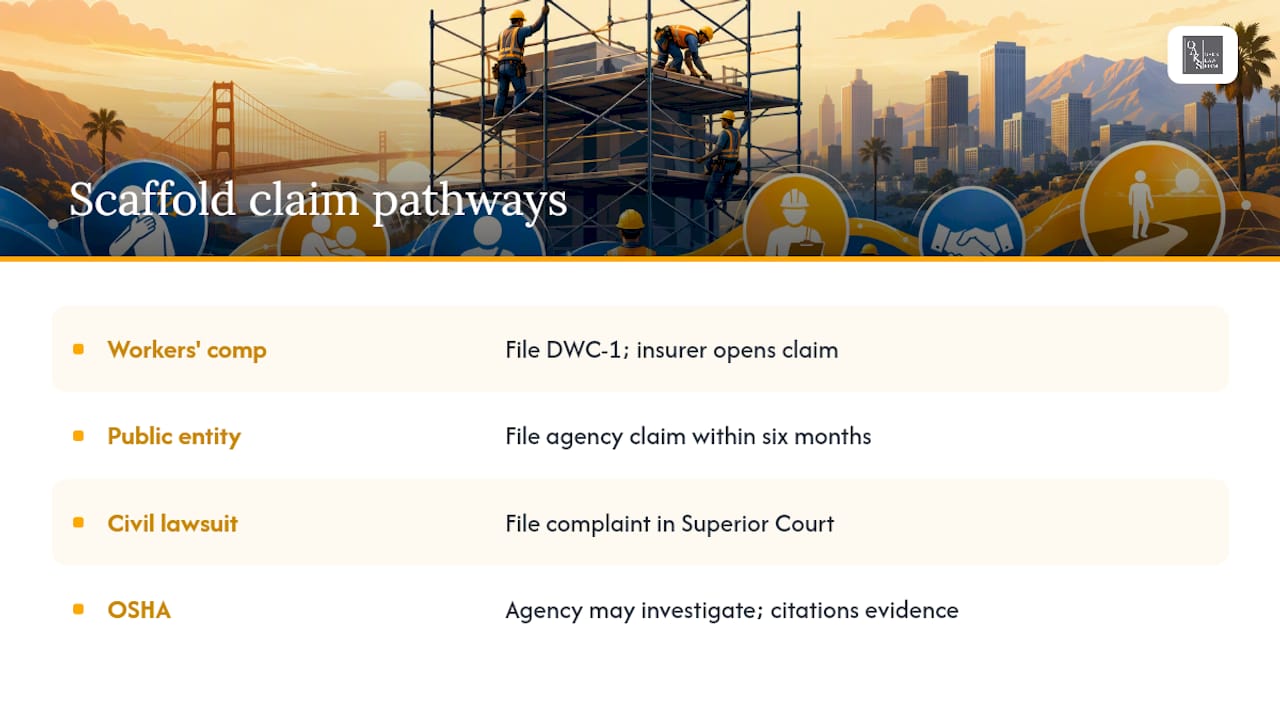
Your workers’ compensation claim starts with a claim form, commonly called a DWC-1, that your employer is required to provide after you report the injury. Your employer’s workers’ comp insurance carrier then opens a claim file and assigns an adjuster who authorizes medical treatment.
If a public entity owned or controlled the job site, a separate government claim form must be filed with that specific agency, whether it’s a city, county, school district, or state department, within the six-month window under Gov. Code §911.2. This is a completely different process from workers’ comp and has its own paperwork and its own agency.
A third-party civil lawsuit, if you have one, gets filed in California Superior Court in the county where the accident occurred or where the defendant is located. This isn’t a form you file with a government agency. It’s a formal complaint an attorney prepares and files with the court.
OSHA may also investigate serious scaffold accidents independently, particularly ones involving a fall from height or a fatality, and any citations issued become valuable evidence in both your workers’ comp case and a third-party claim. None of these systems talk to each other automatically, which is exactly why so many injured workers benefit from having one attorney tracking all three simultaneously.
Are There Special Rules for OSHA Violations in Scaffold Cases?
Scaffold work is one of the most heavily regulated areas of construction safety, and an OSHA citation issued after your accident can become a powerful piece of evidence, even though it doesn’t automatically win your case for you.
If OSHA investigates and finds that a scaffold lacked required guardrails, was overloaded beyond its rated capacity, or was erected without a qualified supervisor present, as federal scaffold standards require, that citation documents a safety violation that existed independently of your injury. In a third-party negligence claim, evidence that a company violated a known safety standard can be used to show it failed to meet the basic duty of care owed to workers on site.
An OSHA citation does not by itself entitle you to a lawsuit, and it doesn’t replace the need to prove your specific damages. What it does is give your attorney documented proof that a hazard existed and that a specific party was on notice of safety requirements it didn’t follow. That’s often the difference between a defendant’s insurer disputing liability outright and negotiating in good faith once they see a citation in the file.
One wrinkle worth knowing: OSHA investigations and citations sometimes take months to finalize, occasionally longer than the fast-moving six-month government claim deadline if a public entity is involved. That’s another reason not to wait for an OSHA report before contacting an attorney. A lawyer can start building your case, and formally request OSHA’s investigation file once it’s complete, while your claim deadlines keep running in the background.
A Note From Oaks Law Firm
Construction workers build the state we all live in, and when a scaffold fails, we believe the people responsible should answer for it, not the worker left with the injury. Every case we take, we handle on contingency with a free evaluation upfront, so cost is never the reason someone doesn’t call.
— Matthew Nezhad
How to Get a Free Case Evaluation From Oaks Law Firm
If a scaffold accident has left you hurt, worried about bills, and unsure whether your employer’s insurance covers everything you’re owed, you don’t have to sort out workers’ comp versus a third-party claim by yourself. Oaks Law Firm offers free case evaluations and represents injured construction workers throughout California on a contingency-fee basis, meaning there’s no upfront cost and no fee unless we recover compensation for you.

When you reach out, bring what you have: photos of the accident scene, your incident report, medical records so far, and contact information for anyone who witnessed what happened. If you don’t have all of it yet, that’s fine. The firm’s attorneys can help identify what’s still needed and start preserving evidence, including any surveillance footage, before it disappears. Because Oaks Law Firm accepts a limited number of cases each year, clients get direct attention from an attorney rather than getting shuffled through a large case queue.
Visit the firm’s construction accident practice page to see how the firm handles scaffold and job-site injury claims, or review the broader personal injury services overview to understand how workers’ comp and third-party claims can work together. If your fall involved a fatality, the firm’s wrongful death practice team can walk surviving family members through their options. Call for your free evaluation before evidence disappears and deadlines close in.
This article is general information, not a substitute for advice from a qualified lawyer. Consult a qualified legal professional about your own circumstances before acting on anything here.
FAQ
Can I Sue My Employer After a Scaffold Accident in California?
Generally no. Workers’ compensation is the exclusive remedy against your direct employer for a workplace injury, but you may still have a separate claim against a property owner, contractor, or manufacturer whose negligence contributed to the fall.
What if I Already Filed a Workers’ Comp Claim, Can I Still Sue a Third Party?
Yes. Workers’ compensation and a third-party personal injury lawsuit run on parallel tracks, and filing one doesn’t waive your right to pursue the other against a non-employer party.
How Long Do I Have to File a Scaffold Accident Claim in California?
You generally have two years from the injury date under CCP §335.1 to file a lawsuit against a private party. If a public entity owned the site, you typically have only six months to file a government claim under Gov. Code §911.2.
What Evidence Should I Keep After a Scaffold Fall?
Photograph the scene from multiple angles, preserve your PPE and torn clothing, get your incident report in writing, collect witness contact information, and request any available security or drone footage before it gets deleted.
Does Oaks Law Firm Charge Upfront Fees for Scaffold Accident Cases?
No. Oaks Law Firm offers free case evaluations and works on a contingency-fee basis, so you pay nothing unless the firm recovers compensation for you.
This article provides general information about California personal injury law and does not constitute legal advice. Past results do not guarantee future outcomes. For guidance specific to your situation, contact Oaks Law Firm for a free case evaluation.
