

A rear end collision injury claim is a formal legal request for compensation after your vehicle was struck from behind, typically covering injuries such as whiplash, spinal trauma, and soft tissue damage. Rear-end crashes account for nearly 29–30% of all annual car accidents in the United States, making them the most common type of traffic collision. That frequency matters because it means insurers have refined their tactics for minimizing payouts on these exact claims. California law generally presumes the trailing driver is at fault, but that presumption alone does not guarantee fair compensation. Oakslawfirm has represented injured victims throughout the and greater Los Angeles area, and the difference between a low settlement and a full recovery almost always comes down to documentation and timing.
Disclaimer: This article provides general information only. Your specific case facts, injuries, and circumstances may produce different legal outcomes. Consult a qualified personal injury attorney for advice tailored to your situation.
What injuries and damages qualify for a rear end collision injury claim?
The injuries that support a rear impact injury claim range from minor muscle strains to permanent spinal damage. Understanding which injuries qualify, and how they affect claim value, is the first step toward knowing what you are owed.
Common injury types
Whiplash is the most frequent injury in rear-end crashes. The sudden forward and backward snap of the neck tears ligaments and strains muscles, often without any visible fracture on an X-ray. That invisibility is exactly what makes whiplash injury claims so contested by insurance companies.

Herniated discs occur when the force of impact pushes spinal disc material out of place, pressing on nerves. Victims often experience radiating pain, numbness, or weakness in the arms or legs. These injuries show on MRI scans, which strengthens the claim considerably.
Traumatic brain injuries (TBI) can result even from low-speed impacts when the head snaps forward and strikes the steering wheel, headrest, or airbag. Concussion symptoms sometimes appear days after the crash, which is one reason immediate medical evaluation matters.
Soft tissue injuries cover a broad category including muscle tears, ligament sprains, and tendon damage throughout the back, shoulders, and neck. These injuries are painful and can limit daily function for months.
Categories of damages
A qualifying rear end collision injury claim covers two main categories of damages.
Economic damages are the measurable financial losses:
- Medical bills, including emergency care, imaging, physical therapy, and future treatment
- Lost wages from missed work during recovery
- Vehicle repair or replacement costs
- Out-of-pocket expenses such as prescription costs and transportation to appointments
Non-economic damages cover the human cost of the injury:
- Pain and suffering
- Emotional distress and anxiety
- Loss of enjoyment of daily activities
- Reduced quality of life for permanent injuries
How injury severity affects settlement value
Settlement values vary significantly by injury severity. Minor soft tissue injuries that fully resolve typically settle between $3,000 and $35,000. Severe cases involving spinal surgery or permanent disability often range from $75,000 to over $500,000. That gap exists because the claim must account for future medical costs, long-term lost earning capacity, and the ongoing impact on daily life.
Reaching Maximum Medical Improvement (MMI) before settling is critical. MMI is the point at which a treating physician determines your condition has stabilized and further significant improvement is unlikely. Settling before MMI means you cannot accurately calculate future costs, and you may accept far less than your injuries ultimately require.
Pro Tip: Ask your treating physician to document every functional limitation in writing, not just the diagnosis. Adjusters respond to specifics, not general descriptions of pain.
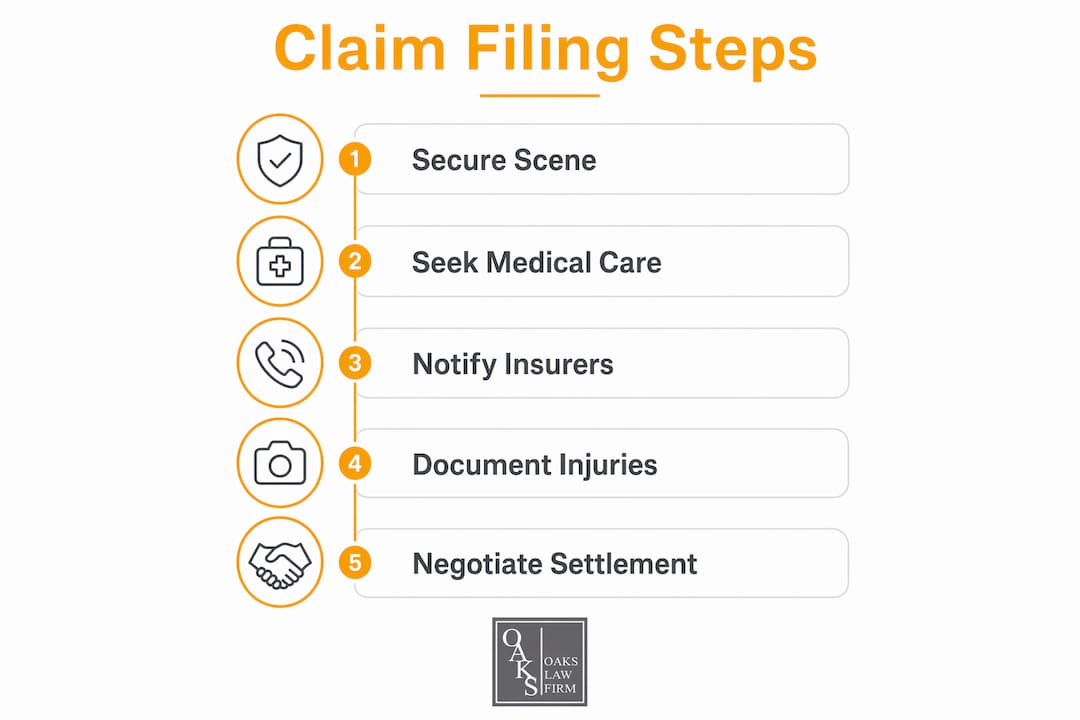
How to file a rear end collision injury claim step by step
The auto accident claim process has a defined sequence. Skipping steps or getting them out of order directly reduces what you recover.
Step 1: Secure the scene and gather evidence
Immediately after the crash, move to safety if possible and call 911. A police report creates an official record of the collision that insurers cannot easily dispute. While at the scene:
- Photograph all vehicle damage from multiple angles
- Photograph the road, skid marks, traffic signals, and any debris
- Collect the other driver’s name, license number, insurance carrier, and policy number
- Get contact information from every witness present
- Note the exact time, location, and weather conditions
Do not apologize or admit any fault at the scene. Statements made in the moment can be used against you later.
Step 2: Seek medical care within 24 hours
Go to an emergency room, urgent care clinic, or your primary care physician the same day if possible. Delaying treatment by more than 48 hours gives insurance adjusters grounds to argue your injuries were not caused by the crash. That argument alone can sink an otherwise valid claim.
Step 3: Notify both insurance companies
Filing a claim involves contacting the at-fault driver’s insurer and notifying your own insurance company. California requires prompt notification to your own insurer regardless of who caused the crash. Your own policy may provide uninsured or underinsured motorist coverage if the at-fault driver carries insufficient limits.
Step 4: Build your documentation file
Strong injury documentation is the backbone of any successful claim. Collect and organize:
- All medical records and bills from every provider
- The official police report
- Photographs of injuries as they develop (bruising often appears days later)
- A personal injury journal documenting daily pain levels and limitations
- Pay stubs or employer letters confirming missed work
Step 5: Understand the timeline
Minor cases with resolved injuries often settle within 2 to 6 months after treatment ends. Moderate to severe cases take longer, sometimes years if litigation becomes necessary. Rushing a settlement to close the case quickly is one of the most expensive mistakes an injured person can make.
Pro Tip: Never give a recorded statement to the other driver’s insurance adjuster without speaking to an attorney first. Adjusters are trained to ask questions that produce answers they can use to reduce your payout.
What are the most common mistakes in rear end collision claims?
Knowing where claims fail is just as valuable as knowing how to build one. Insurance companies handle thousands of rear-end claims every year and have developed specific strategies to reduce what they pay.
The whiplash documentation problem
Insurance adjusters routinely undervalue whiplash claims because soft tissue injuries do not appear on standard X-rays. An adjuster who sees a clean X-ray report will argue the injury is minor or fabricated, regardless of how much pain you are in. The counter to this is an MRI or CT scan ordered by your physician, combined with detailed clinical notes describing your functional limitations at every appointment.
Comparative negligence arguments
California follows a pure comparative negligence rule. That means even if the rear driver is presumed at fault, insurers aggressively seek evidence of partial fault by the lead driver to reduce the payout. Common arguments include:
- You braked suddenly without cause (“brake checking”)
- Your brake lights were not functioning at the time of impact
- You merged into the lane without adequate space
- You were driving below the minimum safe speed
Each of these arguments, if accepted, reduces your compensation by the percentage of fault assigned to you. A 20% fault finding on a $100,000 claim costs you $20,000.
“Adjusters frequently investigate incidents like brake checking and non-working brake lights to shift partial fault to victims, even when the law presumes the rear driver is responsible. Document your vehicle’s maintenance records and any dashcam footage immediately after the crash.”
Settling before Maximum Medical Improvement
Settling before reaching MMI is a costly and irreversible mistake. Once you sign a release, you cannot reopen the claim if your condition worsens or requires additional surgery. The insurer knows this and will often push early settlement offers precisely because they are cheaper than what your claim is actually worth.
Treatment gaps
Any gap in medical treatment gives the adjuster a narrative: “If you were really injured, why did you stop going to the doctor?” Consistent treatment, even when you feel you are improving slowly, protects your claim from this argument. If you must pause treatment for financial reasons, document that reason in writing with your provider.
Pro Tip: Keep every appointment, follow every referral, and never discharge yourself from care before your physician recommends it. Gaps in treatment records are the single most common reason valid claims get reduced.
What compensation can you expect from a rear end accident settlement?
Realistic expectations on settlement amounts help you evaluate offers and decide when to push back. The numbers vary widely based on injury type, insurance coverage limits, and how well the claim is documented.
Settlement ranges by injury type
| Injury Type | Typical Settlement Range |
|---|---|
| Minor whiplash, fully resolved | $3,000 to $35,000 |
| Moderate soft tissue, ongoing symptoms | $15,000 to $75,000 |
| Herniated disc, conservative treatment | $50,000 to $150,000 |
| Herniated disc requiring surgery | $100,000 to $500,000+ |
| Traumatic brain injury | $75,000 to $1,000,000+ |
The average rear end accident settlement across all severity levels falls between $10,000 and $50,000, with catastrophic injuries pushing well beyond that range. These figures reflect resolved claims and do not guarantee any specific outcome for your case.
Factors that move the number up or down
Several variables directly influence what a rear end crash compensation offer looks like:
- Insurance policy limits. The at-fault driver’s liability coverage caps what their insurer will pay. If your damages exceed those limits, your own underinsured motorist coverage becomes critical.
- Injury documentation quality. Claims supported by MRI findings, specialist reports, and consistent treatment records settle for more than those relying on patient-reported symptoms alone.
- Lost wages evidence. Pay stubs, tax returns, and employer letters quantify economic loss in a way adjusters cannot easily dispute.
- Pre-existing conditions. Insurers will argue a prior neck or back condition caused your current symptoms. Your attorney must show the crash aggravated or accelerated a condition that was previously manageable.
- Liability clarity. A clean police report attributing fault to the rear driver, combined with witness statements and dashcam footage, removes the comparative negligence argument and increases settlement value.
When a claim becomes a lawsuit
Most rear-end injury claims settle without litigation. When an insurer refuses to offer fair compensation, filing a personal injury lawsuit in California Superior Court becomes the path to full recovery. Litigation takes longer but often produces significantly higher results, particularly for severe injuries where future costs are substantial. California’s statute of limitations for personal injury claims is generally two years from the date of the accident, so timing matters.
Key Takeaways
A successful rear end collision injury claim depends on prompt medical care, thorough documentation, and waiting until Maximum Medical Improvement before accepting any settlement offer.
| Point | Details |
|---|---|
| Seek care within 24–48 hours | Delayed treatment gives insurers grounds to deny causation and devalue your claim. |
| Document everything in writing | Medical records, police reports, photos, and a daily pain journal all strengthen your position. |
| Wait for MMI before settling | Settling early locks in a number that may not cover future surgery, therapy, or lost wages. |
| Know the comparative negligence risk | Insurers will look for any evidence of partial fault to reduce what they pay you. |
| Understand realistic settlement ranges | Minor injuries typically resolve between $3,000 and $35,000; severe cases can exceed $500,000. |
What I have learned after years of rear-end collision cases
After more than two decades representing injured clients in the , I have seen the same pattern repeat itself. The people who recover the most are not necessarily those with the most severe injuries. They are the ones who took their medical care seriously from day one and did not let an insurance adjuster rush them into a decision.
The hardest conversation I have with clients is the one where I have to explain that they already settled. They signed a release three weeks after the crash for $8,000 because the adjuster called every day and the offer felt like real money at the time. Then the MRI came back showing a herniated disc. The case was closed. That $8,000 did not cover one round of physical therapy, let alone the surgery they eventually needed.
The other pattern I see constantly is clients who waited too long to call anyone. They assumed the other driver’s insurance would do the right thing. Insurance companies are not in the business of doing the right thing. They are in the business of closing claims for as little as possible. The adjuster who sounds friendly on the phone is working toward a number that protects the insurer, not you.
My honest advice: get your medical care, keep your records, and do not talk to the other driver’s insurer without representation. The legal process for rear-end claims is navigable, but it rewards people who are prepared and patient. Know your rights. Do not accept the first offer. And if the insurer is playing games with your whiplash claim because there is no imaging evidence, that is exactly the situation where an experienced attorney changes the outcome.
— Matthew Nezhad
How Oakslawfirm can help with your rear end collision claim
Oakslawfirm has spent more than two decades fighting for injured victims across the and throughout California. If you were rear-ended and are dealing with medical bills, lost wages, and an insurer that is not taking your injuries seriously, you do not have to handle it alone.

Attorney Matthew Nezhad and his team take a limited number of cases each year, which means every client receives direct, focused attention. The firm offers a free case evaluation so you can understand your options before making any decisions. Whether your situation calls for a negotiated settlement or a full car accident compensation claim through the courts, Oakslawfirm has the experience to pursue the maximum recovery your injuries warrant. Contact Oakslawfirm today to schedule your free consultation.
This article is for general informational purposes only and does not constitute legal advice. Every case is different, and the outcome of your claim will depend on the specific facts, evidence, and applicable law in your situation. Consult a licensed personal injury attorney for guidance specific to your circumstances.
FAQ
What is a rear end collision injury claim?
A rear end collision injury claim is a formal demand for compensation filed against the at-fault driver’s insurer after your vehicle was struck from behind. It covers medical costs, lost wages, vehicle damage, and pain and suffering.
Who is at fault in a rear-end car accident?
California law presumes the trailing driver is at fault in a rear-end crash. However, insurers can argue comparative negligence if they find evidence the lead driver contributed to the collision, such as sudden braking or a broken brake light.
How long does a rear end accident settlement take?
Minor injury claims typically settle within 2 to 6 months after treatment ends. Severe or disputed cases can take one to several years, especially if litigation is required.
Should I accept the first settlement offer from the insurance company?
No. First offers are almost always below the full value of your claim. Wait until you reach Maximum Medical Improvement so your attorney can calculate the true cost of your injuries, including future treatment and lost earning capacity.
What if the other driver has no insurance or not enough coverage?
Your own auto policy may include uninsured or underinsured motorist coverage, which pays the difference when the at-fault driver’s limits are insufficient. Review your policy limits and speak with an attorney about your options before accepting any offer.
