

Attorney Advertising. This article was prepared with the assistance of artificial intelligence and reviewed by Oaks Law Firm prior to publication.
If you were uninsured, later convicted of DUI, or committing a felony at the time of a crash, Proposition 213 (Civil Code §3333.4) blocks you from collecting non-economic damages like pain and suffering. Economic damages, your medical bills, lost wages, property repair costs, generally remain on the table. Several exceptions can restore your full recovery, including a DUI-conviction exception for uninsured victims and separate rights for passengers and wrongful-death survivors.
- The core bar: No pain-and-suffering damages for the three barred groups.
- What survives: Medical expenses, lost income, and property damage claims in most cases.
- What changes the outcome: A DUI conviction against the other driver, your status as a passenger, or a wrongful-death claim.
- What to do now: Preserve your insurance paperwork and crash evidence, then talk to an attorney before accepting any insurer’s determination.
Key Takeaways
Proposition 213 bars non-economic damages for uninsured motorists, DUI-convicted drivers, and felons injured during a crime, but economic damages and several key exceptions often preserve full recovery.
| Point | Details |
|---|---|
| Core statute | Civil Code §3333.4 bars non-economic damages for uninsured motorists, DUI-convicted drivers, and felons in specific circumstances. |
| Damages that survive | Medical bills, lost wages, and property damage remain recoverable even when Prop 213 applies. |
| Biggest exception | A DUI conviction, not just an arrest, against the at-fault driver restores an uninsured victim’s non-economic damages. |
| Deadlines matter | File within two years under CCP §335.1, or six months for government claims under Gov. Code §911.2. |
| Get a legal review | Oaks Law Firm evaluates Prop 213 exposure, pulls conviction records, and challenges insurer denials at no upfront cost. |
Table of Contents
- Understanding Prop 213 California and Its Legal Roots
- Who Prop 213 Actually Reaches
- Economic Versus Non-Economic Damages Under Prop 213
- The Exceptions That Can Restore Full Recovery
- How California Courts Have Shaped Prop 213
- Protecting Your Claim When Prop 213 Is in Play
- How Oaks Law Firm Approaches Prop 213 Cases
- Attorney Note: Common Pitfalls Worth Avoiding
- Get Help Determining Your Rights Under Prop 213
- Primary Sources on Prop 213
- Sources
- FAQ
Understanding Prop 213 California and Its Legal Roots
California voters passed Proposition 213, the Personal Responsibility Act of 1996, in a direct response to concerns about uninsured drivers collecting large pain-and-suffering awards after causing or being involved in a crash. The ballot pamphlet’s proposed law laid out the measure’s core logic plainly: people who ignore financial responsibility laws, drive drunk, or commit felonies shouldn’t collect the same non-economic damages as everyone else.
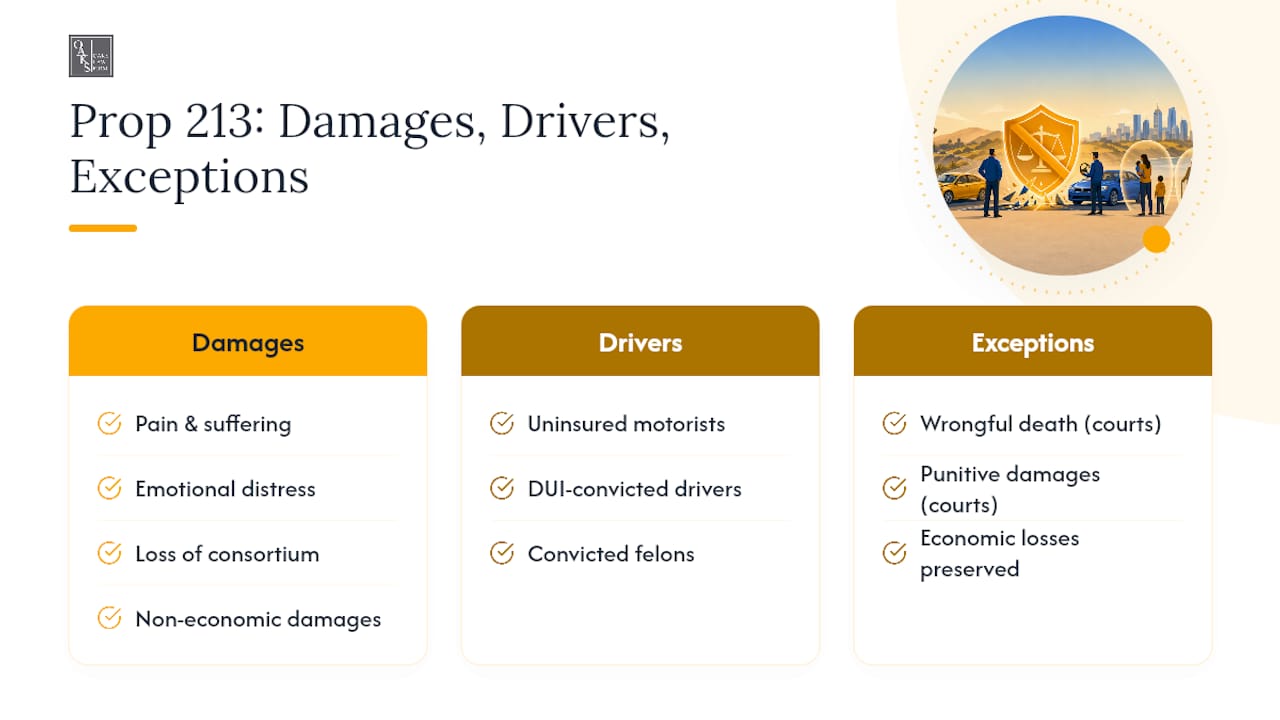
That initiative became Civil Code §3333.4, the statute doing the actual work today. In plain terms, the law says an uninsured motorist, a driver later convicted of DUI at the time of the crash, or a convicted felon injured while committing or fleeing a felony cannot recover damages for pain, suffering, emotional distress, or loss of consortium. The full statutory text also carves out the DUI-conviction exception that shows up repeatedly in real cases. The Legislative Analyst’s Office summarized the measure’s intent as limiting recovery for these specific groups while leaving compensation for actual financial losses intact.
Who Prop 213 Actually Reaches
Not every uninsured person loses their non-economic damages. The statute targets specific roles and specific facts, and getting this wrong is one of the most common mistakes injury victims make when reading about their own case.
- Vehicle owners without insurance. If you own the car and let your policy lapse, Prop 213 can apply to you directly, even if someone else was driving at the time.
- Operators who lack financial responsibility. California’s Vehicle Code financial responsibility rules tie directly into who counts as “uninsured” under §3333.4, so borrowing a friend’s uninsured car can trigger the same bar.
- Convicted felons hurt during the crime. The bar applies only when the injury happened while committing a felony or fleeing the scene, not to felons generally.
- DUI-convicted drivers. The bar attaches once there’s an actual conviction tied to the crash, not merely an arrest.
- Passengers and many employees. If you were a passenger, or an employee driving a vehicle your employer insured, you typically fall outside Prop 213’s reach entirely.
That last point trips people up constantly. Being in an uninsured car as a passenger doesn’t strip your rights, the statute is aimed at the uninsured owner or operator, not everyone who happened to be riding along.
Economic Versus Non-Economic Damages Under Prop 213
Prop 213’s bar is narrower than most people assume. It targets non-economic damages, the compensation for pain, suffering, mental anguish, disfigurement, and loss of enjoyment of life. It does not touch economic damages, the costs you can actually calculate and document.
- Barred (for affected groups): Pain and suffering, emotional distress, loss of consortium, and similar subjective losses.
- Still recoverable: Medical bills, future lost wages, property damage, and other quantifiable losses.
- Often still available: Punitive damages in cases involving malice or gross misconduct, according to practitioner analysis of the statute.
- Available to survivors: Wrongful-death heirs, who can pursue their own non-economic losses even when the deceased would have been barred.
Roughly 1 in 5 California drivers are estimated to be uninsured, according to the Legislative Analyst’s Office. That figure explains why Prop 213 issues surface in such a large share of California crash claims, and why understanding what happens when the at-fault driver was uninsured matters well beyond the barred groups themselves.
The Exceptions That Can Restore Full Recovery
Prop 213 has real teeth, but it isn’t absolute. Several exceptions come up in practice often enough that no injury victim should assume they’re automatically barred without checking.
- The DUI-conviction exception. Subdivision © of §3333.4 lets an uninsured motorist recover non-economic damages if the at-fault driver was convicted of DUI in connection with the crash. This is the exception attorneys lean on most.
- Passenger protections. Passengers generally aren’t subject to the bar regardless of whose car they were riding in or who was insured.
- Wrongful-death survivor claims. Surviving family members can typically pursue their own non-economic damages, separate from what the deceased victim could have claimed.
- Employer-vehicle nuances. Employees driving employer-insured vehicles with permission usually fall outside the bar even if their personal policy had lapsed.
- Excessive-force exception for felons. A felon injured by law enforcement using excessive force during an arrest may still recover, even if the felony exception would otherwise apply.
Pro Tip: An arrest for DUI is not enough to trigger the exception. The other driver must actually be convicted, so ask your attorney to pull the criminal case disposition early rather than assuming a pending charge will resolve in your favor.
How California Courts Have Shaped Prop 213
Statutory language only gets you so far. California courts have spent years clarifying where Prop 213’s bar starts and stops, and three cases come up constantly in practitioner discussions of the statute.
Horwich v. Superior Court addressed how Prop 213 interacts with wrongful-death claims, reinforcing that survivors’ own non-economic damages sit apart from restrictions that might have applied to the deceased. Nakamura v. Superior Court tackled the question of punitive damages, an issue that matters enormously to victims facing an uninsured or DUI-convicted defendant, since punitive damages can remain available even when compensatory non-economic damages are barred. Other decisions, sometimes cited alongside Hodges, have wrestled with statutory ambiguity in how “convicted” and “uninsured” get applied to edge-case fact patterns.
The practical takeaway: defendants and insurers sometimes cite Prop 213 to try to knock out an entire claim on summary adjudication, but courts have repeatedly refused to read the statute more broadly than its text supports. Case law shifts, so verifying current citations before relying on any single decision matters.
Protecting Your Claim When Prop 213 Is in Play
What you do in the days and weeks after a crash often decides whether Prop 213 becomes a real obstacle or a non-issue.
- Document everything at the scene. Photos, witness contact information, and the other driver’s insurance card or lack thereof all matter later.
- Get your medical records organized early. These support economic damages regardless of how the Prop 213 analysis shakes out.
- Track the criminal case. If the other driver was arrested for DUI, follow the case to its disposition. A conviction is what unlocks the exception, not the arrest report.
- Don’t take an insurer’s word for it. An adjuster telling you that “Prop 213 bars your claim” is not a legal ruling, it’s a negotiating position, and it’s frequently wrong or incomplete.
- Watch your deadlines. California’s general personal injury statute of limitations is two years from the date of injury under CCP §335.1. If a government entity, a city vehicle, a public bus, is involved, you generally must file a government claim within six months under Gov. Code §911.2, with limited exceptions for late-claim relief.
| Point | Details |
|---|---|
| Statute location | Prop 213’s bar is codified at Civil Code §3333.4, covering uninsured motorists, DUI-convicted drivers, and felons. |
| Damages split | Non-economic damages are barred for affected groups; economic damages generally remain recoverable. |
| Key exception | A DUI conviction against the other driver restores an uninsured victim’s non-economic damages. |
| Filing deadlines | Two years under CCP §335.1, or six months for government-entity claims under Gov. Code §911.2. |
How Oaks Law Firm Approaches Prop 213 Cases
Since 2002, Matthew Nezhad and the team at Oaks Law Firm have represented injured Californians throughout the and beyond, with offices in Sherman Oaks and Woodland Hills. When Prop 213 questions arise, the firm’s process starts with early fact-finding: pulling criminal-case dispositions, verifying insurance coverage on all vehicles involved, and analyzing whether an exception applies before an insurer’s initial denial ever becomes the final word. That groundwork shapes whether a case heads toward negotiation or full litigation readiness.
Attorney Note: Common Pitfalls Worth Avoiding
Too many injured drivers accept an insurer’s Prop 213 denial without a second opinion, and it costs them. Recoveries and timelines vary case by case, so treat any early estimate skeptically. If you’re unsure where you stand, reach out for a free evaluation before deadlines start working against you.
— Matthew Nezhad
Get Help Determining Your Rights Under Prop 213
Figuring out whether Prop 213 applies to your case, and whether an exception restores your full recovery, isn’t something you should sort out alone against an insurance company’s legal team. Oaks Law Firm reviews the DUI conviction records, insurance paperwork, and crash details that actually decide these cases, at no upfront cost to you.
Oaks Law Firm handles car accident claims, wrongful death cases, and insurance-coverage disputes throughout California on a contingency-fee basis, meaning you pay nothing unless the firm wins your case. That includes situations where an insurer has already pointed to Prop 213 as a reason to deny your claim, a position that deserves scrutiny rather than automatic acceptance. If you’ve lost a loved one in circumstances touching on Prop 213, the firm’s wrongful death representation addresses survivor claims specifically. To understand what your case might be worth and how the filing process works, start with the firm’s guide on how to file a personal injury lawsuit and request your free case evaluation today.
Primary Sources on Prop 213
For readers who want to verify the statute directly, the Legislative Analyst’s Office analysis explains the measure’s intended effects, the official ballot pamphlet contains the original proposed law, and Civil Code §3333.4 provides the current codified text, including the DUI-conviction exception.
Sources
- Proposition 213: Limitation on Recovery to Felons, Uninsured Motorists, Drunk Drivers (Legislative Analyst’s Office)
- California Code, Civil Code – CIV § 3333.4 | FindLaw
- Proposition 213: Text of Proposed Law (CA Secretary of State Vote96)
- Understanding California’s Prop 213 and uninsured drivers (LegalClarity)
FAQ
What does Prop 213 mean in California?
Prop 213 bars uninsured motorists, DUI-convicted drivers, and felons injured during a crime from recovering non-economic damages like pain and suffering, while leaving economic damages like medical bills generally recoverable.
What does “ruling out Prop 213” mean in a claim?
It means an attorney has confirmed that an exception, such as the DUI-conviction rule, your status as a passenger, or a wrongful-death claim, applies, so the bar on non-economic damages doesn’t limit your recovery.
What are the exceptions to Prop 213 in California?
The main exceptions include the DUI-conviction exception for uninsured victims, passenger protections, wrongful-death survivor claims, certain employer-vehicle situations, and the excessive-force exception for felons injured by law enforcement.
Is it against the law to not have auto insurance in California?
Yes, California requires drivers to carry minimum liability insurance or otherwise prove financial responsibility, and driving uninsured can expose you to both traffic penalties and the damages limitations under Prop 213.
Can Oaks Law Firm help if my insurer says Prop 213 blocks my claim?
Yes, Oaks Law Firm reviews criminal-case dispositions, insurance records, and the specific facts of your crash to determine whether an exception applies before accepting an insurer’s denial as final.
This article provides general information about California law and does not constitute legal advice. Laws change, and outcomes depend on the specific facts of each case. For guidance on your situation, consult a licensed California attorney.
