

Walking into a free personal injury consultation without preparation is one of the most common mistakes injured people make. You get limited time with an attorney, your memory of the accident is already fading, and the stakes are real. Personal injury free consultation prep, the process of organizing your documents, account, and questions before the meeting, is what separates clients who leave with clarity from those who leave with more confusion than they arrived with. This guide gives you a precise, step-by-step plan so you walk in ready.
Table of Contents
- Key takeaways
- Personal injury free consultation prep: what to bring
- How to write your account of the accident
- Questions to ask your personal injury lawyer
- What to expect during the injury consultation
- What to do after the consultation
- My take: preparation is the real first step toward justice
- Ready to put your preparation to work?
- FAQ
Key takeaways
| Point | Details |
|---|---|
| Gather documents first | Police reports, medical records, and financial proof turn your story into a verifiable case from the start. |
| Write your account early | Accident details fade fast; a written chronological narrative helps you communicate clearly and accurately. |
| Prepare your questions | A prepared question list keeps you in control of the meeting and helps you evaluate the attorney. |
| Know what to expect | Consultations last 30 to 60 minutes and follow a structured flow from storytelling to legal assessment. |
| Verify fit after the meeting | Reviewing the attorney’s responses and communication style is as important as the meeting itself. |
Personal injury free consultation prep: what to bring
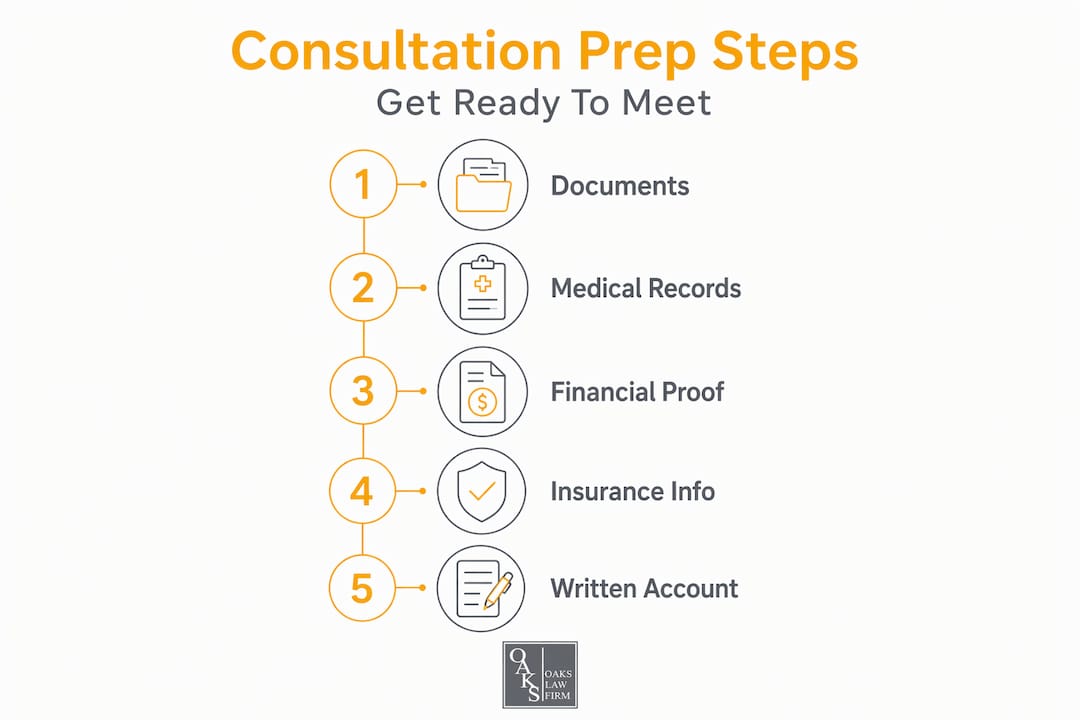
Preparation starts before you ever sit down across from an attorney. The documents you bring to your free injury lawyer consultation are what allow a lawyer to move from listening to actually evaluating your case. Without them, the meeting stays surface-level. With them, you get real answers.
Accident documentation
Bring accident documents as your starting foundation. That means the police or incident report, photographs of the scene, your vehicle, visible injuries, and any hazardous conditions that caused the accident. If witnesses were present, include their names and contact information. These records establish facts that your personal account alone cannot.
Medical records
Medical records are the backbone of any strong injury case. Gather everything related to treatment: emergency room reports, specialist notes, physical therapy records, prescription records, and all billing statements. These documents prove your injuries are real, show the severity, and counter any attempt by an insurer to minimize your claim.
Financial documents
People consistently underestimate this category. Lost wage documentation from pay stubs or employer letters turns your financial harm into concrete numbers an attorney can work with. Add any receipts for out-of-pocket expenses: transportation to medical appointments, medical equipment, home care costs.
Insurance and correspondence records
Bring your insurance policy, any communications from the at-fault party’s insurer, and letters or emails you have received since the incident. These reveal what the other side is already saying about your claim and help the attorney spot red flags early.
Here is a quick reference for what to organize before the meeting:
| Document type | Examples | Why it matters |
|---|---|---|
| Accident records | Police report, photos, witness info | Establishes facts of the incident |
| Medical records | ER reports, specialist notes, therapy records | Proves injury severity and treatment |
| Financial records | Pay stubs, employer letter, expense receipts | Quantifies economic losses |
| Insurance and correspondence | Policy documents, insurer emails, settlement offers | Shows the other side’s position |
Pro Tip: Organize everything into a single folder, either physical or digital, in the same order as the table above. Attorneys work faster when documents are grouped by type, and it signals that you are a serious, organized client.
If you have been in a car accident, a detailed checklist on documenting car accident injuries can help you fill in any gaps before the meeting.
How to write your account of the accident
Your memory is not as reliable as you think it is. Research confirms that accident details fade quickly, which is exactly why writing down your account before the consultation is one of the most practical steps for a personal injury consultation you can take. A written account gives the attorney a clear, consistent story and helps you answer questions under the mild pressure of a formal meeting.
Here is how to build your written account step by step:
- Start with the date, time, and location. Be precise. “Around noon on March 4 at the intersection of Ventura Boulevard and Sepulveda” is more useful than “a Tuesday afternoon in the Valley.”
- Describe the conditions. Note weather, lighting, road conditions, and any environmental factors that contributed to what happened.
- Walk through your actions. What were you doing just before the incident? Where were you going? This context matters for establishing what was normal and expected of you.
- Describe the incident itself. What happened, in the order it happened. Keep this factual. Avoid language that assigns blame; your attorney will handle that analysis.
- Document immediate aftermath. Did you call 911? Did you speak to anyone? Did you feel pain right away or hours later? Note all of it.
- Track your symptoms and recovery. List when symptoms appeared, how they progressed, what treatments you received, and how the injury has affected your daily life. Include sleep disruption, inability to work, canceled plans, and emotional impact.
Pro Tip: Keep the tone factual and specific, not emotional. Write “I could not lift my right arm above shoulder height for six weeks” rather than “I was in terrible pain.” Specific, measurable statements carry more weight in legal evaluation.
Your written account is not a legal document. It is a tool to help you communicate clearly so that the attorney can assess your case accurately. Think of it as your briefing notes for the meeting.
Questions to ask your personal injury lawyer
Most people go into a free legal advice consultation for injury claims with the vague goal of “finding out if they have a case.” That is too passive. A prepared list of questions transforms the meeting from a one-way assessment into a genuine conversation where you are evaluating the attorney just as much as they are evaluating your claim.
Experts confirm that a prepared question list levels the playing field and lets you actively engage rather than simply react. Here are the questions worth asking:
- Do you have experience with cases like mine? Experience with car accidents, slip and falls, or workplace injuries varies. Ask specifically about the type of incident you experienced.
- How do you communicate with clients? Find out whether they use phone, email, or a client portal, and how often you can expect updates.
- What is your fee structure? Personal injury attorneys commonly work on contingency fee arrangements, meaning they only charge if they recover money for you. Confirm this upfront and ask what percentage they take.
- What are the realistic challenges in my case? A trustworthy attorney will name the obstacles directly. Anyone who guarantees a win at a first meeting is not being straight with you.
- Who will actually handle my case day to day? Some firms hand cases to junior staff after the initial meeting. Know who you are actually hiring.
- What is the likely timeline? Personal injury cases vary widely. Get a realistic range so you can plan accordingly.
- What happens if we do not settle and need to go to trial? Understanding the full process helps you make an informed commitment.
Pro Tip: Bring a notebook and write down the attorney’s answers during the meeting. You will not remember everything afterward, and comparing answers across multiple consultations becomes much easier when you have notes.
Understanding compensation types in car accident cases before you meet with an attorney gives you even sharper questions to ask about what your claim may actually be worth.
What to expect during the injury consultation
Knowing the structure of the meeting in advance removes most of the anxiety. A typical consultation follows a clear sequence: the attorney asks you to tell your story, reviews your documents, assesses your case, and discusses potential next steps. That is it. There is no trick to it.

Most consultations run between 30 and 60 minutes. More complex injuries or larger document sets can extend that. Plan accordingly and do not feel rushed if the attorney takes time with your materials.
How the attorney evaluates your claim
After hearing your account, the attorney examines two core questions. First: can liability be established? That means determining whether another party’s negligence caused your injury. Second: what are the damages? They will look at both economic losses like medical bills and lost income, and non-economic losses like pain, emotional distress, and reduced quality of life. Your documents feed directly into both assessments.
The fee conversation
The fee structure discussion should happen in every first meeting. A reputable personal injury attorney will clearly explain the contingency arrangement, what percentage they charge, and whether there are any costs you might owe even if the case does not succeed. Do not leave without understanding this.
What good lawyer communication looks like
Here is a quick comparison of what you want to hear versus what should raise concern:
| What a good attorney says | What should concern you |
|---|---|
| “Here are the realistic strengths and challenges in your case.” | “You definitely have a strong case.” |
| “Here is exactly how our fees work.” | Vague or evasive answers about costs |
| “You should hear from us every two weeks.” | No clear communication plan offered |
| “This could take 12 to 18 months depending on complexity.” | Unrealistically short timelines promised |
“A good lawyer will never make false promises during the first meeting, focusing instead on a realistic assessment and clear next steps.” — Impakter
Pro Tip: Pay attention to how the attorney listens, not just what they say. Do they interrupt? Do they ask follow-up questions? An attorney who listens carefully during the consultation will likely listen carefully to you throughout your case.
One common misconception: the consultation is not an interrogation. You are not being judged. The attorney is gathering information to help you, and the consultation is a two-way process where both parties decide if the relationship makes sense. You have every right to walk away and consult with someone else.
What to do after the consultation
The work does not end when you walk out of the meeting. What you do in the days after your free injury lawyer consultation shapes whether you move forward with confidence or second-guess every decision.
Here are the most important post-consultation steps:
- Review your notes the same day. Your memory of the attorney’s answers will fade just like your memory of the accident. Write down your impressions while they are fresh.
- Compare consultations if you saw multiple attorneys. Use your question notes to evaluate responses side by side. Look for consistency, honesty, and clear communication.
- Gather any additional documents the attorney requested. Most attorneys will identify gaps in your documentation during the meeting. Track down those items quickly.
- Read the representation agreement carefully before signing. Understand the contingency percentage, what expenses may be deducted from a settlement, and what happens if you choose to end the relationship.
- Look for these signs of a good fit: The attorney answered your questions directly, explained the fee structure without prompting, gave you a realistic picture of your case, and communicated clearly about who handles what.
- Do not delay a decision unnecessarily. California has a statute of limitations on personal injury claims. Getting representation in place matters for preserving your legal options.
Once you decide to move forward, understanding the full personal injury lawsuit process in California helps you know exactly what comes next after you sign with an attorney.
My take: preparation is the real first step toward justice
In my experience, the clients who come in prepared are not just easier to help. They get better results. It sounds straightforward, but the difference is significant. When someone arrives with organized records, a written account, and specific questions, the entire meeting shifts. We can spend time on strategy instead of reconstructing basic facts. We can talk about realistic outcomes instead of asking follow-up questions that could have been answered by a police report sitting at home on a kitchen table.
I have seen people with genuinely strong cases walk away uncertain because they could not articulate what happened or what they had lost. The injury was real. The negligence was clear. But without documentation and a coherent account, the attorney cannot move with confidence either.
What I have learned after years of handling cases in the is that preparation signals something beyond organization. It tells me the client takes their own claim seriously. That matters because the cases that get resolved well are the ones where the attorney and client are working as a team from day one.
My honest advice: treat the consultation not as a hurdle but as the first strategic move in your case. Every document you bring, every question you ask, every note you take is you doing the work that gets you closer to real compensation. The attorney’s job is to carry the legal weight. Your job is to give them what they need to carry it effectively.
— Matthew Nezhad
Ready to put your preparation to work?

If you have done the work this guide describes, you are ready for a real conversation about your case. At Oaks Law Firm, attorney Matthew Nezhad and his team have spent decades protecting injured victims throughout the and greater Los Angeles area. The firm operates on a no-fee-unless-you-win basis, meaning you pay nothing unless your case succeeds. There is no financial risk to getting experienced legal eyes on what happened to you.
Oaks Law Firm handles a limited number of cases each year, which means every client receives focused, attentive representation rather than being lost in a high-volume caseload. Whether your injury stems from a car accident, a slip and fall, a workplace incident, or another act of negligence, the team knows how to build a case that holds negligent parties accountable. To understand how California compensation works and what your claim may be worth, the firm’s resources are there to help you go in informed. Schedule your free case evaluation and start with the conversation your case deserves.
FAQ
What should I bring to a free personal injury consultation?
Bring police or incident reports, photographs, witness contact information, all medical records and bills, proof of lost wages, insurance documents, and any correspondence from insurers. Organized documentation allows the attorney to evaluate your case accurately in the time available.
How long does a free injury lawyer consultation usually last?
Most personal injury consultations run 30 to 60 minutes. Complex cases with extensive injuries or large document sets may require more time, so plan to stay available for up to an hour.
What questions should I ask during my personal injury consultation?
Ask about the attorney’s experience with your type of case, their fee structure, who handles your case day to day, the realistic challenges ahead, and the expected timeline. A prepared question list keeps you focused and helps you compare attorneys after multiple consultations.
Do personal injury lawyers charge for the initial consultation?
Most personal injury attorneys offer free consultations and work on contingency, meaning they charge only if they recover money for you. Always confirm the fee structure during the meeting before signing any agreement.
What happens after the free consultation if I decide to hire the attorney?
You will sign a representation agreement outlining the contingency fee and costs, then the attorney begins building your case by gathering additional evidence and communicating with insurers. Understanding the full lawsuit process in California helps you know what to expect at each stage moving forward.
