
Attorney Advertising. This article was prepared with the assistance of artificial intelligence and reviewed by Oaks Law Firm prior to publication.
Under California law, drivers must yield to pedestrians in marked and unmarked crosswalks under California Vehicle Code §21950, but that right-of-way is not unconditional. Pedestrians crossing outside a crosswalk must yield to vehicles close enough to pose an immediate hazard under CVC §21954. Both duties matter in a crash: fault gets divided, not assigned to one side automatically, and that division can shrink or wipe out a settlement.
TL;DR:
- Pedestrians crossing outside marked crosswalks must yield to vehicles posing an immediate hazard, limiting their right-of-way in those situations.
- California law treats unmarked crosswalks at intersections as legally equivalent to marked ones, requiring drivers to yield and pedestrians to be cautious.
- Police enforcement of jaywalking laws is now limited to situations where crossing outside a crosswalk creates an immediate danger, but fault can still be assigned in civil cases.
- Fault in pedestrian-vehicle crashes is determined by a percentage of negligence based on evidence like police reports, cameras, witness statements, and scene photos.
- Victims should act quickly to preserve evidence, seek medical treatment, and contact an attorney within two years for most claims, or six months if a government entity is involved.
Table of Contents
- Pedestrian Right of Way California: What the Statutes Actually Require
- Jaywalking Law in California After the Freedom to Walk Act
- Marked Crosswalks, Unmarked Crosswalks, and Rules for Blind Pedestrians
- How Fault Gets Determined After a Pedestrian-Vehicle Collision
- What to Do After a Pedestrian Accident and the Deadlines That Control Your Case
- How a California Pedestrian Accident Attorney Builds Your Case
- Why We Focus on Pedestrian Cases Across California
- Get a Free Case Evaluation From Oaks Law Firm
- Sources
- FAQ
Pedestrian Right of Way California: What the Statutes Actually Require
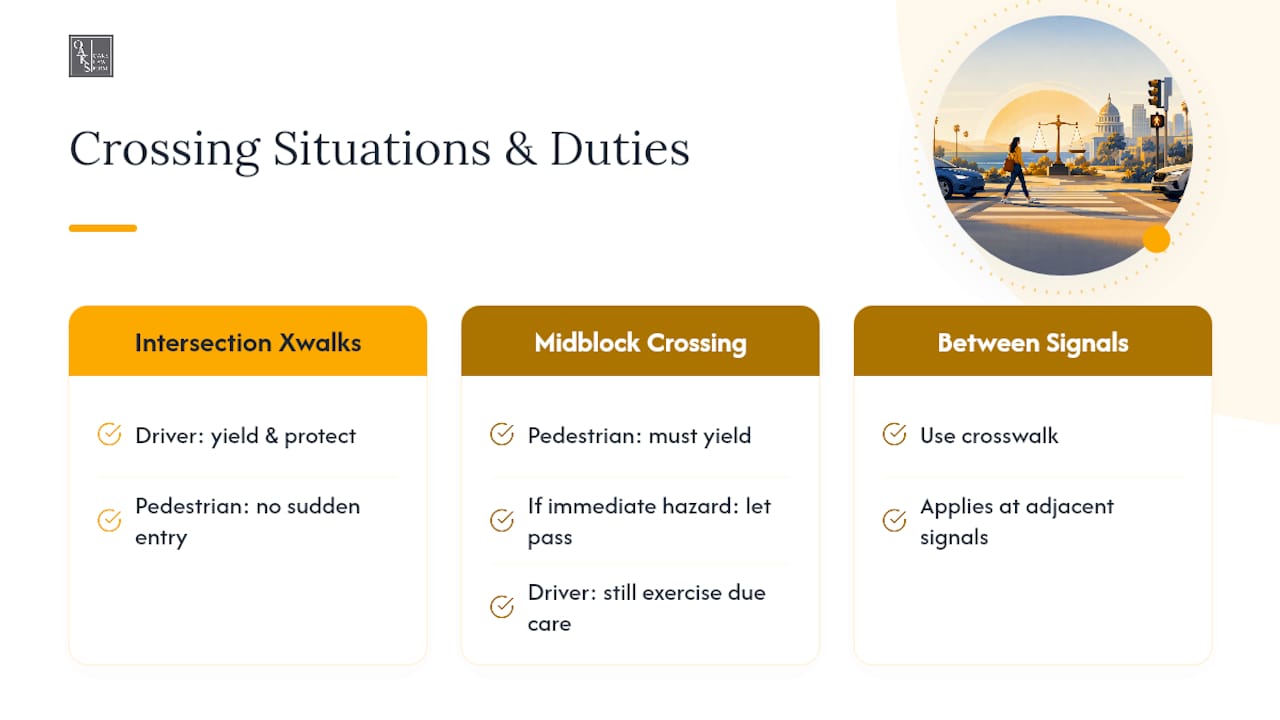
California Vehicle Code §21950 is the backbone of pedestrian right-of-way law in the state. It requires drivers to yield to pedestrians crossing within any marked crosswalk, or any unmarked crosswalk at an intersection, and to slow down or take whatever action is necessary to protect the person crossing. The same statute cuts the other way, too: pedestrians can’t abruptly leave a curb or other place of safety and walk into the path of a vehicle that’s close enough that the driver has no reasonable chance to stop.
CVC §21954 governs the flip side, when someone crosses mid-block or outside any crosswalk. There, the pedestrian owes the yielding duty. If a car is close enough to be an “immediate hazard,” the person on foot has to let it pass before crossing. Drivers still aren’t off the hook entirely. The law still expects them to exercise due care and avoid colliding with any pedestrian on the roadway, crosswalk or not.
Then there’s CVC §21955, which restricts crossing between two adjacent intersections that both have traffic signals or officer control. If you’re between two signalized intersections, you’re generally supposed to use the crosswalk rather than cut across the middle of the block.
The DMV Driver Handbook fills in the practical details licensed drivers are tested on: stop behind the limit line, never pass a vehicle stopped for a pedestrian at a crosswalk, and watch for pedestrian signals even where there’s no painted crosswalk at all. Those instructions aren’t just driving-test trivia. Insurance adjusters and courts routinely point to that same DMV guidance when deciding whether a driver acted reasonably.
Jaywalking Law in California After the Freedom to Walk Act
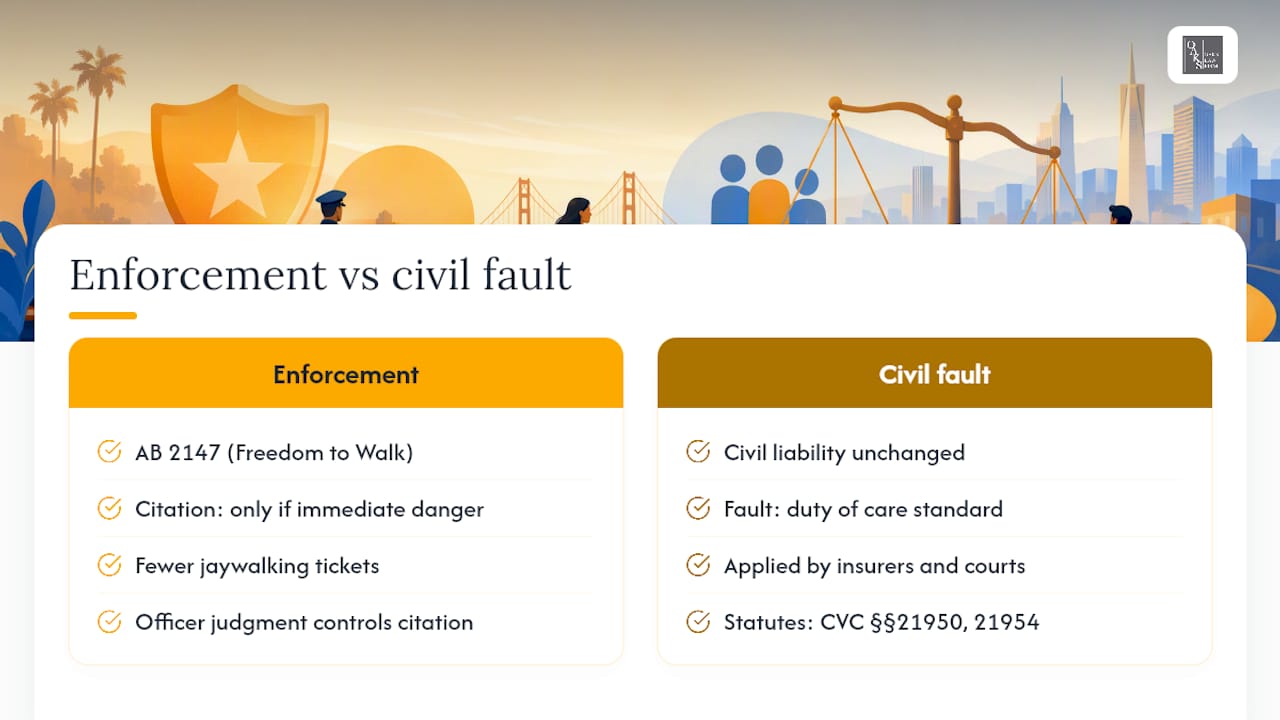
Assembly Bill 2147, known as the Freedom to Walk Act, changed how police can enforce jaywalking. Officers can no longer stop or cite a pedestrian for crossing outside a crosswalk or against a signal unless “a reasonably careful person would realize there is an immediate danger of a collision,” as the Sacramento Bee reported when the law changed enforcement practice statewide. In plain terms, jaywalking that doesn’t create real danger stops being a ticketable offense.
That’s an enforcement rule, not a civil liability rule, and the distinction trips people up constantly. A police officer’s decision not to write a jaywalking ticket at the scene tells you nothing about who was at fault if a collision actually happens. Insurance companies and civil courts apply their own separate analysis: did the pedestrian or the driver breach a duty of care under CVC §21954, §21950, or general negligence principles?
Picture two scenarios. In the first, a pedestrian crosses mid-block on an empty residential street with no cars in sight. No ticket, no accident, no issue. In the second, that same pedestrian crosses mid-block and steps directly into a lane where a car is approaching at 35 miles per hour. No citation follows because AB 2147’s threshold wasn’t met by the officer’s assessment, but if a collision happens, the pedestrian’s decision to enter the roadway is still very much on the table in a civil fault analysis. Legal experts have noted that AB 2147 narrows tickets, not the underlying civil-duty standard insurers and courts still used to sort out blame.
Marked Crosswalks, Unmarked Crosswalks, and Rules for Blind Pedestrians
Most people assume a crosswalk needs painted lines to count legally. It doesn’t. California law treats the area where two sidewalks would connect across an intersection as an unmarked crosswalk, whether or not any paint exists on the pavement. That single fact causes more driver confusion, and more contested liability disputes, than almost any other pedestrian rule on the books.
Drivers owe pedestrians the same yielding duty in both marked and unmarked crosswalks. The practical rules are identical either way: slow down approaching any intersection, stop behind the limit line rather than blocking the crosswalk, and never pass a vehicle that has stopped for a pedestrian, since the stopped car may be blocking your view of someone still crossing.
Blind and visually impaired pedestrians get an extra layer of protection. Under California’s pedestrian rights statutes, a person carrying a white cane or using a guide dog has the right-of-way at all times, and a driver who fails to yield to them can face misdemeanor penalties, including fines and potential jail time. That heightened statutory duty also strengthens a civil claim if a driver ignores it and causes injury.
Pro Tip: If you’re driving through a residential intersection with no painted lines, assume it’s a legal crosswalk anyway. That habit alone prevents a lot of avoidable collisions.
How Fault Gets Determined After a Pedestrian-Vehicle Collision
California follows a pure comparative negligence rule, meaning a jury or insurer can assign a percentage of fault to each party and reduce the pedestrian’s recovery by that percentage. If a pedestrian is found 20% at fault for stepping off a curb without looking, and the driver 80% at fault for speeding, the pedestrian’s damages award drops by 20%. Even a pedestrian found mostly at fault can often still recover something for the driver’s share of the blame. The mechanics of how comparative fault works in California injury cases end up mattering as much as the crash itself.
The evidence that typically shifts these percentages includes:
- The police collision report, including officer observations at the scene
- Traffic camera or dashcam video, where it exists
- Independent witness statements taken close to the time of the crash
- Medical records documenting the pedestrian’s injuries and treatment timeline
- Scene photos showing crosswalk markings, signal timing, and sightlines
Certain behaviors reliably push fault toward the pedestrian: darting off a curb without checking traffic, crossing against a “Don’t Walk” signal, or walking into a lane while looking at a phone. Others push fault toward the driver: speeding through a marked crosswalk, distracted driving, failing to stop at a limit line, or blowing through a stale yellow light. Most real cases land somewhere between those extremes, which is exactly why documentation matters so much.
What to Do After a Pedestrian Accident and the Deadlines That Control Your Case
The first hour after a crash shapes the case more than almost anything that happens later. Get medical care immediately, even for injuries that seem minor, since some soft-tissue and head injuries don’t show symptoms for days. Call the police so an official report exists. Photograph the scene, the vehicle, the crosswalk markings, and your own injuries before evidence disappears or gets cleaned up. Collect names and phone numbers from any witnesses on the spot; they rarely stick around, and they’re almost impossible to track down later. Avoid saying anything that sounds like an apology or an admission of fault at the scene, since those statements get repeated in claims files.
- Seek medical treatment and keep every record, bill, and diagnosis.
- Report the collision to police and request a copy of the report number.
- Preserve photos, video, and witness contact information before it’s lost.
- Avoid discussing fault with insurance adjusters until you’ve spoken with an attorney.
- Contact a personal injury attorney promptly to evaluate your claim.
California’s general statute of limitations for personal injury claims is two years from the date of the accident, under Code of Civil Procedure §335.1. That deadline shrinks dramatically if a government entity is involved, say a city-owned intersection with a malfunctioning signal. In those cases, Government Code §911.2 requires filing an administrative claim within six months of the incident, and missing that window can bar the case entirely regardless of how strong the underlying facts are. Some exceptions extend these deadlines, such as when the injured person is a minor, but exceptions are narrow and fact-specific, which is exactly why understanding the government tort claim process early on matters so much when a public roadway or agency is involved.
How a California Pedestrian Accident Attorney Builds Your Case
Evidence in pedestrian cases disappears fast. Skid marks fade, surveillance footage gets overwritten, and witnesses forget details within weeks. An attorney’s job starts with locking that evidence down before it’s gone.
- Sending preservation letters for surveillance and traffic camera footage
- Working with accident reconstruction and medical experts to establish causation
- Filing government claims or lawsuits within the applicable deadlines
- Negotiating directly with insurance adjusters who are trained to minimize payouts
- Taking the case to litigation when a fair settlement isn’t on the table
Oaks Law Firm has represented injured pedestrians and other accident victims throughout the since 2002, with offices in Sherman Oaks and Woodland Hills. Founder Matthew Nezhad built the practice around taking a limited number of cases each year rather than volume, which allows more time on fact-finding in each individual claim. Every case starts with a free case evaluation.
Pro Tip: Ask any attorney you’re considering how many cases they’re actively handling right now. A firm juggling hundreds of files can’t give your evidence the same attention as one working a limited caseload.
No attorney can guarantee a specific outcome, and compensation varies based on medical costs, lost income, pain and suffering, and the percentage of fault ultimately assigned to each side.
Why We Focus on Pedestrian Cases Across California
Pedestrian collisions leave some of the most serious injuries we see, and the legal questions around fault are rarely as simple as who had the walk signal. Because we take on a limited number of cases each year, our team can dig into the police report, the signal timing, the witness statements, and the medical record in the kind of detail these cases demand. If you were hit while walking anywhere in California, we’ll review what happened with you at no cost.
— Matthew Nezhad
Get a Free Case Evaluation From Oaks Law Firm
If you’ve been hurt in a crosswalk, at an intersection, or crossing a California street, Oaks Law Firm works on contingency, meaning there’s no upfront cost and no fee unless we recover compensation for you. A free case evaluation covers what happened, what evidence still needs to be preserved, and whether a six-month government claim deadline applies to your situation.

Our team has handled pedestrian and vehicle collision claims throughout the since 2002, from initial evidence gathering through settlement negotiation or litigation. If you’re weighing whether to move forward, our guide on how to file a personal injury lawsuit in Los Angeles walks through what that process actually looks like, and our page on how car accident compensation works in California breaks down the categories of damages pedestrians can pursue. Call our Sherman Oaks or Woodland Hills office, or submit our online form, to start your free evaluation today.
This article is general information, not a substitute for advice from a qualified lawyer. Consult a qualified legal professional about your own circumstances before acting on anything here.
Sources
- California Vehicle Code §21950
- Is jaywalking legal in California? New law will change rules | Sacramento Bee
- Section 7: Laws and Rules of the Road – California DMV
FAQ
Do pedestrians always have the right-of-way in California?
No. Pedestrians have the right-of-way in marked and unmarked crosswalks under CVC §21950, but outside a crosswalk they must yield to vehicles close enough to be an immediate hazard.
Does a pedestrian still have the right-of-way if they were jaywalking?
Not automatically. Jaywalking outside a crosswalk shifts the yielding duty to the pedestrian under CVC §21954, and it can increase their share of fault in a civil claim even if police issued no citation.
Do pedestrians have the right-of-way anywhere in the United States, or is this specific to California?
Right-of-way rules vary by state; this article addresses California’s statutory framework specifically, and drivers or pedestrians relying on rules from another state risk misjudging their obligations here.
What should I do immediately after being hit as a pedestrian in California?
Seek medical care, call police to file a report, photograph the scene, and collect witness contact information before speaking with any insurance adjuster about fault.
How long do I have to file a pedestrian injury claim in California?
Generally two years from the date of the incident under CCP §335.1, but only six months if a government entity is involved, under Gov. Code §911.2.
This article provides general information about California law and does not constitute legal advice. Laws change, and outcomes depend on the specific facts of each case. For guidance about your situation, contact Oaks Law Firm for a free case evaluation.
