
Attorney Advertising. This article was prepared with the assistance of artificial intelligence and reviewed by Oaks Law Firm prior to publication.
The open and obvious defense in California does not automatically end your slip-and-fall claim. A property owner who argues that a hazard was plainly visible may eliminate their duty to warn you about it, but California law can still hold them responsible for failing to fix it. That distinction is what most injured people never hear until it is too late.
CACI No. 1004 (Obviously Unsafe Conditions) is the jury instruction that governs this split. It tells jurors that an obvious hazard may excuse a warning, yet a separate duty to remedy can survive when it was foreseeable that someone would encounter the condition anyway. The Rowland v. Christian framework and Kinsman v. Unocal reinforce that point: obviousness goes to breach and comparative fault, not to an automatic dismissal of the claim. Under California’s pure comparative negligence system, your recovery is reduced by your share of fault, but it is rarely zeroed out entirely.
If you were hurt on someone else’s property, collect photos and witness information now, note every deadline below, and speak with an attorney before the clock runs out.
Key Takeaways
The open and obvious defense in California eliminates only the duty to warn, not the duty to remedy, and comparative fault reduces recovery without eliminating it.
| Point | Details |
|---|---|
| Duty to warn vs. duty to remedy | Obviousness removes the warning obligation but a duty to fix the hazard can survive under CACI No. 1004. |
| Comparative fault preserves recovery | California’s pure comparative negligence system reduces damages by your fault share but does not bar recovery entirely. |
| Deadlines are strict | CCP §335.1 gives most claimants two years; Gov. Code §911.2 gives only six months for claims against public entities. |
| Evidence is time-sensitive | Send a preservation letter within 24 hours; surveillance footage is often overwritten in 24 to 72 hours. |
| Oaks Law Firm | Offers free case evaluations and contingency-fee representation for premises liability claims throughout California. |
Table of Contents
- What does CACI No. 1004 actually say about open and obvious dangers?
- How do courts decide whether a hazard is truly “open and obvious”?
- How defendants use the open and obvious defense in litigation
- Concrete strategies to defeat the open and obvious defense
- Critical California deadlines every claimant must know
- How Oaks Law Firm assesses and attacks open and obvious defenses
- What people in these situations actually need to hear
- Oaks Law Firm is ready to evaluate your premises liability claim
- Sources
- FAQ
What does CACI No. 1004 actually say about open and obvious dangers?
CACI No. 1000 lays the foundation: a plaintiff must prove the defendant controlled the property, was negligent in maintaining or using it, and that negligence caused harm. CACI No. 1004 then carves out a specific rule for obviously unsafe conditions.
The instruction has two distinct paragraphs. The first says a landowner owes no duty to warn when a condition is so apparent that a reasonable person would be expected to notice and avoid it. The second says that even when warning is unnecessary, the owner may still owe a duty to remedy the condition if it is foreseeable that someone will encounter it despite its obviousness.
The statutory anchor for all of this is Civil Code §1714(a), which imposes a general duty of reasonable care on everyone, including property owners. Rowland v. Christian (1968) translated that statute into the multi-factor balancing test California courts still apply when deciding whether a duty exists at all.
Duty to warn vs. duty to remedy: the practical split
| Dimension | Duty to warn | Duty to remedy |
|---|---|---|
| When it applies | Condition is not obvious; visitor cannot reasonably detect it | Condition is obvious but foreseeably encountered anyway |
| Typical evidence | Lack of signage, poor lighting, hidden defect | Prior complaints, high-traffic area, necessity of path |
| Practical effect | Eliminated when hazard is open and obvious | Survives even when hazard is open and obvious |
LegalClarity’s analysis of California case law confirms this split: obviousness typically removes only the warning obligation, leaving the remediation question open for a jury.
How do courts decide whether a hazard is truly “open and obvious”?
The standard is objective: would a reasonable person observing the condition have noticed it? Courts do not ask whether this particular plaintiff saw it. They ask whether a hypothetical reasonable person in the same situation would have.
Judges and juries weigh several factors when answering that question:
- Visibility and lighting. A crack in a dimly lit stairwell reads very differently from the same crack in bright daylight.
- Duration. How long had the condition existed? A spill that formed minutes before a fall is treated differently from one that sat for hours.
- Location. Is the hazard in a spot visitors are expected to walk through, or off to the side?
- Prior complaints and notice. Did the owner know about the condition before the fall? Written complaints or maintenance requests are powerful evidence.
- Foreseeability. Was it predictable that someone would encounter the hazard even knowing it was there?
- Distraction. Did the defendant create a condition (a display, a crowd, a loud environment) that pulled attention away from the hazard?
- Necessity. Was the plaintiff forced to encounter the hazard because there was no reasonable alternative path?
- Complexity. Some hazards look minor but are structurally dangerous; a surface that appears dry but is actually slick is not “obvious” in any meaningful sense.
Two quick examples show how these factors shift outcomes. A bright yellow “wet floor” cone in the center of an empty aisle is about as obvious as a hazard gets. A jury would likely find the warning duty satisfied. Now move that same wet floor behind a seasonal merchandise display that funnels shoppers directly into the slick area. The distraction and necessity factors change the analysis entirely, and California courts recognize that defendant-created distractions can revive a duty to remedy even when the underlying hazard was technically visible.
How defendants use the open and obvious defense in litigation
Defense teams rarely wait for trial to raise this argument. Advocate Magazine’s review of common premises-liability defense tactics notes that open-and-obvious is frequently deployed early to pressure plaintiffs into low settlements before discovery is complete.
Here is the typical procedural sequence:
- Pre-litigation denial letters. Insurers cite open-and-obvious in their initial coverage or liability denial to set a low anchor for any settlement discussion.
- Demurrer or early motion practice. Defense counsel may argue the complaint fails to state a claim because the condition was obviously unsafe, though California courts rarely dismiss on this basis alone.
- Motion for summary judgment or summary adjudication. This is the main battleground. The defense submits declarations, site photos, and surveillance footage to argue no triable issue of fact exists on the duty question.
- Jury instruction requests. If the case reaches trial, defense counsel requests CACI No. 1004 alongside CACI No. 1000 to frame the jury’s analysis around the plaintiff’s own awareness of the hazard.
The summary-judgment stage is where most open-and-obvious fights are won or lost. California’s summary-judgment standard requires the moving party to show there is no triable issue of material fact. Because “obviousness” almost always depends on specific conditions (lighting, signage, distraction, necessity), courts frequently find it is a question for the jury rather than a matter of law. Typical defense evidence includes surveillance footage, witness declarations, inspection logs, and expert opinions on industry safety standards. Plaintiffs who have preserved their own evidence can create genuine factual disputes that defeat these motions.
Concrete strategies to defeat the open and obvious defense
The single most important thing you can do after a fall is preserve evidence before it disappears. Surveillance footage is often overwritten quickly, sometimes within a few days, so timely preservation is critical. Maintenance logs get “updated.” Witnesses move on.
Evidence checklist (prioritized by time-sensitivity):
- Timestamped photos and video of the exact hazard, the surrounding area, lighting conditions, and any signage (or its absence)
- Written preservation demand sent immediately to the property owner or manager, requesting that surveillance footage be retained
- Names and contact information for every witness present
- Incident report filed with the property owner before you leave (get a copy)
- Medical records from the day of the injury and every follow-up visit
- Weather records if the condition involved moisture or outdoor elements
- Maintenance logs, inspection schedules, and prior complaint records (obtained through discovery)
- Prior incident histories at the same location (obtained through discovery or public records)
Legal arguments that neutralize the defense:
Necessity. If the only path to the exit, restroom, or required destination ran through the hazardous area, the plaintiff had no real choice. Courts treat forced encounters as a strong counter to open-and-obvious arguments.
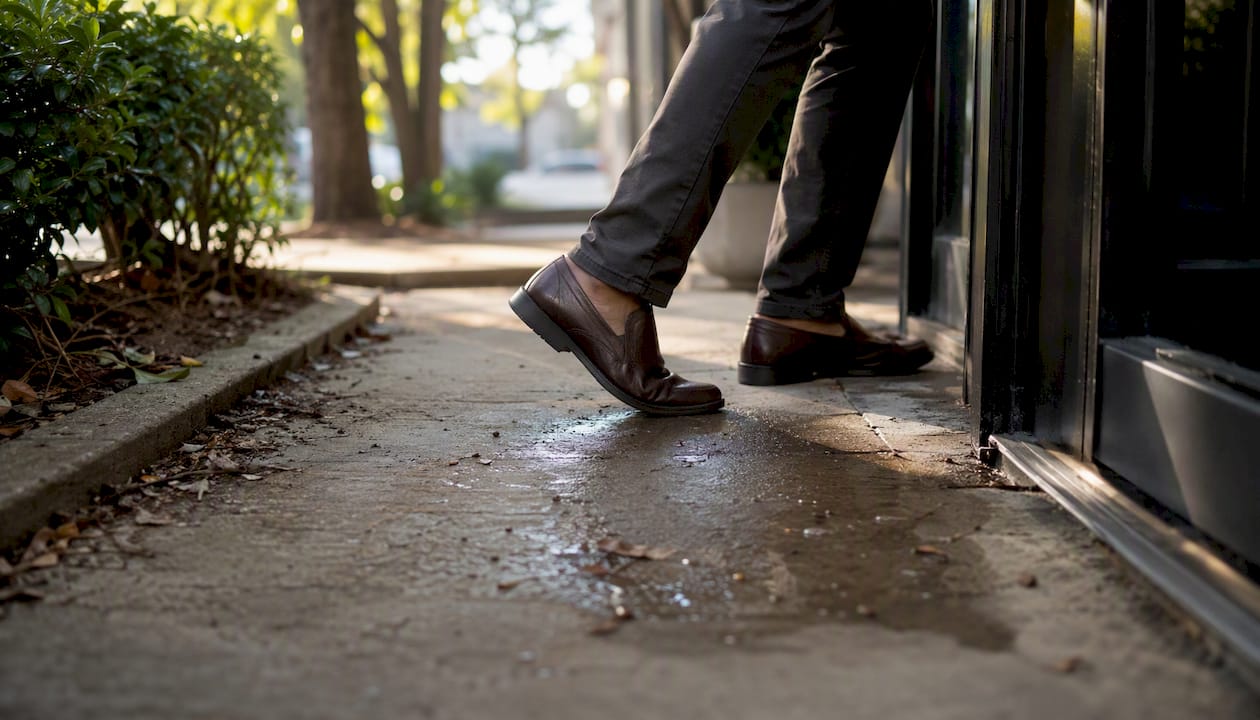
Distraction. When the defendant’s own displays, signage, or crowd management pulled attention away from the hazard, the “reasonable person would have noticed” standard becomes much harder to satisfy.
Foreseeability and prior notice. Evidence that the owner received complaints, had prior incidents, or knew the condition existed for an extended period shifts the duty-to-remedy analysis sharply toward the plaintiff.
Comparative fault framing. Even if the jury finds the plaintiff partly at fault, California’s pure comparative negligence system reduces recovery proportionally. It does not eliminate it. Framing the defense as a fault-allocation question rather than a duty question keeps damages on the table.
Discovery targets: maintenance schedules, vendor contracts, prior incident reports, employee training materials, and deposition testimony from the property manager on inspection frequency.
Pro Tip: Send a written evidence-preservation letter to the property owner within 24 hours of the incident. Address it to the owner, manager, and their insurance carrier. Specify surveillance footage, maintenance logs, and inspection records by date range. Courts look unfavorably on defendants who allow evidence to be destroyed after receiving a preservation demand.
Critical California deadlines every claimant must know
General statute of limitations. Under CCP §335.1, most personal injury claims in California must be filed within two years of the date of injury. Miss that window and the court will almost certainly dismiss the case, regardless of how strong the facts are. Exceptions exist for minors (the clock typically starts at age 18), delayed discovery of an injury, and certain tolling events.
Government-entity claims. If you were hurt on public property (a city sidewalk, a school, a government building), a different and much shorter deadline applies. Under Gov. Code §911.2, you must file a government tort claim with the responsible agency within six months of the incident. Filing a lawsuit is a separate step that comes later. Miss the six-month claim deadline and you generally lose the right to sue the public entity entirely.
What to do right now:
Document your injury with photos and a written account of exactly what happened, while details are fresh. Seek medical care immediately, both for your health and to create a contemporaneous record. Identify and contact witnesses before they forget details. Consult an attorney as soon as possible. Deadline exceptions are fact-specific and complex; only a licensed California attorney can tell you whether tolling applies to your situation.
This article provides general information, not legal advice. Confirm current deadlines and exceptions with a qualified California attorney.
How Oaks Law Firm assesses and attacks open and obvious defenses
At Oaks Law Firm, the work on an open-and-obvious case starts before any lawsuit is filed. Matthew Nezhad founded the firm in 2002 specifically to fight for injured people in the and throughout California, and the firm’s approach to these cases reflects two decades of doing exactly that.
Firm actions from day one:
- Immediate evidence-preservation letters to property owners, managers, and insurers
- Preservation subpoenas for surveillance footage when the owner is uncooperative
- Retention of safety and engineering experts to document the condition and evaluate industry standards
- Targeted discovery requests for maintenance logs, inspection schedules, prior complaints, and vendor contracts
- Damages documentation from the first medical visit through full recovery
Casework workflow:
Initial evaluation covers the facts, the property, and the applicable deadlines. Preservation follows immediately. Discovery and expert retention run in parallel. When the defense files a summary-judgment motion, the firm prepares a detailed opposition grounded in the foreseeability, necessity, and distraction arguments the evidence supports. If the case does not resolve at that stage, the team prepares for trial with CACI No. 1004 and No. 1000 instructions in mind from the start.
Oaks Law Firm works on a contingency-fee basis. There are no upfront attorney fees for accepted cases. The firm offers a free case evaluation so you can understand your options before committing to anything. The premises liability practice page describes the firm’s process in more detail.
What people in these situations actually need to hear
The open-and-obvious defense is one of the most misunderstood arguments in California premises liability law. Most people hear it and assume their case is over. It is not.
What the defense actually does is shift the conversation from “did the owner warn you?” to “should the owner have fixed it?” That is a harder question for a defendant to win, especially when the evidence shows they knew about the condition, had the resources to correct it, and chose not to. The law does not reward that choice just because the hazard happened to be visible.
Oaks Law Firm is ready to evaluate your premises liability claim
If you were hurt on someone else’s property in the or anywhere in California, Oaks Law Firm offers a free case evaluation with no obligation. Matthew Nezhad and his team handle premises liability claims on a contingency-fee basis, meaning you pay nothing unless the firm recovers compensation for you.

The firm serves clients from offices in Sherman Oaks and Woodland Hills, and takes cases throughout California. To understand your options and get the evidence-preservation process started, schedule a free consultation today. The sooner you act, the more options you have.
Sources
The following official and authoritative resources underpin the guidance in this article. Share them with your attorney or use them to verify the rules that apply to your situation.
- Leginfo
- Open and Obvious Defense in California: Limits and Exceptions – LegalClarity
- California Slip and Fall Laws: Proving Premises Liability | Recording Law
This article is general information, not legal advice. Laws and deadlines change; confirm current rules with a qualified California attorney or the primary sources above.
This article is general information, not a substitute for advice from a qualified lawyer. Consult a qualified legal professional about your own circumstances before acting on anything here.
FAQ
Does the open and obvious defense automatically defeat a California slip-and-fall claim?
No. Under CACI No. 1004, an obvious hazard may eliminate the duty to warn but not necessarily the duty to remedy. If the owner could foresee that someone would encounter the condition anyway, liability can still attach.
What is the statute of limitations for a premises liability claim in California?
Most personal injury claims, including slip-and-fall cases, must be filed within two years under CCP §335.1. Claims against government entities require a tort claim filed within six months under Gov. Code §911.2 before any lawsuit can proceed.
Can I still recover damages if I was partly at fault for my fall?
Yes. California follows pure comparative negligence, so your damages are reduced by your percentage of fault but are not eliminated.
What evidence most effectively defeats an open and obvious argument?
Prior complaints about the same condition, maintenance logs showing the owner knew about the hazard, surveillance footage, and expert testimony on industry safety standards are the most persuasive. Evidence of distraction or necessity of encountering the hazard also carries significant weight.
How does Oaks Law Firm handle open and obvious defense cases?
Oaks Law Firm sends immediate evidence-preservation letters, retains safety experts, and targets maintenance and inspection records through discovery. The firm works on contingency, so there are no upfront fees, and offers a free case evaluation to assess your claim.
This article is for general informational purposes only and does not constitute legal advice. No attorney-client relationship is formed by reading this content. Laws and procedures may change; consult a qualified California attorney for advice specific to your situation.
