

Attorney Advertising. This article was prepared with the assistance of artificial intelligence and reviewed by and Oaks Law Firm prior to publication.
Yes, lane splitting is legal in California under Vehicle Code §21658.1, which authorizes the California Highway Patrol to publish educational guidance on how to do it. The statute does not set a numeric speed limit or a maximum speed differential. Legality, though, is not the same thing as immunity from a lawsuit. If a crash happens while a rider is splitting lanes, fault still gets decided the same way it does in any other California collision: through evidence, negligence law, and comparative fault rules.
TL;DR:
- Lane splitting in California is legal under Vehicle Code §21658.1, but liability is determined by negligence, evidence, and fault rules, not the law itself.
- The California Highway Patrol offers safety recommendations, such as riding at a speed slightly above traffic, avoiding large vehicles, and not riding on the shoulder.
- Significant factors influencing safety include lane width, traffic speed, vehicle types, and real-time conditions, not a fixed speed limit.
- Fault in lane-splitting crashes depends on specific circumstances, with evidence like dashcam footage and witness statements crucial for liability assessment.
- Legal deadlines for filing injury claims are two years after a crash, or six months if a public entity is involved; early evidence preservation is essential.
Table of Contents
- Is Lane Splitting Legal in California? What the Statute Actually Says
- What CHP Actually Recommends: Official Guidance and Safety Tips
- When Is Lane Splitting Actually Safer, and When Does It Get Dangerous?
- Who’s at Fault When a Lane-Splitting Crash Happens?
- What Drivers Owe Motorcyclists Who Are Splitting Lanes
- After a Lane-Splitting Crash: Immediate Steps and Legal Deadlines
- How Oaks Law Firm Approaches Lane-Splitting Injury Claims
- The Real Problem With How People Talk About Lane Splitting
- Injured While Lane Splitting? Here’s What Oaks Law Firm Offers
- Where to Verify the Law Yourself
- Sources
- FAQ
Is Lane Splitting Legal in California? What the Statute Actually Says
Motorcycle lane splitting law in California comes down to one code section. Vehicle Code §21658.1 defines lane splitting as “driving a motorcycle, as defined in Section 400, that has two wheels in contact with the ground, between rows of stopped or moving vehicles in the same lane.” The law then does something unusual for California traffic code: it hands rulemaking authority to a law enforcement agency instead of the legislature itself. The statute directs the California Highway Patrol to “develop educational guidelines relating to lane splitting by motorcycles in a manner that would ensure the safety of the motorcyclist and the drivers and passengers of the surrounding vehicles.”
That single sentence is the entire legal foundation. There’s no separate section capping speed at 10 mph over surrounding traffic, no rule limiting the practice to freeways, and no statute barring it on surface streets. California is still the only state with a law that explicitly names and defines lane splitting, though a small number of other states now permit a related maneuver called lane filtering under separate rules.
The current statute has a specific history. Before 2016, lane splitting existed in a gray area. CHP had informally tolerated it and even published tip sheets for years, but no code section actually addressed it. That changed with AB-51, signed in 2016 and effective January 1, 2017, which added §21658.1 to the Vehicle Code and gave CHP the formal authority described above. The bill resolved years of ambiguity by making clear that riding between lanes of traffic isn’t, by itself, a Vehicle Code violation.
That doesn’t mean a rider gets a blank check. Every other traffic law in California still applies while a motorcyclist is splitting lanes. Speeding is still speeding, whether a rider is in a single lane or moving between two. Reckless driving under Vehicle Code §23103 still applies. Riding on the shoulder to pass traffic is illegal regardless of lane splitting’s legal status, a point the DMV’s Motorcycle Driver Handbook makes explicit. So does weaving erratically between three or more lanes, following too closely, or passing on the right in a way that violates other code sections. Lane splitting is legal. Doing it carelessly is not.
What CHP Actually Recommends: Official Guidance and Safety Tips
Because the legislature delegated guideline authority to CHP rather than writing detailed rules itself, the practical rulebook for lane splitting lives on the CHP’s own safety page, not in the Vehicle Code. CHP is explicit that these are recommendations, not enforceable speed limits, and that following them doesn’t guarantee a rider avoids a crash or a citation for some other violation.
The agency’s core guidance includes:
- Travel at a speed slightly faster than surrounding traffic, since a wider gap gives other drivers less time to react to a motorcycle’s approach.
- Avoid splitting lanes next to large vehicles like big rigs and buses, which have larger blind spots and less ability to see a motorcycle beside them.
- Choose the far-left lanes when possible, since drivers there tend to expect and watch for motorcycles more than drivers in center or right lanes do.
- Ride only when traffic allows enough space between vehicles to pass safely, and stop splitting if that space closes up.
- Be alert for changing conditions such as uneven road surfaces, opening doors, or vehicles that may suddenly change lanes.
- Never ride on the shoulder to bypass traffic; that’s a separate violation regardless of lane splitting’s legality.
CHP also points riders toward its broader California Motorcyclist Safety program for training resources, and the agency’s messaging consistently frames these tips as risk-reduction guidance rather than a legal shield. A rider who follows every CHP tip to the letter can still be found partly at fault if a crash happens, and a rider who ignores them isn’t automatically breaking the law either. The tips describe what’s safer, not what’s mandatory.
When Is Lane Splitting Actually Safer, and When Does It Get Dangerous?
The honest answer is that lane splitting’s safety depends heavily on conditions a rider has to judge in real time, not on a fixed legal formula. The Office of Traffic Safety’s 2015 report on lane splitting looked closely at this question and landed on a conclusion that surprises a lot of people: the agency recommended rider education and public awareness campaigns over a fixed legislative speed cap, because risk in lane splitting scenarios varies too much by situation to reduce to one number.
Three factors matter most before you decide whether to split:
- Lane width. Narrow lanes on older surface streets or congested downtown corridors leave less margin for error than wide freeway lanes.
- Traffic speed and speed differential. The gap between a rider’s speed and surrounding traffic speed is the single biggest variable CHP and OTS both point to. A rider moving 10 mph faster than stopped traffic has a very different risk profile than one moving 30 mph faster.
- Vehicle mix. Splitting between two sedans is a different proposition than splitting next to a delivery truck, a bus, or a vehicle towing a trailer, all of which reduce visibility and reaction time.
A practical mental checklist before and during a split looks something like this:
- Is traffic actually stopped or moving slowly enough that splitting saves meaningful time, or would waiting in-lane be nearly as fast?
- Is the speed differential close to the CHP-recommended range, or am I moving significantly faster than the cars around me?
- Are there large vehicles immediately next to my intended path?
- Is there enough lane width to maintain a safety margin on both sides?
- Have I checked for brake lights, turn signals, or drivers who appear to be changing lanes?
Pro Tip: Cover your front brake lever with two fingers while splitting at low speeds in heavy traffic. That half-second head start on braking is often the difference between a close call and a collision when a car door or a lane change happens without warning.
Who’s at Fault When a Lane-Splitting Crash Happens?
Legality and liability are two separate questions, and this is where a lot of riders get surprised after a crash. The fact that lane splitting is legal under §21658.1 doesn’t create a presumption that the rider was safe or that the other driver was at fault. California courts and insurance adjusters analyze a lane-splitting crash the same way they analyze any other: by asking whether someone acted unreasonably given the circumstances, and how much each party contributed to what happened.
Negligence gets established through the specific facts of the crash. A driver who changed lanes without signaling or checking a mirror is likely negligent. A rider moving 35 mph faster than surrounding traffic, well outside CHP’s recommended range, may be found partly or substantially at fault even if the other driver also made a mistake. Neither party gets an automatic pass just because one law or one set of guidelines existed.
Insurance investigators and, if it goes further, courts, typically look at:
- Speed differential at the moment of impact, often reconstructed from skid marks, vehicle damage patterns, and event data recorder information.
- Dashcam or traffic camera video, which has become one of the single most influential pieces of evidence in lane-splitting disputes because it removes guesswork about who moved first.
- Witness statements from other drivers or pedestrians who saw the sequence of events.
- Point of impact and damage location on both vehicles, which often indicates whether the car drifted into the rider’s path or the rider misjudged available space.
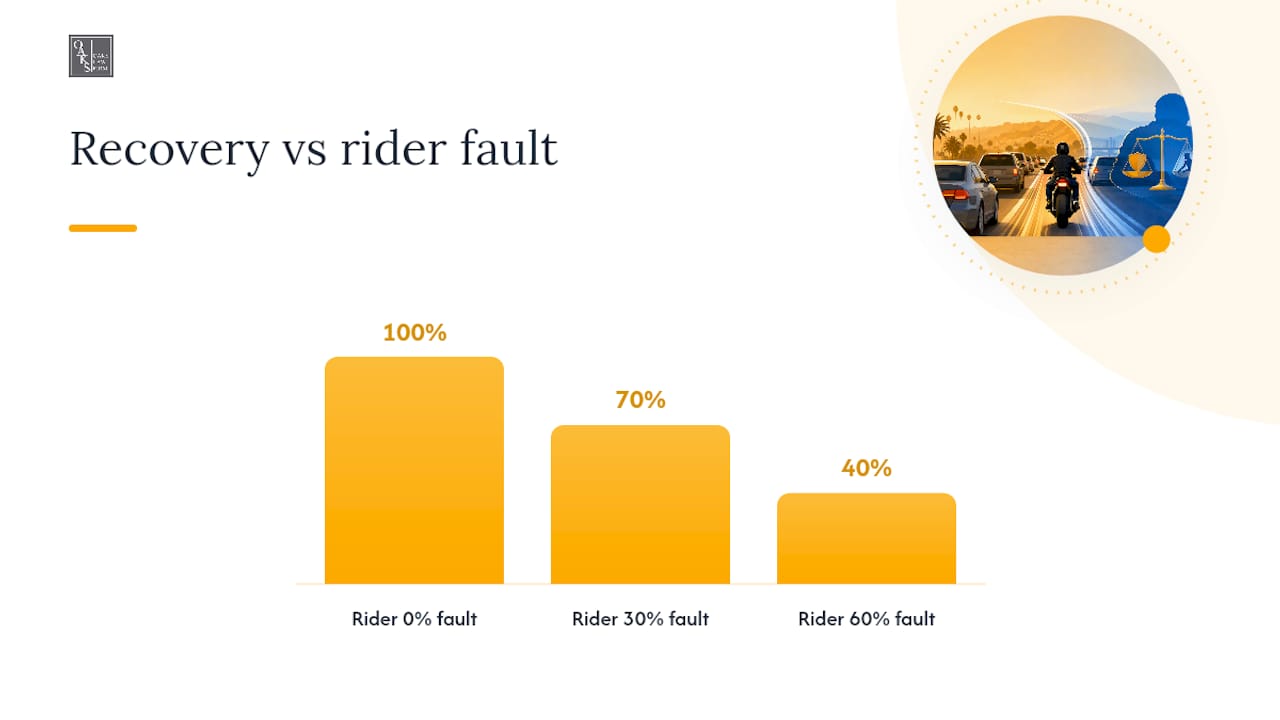
California follows a pure comparative negligence rule, meaning a rider’s compensation gets reduced by their own percentage of fault rather than eliminated entirely, even if they’re found mostly responsible. A rider found 30% at fault for splitting at an excessive speed differential can still recover 70% of their damages from a driver who changed lanes carelessly. A rider found 60% at fault recovers only 40%. There’s no fixed formula for these percentages. They come from the specific evidence in each case, which is exactly why preserving that evidence matters so much. Our guide on how fault gets determined in California motorcycle collisions walks through how these allocations typically play out.
What Drivers Owe Motorcyclists Who Are Splitting Lanes
Lane splitting law isn’t just about what riders can do. Other drivers have real legal obligations too, and violating them can shift substantial fault onto a driver even when a motorcyclist was moving through traffic in a legal manner.
Drivers may not:
- Intentionally move to block a motorcycle from passing, sometimes called “brake checking” or lane blocking, which several riders and CHP officials have flagged as a genuine safety hazard and a potential basis for liability.
- Open a vehicle door into traffic without checking mirrors and blind spots first.
- Change lanes without signaling, particularly in congested traffic where a rider may already be approaching from behind.
Drivers sitting in far-left lanes, where CHP tells riders splitting is generally safer, should get in the habit of checking mirrors before any lane movement, since that’s precisely where a motorcycle is statistically more likely to appear. Simple habits like signaling earlier and shoulder-checking before merging cut down on the split-second surprises that cause most lane-splitting collisions. When a driver’s own inattention or aggressive maneuver causes a crash, that conduct can significantly reduce or eliminate the rider’s share of fault under California’s comparative negligence rules.
After a Lane-Splitting Crash: Immediate Steps and Legal Deadlines
The minutes and days after a crash shape a claim more than almost anything that happens later. Getting a few things right early on protects both your health and your legal options.
- Call 911 and get medical attention, even if injuries seem minor. Adrenaline masks pain, and a documented medical visit creates a timestamped record connecting the crash to your injuries.
- Preserve evidence immediately. Photograph vehicle positions, damage, skid marks, and the surrounding lane widths before traffic clears the scene. Ask nearby witnesses for contact information, since memories fade fast and people are far less likely to help track down after the fact.
- Request the police report and check whether any nearby businesses or vehicles had dashcam or surveillance footage, which needs to be requested before it’s overwritten or deleted.
- Track every deadline. California’s general statute of limitations for personal injury claims is two years from the date of the crash under Code of Civil Procedure §335.1. If a government vehicle or public entity was involved, such as a city bus or a crash caused by a road defect, a separate and much shorter deadline applies: a claim must generally be presented within six months under Government Code §911.2. Missing that six-month window can bar a claim entirely, regardless of how strong the underlying case is. Certain exceptions exist for minors, delayed discovery of injuries, and other specific circumstances, which is exactly why early contact with an attorney matters more in government-entity cases than in almost any other personal injury scenario.
How Oaks Law Firm Approaches Lane-Splitting Injury Claims
We’ve watched insurers lean hard on the “the rider was lane splitting” argument as if it settles fault by itself. It doesn’t, and treating it that way is one of the most common mistakes injured riders make when handling a claim alone. Founding attorney Matthew Nezhad built Oaks Law Firm in 2002 around a simple idea: listen first, then fight. The firm takes on a limited number of cases each year so that motorcycle crash investigations get the attention they require, from securing dashcam footage before it’s deleted to reconstructing speed differential from physical evidence.
The most common pitfall we see is delayed evidence collection. Skid marks fade, surveillance footage gets overwritten, and witnesses move on. Clients working with us get a free case evaluation upfront, with representation on a contingency basis, meaning no upfront cost and no fee unless we recover compensation. We can’t guarantee an outcome in any case, but we can promise a thorough, honest investigation into what actually happened.
The Real Problem With How People Talk About Lane Splitting
Most online discussion of California lane splitting law treats it as a binary: legal or not legal, safe or not safe. That framing misses what the statute and the evidence actually show. §21658.1 doesn’t set a speed cap because speed differential isn’t the only variable that matters, and the OTS research backs that up. Lane width, vehicle type, and traffic density all shift the risk calculation as much as speed does. A rider moving 8 mph over stopped traffic on a wide freeway lane is in a fundamentally different position than one doing the same speed differential between two box trucks on a narrow surface street.
The conventional advice, “just follow the 10 mph rule,” treats a CHP recommendation as if it were statutory law. It isn’t, and courts don’t treat it that way either. What actually determines outcomes after a crash is evidence: video, physical damage, and witness accounts that show who created the dangerous situation. If you ride, your first priority shouldn’t be memorizing a speed number. It should be building the habit of riding in a way you could defend with evidence if you had to, because eventually you might need to.
— Matthew Nezhad
Injured While Lane Splitting? Here’s What Oaks Law Firm Offers
If you were hurt in a lane-splitting crash, you’re likely dealing with insurance adjusters who assume the maneuver itself makes you at fault. That assumption doesn’t hold up under California’s comparative negligence rules, but proving it takes real investigation: pulling dashcam footage, reconstructing speed differential, and tracking down witnesses before they’re gone. Oaks Law Firm handles that work directly, from initial investigation through negotiation and, when necessary, litigation, with offices in Sherman Oaks and Woodland Hills serving riders throughout California.
Every case evaluation is free, and representation is handled on a contingency-fee basis, so there’s no upfront cost and no fee unless we recover compensation on your behalf. If a crash left you with injuries, lost wages, or mounting medical bills, the next step is simple: reach out for a free case evaluation with our motorcycle accident team and find out where you actually stand before you accept anything an insurer offers.
Where to Verify the Law Yourself
For readers who want to check the primary sources directly: the statute itself lives at Vehicle Code §21658.1, with an alternate reproduction available through Justia’s California Code database. CHP’s safety guidance is published on its California Motorcyclist Safety page, and the DMV’s rider expectations appear in the Motorcycle Driver Handbook. The OTS 2015 lane-splitting report and NHTSA’s motorcycle safety resources round out the federal and state safety context.
This article is general information, not a substitute for advice from a qualified lawyer. Consult a qualified legal professional about your own circumstances before acting on anything here.
Sources
- California Code, Vehicle Code – VEH § 21658.1
- California Motorcyclist Safety – California Highway Patrol
- Motorcycle Lane-Splitting and Safety (OTS report)
- Motorcycle Driver Handbook – DMV California
FAQ
At what speed can motorcycles lane split in California?
There’s no legal speed limit written into §21658.1. CHP recommends riders travel no more than about 10 mph faster than surrounding traffic as a safety guideline, not a binding legal cap.
Which US states allow motorcycle lane splitting?
California is the only state with a law that explicitly defines and permits lane splitting. A handful of other states have passed narrower lane filtering laws, which typically apply only to slow or stopped traffic and carry stricter speed limits than California’s guidance.
Who’s at fault if a motorcycle is lane splitting during a crash?
Fault depends on the specific facts, not on the fact that lane splitting occurred. California’s pure comparative negligence rule means both the rider and the other driver can share fault, with compensation reduced by each party’s percentage of responsibility.
Is lane splitting the same as lane filtering?
No. Lane splitting generally refers to riding between lanes of moving or stopped traffic at any speed differential, while lane filtering, permitted in some other states, typically applies only to stopped or very slow traffic under a set speed threshold.
How long do I have to file a claim after a lane-splitting crash in California?
The general deadline is two years from the crash date under CCP §335.1. If a government entity or vehicle was involved, you generally must file a claim within six months under Gov. Code §911.2, with limited exceptions.
Attorney Advertising. This article was prepared with the assistance of artificial intelligence and reviewed by and Oaks Law Firm prior to publication. This article provides general information about California law and does not constitute legal advice. Reading this article does not create an attorney-client relationship with Oaks Law Firm. Past results do not guarantee future outcomes. Every case is different, and you should consult a licensed attorney regarding your specific situation.
