

Getting into a motorcycle accident is traumatic enough. Then comes the assumption you often face from other drivers, insurance adjusters, and sometimes even police officers: that you were probably to blame. Understanding motorcycle accident fault explained as a legal concept, formally called fault determination or liability attribution, is the difference between recovering what you’re owed and walking away with nothing. This guide breaks down how fault is actually assigned, what evidence matters most, and what your rights look like when someone else’s negligence put you on the ground.
Table of Contents
- Key takeaways
- Motorcycle accident fault explained: how liability actually works
- Common causes and how they shape fault assignment
- How to prove fault in a motorcycle crash
- Navigating the claims process and fighting insurer bias
- My perspective on fault disputes after two decades of cases
- How Oaks Law Firm can help with your motorcycle claim
- FAQ
Key takeaways
| Point | Details |
|---|---|
| Fault is rarely automatic | Most motorcycle accidents are caused by other drivers failing to yield or driving distracted, not by riders. |
| Your state’s fault system controls compensation | California uses comparative fault, so partial blame reduces your award but does not eliminate it. |
| Evidence timing is critical | Video footage and physical evidence disappear fast. Collecting both within hours can determine your case outcome. |
| Insurers will challenge rider behavior | Expect adjusters to raise speeding, helmet use, and lane position as reasons to cut your payout. |
| An attorney changes the outcome | Legal representation counters insurer bias, organizes evidence, and builds the narrative needed to win. |
Motorcycle accident fault explained: how liability actually works
In legal terms, fault means negligence. One party failed to exercise reasonable care, and that failure caused the crash. Fault determination is the process of figuring out who was negligent, by how much, and what that means for compensation. Two main legal systems govern this in the United States, and knowing the difference matters enormously for your claim.
Comparative fault vs. contributory negligence
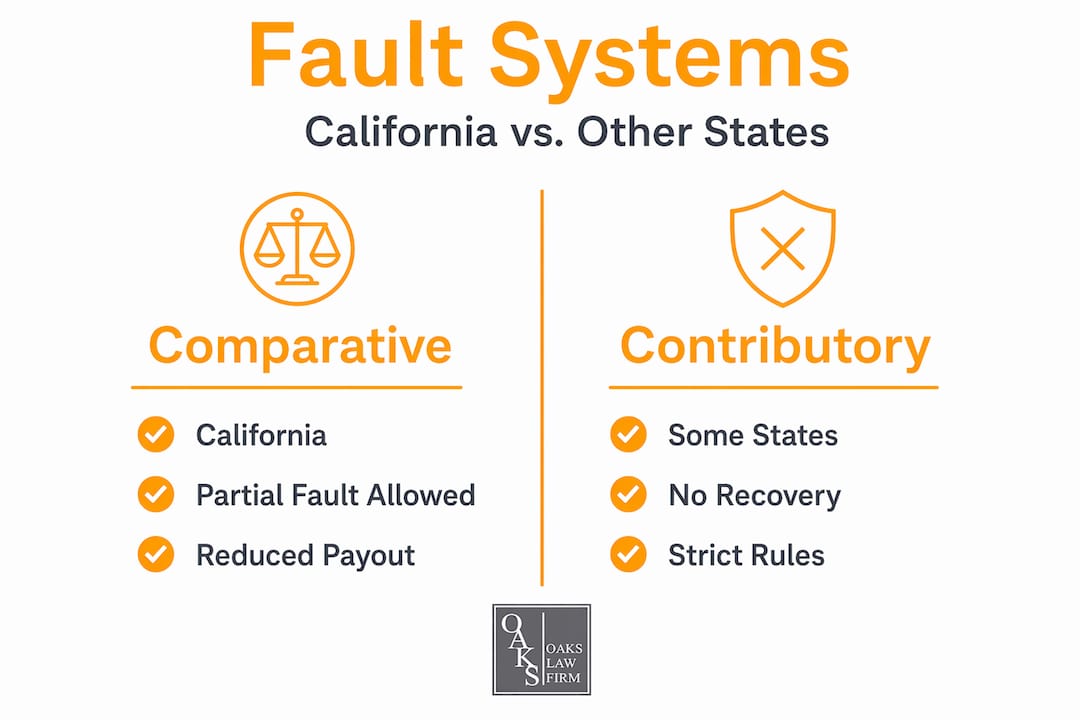
Under a comparative fault system, which California follows, each party in an accident is assigned a percentage of responsibility. If a jury finds you 20% at fault and the other driver 80% at fault, you still recover compensation. Your award is simply reduced by your fault percentage. In a case worth $100,000, you would receive $80,000.
Some states use pure comparative fault, meaning you can recover even if you are 99% at fault, though the award gets very small. California uses this model. Other states use modified comparative fault, which cuts off recovery once you hit a certain fault threshold, typically 50% or 51%.
The strictest system is contributory negligence. In states like Virginia, even 1% rider fault can bar all recovery entirely. You could be an almost completely innocent victim and still receive nothing if the insurer can convince a jury you bore any sliver of responsibility.
| Fault system | States using it | Effect on your recovery |
|---|---|---|
| Pure comparative fault | California, New York, Florida | Recovery reduced by your fault % |
| Modified comparative fault | Texas, Colorado, Illinois | Barred at 50% or 51% fault |
| Contributory negligence | Virginia, Maryland, D.C. | Any fault at all bars recovery |
Pro Tip: If your accident happened near a state line or involved an out-of-state driver, the applicable fault law can get complicated quickly. Always confirm which state’s rules govern your specific claim before accepting any settlement offer.
For riders in Southern California, the comparative fault framework is generally workable. But that does not mean insurers will play fair. Understanding the rules they operate under gives you leverage.
Common causes and how they shape fault assignment
One of the most stubborn myths in motorcycle accident cases is that riders are reckless by nature and therefore usually at fault. The data tells a different story. Distracted driving, failure to yield, and left-turn collisions are among the most frequent causes of serious motorcycle crashes, and all three typically place fault squarely on the other driver.
Here is how some of the most common accident types break down in terms of fault:
- Left-turn collisions. A car turning left in front of an oncoming motorcycle is one of the deadliest and most common scenarios. The turning driver almost always bears fault for failing to yield to a motorcycle proceeding straight through the intersection.
- Rear-end crashes. When a driver behind a motorcycle fails to brake in time, responsibility in motorcycle accidents typically falls on the following driver. Motorcycles can stop faster than many cars, but a distracted driver has no chance to react.
- Lane change crashes. A driver who fails to check blind spots before merging into a lane occupied by a motorcycle is nearly always at fault. These crashes often happen on freeways at highway speeds.
- Road hazard accidents. Potholes, loose gravel, missing signage, and broken pavement can cause a rider to lose control. In these cases, a government entity or road maintenance contractor may bear liability, not the rider.
- Defective parts. A tire blowout caused by a manufacturer defect shifts fault away from the rider entirely and toward the product manufacturer under product liability law.
Identifying the accurate cause of an accident is not just an academic exercise. It determines which party is liable, what evidence you need, and which legal theories your attorney will pursue.
Pro Tip: Take photos of the road surface, lane markings, traffic signals, and any debris at the scene immediately after a crash. Road conditions are cleaned up or repaired quickly, and that evidence can disappear before any investigation begins.
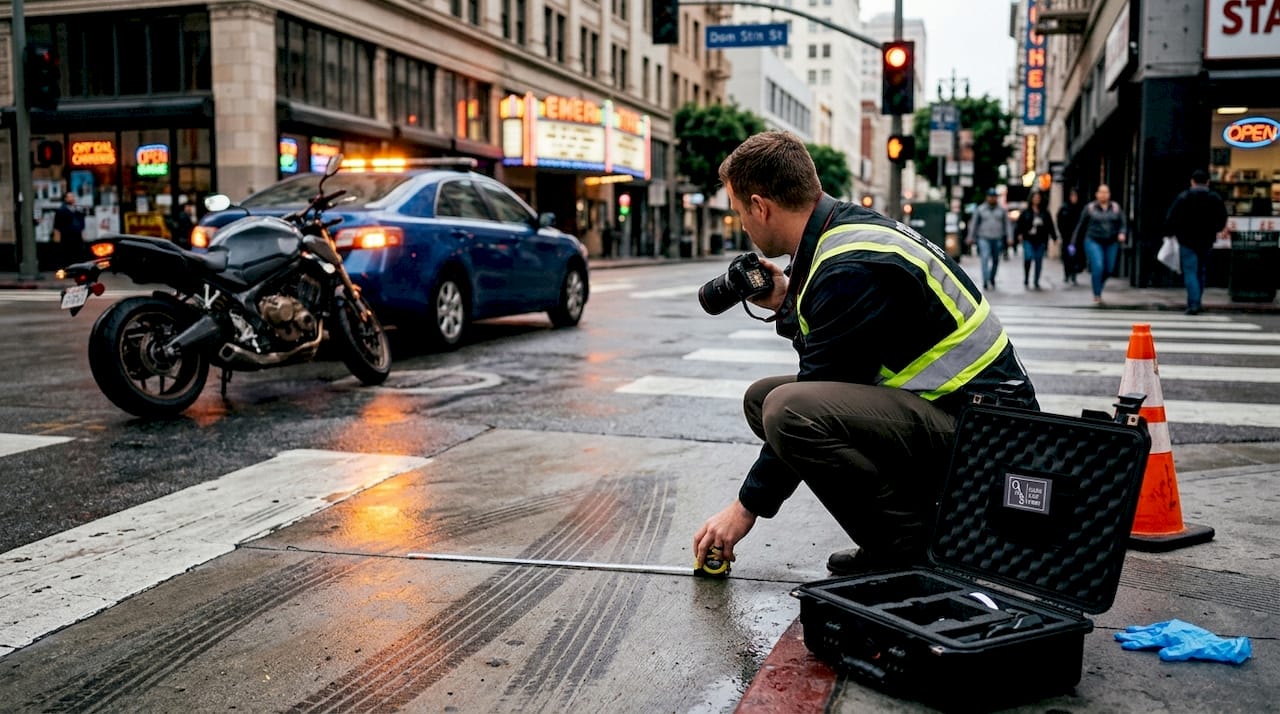
Driver behavior like phone use, running red lights, and driving under the influence all create clear fault signals that work in a rider’s favor. When these behaviors are documented early, they become powerful leverage against a defense that tries to blame the motorcyclist.
How to prove fault in a motorcycle crash
Knowing who caused the accident is one thing. Proving it in a way that holds up to an insurance company or a jury is another challenge entirely. Lawyers build a chain of proof using police reports, traffic camera footage, witness accounts, and accident reconstruction evidence to establish fault, especially in right-of-way disputes where timing and sequence are everything.
Here is the order in which evidence is typically gathered and used:
- Police report. This is usually the first official document in any claim. Officers note road conditions, witness statements, violations observed, and sometimes include a preliminary fault opinion. Request a copy as soon as it is available.
- Traffic and surveillance camera footage. Video footage must be obtained quickly before it is overwritten or deleted. Many traffic systems retain only 24 to 72 hours of footage. Businesses near the crash scene often have exterior cameras that captured the collision.
- Physical evidence at the scene. Skid marks, debris fields, and impact angles tell the story of what happened before investigators arrived. A forensic accident reconstructionist can interpret these clues to establish vehicle speeds, directions, and sequences.
- Witness statements. Independent witnesses have no stake in the outcome and carry significant weight with adjusters and juries. Collect names and contact information at the scene before people leave.
- Medical records. Injury patterns can reinforce the collision sequence and fault narrative. A rider whose left side sustained the primary impact after a car turned left across their path has injury evidence that matches the mechanical story of the crash.
- Expert reconstruction reports. Accident reconstruction specialists analyze all available physical and digital evidence to produce a timeline of events. Their reports can challenge an insurer’s version of events with objective data.
The lesson here is that a single photo is rarely enough. Success in fault disputes depends on a comprehensive chain of proof where signal phases, physical damage, and witness timing all fit logically together. Any gap in that chain becomes an opening for the defense.
A good practice is to document your injuries thoroughly from the moment you receive treatment. Photos of injuries, medical records, and follow-up visit notes all support the larger fault narrative your attorney builds.
| Evidence type | What it proves | Time sensitivity |
|---|---|---|
| Traffic camera footage | Vehicle movements and signal state | Very high: 24 to 72 hours |
| Skid marks and debris | Speed, direction, point of impact | High: may be cleaned up within days |
| Witness statements | Sequence and driver behavior | High: memories fade quickly |
| Medical records | Injury patterns matching fault theory | Moderate: obtainable later but delays hurt |
| Police report | Official account and observed violations | Moderate: takes days to process |
Navigating the claims process and fighting insurer bias
Once you understand fault, you need to understand how insurance companies use fault as a financial tool. Adjusters are trained to minimize payouts. Insurers often attempt to assign fault to riders by raising claims about speeding, helmet use, lane position, and even the type of motorcycle being ridden. None of these factors automatically create fault, but they create doubt, and doubt costs you money.
Here is how the typical claims and litigation process works:
- Initial consultation with an attorney. A motorcycle accident attorney reviews your facts, identifies which fault system applies, and assesses the strength of your evidence before any claim is filed.
- Independent investigation. Your attorney sends preservation letters to secure camera footage, requests police reports, and may hire a reconstruction expert before evidence disappears.
- Demand letter. Once your injuries are documented and fault is established, your attorney sends a formal demand to the at-fault party’s insurer outlining liability and the damages you are seeking.
- Negotiation. Most motorcycle accident claims settle during negotiation. The strength of your evidence directly determines the leverage you have at this stage.
- Litigation. If the insurer refuses to offer fair compensation, your attorney files a lawsuit. In California, you generally have two years from the date of the accident to file a personal injury claim, so timing matters.
One common insurer tactic deserves specific attention. In comparative fault jurisdictions, insurers may exaggerate rider fault based on neutral factors like the rider’s speed or road position, factors that may not actually constitute negligence. Objective evidence such as video and reconstruction data counters this effectively. An attorney who knows how to read and present that evidence can shift the fault percentage significantly in your favor, which translates directly to a larger recovery.
Riders in California also benefit from knowing that the state’s right-of-way rules are well developed, and courts here are familiar with motorcycle accident cases. That familiarity can work in your favor when you have the evidence to back your account.
My perspective on fault disputes after two decades of cases
I have spent my entire legal career representing injured victims, and motorcycle cases have some of the most consistent patterns I have ever seen in litigation. First impressions of fault almost always favor the other driver. Police officers sometimes note in reports that the rider “appeared to be traveling at speed” without any supporting measurement. Witnesses recall the motorcycle more vividly because it was unusual in the traffic mix. Adjusters lean into those impressions before a single piece of physical evidence has been analyzed.
What I have learned is that timing changes everything. The clients who call me within 24 hours of their accident are the ones whose cases get built on solid ground. Camera footage still exists. Witnesses remember clearly. Road conditions are unchanged. The clients who wait two weeks because they were focused on recovery, which is completely understandable, often find that key evidence has vanished.
I also want to be direct about something most articles skip. Insurance companies are not neutral parties trying to find the truth. They have a financial incentive to pin blame on you, and they are experienced at doing it. The rider stereotypes they exploit, recklessness, excessive speed, poor judgment, are culturally embedded in a way that makes them easy to weaponize. The only real counter to that is hard evidence and a legal team willing to dismantle the narrative piece by piece.
My advice to any rider reading this: do not give a recorded statement to the other driver’s insurance company without speaking to an attorney first. That statement will be used to build a fault case against you. Everything else can be addressed, but that window closes fast.
— Matthew Nezhad
How Oaks Law Firm can help with your motorcycle claim
If you have been in a motorcycle accident in Los Angeles, the , or anywhere in California and you are facing questions about fault, you do not have to figure it out alone.

At Oaks Law Firm, attorney Matthew Nezhad and his team have spent decades fighting for injured riders against insurance companies that use every available tool to minimize or deny claims. The firm handles every phase of the process: independent accident investigation, evidence preservation, expert reconstruction analysis, demand preparation, negotiation, and trial when necessary. Because the firm accepts a limited number of cases each year, every client receives focused, hands-on attention rather than being passed to junior staff.
Oaks Law Firm works on a contingency basis, meaning you pay nothing unless you recover compensation. If you are ready to understand your rights and build a real case, explore your compensation options or learn about filing a personal injury lawsuit in California. Contact Oaks Law Firm today for a free case evaluation.
FAQ
Who is typically at fault in a motorcycle accident?
Fault depends on the specific facts of each accident, but many crashes are caused by other drivers failing to yield, driving distracted, or making illegal turns. Motorcyclists are not automatically at fault.
How does California’s fault system affect my motorcycle accident claim?
California uses pure comparative fault, meaning your compensation is reduced by your percentage of responsibility in the accident. Even if you are partially at fault, you can still recover damages.
What evidence is most important for proving fault in a motorcycle crash?
Traffic camera footage, police reports, skid marks, witness statements, and medical records all play a role. Video evidence is the most time-sensitive and should be secured within 24 hours of the accident.
Can an insurer reduce my payout by claiming I was speeding?
Yes. Insurers often raise rider behavior like speed or lane position to inflate fault percentages and reduce payouts. An attorney can counter these claims with objective reconstruction evidence and video.
How long do I have to file a motorcycle accident claim in California?
California’s statute of limitations for personal injury claims is generally two years from the date of the accident. Missing this deadline typically bars you from recovering any compensation.
Recommended
- Motorcycle Safety Awareness Month Isn’t Just for Riders — It’s a Wake-Up Call for Drivers – Oaks Law Firm
- San Bernardino Motorcycle Accident Lawyer | Injured Rider Claims
- Los Angeles Scooter Sidewalk Accidents | Liability and Legal Options
- How Car Accident Compensation Works in California | Oaks Law Firm
