Attorney Advertising. This article was prepared with the assistance of artificial intelligence and reviewed by Oaks Law Firm prior to publication.
In California, only a married spouse or registered domestic partner can bring a loss of consortium claim, and it compensates the loss of companionship, affection, sexual relations, and household services caused by a partner’s injury. California recognized this cause of action decades ago, and the Judicial Council’s civil jury instructions still guide how juries weigh it today. The claim rides on a strict clock: two years generally, but only six months if a government agency is involved.
TL;DR:
- Loss of consortium claims in California are limited to spouses or registered domestic partners, with proof required of an existing valid relationship at the time of injury.
- The statute of limitations is generally two years from injury, but only six months when a government entity causes or contributes to the injury, requiring immediate claim filing.
- Damages focus on noneconomic losses like companionship, affection, and household services, which juries award based on subjective evidence and are often capped in medical malpractice cases.
- Strong evidence includes personal testimony, medical records, and witness statements, but the claim is highly sensitive to pre- and post-injury relationship dynamics.
- Filing early, preserving records, and reserving damages in settlement negotiations are crucial, as claims are derivative and can be lost if the underlying case or deadlines are missed.
Table of Contents
- What Is Loss of Consortium Under California Law?
- Legal Elements of a Loss of Consortium Claim
- What Damages Can You Recover for Loss of Consortium?
- How Long Do You Have to File a Loss of Consortium Claim in California?
- What Evidence Proves Loss of Consortium?
- Settlement Risks and Common Defenses in Consortium Claims
- How Oaks Law Firm Approaches These Claims
- How Oaks Law Firm Can Help With Your Consortium Claim
- Why California’s Approach to Loss of Consortium Misses the Point Sometimes
- Sources
- FAQ
What Is Loss of Consortium Under California Law?
California courts have recognized loss of consortium as its own legal claim since Rodriguez v. Bethlehem Steel Corp. in 1974, when the California Supreme Court ruled that each spouse holds an independent right to sue when negligence robs them of their partner’s companionship. Only a spouse or registered domestic partner has standing. Unmarried partners, no matter how committed or long together, generally cannot bring this claim under current California law.
Parents and children face the same wall. A child who watches a parent struggle after a catastrophic injury has no consortium claim of their own in California, even though the emotional toll is real. Wrongful death cases work differently, and survivors there pursue remedies under a separate statute rather than a consortium theory. Before moving forward, gather:
- Proof of marriage or registered domestic partnership at the time of the injury
- Documentation showing the relationship was intact and functioning before the accident
- Any records showing when the marriage or partnership began relative to the injury date
Legal Elements of a Loss of Consortium Claim
A spouse pursuing this claim in California must prove four things, and each one needs its own supporting evidence.
- A valid marriage or domestic partnership existed at the time of the injury. Marriage certificates or partnership registration documents establish this.
- The other spouse suffered a tortious injury caused by someone’s negligence or wrongdoing. This ties directly to the underlying personal injury case.
- The claimant suffered a genuine loss of consortium. Testimony, therapy records, and third-party statements typically support this.
- The injury proximately caused that loss. Medical records connecting the injury to specific changes in the relationship close the loop.
Because this claim is derivative, it lives or dies with the injured spouse’s underlying case. If that claim fails or gets dismissed, the consortium claim usually collapses with it. Attorneys typically join both claims in a single complaint and reference consortium damages explicitly in any demand letter, since silence on this point can cost a spouse their recovery later.
What Damages Can You Recover for Loss of Consortium?
Consortium damages fall entirely under noneconomic loss, meaning there’s no pay stub or medical bill to hand a jury. CACI No. 3920 lists what juries may consider:
- Loss of companionship, comfort, and society
- Loss of affection and moral support
- Loss of sexual relations
- Loss of household services the injured spouse used to provide
Pro Tip: Juries respond far better to specifics than to abstractions. “We stopped taking our Sunday hikes” lands harder than “our relationship changed.”
Valuing these losses is inherently subjective. There’s no formula, no chart, no multiplier a lawyer can hand a jury. CACI No. 3920 does clarify one important rule: future noneconomic damages, including future consortium losses, do not need to be reduced to present cash value the way future economic losses often are. That gives juries more room to award meaningful figures for losses that will stretch for decades.
Real-world limits still apply. In medical malpractice cases, California’s MICRA statute caps noneconomic damages, which includes consortium, regardless of how compelling the testimony. Outside malpractice, insurance policy limits frequently cap what’s actually collectible even when a jury awards more. California Courts Self-Help notes that noneconomic losses are inherently harder to quantify than medical bills or lost wages, which is exactly why documentation matters so much. For context on how juries and insurers approach these valuations generally, see how pain and suffering gets calculated in California injury cases.
How Long Do You Have to File a Loss of Consortium Claim in California?
California’s general statute of limitations for personal injury claims, including loss of consortium, is two years from the date of injury under Cal. Code Civ. Proc. §335.1. Exceptions exist for the discovery rule, injuries to minors, and medical malpractice cases, which carry their own shorter and more technical deadlines.
If a government entity caused or contributed to the injury, such as a city bus, a county road hazard, or a public hospital, the timeline shrinks dramatically. Under Gov. Code §911.2, you generally must file a written administrative claim within six months of the incident. Miss that window, and the consortium claim can be permanently barred, no matter how strong the underlying case is.
- Preserve medical records and communications from day one
- Note the date of injury and identify whether any government entity might be involved
- Avoid signing any release or settlement document before consulting an attorney
- Start the government claim process immediately if a public entity is even possibly responsible
Pro Tip: If you’re unsure whether a public entity was involved, treat the case as if the six-month clock applies. Sorting that out after the deadline has already passed rarely works out.
What Evidence Proves Loss of Consortium?
Proving this claim means turning a private, often painful, change in a marriage into something a jury can actually see. The strongest cases rely on layered evidence rather than a single dramatic statement.
- Direct testimony from the injured spouse’s partner about specific changes in daily life
- Medical and mental-health records documenting the injured spouse’s condition and its effects
- Therapist or counselor statements addressing relationship strain
- Statements from close friends or family who observed the change firsthand
- Household logs, photos, or journals showing lost activities and responsibilities
- Expert testimony when the connection between injury and relationship harm isn’t obvious
Discovery in these cases can feel invasive. Depositions frequently probe intimate details about a marriage, and practical guides on this topic consistently note that defense counsel will ask pointed questions about sexual relations and daily companionship. Good counsel prepares clients for that line of questioning ahead of time and works to limit unnecessary exposure of sensitive records where the law allows.
Settlement Risks and Common Defenses in Consortium Claims
A worldwide release signed by the injured spouse can accidentally extinguish the other spouse’s consortium claim entirely unless that claim is specifically reserved or the spouse is joined in the lawsuit. This trips up unrepresented claimants constantly.
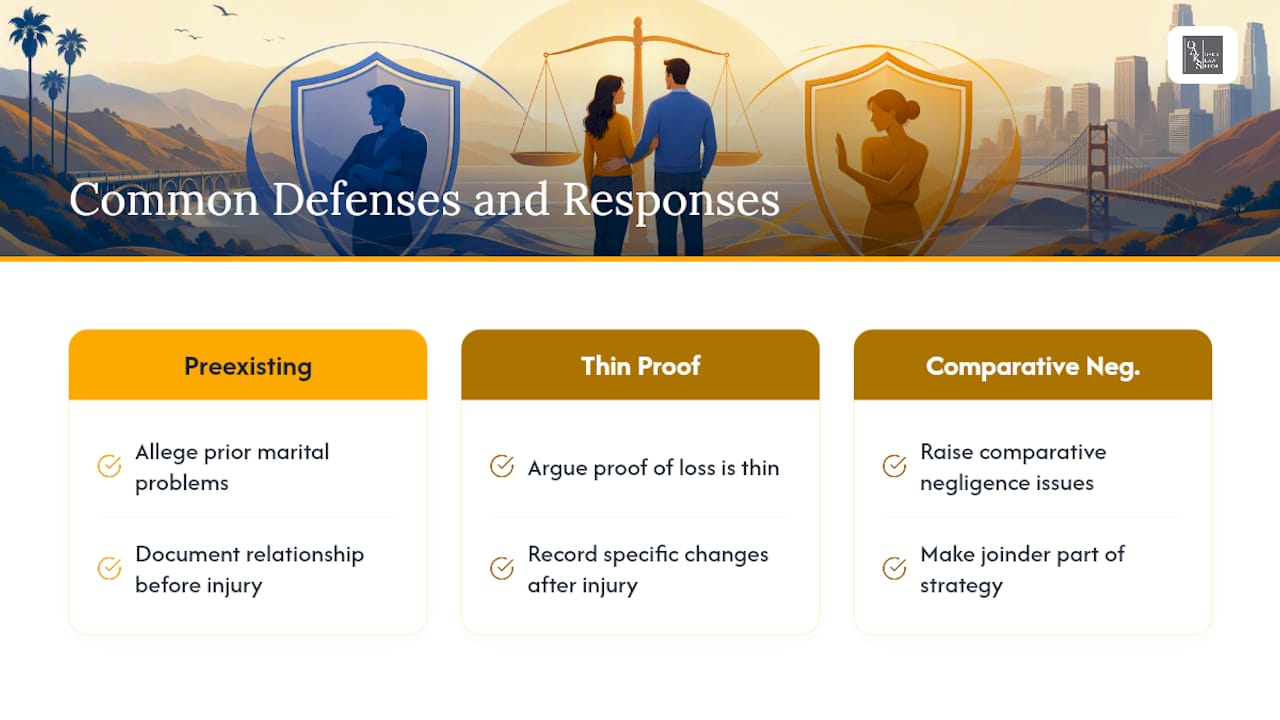
Defense attorneys typically attack these claims on three fronts: pointing to marital problems that existed before the injury, arguing the proof of loss is too thin, or raising comparative negligence issues tied to the underlying accident. Countering that requires documented evidence of a healthy relationship before the injury and a clear, specific record of what changed after. Smart negotiation means demanding consortium damages separately in writing and making joinder part of the strategy from day one, not an afterthought raised after a release is already signed.
How Oaks Law Firm Approaches These Claims
Matthew Nezhad founded Oaks Law Firm in 2002 and has spent his career litigating California personal injury cases, including the consortium claims that often ride alongside catastrophic injury and wrongful death matters. In practice, that means treating the spouse’s claim as its own priority from the first client meeting, not an afterthought tacked onto the injured party’s case.
Early evidence collection matters because memories fade and household routines shift quickly after a serious injury. The firm’s approach includes protecting consortium damages during settlement talks, preparing spouses for the realities of deposition testimony, and building cases that hold up if they go to trial rather than settle quietly for less than they’re worth.
How Oaks Law Firm Can Help With Your Consortium Claim
There’s a narrow window to act, and most people trying to sort out a consortium claim on their own run into the same problems: missed government-claim deadlines, releases signed without reserving spousal damages, or evidence that never gets collected before it disappears. Oaks Law Firm handles California personal injury cases, including claims involving spousal loss of consortium, on a contingency basis, meaning there’s no upfront cost and you pay nothing unless the firm recovers compensation for you.
If your spouse or partner was seriously injured by someone else’s negligence, start by preserving medical records and avoiding any settlement discussion until you’ve spoken with counsel. A free case evaluation can help determine whether a consortium claim applies to your situation and how to include it properly in a demand or government claim notice. Oaks Law Firm serves clients throughout California with offices in Sherman Oaks and Woodland Hills. Learn more about how to file a personal injury lawsuit or, for cases involving a death, review the firm’s guidance on wrongful death claims in Los Angeles.
Why California’s Approach to Loss of Consortium Misses the Point Sometimes
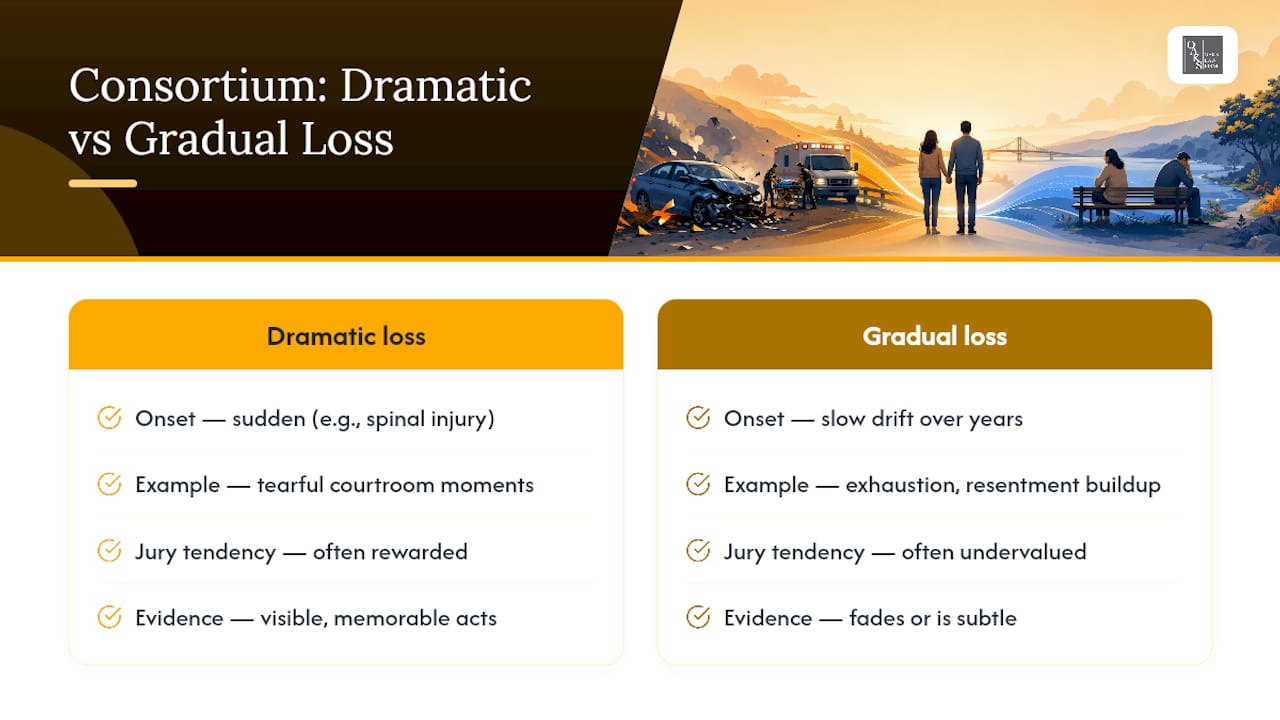
The law treats loss of consortium as a single, tidy category, but marriages don’t break down in tidy ways. Some couples lose intimacy overnight after a spinal injury. Others slowly drift apart over years as one partner takes on caregiving duties nobody signed up for. California’s jury instructions give room for both stories, but juries still default to rewarding the dramatic, visible loss over the slow, grinding one. That’s a real problem for spouses whose losses show up as exhaustion and resentment rather than a single tearful moment on the witness stand.
The bigger issue I see is timing. Spouses often don’t think about their own claim until months into their partner’s recovery, by which point evidence of the “before” version of the relationship has already faded from memory or, worse, been signed away in a release nobody explained clearly. The claim’s derivative nature isn’t a technicality. It’s the reason so many valid consortium claims never get filed at all. Anyone whose spouse or partner was seriously hurt by someone else’s negligence should treat their own claim as urgent, not secondary, from the very first conversation with a lawyer.
— Matthew Nezhad
This article is general information, not a substitute for advice from a qualified lawyer. Consult a qualified legal professional about your own circumstances before acting on anything here.
Sources
- Rodriguez v. Bethlehem Steel Corp. (1974) — California Supreme Court
- Personal injury | California Courts Self-Help
- California Government Code — Government claims filing requirements (Gov. Code §911.2)
FAQ
How Much Is a Loss of Consortium Claim Worth?
There’s no fixed formula. Value depends on the severity of the underlying injury, the strength of the evidence showing changed companionship and intimacy, and any caps or policy limits that apply, so amounts vary significantly case by case.
Is Loss of Consortium Difficult to Prove?
Yes, because it relies on subjective, noneconomic evidence like testimony and therapy records rather than bills or pay stubs, and defense attorneys often challenge the sufficiency of that proof.
Who Can Bring a Loss of Consortium Claim in California?
Only a legally married spouse or a registered domestic partner has standing under California law, following the precedent set in Rodriguez v. Bethlehem Steel Corp. Unmarried partners, parents, and children generally cannot bring this specific claim.
How Do You Calculate Loss of Consortium Damages?
Juries use CACI No. 3920 as a framework, weighing testimony and evidence about lost companionship, affection, and household services rather than applying any set calculation, and future noneconomic damages don’t need to be reduced to present value.
Disclaimer: This article is provided for general informational purposes only and does not constitute legal advice. No attorney-client relationship is created by reading this content. Laws referenced may change, and outcomes depend on the specific facts of each case. For guidance regarding your individual situation, please contact Oaks Law Firm directly for a free case evaluation. Oaks Law Firm makes no guarantee of results, and past outcomes do not predict future results.
