

A long-term injury claim is a legal claim filed when an accident causes physical or cognitive harm that persists for months, years, or permanently. Unlike a minor soft-tissue claim that resolves in weeks, these cases involve ongoing medical care, reduced earning capacity, and lasting effects on daily life. The legal term used by attorneys and courts is a “serious personal injury claim,” though “long-term injury claim” accurately describes the core issue: your injuries do not go away quickly, and your compensation must reflect that reality. Oakslawfirm has represented injured victims throughout California for over two decades, and the single most common mistake we see is claimants settling before they fully understand what their injury will cost them over a lifetime.
Disclaimer: This article provides general legal information only. Your specific case facts, jurisdiction, and circumstances may produce different outcomes. Consult a qualified personal injury attorney for advice tailored to your situation.
What is a long term injury claim and who qualifies?
A long-term injury claim covers any accident-related injury that causes lasting physical limitations, cognitive impairments, or chronic conditions requiring ongoing treatment. The key legal threshold is not a specific number of days. Courts and insurance companies look at whether the injury affects your ability to work, care for yourself, or enjoy life over an extended period.

Medical criteria typically include a diagnosis of permanent or semi-permanent impairment, a need for future surgeries or therapies, or a condition that limits your functional capacity. Cognitive limitations from a traumatic brain injury qualify just as clearly as a physical disability. The injury does not need to be total or catastrophic to support a serious claim.
Common qualifying injuries include spinal cord damage, herniated discs requiring surgery, traumatic brain injuries, severe burns, crush injuries, and chronic pain syndromes such as complex regional pain syndrome (CRPS). Each of these conditions shares one trait: they change how you live, work, and function, not just for a few weeks, but for years or permanently.
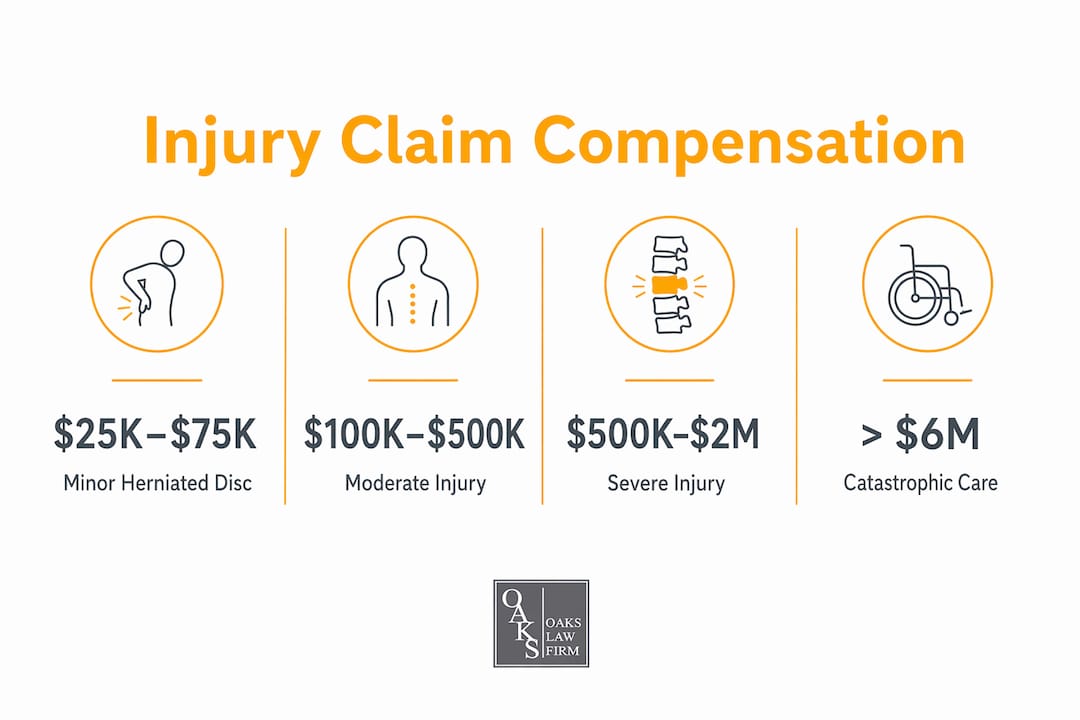
The table below shows how injury severity typically correlates with claim value ranges, based on reported settlement data.
| Injury Type | Typical Claim Range |
|---|---|
| Herniated disc (non-surgical) | $25,000–$75,000 |
| Surgical spinal disc injury | $75,000–$250,000+ |
| Traumatic brain injury (moderate) | $250,000–$1,000,000+ |
| Severe spinal cord or brain injury | $1,000,000 to several million |
| Chronic pain syndrome | Varies widely by functional loss |
These ranges reflect the lasting nature of the harm. A surgical spinal injury does not end at the operating table. It reshapes your career, your relationships, and your daily routine for years.
Pro Tip: If your doctor has mentioned the possibility of future surgery, long-term physical therapy, or permanent restrictions, you likely have a long-term injury claim regardless of how your injury was initially described.
How is compensation calculated in a serious injury claim?
Long-term injury compensation divides into two categories: economic damages and non-economic damages. Both are recoverable in California personal injury claims, and both require detailed documentation to maximize value.
Economic damages cover every financial loss tied to the injury. These include:
- Past medical expenses already paid or incurred
- Future medical costs projected over your remaining life expectancy
- Lost wages from time already missed at work
- Lost earning capacity projected over your remaining working years
- Cost of in-home care, assistive devices, and home modifications
- Transportation costs for ongoing medical appointments
Lifetime medical care for catastrophic injuries can exceed $6 million. That figure is not an outlier. It reflects the compounding cost of surgeries, rehabilitation, medications, specialist visits, and personal care assistance over decades.
Non-economic damages cover the human cost of the injury. Pain and suffering, emotional distress, loss of enjoyment of life, and loss of consortium are all recoverable. These damages often represent the largest portion of a serious injury settlement. California does not cap non-economic damages in most personal injury cases, which means the full weight of your suffering can be argued before a jury or in settlement negotiations.
Attorneys and insurance companies use two specialized tools to calculate these figures accurately. Life Care Plans, prepared by medical experts, detail every treatment, therapy, and care hour you will need over your life expectancy. Forensic economists then calculate the present value of those costs, accounting for inflation and investment returns. Together, these documents give your claim a defensible dollar figure that holds up in court.
Pro Tip: Ask your attorney early whether a Life Care Planner will be retained. This expert can be the difference between a fair settlement and one that leaves you covering future costs out of pocket.
To understand how pain and suffering is calculated in California specifically, the method varies by case and is worth reviewing before any settlement discussion.
How long does a serious injury claim take to resolve?
Serious injury claims take 18 months to 5 years to resolve. That timeline is not a flaw in the system. It reflects the reality that you cannot accurately value a long-term injury until you know what it will actually cost.
The process follows a predictable sequence:
- Medical treatment phase: You receive ongoing care while your attorney gathers records, bills, and physician opinions.
- Maximum Medical Improvement (MMI): Your treating physician declares your condition stable. MMI allows accurate documentation of future medical expenses and permanent impairments. This is the earliest point at which a settlement should be seriously considered.
- Evidence gathering: Your legal team collects accident reports, witness statements, expert opinions, employment records, and life care plan documentation.
- Demand and negotiation: Your attorney submits a formal demand to the at-fault party’s insurer. Negotiation follows, often over several months.
- Settlement or trial: Most cases settle. Those that do not proceed to litigation, which adds additional time but can produce significantly higher awards.
The critical mistake claimants make is settling before reaching MMI. Signing a settlement release closes your claim permanently. If your condition worsens after you sign, you cannot return for more compensation. That is not a technicality. It is a permanent financial consequence.
Minor soft-tissue claims typically resolve in 6–12 months. The extended duration of injury claims reflects the complexity of the evidence, the number of experts involved, and the higher stakes for both sides. Patience in this process is not passive. It is a legal strategy.
For a deeper look at when settlement makes sense versus going to trial, the comparison of a lawsuit vs. settlement is worth reviewing before you make any decisions.
How do long-term injury claims differ from long-term disability benefits?
Long-term disability (LTD) benefits and personal injury claims are separate legal concepts. Confusing them leads to gaps in financial recovery that can be very difficult to fix later.
LTD benefits pay 50%–70% of pre-injury income through an insurance policy, typically provided by an employer. They are contractual. You do not need to prove anyone was negligent to receive them. You only need to show that your injury prevents you from working according to the policy’s definition of disability.
Personal injury claims work differently:
- You must prove another party’s negligence caused your injury.
- Recovery is not limited to wage replacement. You can claim medical expenses, future care costs, pain and suffering, emotional distress, and loss of enjoyment of life.
- There is no policy cap equivalent to an LTD benefit percentage.
- The distinction between LTD and injury claims matters because pursuing one does not automatically bar you from pursuing the other.
You can receive LTD benefits while simultaneously pursuing a personal injury claim. However, coordination is critical. Many LTD policies include reimbursement clauses that require you to repay benefits from any personal injury settlement. Failing to account for this can reduce your net recovery significantly.
A qualified attorney handles this coordination as part of case management. The goal is to maximize your total recovery across both sources without triggering unexpected reimbursement obligations. For context on proving negligence in injury claims, the legal standard is consistent across most common-law jurisdictions.
Key Takeaways
A long-term injury claim requires waiting for Maximum Medical Improvement, building detailed economic and medical evidence, and never signing a release before the full scope of future losses is documented.
| Point | Details |
|---|---|
| Qualifying injuries | Spinal, brain, burn, and chronic pain injuries that limit work or daily life qualify for long-term claims. |
| Compensation scope | Claims cover past and future medical costs, lost earning capacity, pain, suffering, and emotional distress. |
| Claim timeline | Serious injury claims take 18 months to 5 years; settling before MMI risks permanent undercompensation. |
| LTD vs. injury claims | LTD replaces wages only; personal injury claims recover the full range of economic and non-economic losses. |
| Life Care Plans | Expert-prepared Life Care Plans and forensic economic projections are the foundation of a defensible claim value. |
What I’ve learned after 20+ years of serious injury cases
The most damaging thing I see in long-term injury cases is not the injury itself. It is the pressure claimants feel to settle quickly. Insurance adjusters are trained to move fast. They call within days of an accident, offer a number that sounds reasonable, and create urgency. That urgency is manufactured. It serves the insurer, not you.
Waiting for MMI is not just a legal strategy. It is the only way to know what your injury actually costs. I have seen clients with herniated discs who were told they would recover fully, only to need surgery 18 months later. If they had settled at month three, they would have paid for that surgery out of pocket.
The evidence phase matters just as much as the waiting. A claim without a Life Care Plan, without forensic economic projections, and without thorough medical records is a claim the defense will undervalue. Every dollar of future care that goes undocumented is a dollar you will not recover. I tell every client: your job is to follow your treatment plan and keep records. My job is to build the financial case around what those records show.
I also want to be direct about legal representation. Long-term injury claims are not cases where self-representation produces good outcomes. The opposing side has experienced adjusters, defense attorneys, and medical consultants working against your claim from day one. Matching that requires the same level of expertise on your side. The benefits of hiring a personal injury attorney in a complex case are not theoretical. They show up in the final settlement number.
— Matthew Nezhad
How Oakslawfirm can help with your injury claim
Serious injury claims require attorneys who understand both the medical and financial dimensions of long-term harm. Oakslawfirm has spent over two decades representing injured victims throughout the and California, building cases that account for every future cost, every limitation, and every dollar of compensation clients deserve.

Attorney Matthew Nezhad and his team work with Life Care Planners, forensic economists, and medical experts to build claims that hold up under scrutiny. Oakslawfirm accepts a limited number of cases each year, which means every client receives focused, experienced attention. If you or someone you know has suffered a serious injury, understanding how California compensation works is the right first step. Contact Oakslawfirm today for a free case evaluation and get a clear picture of what your claim may be worth.
This content is general legal information. Your case facts, jurisdiction, and specific circumstances may lead to different outcomes. Always consult a qualified attorney before making legal decisions.
FAQ
What is a long term injury claim in simple terms?
A long-term injury claim is a legal case seeking compensation for an accident-related injury that causes lasting physical or cognitive harm, requiring ongoing medical care and affecting your ability to work or enjoy life.
How long does it take to settle a serious injury claim?
Serious injury claims typically take 18 months to 5 years to resolve, depending on injury complexity, the time needed to reach Maximum Medical Improvement, and whether the case settles or goes to trial.
Can I collect long-term disability benefits and file a personal injury claim at the same time?
Yes. LTD benefits and personal injury claims are separate legal processes. You can pursue both simultaneously, but your attorney must coordinate them to avoid unexpected reimbursement obligations to your LTD insurer.
What happens if I settle my injury claim too early?
Signing a settlement release permanently closes your claim. If your condition worsens or new treatment is needed afterward, you cannot seek additional compensation.
What types of damages can I recover in a long-term injury claim?
You can recover economic damages including future medical costs and lost earning capacity, as well as non-economic damages such as pain and suffering, emotional distress, and loss of enjoyment of life.
