

Attorney Advertising. This article was prepared with the assistance of artificial intelligence and reviewed by Oaks Law Firm prior to publication.
An independent medical examination is a one-time evaluation by a doctor you have never met, ordered and paid for by the insurance company or defense attorney in your case, to assess your injuries for their own purposes. Despite the neutral-sounding name, the doctor works for the party that hired them, and the findings can decide whether your treatment keeps getting authorized, whether your benefits continue, or how much your case is worth at settlement. If an IME has been scheduled in your independent medical exam injury claim, take three steps immediately:
- Call your attorney before you confirm attendance or discuss anything about your injuries with the examiner’s office.
- Gather your medical records, imaging, and a symptom timeline so your side of the story is documented before the exam happens.
- Follow your attorney’s instructions on what to bring, what to say, and what to avoid volunteering during the visit.
Key Takeaways
An unfavorable IME report is not the final word on your injury claim, and treating physician rebuttals, retained experts, and depositions all exist to challenge it.
| Point | Details |
|---|---|
| IME is evaluative, not treatment | The examiner works for the requesting party and has no ongoing duty to you as a patient. |
| Requester pays, not you | Insurers or defense attorneys arrange and pay for the exam; you should never get a bill. |
| Attendance can be mandatory | Court discovery rules or workers’ comp policies can compel attendance, and skipping it can carry penalties. |
| Document the exam immediately | Write down what happened, including timing and tests performed, within an hour of leaving. |
| Rebuttal options exist | A treating physician letter, a retained expert report, or a deposition can all challenge a weak IME. |
| Oaks Law Firm reviews IME reports for credibility gaps | The firm checks record review depth, exam thoroughness, and reasoning before deciding on a rebuttal strategy. |
This article is general information, not a substitute for advice from a qualified lawyer. Consult a qualified legal professional about your own circumstances before acting on anything here.
Table of Contents
- What Is an Independent Medical Exam and What Role Does the Examiner Play?
- Who Orders an IME and Can You Be Forced to Attend?
- What Happens During the Exam: Records, Testing, and Timing
- How an IME Report Can Change the Outcome of Your Claim
- How to Prepare for an IME: A Step-by-Step Checklist
- What to Do When the IME Report Hurts Your Case
- How Oaks Law Firm Prepares Clients for an IME
- Why the Standard IME Advice Falls Short
- How Oaks Law Firm Helps You Handle an IME
- Sources
- FAQ
What Is an Independent Medical Exam and What Role Does the Examiner Play?
An IME is not a treatment appointment. The doctor examines you once, answers narrow questions posed by whoever hired them, and moves on, according to LegalClarity’s overview of the IME process. No ongoing doctor-patient relationship exists, and no duty of care extends the way it does with your own physician.
The American Medical Association’s ethics guidance on IMEs instructs examining physicians to disclose upfront that they are acting as an agent of the requesting party, not as your treating doctor. That disclosure matters because it sets the legal and ethical boundary of what the exam can and cannot be used for.
Examiners typically fall into a few categories:
- Orthopedic surgeons for musculoskeletal injuries like herniated discs or joint damage.
- Neurologists or neuropsychologists for head trauma, concussion, or cognitive complaints.
- Psychiatrists or psychologists for claims involving PTSD, anxiety, or emotional distress.
Quick fact: The AMA’s disclosure requirement is frequently the first thing a plaintiff’s attorney checks when an IME report looks one-sided. A skipped disclosure or an examiner who never mentions who’s paying them becomes fair game for cross-examination.
Who Orders an IME and Can You Be Forced to Attend?
Insurers, defense attorneys, and employers in workers’ compensation cases are the parties who typically request an IME, and the requesting party pays the examiner’s fee directly; see Can You File an Insurance Claim Without a Police Report? for more details on insurance claim procedures. You should never receive a bill for attending one.
Whether you can be compelled to go depends on the type of claim. In litigation, court discovery rules can require attendance once a lawsuit is filed. In workers’ compensation, state agencies like Oregon’s Department of Consumer and Business Services confirm that skipping a scheduled IME can trigger penalties, including suspended benefits, because the insurer arranges and controls the appointment.
Before you go, confirm two things with your attorney’s office:
- Whether mileage or travel reimbursement applies, and how to request it.
- Whether the appointment date and location actually work with your treatment schedule, since rescheduling requests usually need to go through your lawyer.
What Happens During the Exam: Records, Testing, and Timing
The exam usually follows a predictable sequence, though the depth varies by specialty and by how thorough the examiner chooses to be.
- Records review. The doctor reviews medical records, imaging, and sometimes surveillance or prior claim history before you ever walk in.
- History intake. You’ll be asked to describe the accident, your symptoms, and your treatment history, often while the exam is being recorded or transcribed.
- Physical or psychological testing. Orthopedic exams involve range-of-motion checks, strength testing, and sometimes provocative maneuvers designed to reproduce pain. Psychological or neuropsych evaluations involve standardized testing batteries and structured interviews.
- Wrap-up. The examiner may ask a few closing questions but rarely gives you any indication of their conclusions.
Duration depends heavily on complexity. A straightforward orthopedic IME often runs 30 to 45 minutes, while psychiatric or neuropsychological evaluations can take considerably longer due to the complexity and testing involved.
How an IME Report Can Change the Outcome of Your Claim
An unfavorable IME report is one of the most common ways an injury claim loses value, and it can hit your case in several distinct ways.
- Treatment cutoff. If the examiner concludes you’ve reached maximum medical improvement, an insurer can use that finding to deny further treatment authorization or end wage-replacement benefits.
- Reduced settlement offers. A report minimizing your injury severity gives the defense leverage to lowball a settlement number.
- Causation disputes. The examiner may conclude your symptoms stem from a pre-existing condition rather than the accident, undercutting your entire theory of the case.
Not every IME carries equal weight, though. Courts and claims adjusters look at whether the examiner actually reviewed the full medical record, whether the exam matched the complexity of your condition, and whether the conclusions follow logically from the findings, per LegalClarity’s analysis of how IME credibility gets evaluated. A rushed 20-minute exam for a complex spinal injury is a weaker report than one built on a full chart review and hours of testing, and that gap is exactly where a skilled attorney pushes back. Detailed, consistent treating records and clear imaging remain your best counterweight to an examiner who never spent enough time with you to understand the injury.
How to Prepare for an IME: A Step-by-Step Checklist
Preparation is where most of the outcome gets decided, long before you sit down in the exam room.
- Work with your attorney to compile records. Your lawyer should assemble your treatment history, imaging results, and prior diagnoses so nothing gets misrepresented by an incomplete file. Our guide on organizing medical records for a personal injury claim walks through what to gather.
- Write a short symptom and medication list. Keep it factual: what hurts, when, what makes it worse, and what you’re currently taking. Don’t editorialize or exaggerate.
- Dress comfortably and arrive early. Wear clothing that allows the examiner to check range of motion without difficulty, and give yourself buffer time for parking and check-in.
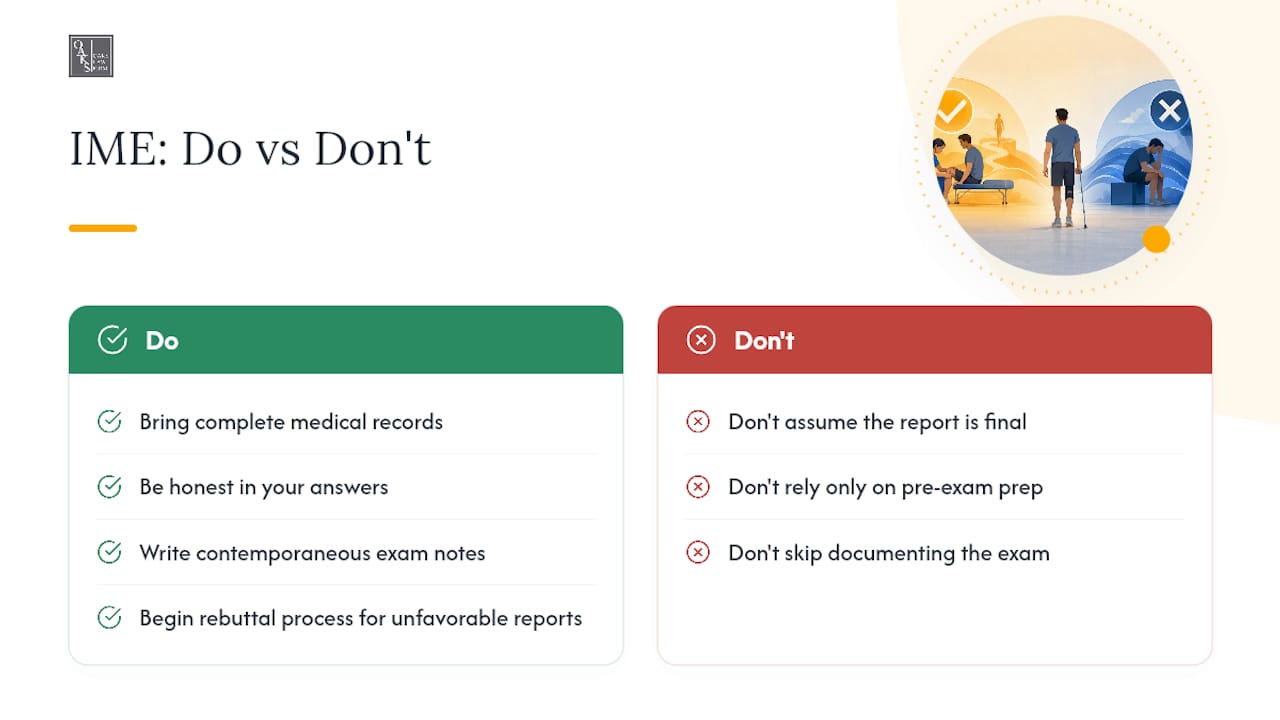
- Answer truthfully and briefly. Respond to what’s asked. Don’t fill silence with extra history, opinions about fault, or details about your case that weren’t requested.
- Confirm logistics ahead of time. Verify the address, expected length, and mileage reimbursement process with your attorney’s office beforehand.
- Flag concerns immediately afterward. If the exam felt unusually short or superficial for your condition, tell your attorney the same day while details are fresh.
Pro Tip: Write down exactly what happened during the exam within an hour of leaving, including how long it lasted and which tests the doctor actually performed. That contemporaneous note becomes powerful evidence if the report later claims a thoroughness the exam never had.
Before the appointment, it also helps to revisit what to bring to any attorney meeting; our consultation checklist applies just as well to IME prep sessions with your lawyer.

What to Do When the IME Report Hurts Your Case
An unfavorable report is a setback, not a dead end. Several concrete responses exist, and the right one depends on how far your claim has progressed.
- Treating physician rebuttal. Your own doctor can write a targeted response addressing specific findings the IME got wrong, ideally citing your actual chart and imaging.
- Retained expert counter-report. For higher-value claims, hiring an independent expert to produce a competing report can directly challenge the IME’s conclusions with fresh analysis.
- Deposing the IME examiner. In litigation, your attorney can depose the examiner under oath, probing how much of your file they actually reviewed and how often they work for the same insurance company.
- Adjusting settlement strategy. A weak IME report, once exposed, often strengthens your negotiating position rather than weakening it, since defense counsel knows a jury may see through it too.
Consumer guidance on IMEs consistently recommends having legal representation precisely because these rebuttal options require someone who knows how to build the record and press for a deposition when it’s warranted.
How Oaks Law Firm Prepares Clients for an IME
At Oaks Law Firm, IME preparation starts well before the appointment date. We review your full treatment history, walk through the kinds of questions a defense-hired examiner is likely to ask, and make sure your documented symptoms and functional limitations are consistent and complete going in.
When a report comes back unfavorable, we look at a few things before deciding on a rebuttal report or a deposition: how much of the medical record the examiner actually reviewed, whether the conclusions match the exam’s own findings, and whether the exam length was reasonable given your injury’s complexity.
Since founding the firm in 2002, Matthew Nezhad has built a practice around a limited caseload, taking on fewer clients so each case gets the attention an IME dispute demands. That approach, run out of offices in Sherman Oaks and Woodland Hills, is what allows the firm to dig into an unfavorable report line by line instead of treating it as a foregone conclusion.
- We document functional limitations in detail before the exam, not after a bad report arrives.
- We flag examiners with a pattern of defense-favorable conclusions when the case history supports it.
Why the Standard IME Advice Falls Short
Most articles on this topic tell you to “be honest” and “bring your records,” and stop there. That advice isn’t wrong, it’s just incomplete, because it treats the IME as a neutral checkpoint instead of what it actually is: a defense-controlled data-gathering exercise with a financial incentive built into its structure. The party that pays the examiner also selects them, and that selection pattern is exactly why credibility factors like record review and exam thoroughness matter so much once a report gets challenged.
What gets underweighted is the immediate aftermath. The window right after the exam, when you can still document what actually happened in the room, matters as much as anything you did to prepare beforehand. A report claiming a 45-minute comprehensive evaluation is far easier to challenge when your own contemporaneous notes say it lasted 12 minutes and skipped half the tests it describes.
My honest read: the biggest mistake claimants make isn’t showing up unprepared. It’s assuming the report is final once it’s written. It rarely is, and the strongest cases treat an unfavorable IME as the start of a rebuttal process, not the end of the claim.
How Oaks Law Firm Helps You Handle an IME
If an IME has been scheduled in your case, or a report has already come back working against you, Oaks Law Firm gives you a direct path to push back, without paying anything upfront. We work on contingency, so you owe nothing unless we recover compensation for you.

Our team reviews your records before the exam, prepares you for what to expect, and knows exactly which credibility factors to challenge when a report doesn’t hold up to scrutiny, whether that means a treating physician rebuttal, a retained expert, or deposing the examiner. Because Oaks Law Firm takes on a limited number of cases each year, your file gets sustained attention rather than being one of hundreds moving through a system on autopilot. We serve clients throughout California from our Sherman Oaks and Woodland Hills offices.
If you’re facing an IME or you’ve already received a report that seems to understate your injuries, learn more about how to file a personal injury lawsuit in California and request a free case evaluation to talk through your specific situation.
Sources
- Work-Related & Independent Medical Examinations | AMA-Code
- What Is an Independent Medical Examination (IME)? – LegalClarity
- What Is an IME and How Do They Work in Injury Cases?
FAQ
What Is an Independent Medical Exam in a Personal Injury Claim?
It’s a one-time evaluation by a doctor hired and paid by the insurance company or defense attorney to assess your injuries for their own case-related purposes, not to provide treatment.
Who Pays for an Independent Medical Exam?
The party requesting the exam, usually the insurer, defendant, or employer in a workers’ compensation claim, pays the examiner directly. You should not receive a bill.
Can I Refuse to Attend an IME?
Refusing can carry consequences, including suspended benefits in workers’ compensation cases or discovery sanctions in litigation, so confirm your obligations with your attorney before declining.
How Long Does an IME Usually Last?
A straightforward orthopedic exam often runs 30 to 45 minutes, while psychiatric or neuropsychological evaluations can take considerably longer due to standardized testing.
What Can I Do if the IME Report Is Unfavorable?
Options include a treating physician rebuttal letter, hiring a retained expert for a counter-report, or deposing the IME examiner, and Oaks Law Firm evaluates which approach fits your case during a free consultation.
Do I Need a Lawyer Before Attending an IME?
Having representation before the exam helps you understand what to expect, what not to volunteer, and how to document the appointment in case the report needs to be challenged later.
Attorney Advertising. This website is an advertisement for legal services. Prior results do not guarantee a similar outcome. The information provided on this website does not, and is not intended to, constitute legal advice; all information, content, and materials available on this site are for general informational purposes only. Contacting Oaks Law Firm does not create an attorney-client relationship. Please consult with a qualified attorney to discuss your specific legal situation.
