

How Long Does It Take to Get a Settlement Check After a California Personal Injury Case?
After you settle a personal injury claim in California, most people in straightforward cases receive their check within roughly two to six weeks of signing the release paperwork. That window can stretch considerably longer when liens, court approval, or multiple insurers are involved. The wait is rarely about anyone sitting on your money. It reflects a series of required legal and administrative steps that protect you and keep the disbursement clean. This article walks through what happens between “we have a deal” and “the check is in my hand,” why some cases take longer, and what you can actually do to keep things moving.

How long does it take to receive a settlement check after signing in California?
In most uncomplicated California cases, the time from signing the release to receiving your portion runs about two to six weeks. The clock effectively starts when you sign and return the release of claims. That document is the legal agreement ending your claim in exchange for the agreed payment, and the insurer generally will not issue funds until it has the signed release in hand.
Once the insurer has your signed release, it processes payment through its own internal review and approval steps before issuing the check. After the check is issued, it travels to your attorney’s office, because settlement checks are almost always made payable jointly to you and your attorney. It does not go straight into your personal account.
Your attorney then deposits the check into a client trust account. In California, attorneys who hold client settlement funds are required under Rule 1.15 of the California Rules of Professional Conduct to place those funds in a clearly identified trust account, typically an IOLTA (Interest on Lawyers’ Trust Accounts) account at a State Bar-approved financial institution. The bank needs time to fully clear the deposited funds, and your attorney cannot distribute anything until that clearance is complete and any liens and fees are resolved. Only after those steps does your net portion get released to you.
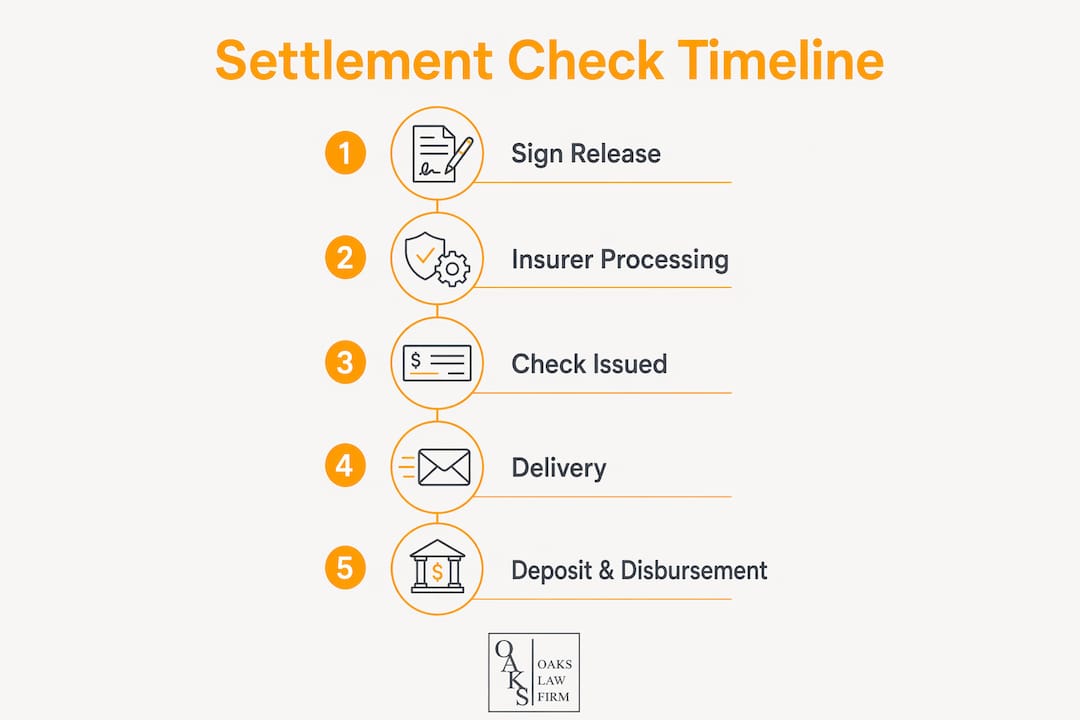
What are the steps between settling and getting paid?
The path from agreement to payment follows a predictable sequence:
First, you sign the release. This ends your claim in exchange for the settlement amount, so reviewing it carefully and returning it promptly matters.
Second, the insurer processes the release and issues the check. Internal review and approval take time that varies by company and claim size.
Third, the check is delivered to your attorney, since it is made jointly payable to you and your lawyer.
Fourth, your attorney deposits it into the client trust account. This is not optional. Under California’s trust-accounting rules, settlement money belonging to a client must pass through a properly maintained trust account.
Fifth, the bank clears the funds. Larger checks can draw longer holds.
Sixth, your attorney resolves liens, fees, and case costs out of the trust account.
Finally, your net portion is disbursed to you, along with a settlement statement showing how the total was distributed.
A practical tip: ask your attorney for the release document the moment settlement is agreed, and sign and return it the same day. Of every step in this process, the speed of returning the release is the one most firmly within your control.
Why does case complexity change how long the settlement takes?
Case complexity is the single biggest variable in how long you wait. A clean case with one insurer, clear liability, and no government liens tends to resolve fastest. Once you add liens, additional parties, or required court approval, the timeline lengthens, sometimes substantially.
Cases involving Medicare or Medi-Cal take longer because those programs have reimbursement rights that must be addressed before funds are distributed. With Medicare, the attorney generally must obtain the program’s conditional payment information, work through the reimbursement amount, and get the final figure confirmed before disbursing.
Medi-Cal, California’s Medicaid program, has its own process administered by the Department of Health Care Services (DHCS). According to DHCS, no settlement is final until Medi-Cal has had a reasonable time to perfect its lien under Welfare and Institutions Code section 14124.76, and the department’s procedures build in waiting periods to allow providers time to bill before the lien amount is finalized. California law also requires that a Medi-Cal lien be reduced to account for the plaintiff’s attorney’s fees and a proportional share of litigation costs, and limits recovery to the portion of a settlement representing medical expenses, an apportionment principle California courts draw from the U.S. Supreme Court’s Ahlborn decision as codified in section 14124.76. The point for you as a client is simply that this resolution takes time and is worth starting early.
Settlements involving a minor or a deceased person’s estate require court approval before funds can be distributed. A California court must review and approve the settlement terms, and that approval step adds time beyond the settlement agreement itself.
Common lien situations that extend the wait include hospital liens filed directly against a settlement for unpaid treatment, Medicare conditional payments, Medi-Cal reimbursement claims, and subrogation claims from a private health insurer that paid injury-related bills. These are not bureaucratic busywork. Resolving valid liens properly protects you, because ignoring a known lien can leave you personally exposed for unpaid bills even after you have been paid. Ask your attorney early whether Medicare, Medi-Cal, or any hospital or health plan has asserted a lien, so that resolution can begin as soon as possible.
What causes settlement delays, and how can you avoid them?
Delays fall into two buckets: things within your control and things outside it. Knowing which is which lets you focus your energy where it actually helps.
The most common controllable delay is slow return of the signed release. Every day a signed release sits unreturned is a day added to the whole timeline. Errors on the release, like a misspelled name, wrong date, or incorrect claim number, are nearly as costly, because a kicked-back document restarts the insurer’s processing. Reviewing the release closely before signing catches those problems before they cost you weeks.
Other delays sit outside your control. Insurers have internal approval chains and varying processing speeds. Banks may place extended holds on larger checks before releasing funds. Unresolved liens stop disbursement until the numbers are confirmed in writing. And some insurers require additional documentation, such as a final medical report, before they will issue payment.
To move things along on your end: sign and return the release the same day you get it, review it carefully first, respond to your attorney’s requests promptly, and ask at the very start of your case for all potential liens to be identified so resolution can begin early. A short status email to your attorney every couple of weeks (“which step are we on right now?”) keeps everyone accountable and surfaces small problems before they grow.
Does California law set a deadline for paying out a settlement?
California does not impose a single fixed statutory countdown requiring an insurer to pay settlement funds within a set number of days after receiving a release. What California does have is a strong framework discouraging unreasonable delay. California’s Insurance Code and its fair-claims-practices rules give policyholders and claimants avenues to challenge an insurer that handles a claim in bad faith, including unreasonable delay in payment once liability and amount are settled. In practice, that gives insurers a real incentive to process agreed settlements without dragging their feet.
If your payment is taking longer than expected, the most useful response is not to assume the worst but to ask your attorney exactly which step is causing the holdup. There is a meaningful difference between routine administrative processing, which is normal, and an unexplained stall, which is worth pressing on. A knowledgeable attorney tracks where the money is, follows up with the insurer in writing, and escalates when an insurer is genuinely unreasonable.
What should I do if my settlement check is taking too long?
Start by asking your attorney three specific questions: When was the release sent, and has the insurer confirmed receipt? Which liens have been identified, and where does each stand? Which exact step are we on right now? Those three answers will usually tell you whether you are looking at ordinary processing or a real bottleneck.
Routine administrative delay in the weeks after settlement is normal and not a red flag. A delay that runs noticeably longer without any clear explanation is worth raising directly. Good representation means you should be able to get a clear, honest answer about where your money is in the process. If you cannot, that itself is worth addressing.
A few common questions, answered
Why does my settlement check go to my attorney first? Because these checks are typically made jointly payable to you and your attorney and, under California’s trust-accounting rules, must be deposited into a client trust account. Funds cannot be distributed until the check clears and any liens and fees are resolved.
What slows a settlement check down the most? Unresolved medical or government liens are the most common cause of extended delay. The most controllable delay is slow signing and return of the release.
Can I speed things up? Sign and return the release the same day, respond to your attorney’s requests promptly, and ask early for all liens to be identified. Those steps remove the delays you can actually influence.
Talk to Oaks Law Firm about your situation
Personal injury settlements involve more moving parts than most people expect, from building the claim through resolving liens and seeing the payment through to the end. Oaks Law Firm has worked with injured clients throughout the and across California, and the team can help at any stage, whether you are deciding how to pursue a claim or already waiting on a check.
If you have questions about where your case or your payment stands, Oaks Law Firm offers a free, no-obligation case evaluation. Reach out to speak with a member of the legal team about the specifics of your situation.
Oaks Law Firm — Los Angeles, California.
This article is provided for general informational purposes only and does not constitute legal advice. The information presented may not reflect the most current legal developments and should not be relied upon as a substitute for consultation with a licensed attorney. Every personal injury case involves unique facts and circumstances, and the outcome of any case depends entirely on those specific facts. Any results, settlement amounts, or verdicts referenced in this content are specific to the individual cases described, are not typical, and do not guarantee, promise, or predict a similar outcome in your case. Reading this content does not create an attorney-client relationship with Oaks Law Firm. Contact us directly for a consultation specific to your situation.
Oakslawfirm is ready to help you through every step
Personal injury settlements involve more moving parts than most clients expect. Oakslawfirm has been protecting injured clients throughout the and California since 2002, and attorney Matthew Nezhad’s team handles every stage of the process, from building your claim to managing liens and pushing for timely payment.

Whether you are still deciding how to pursue your claim or you are already waiting on a check, Oakslawfirm offers a free case evaluation with no obligation. The team’s experience with filing personal injury lawsuits in Los Angeles and navigating car accident compensation in California means you have knowledgeable support at every stage. Contact Oakslawfirm today to speak with a member of the legal team.
