

A freeway accident claim in Los Angeles is a formal legal demand for compensation filed after a crash on a California state highway or interstate, and the outcome depends almost entirely on how quickly and thoroughly you act. Under California Code of Civil Procedure §§ 335.1 and 338©, you have 2 years to file a personal injury claim and 3 years for property damage. If a government entity like Caltrans or LA County bears any responsibility, the California Government Claims Act cuts that window to just 6 months. Miss that deadline and you permanently lose the right to sue. Understanding these rules before you need them is the difference between full compensation and nothing.
Disclaimer: This article provides general legal information only. Your specific case facts, circumstances, and jurisdiction may produce different outcomes. Always consult a qualified attorney for advice tailored to your situation.
What are the legal deadlines and documentation required for a freeway accident claim in Los Angeles?
The two most dangerous words in any Los Angeles car accident claim are “I’ll wait.” California law sets firm deadlines, and courts do not grant extensions for missing them. Personal injury claims must be filed within 2 years of the accident date, while property damage claims allow 3 years. Those windows feel generous until you factor in the time needed to gather evidence, negotiate with insurers, and build a case.
The 6-month rule for government entity claims is where most victims get blindsided. If your crash involved a poorly maintained freeway surface, a malfunctioning signal, or a Caltrans construction zone, the California Government Claims Act requires you to file a formal notice within 6 months of the incident. Miss that deadline and you cannot sue Caltrans, LA County, or any other public agency involved, regardless of how strong your evidence is.
Key documents to gather immediately
Strong documentation is the foundation of any successful claim. Start collecting the following as soon as you are safely able to do so:
- Official police report: Request a copy from the California Highway Patrol (CHP) or the LAPD, depending on which agency responded.
- Medical records and bills: Every treatment, diagnosis, and prescription creates a paper trail that ties your injuries directly to the crash.
- Photographs and video: Capture vehicle damage, road conditions, skid marks, traffic signs, and visible injuries from multiple angles.
- Insurance information: Collect policy numbers and contact details from every driver involved.
- Witness contact information: Names and phone numbers from bystanders can prove decisive when liability is disputed.
- Dashcam and surveillance footage: Request footage from nearby businesses or traffic cameras before it is deleted, which can happen within 24–72 hours.
Pro Tip: Set a calendar reminder for the 5-month mark after your accident if a government entity may be involved. That gives you 30 days to file the required notice before the 6-month deadline expires.
How to prove fault and liability in Los Angeles freeway accidents?
Proving fault in a freeway crash requires more than pointing at the other driver. California uses a pure comparative negligence standard, meaning your compensation is reduced by your percentage of fault. A jury could find you 20% responsible and reduce a $100,000 award to $80,000. That makes establishing the other party’s negligence as clearly as possible a financial priority, not just a legal formality.

Chain-reaction freeway crashes complicate liability significantly. On a congested Los Angeles freeway like the I-405 or the 101, a single rear-end collision can trigger a multi-vehicle pileup involving five or more cars. Assigning fault requires analyzing the full crash sequence, not just the first impact. Each driver’s speed, following distance, and reaction time all factor into the liability calculation.
Types of evidence that establish fault
Digital evidence has become the most reliable tool in freeway accident cases. The following sources carry significant weight:
- Event data recorders (EDR): Most modern vehicles store speed, braking, and steering data in the seconds before a crash. This “black box” data is objective and difficult to dispute.
- Dashcam footage: Captures the crash in real time and can show lane changes, signal violations, and driver behavior.
- Witness statements: Bystanders or other drivers who saw the crash can corroborate your account of events.
- Professional accident reconstruction: An expert can use physical evidence and digital data to recreate the crash sequence and assign fault percentages.
- Traffic camera footage: The California Department of Transportation (Caltrans) and the Los Angeles Department of Transportation (LADOT) operate cameras on major freeways.
Pro Tip: Vehicle EDR data can be overwritten after a certain number of ignition cycles. Contact an attorney within days of the crash, not weeks, to issue a legal hold letter preserving that data before it disappears.
What steps should you take immediately after a freeway accident to support your claim?
The actions you take in the first 48 hours after a freeway crash directly affect the value and viability of your car accident claim. Insurers and defense attorneys look for gaps in documentation, delayed medical treatment, and inconsistent statements. Closing those gaps starts at the scene.
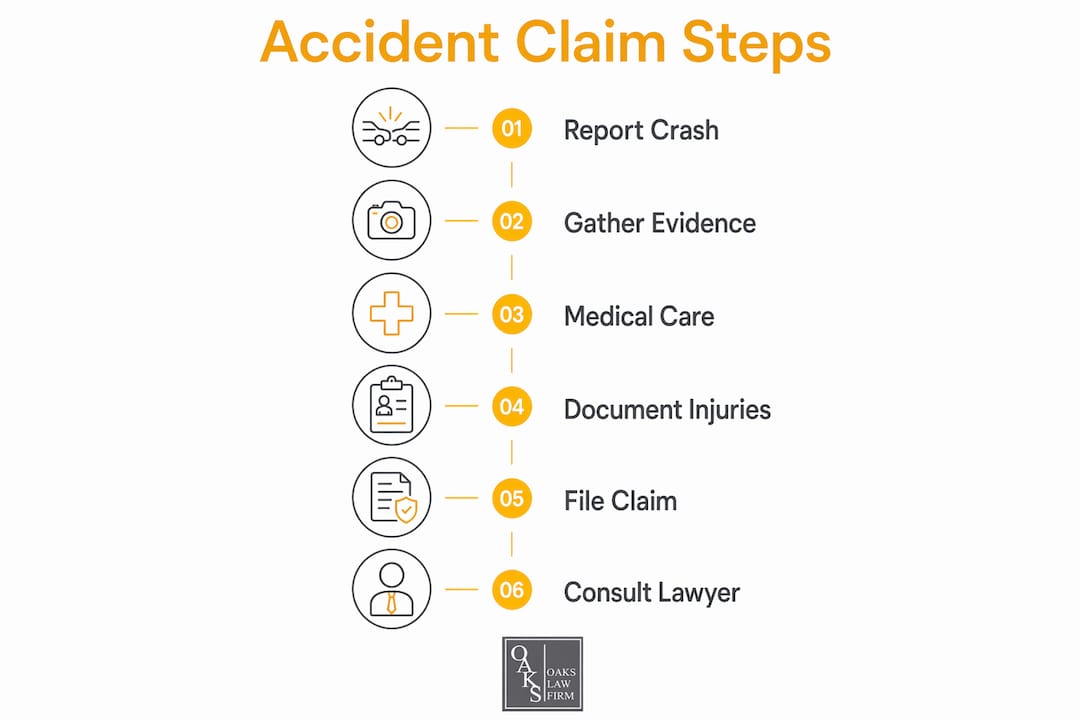
Seeking medical care, documenting the scene, obtaining police reports, and notifying insurers are the four pillars of a protected claim. Each step builds on the last. Follow this sequence:
-
Move to safety and call 911. Get out of traffic if you can do so without worsening injuries. Request both police and emergency medical services.
-
Accept medical evaluation at the scene. Adrenaline masks pain. Injuries like whiplash, internal bleeding, and traumatic brain injuries may not feel serious immediately. Refusing treatment creates a gap insurers will exploit.
-
Document the scene thoroughly. Photograph every vehicle from multiple angles, capture the road surface, any debris, skid marks, and nearby signage. Record a short video narrating what you see while the scene is fresh.
-
Exchange information with all drivers. Collect full names, license numbers, insurance policy numbers, and vehicle registration details.
-
Gather witness contact information. Ask bystanders for their names and phone numbers. Independent witnesses carry significant credibility with insurers and juries.
-
Request the official police report number. You can obtain the full report from CHP or LAPD within a few days. This document is foundational to your claim.
-
Notify your insurance company promptly. Report the accident even if you were not at fault. Delayed reporting can give your insurer grounds to deny coverage.
-
Contact a Los Angeles accident injury lawyer before giving recorded statements. Insurers often request recorded statements early. Anything you say can be used to reduce your payout. An attorney can advise you on what to say and what to avoid.
-
Notify the relevant government agency if applicable. If the crash involved a Caltrans work zone or a road defect, start the government claims process immediately given the 6-month deadline.
-
Follow all medical treatment plans. Gaps in treatment signal to insurers that your injuries were not serious. Attend every appointment and follow every prescription.
One mistake that consistently damages claims is admitting fault at the scene, even casually. Saying “I’m sorry” or “I didn’t see you” can be recorded and used as an admission of liability. Stick to factual exchanges only.
How does insurance coverage affect your freeway accident claim in Los Angeles?
California raised its minimum auto liability insurance limits to 30/60/15 as of january 1, 2025, under AB 1751 and SB 1107. Those figures mean $30,000 per injured person, $60,000 per accident, and $15,000 for property damage. The increase was long overdue, but it created a new problem: many drivers still carry old minimum policies that predate the change.
This is the minimum-coverage trap. A moderate freeway injury involving emergency care, imaging, and follow-up treatment can easily exceed $30,000. If the at-fault driver carries only the old minimums, you may receive far less than your actual damages. That gap is where uninsured and underinsured motorist (UIM) coverage becomes critical.
Underinsured motorist coverage pays the difference between the at-fault driver’s policy limit and your actual damages, up to your own UIM policy limit. Without it, you absorb the shortfall personally. California law allows you to stack UIM coverage in some circumstances, which can significantly increase your recovery.
Coverage limits vs. typical injury costs
| Coverage type | Minimum limit (2025) | Typical moderate injury cost | Gap risk |
|---|---|---|---|
| Bodily injury per person | $30,000 | $40,000–$80,000 | High |
| Bodily injury per accident | $60,000 | $100,000+ (multi-victim) | High |
| Property damage | $15,000 | $20,000–$50,000 | Moderate |
| Uninsured/underinsured motorist | Optional | Covers the gap | Critical |
Understanding how compensation works in California helps you set realistic expectations. Recoverable damages typically include medical expenses, lost wages, vehicle repair or replacement, and pain and suffering. In cases involving severe or permanent injuries, non-economic damages can far exceed the medical bills themselves.
What common challenges arise in freeway accident claims and how can you avoid them?
The most preventable claim failures share a common cause: delayed action. Delayed medical treatment is the single most damaging mistake a victim can make. Insurers argue that a gap between the accident and your first doctor visit proves the injuries were not caused by the crash. Even if you feel fine, get evaluated within 24 hours.
Disputed liability is the second major obstacle. California’s comparative negligence system means the at-fault driver’s insurer will look for any evidence that you contributed to the crash. Speeding, lane changes, or phone use can all reduce your recovery. Solid digital evidence, gathered quickly, is your best defense against these arguments.
The following challenges consistently reduce or eliminate freeway crash injury compensation:
- Missing the government claims deadline. Failure to file within 6 months permanently bars claims against Caltrans, LA County, or any other public entity. There is no exception for ignorance of the rule.
- Accepting early settlement offers. Many claims are lost or reduced because victims accept quick settlements before the full extent of injuries is known. A settlement signed too early releases the insurer from all future liability.
- Giving recorded statements without legal counsel. Insurers train adjusters to ask questions that elicit damaging answers. You are not required to provide a recorded statement to the other driver’s insurer.
- Posting on social media. Photos or comments about your activities after the crash can contradict your injury claims and be used as evidence against you.
- Failing to document ongoing symptoms. Keep a daily journal of pain levels, limitations, and how injuries affect your work and personal life. This record supports non-economic damage claims.
Pro Tip: Consult a qualified Los Angeles accident injury lawyer within the first week after your crash. Early legal guidance prevents the most common and costly mistakes before they happen.
Key Takeaways
A successful freeway accident claim in Los Angeles requires immediate evidence preservation, strict deadline compliance, and a clear understanding of California’s insurance coverage gaps.
| Point | Details |
|---|---|
| File within strict deadlines | Personal injury claims must be filed within 2 years; government entity claims require notice within 6 months. |
| Preserve digital evidence fast | EDR and dashcam data can be overwritten within days. Secure it immediately through legal counsel. |
| Know the coverage gap | California’s 30/60/15 minimums often fall short of real injury costs. UIM coverage fills the gap. |
| Never accept early settlements | Quick offers arrive before your full damages are known. Signing releases all future claims. |
| Document everything from day one | Medical records, photos, witness statements, and a symptom journal all strengthen your compensation claim. |
What I have learned from handling Los Angeles freeway accident claims
After more than two decades representing injured victims in the and across Los Angeles, the pattern I see most often is not complicated. People wait. They wait to see a doctor. They wait to call an attorney. They wait to find out if their injuries are “serious enough.” That waiting is exactly what the other side is counting on.
The freeway cases that settle well share one trait: the client acted fast. They got medical care the same day. They called us within the first week. They had not yet given a recorded statement to the other driver’s insurer. By the time we got involved, the evidence was intact and the deadlines were not yet a problem.
What surprises most clients is how quickly the insurance dynamics shift after the 2025 minimum coverage changes. Drivers are still carrying old policies. That means even a straightforward rear-end collision on the 405 can turn into a UIM coverage dispute if the at-fault driver’s limits are exhausted. I have seen clients with $60,000 in medical bills facing an at-fault driver with a $25,000 policy. Without UIM coverage on their own policy, they absorbed the difference.
The other thing I tell every client: do not let the complexity of a multi-vehicle crash convince you that fault cannot be proven. Chain-reaction crashes on LA freeways look chaotic, but the evidence tells a clear story when you know where to look. EDR data, traffic camera footage, and a thorough reconstruction can untangle even a six-car pileup. The key is moving before that data is gone.
— Matthew Nezhad
Oakslawfirm is ready to fight for your freeway accident claim
Oakslawfirm has spent more than two decades protecting injured victims throughout Los Angeles and the . Attorney Matthew Nezhad and his team specialize in Los Angeles car accident claims, including complex freeway crashes involving multiple vehicles, government entity liability, and disputed fault.
The firm accepts a limited number of cases each year, which means every client receives focused, personal attention. Oakslawfirm operates on a no-fee guarantee policy: you pay nothing unless the firm wins your case. That removes the financial risk of getting professional legal help at the moment you need it most. Contact Oakslawfirm today for a free case evaluation and find out exactly where your claim stands.
FAQ
What is the deadline to file a freeway accident claim in Los Angeles?
California law gives you 2 years for personal injury claims and 3 years for property damage under California Code of Civil Procedure §§ 335.1 and 338©. If a government entity like Caltrans is involved, the California Government Claims Act requires a formal notice within 6 months.
How do I prove fault in a multi-vehicle freeway crash?
Fault is established through a combination of event data recorder (EDR) data, dashcam footage, witness statements, and professional accident reconstruction. California’s pure comparative negligence standard means fault can be shared, so thorough evidence collection is critical.
What compensation can I recover from a freeway crash injury?
Recoverable damages typically include medical expenses, lost wages, vehicle repair or replacement, and pain and suffering. In cases involving severe injuries, non-economic damages can exceed the medical bills themselves.
Should I accept the insurance company’s first settlement offer?
No. Many claims are reduced or lost because victims accept early offers before the full extent of their injuries is known. Signing a settlement releases the insurer from all future liability, even if your condition worsens.
Does it matter if the at-fault driver has minimum insurance coverage?
Yes. California’s minimum limits of $30,000 per person often fall short of real injury costs. Uninsured and underinsured motorist (UIM) coverage on your own policy is the most reliable protection against this gap.
