Attorney Advertising. This article was prepared with the assistance of artificial intelligence and reviewed by Oaks Law Firm prior to publication.
Yes, a delivery driver crash in California can produce a third party personal injury claim, workers’ compensation, platform occupational accident benefits, or some combination of all three, depending on who caused the wreck and whether the driver was on the clock. You generally have two years to sue under Code of Civil Procedure § 335.1, but only six months to file a claim if a government vehicle or entity was involved, under Government Code § 911.2. App logs and GPS data usually decide who ends up paying.
TL;DR:
- Delivery drivers’ insurance coverage varies widely, often excluding delivery use from personal auto policies, making commercial or platform insurance more critical.
- Liability can extend beyond the driver to include the vehicle owner, delivery company, platform, or maintenance provider, depending on control and negligence.
- Evidence such as app logs, GPS data, dashcam footage, and police reports is crucial, with app telemetry preservation being time-sensitive and vital.
- Most personal injury claims have a two-year filing window, with a six-month notice requirement for claims involving government vehicles, requiring quick action.
- Recovery may involve coordinating workers’ compensation, occupational accident benefits, and third-party claims, with actual compensation reduced by fault percentages under California law.
Table of Contents
- Who Can Be Held Liable After a Delivery Driver Accident
- Which Insurance Policies Pay, and Where the Gaps Are
- Employee or Independent Contractor: How Prop 22 Changes Your Claim
- Coordinating Workers’ Comp, Occupational Accident Benefits, and Third-Party Claims
- What Evidence Actually Decides These Cases
- Immediate Steps After a Delivery Driver Accident
- Damages You Can Recover and How Fault Percentages Reduce Them
- How Long You Have to File Your Claim
- Why Oaks Law Firm Handles Delivery Driver Cases Differently
- Get a Free Case Evaluation From Oaks Law Firm
- Sources
- FAQ
Who Can Be Held Liable After a Delivery Driver Accident
Liability in a delivery driver accident claim California case rarely stops at the other driver. Several parties can end up on the hook, and figuring out which ones matters more than most victims realize.
- The driver who caused the crash, whether behind the wheel of a personal car, a company van, or a gig-app vehicle.
- The vehicle owner, if it’s not the driver, since California law lets an injured party pursue the registered owner in many cases.
- The delivery company or delivery service partner (DSP), especially when the driver was an employee or when the company controlled routes, schedules, or vehicle maintenance.
- The platform itself (think DoorDash, Amazon Flex, or similar apps), in narrower cases involving negligent hiring, negligent app design, or direct control over the driver’s conduct.
- A vehicle maintenance provider, if faulty brakes or tires caused the wreck.
- Another driver or a property owner, when a third party’s negligence, not the delivery driver’s, caused the collision.
Vicarious liability holds an employer responsible for an employee’s on-the-job negligence. That doctrine gets murkier with independent contractors, but a company can still be liable for negligent hiring, negligent supervision, or negligent retention when it ignored red flags about a driver’s record. Company-van crashes tend to settle faster because coverage is clearer. Gig-app courier crashes usually take longer to sort out, since the first fight is often over who was legally responsible for the driver at that moment. A DoorDash-specific case illustrates how platform liability plays out in practice.
Which Insurance Policies Pay, and Where the Gaps Are
Figuring out which policy actually pays is often the hardest part of a delivery driver accident claim in California, and it’s where most victims get blind sided.
Personal auto policies commonly exclude commercial or delivery use, and that exclusion typically kicks in when a driver accepts a paid delivery, not at the moment of the crash. That timing detail catches a lot of drivers off guard. A driver who accepted an order minutes before the collision may find their own insurer denying the claim outright, even if they were technically still “between deliveries” in their own mind.
Where coverage can come from:
- Commercial auto liability, typically carried by delivery companies and DSPs.
- Hired and non-owned auto coverage, for companies that use drivers’ personal vehicles for business runs.
- Cargo coverage, which pays for damaged or lost goods, separate from bodily injury claims.
- Platform occupational accident insurance, which covers gig drivers hurt during “engaged time.”
- Uninsured/underinsured motorist (UM/UIM) coverage, the backstop when the at-fault driver has no insurance or not enough.
Pro Tip: Large delivery service partners for platforms like Amazon commonly carry $1,000,000 combined single-limit commercial auto liability plus umbrella coverage. That number matters because it often determines whether there’s enough insurance to cover serious injuries at all.
Employee or Independent Contractor: How Prop 22 Changes Your Claim
Most app-based delivery drivers in California are classified as independent contractors under Proposition 22, the 2020 ballot measure that reshaped gig work in the state. That classification determines almost everything about what benefits a driver can access after a crash.
- Prop 22 requires platforms to provide occupational accident insurance covering medical costs during “engaged time,” up to $1 million, plus disability benefits worth roughly two-thirds of average weekly earnings.
- “Engaged time” usually means the window between accepting a delivery and completing it. Crashes that happen while a driver is logged off or waiting between orders often fall into a coverage gap.
- Employee drivers, by contrast, typically qualify for state workers’ compensation, which covers a broader range of circumstances but caps certain benefits differently than Prop 22’s occupational accident model.
- Contractor status doesn’t automatically shield a company from liability. If the company controlled routes, set schedules, or ignored a driver’s history of unsafe conduct, negligent hiring or negligent supervision claims can still reach the company directly.
Coordinating Workers’ Comp, Occupational Accident Benefits, and Third-Party Claims
These recovery paths don’t cancel each other out. In fact, they frequently run at the same time, and knowing how to coordinate them is often the difference between a partial recovery and a full one.
Workers’ compensation and occupational accident benefits are no-fault. You get medical coverage and partial wage replacement regardless of who caused the crash, but you can’t sue your employer or the platform for pain and suffering through that channel alone. A third-party personal injury claim, filed against the at-fault driver or another negligent party, is fault-based and can recover damages that workers’ comp never touches.
- Workers’ comp and occ/acc benefits: medical bills, partial wage replacement, no fault required.
- Third-party claims: pain and suffering, full lost wages, and other damages workers’ comp doesn’t cover.
- Insurers who paid workers’ comp benefits often have a lien on any third-party settlement, meaning part of that settlement reimburses the comp carrier.
Pro Tip: An attorney who understands lien negotiation can often reduce what the comp carrier claws back, which puts more money in your pocket at the end of the case. Attorneys typically time the third-party settlement carefully, since finalizing it too early can complicate the lien negotiation and shrink the driver’s net recovery.
What Evidence Actually Decides These Cases
The paper trail in a delivery driver accident claim California case is often more decisive than eyewitness accounts, because insurers and courts trust records over memory.
- App status logs showing whether the driver was “engaged,” idle, or offline at the time of the crash.
- GPS and timestamp data, which pinpoint location, speed, and route at the moment of impact.
- Dashcam or nearby doorbell footage, increasingly common and often the clearest proof of fault.
- The police report, filed at the scene whenever possible.
- Photos of the scene, vehicles, and injuries, along with contact information for any witnesses.
- Vehicle maintenance records and personnel files, which can reveal a pattern of neglect or a company’s failure to vet a driver.
Preserving app telemetry within hours, not weeks, often decides whether the platform’s insurance or a driver’s personal policy ends up paying the claim. Screenshot everything before an app update or account change wipes it out, and have a lawyer send a formal preservation request to the company as soon as possible.
Immediate Steps After a Delivery Driver Accident
What you do in the first hour after a crash shapes the entire case that follows.
- Get medical attention first. Call 911 if anyone is hurt, even if injuries seem minor at first.
- Request a police report. Officers document fault indicators that carry weight later.
- Photograph everything. Vehicle damage, the scene, visible injuries, and road conditions.
- Collect witness names and phone numbers before people leave the scene.
- Screenshot your delivery app status immediately, showing whether you were engaged in a delivery.
- Report the crash to your employer or the platform within any window the company specifies.
- Avoid giving a recorded statement to any insurer until you’ve spoken with an attorney.
Pro Tip: Insurance adjusters often call within 24 hours, hoping to lock in a statement before you understand the full extent of your injuries. You’re not required to give one on the spot.
Damages You Can Recover and How Fault Percentages Reduce Them
California follows pure comparative negligence, which means you can recover damages even if you were partly at fault, but your award shrinks by your percentage of fault.
- Past and future medical expenses, including anticipated treatment and rehabilitation.
- Lost wages, both past income and diminished future earning capacity.
- Property damage to a vehicle or damaged goods.
- Pain and suffering, covering physical pain and emotional distress.
- Wrongful death damages, when a delivery-related crash proves fatal.
Future earning-capacity claims usually rely on medical testimony and vocational assessments to project what a serious injury costs someone over a working lifetime.
How Long You Have to File Your Claim
Under Code of Civil Procedure § 335.1, most California personal injury lawsuits must be filed within two years of the accident date. Miss it, and the court will almost certainly dismiss the case, no matter how strong the evidence is.
- Two-year deadline (CCP §335.1): standard filing window for personal injury claims.
- Six-month notice (Gov. Code §911.2): applies when a government vehicle or public entity is involved, and it comes with strict formal requirements.
- Exceptions exist for minors, certain discovery-of-injury situations, and other narrow circumstances, so don’t assume you’re automatically outside the window. Review California’s statute of limitations rules for the specifics that could apply to your case.
Evidence disappears fast. App data gets purged, witnesses move, and dashcam footage gets overwritten. Acting quickly protects your legal rights long before any filing deadline arrives.
Why Oaks Law Firm Handles Delivery Driver Cases Differently
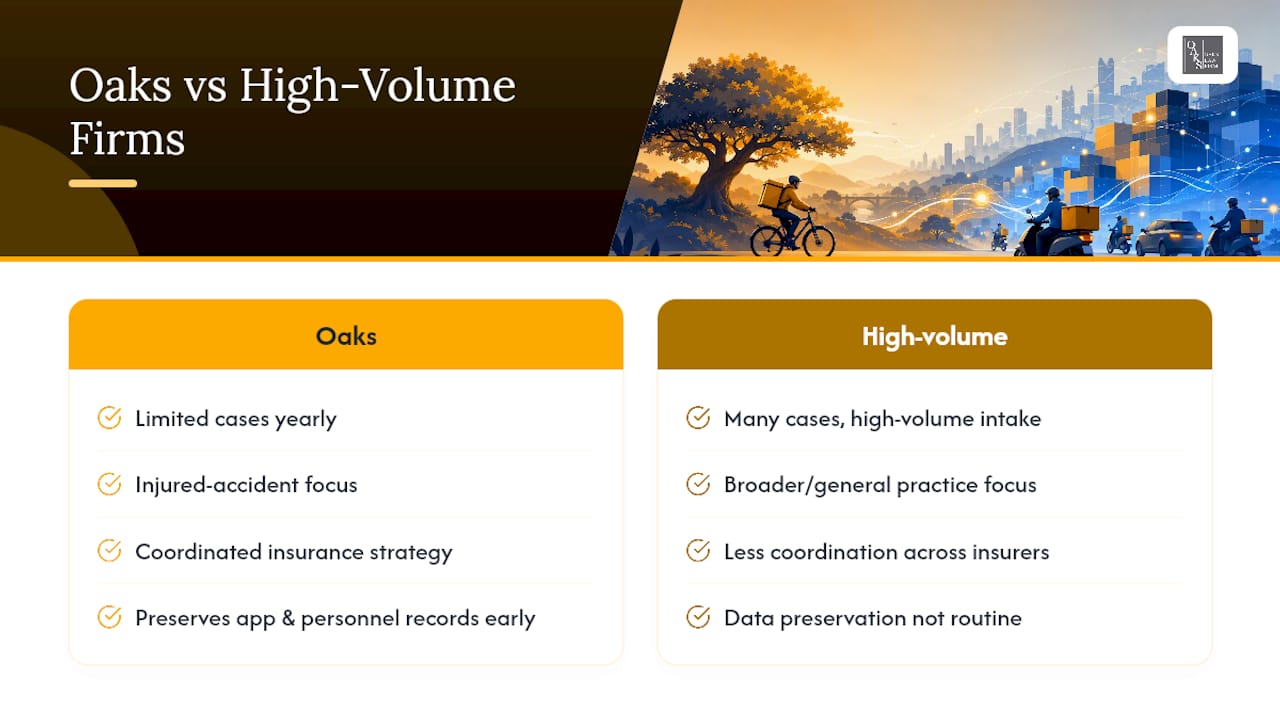
The law firm was founded by its lead attorney, who has focused his career on injured accident victims across California. The firm operates from offices in the San Fernando Valley area and accepts a limited number of cases each year rather than running a high-volume practice.
That approach matters in delivery driver cases, where success depends on untangling multiple insurance layers, coordinating workers’ comp or occupational accident benefits with a third-party claim, and dealing with commercial carriers who have far more resources than an individual driver. Preserving app data and personnel records early, before they disappear, is routine practice for a firm built around this kind of coordination.
— Matthew Nezhad
Get a Free Case Evaluation From Oaks Law Firm
This law firm represents delivery drivers and other crash victims and emphasizes personalized service with direct attorney access rather than passing clients between case managers. This approach can be important in delivery accident claims, where coordinating workers’ compensation, occupational accident benefits, and a third-party lawsuit requires careful management.
There’s no upfront cost to find out where you stand. The firm offers a free case evaluation and works on contingency, meaning clients pay nothing unless their case is won. If you were hurt in a car accident while making deliveries or as a bystander hit by a delivery vehicle, reach out now to get your app data and evidence preserved before it disappears, and to find out what your claim might realistically be worth.
This article is general information, not a substitute for advice from a qualified lawyer. Consult a qualified legal professional about your own circumstances before acting on anything here.
Sources
- Delivery-Driver Accident Claims in California — What Victims Need to Know — California Accident Attorneys Blog
- CA passes Prop 22: gig drivers are independent contractors — IMACorp insights
- Commercial auto vs business use — TCS Insurance Brokers
- Last-Mile & Delivery Insurance | Amazon DSP & Courier | Pro Insurance
FAQ
What Happens if a Delivery Driver Gets in an Accident?
The outcome depends on employment status and whether the driver was actively engaged in a delivery. Employee drivers usually access workers’ compensation, while independent contractors under Proposition 22 typically rely on platform occupational accident insurance, and either can also pursue a third-party claim against an at-fault driver.
Are Delivery Drivers Liable for Damages?
A delivery driver can be personally liable if their negligence caused the crash, but liability often extends to the delivery company, the vehicle owner, or the platform under theories like vicarious liability or negligent hiring. Multiple parties frequently share responsibility in these cases.
How Much of a $25,000 Settlement Will I Get?
The final amount depends on attorney fees under a contingency agreement, medical liens from workers’ comp or health insurers, and any reduction for your own percentage of fault under California’s comparative negligence rule. An attorney can estimate your net recovery once these factors are known, and you can learn more about typical claim resolution timelines here.
What Happens if Your Dasher Gets in an Accident?
If a DoorDash driver causes a crash while actively delivering, the platform’s occupational accident insurance may cover the driver’s injuries, and injured third parties can typically pursue a claim against the driver, DoorDash’s contingent liability coverage, or both. Details on suing the platform directly are covered in this DoorDash accident guide.
How Long Do I Have to File a Delivery Driver Accident Claim in California?
Most personal injury claims must be filed within two years under CCP §335.1, while claims involving a government entity require formal notice within six months under Gov. Code §911.2. Exceptions can apply, so early legal review is worth pursuing, and you can review deadline nuances for truck accident claims as a comparison point.
Attorney Advertising. Prior results do not guarantee a similar outcome. This article provides general information about California personal injury law and is not legal advice. No attorney-client relationship is formed by reading this content. For advice about your specific situation, contact Oaks Law Firm for a free consultation.
