

Attorney Advertising. This article was prepared with the assistance of artificial intelligence and reviewed by Oaks Law Firm prior to publication.
A defective product injury claim is a legal action that lets you recover compensation when a flawed product causes you harm. Three defect categories drive these claims: a manufacturing defect (a single unit built wrong), a design defect (a flaw baked into every unit), or a marketing defect (missing or inadequate warnings). To win, you must prove the product was defective, that defect caused your injury, and that you suffered real damages. In California, you generally have two years from the date of injury to file under CCP §335.1, and a much shorter period if a government entity is involved under Gov. Code §911.2.
What to do right now: Get medical care, preserve the product and its packaging, photograph everything, and call a product liability attorney before you say anything to the manufacturer or their insurer.
Preserve in the first 48 hours:
- The product itself (do not repair, modify, or discard it)
- Original packaging, labels, and any inserts
- Purchase receipt or order confirmation with serial/batch number
- Photographs of the defect, your injuries, and the scene
- Names and contact information for any witnesses
Pro Tip: Date-stamp every photo immediately and back them up to cloud storage. A timestamped photo taken within hours of the injury is far harder for a defense attorney to challenge than one taken days later.
Table of Contents
- What is a defective product injury claim under U.S. law?
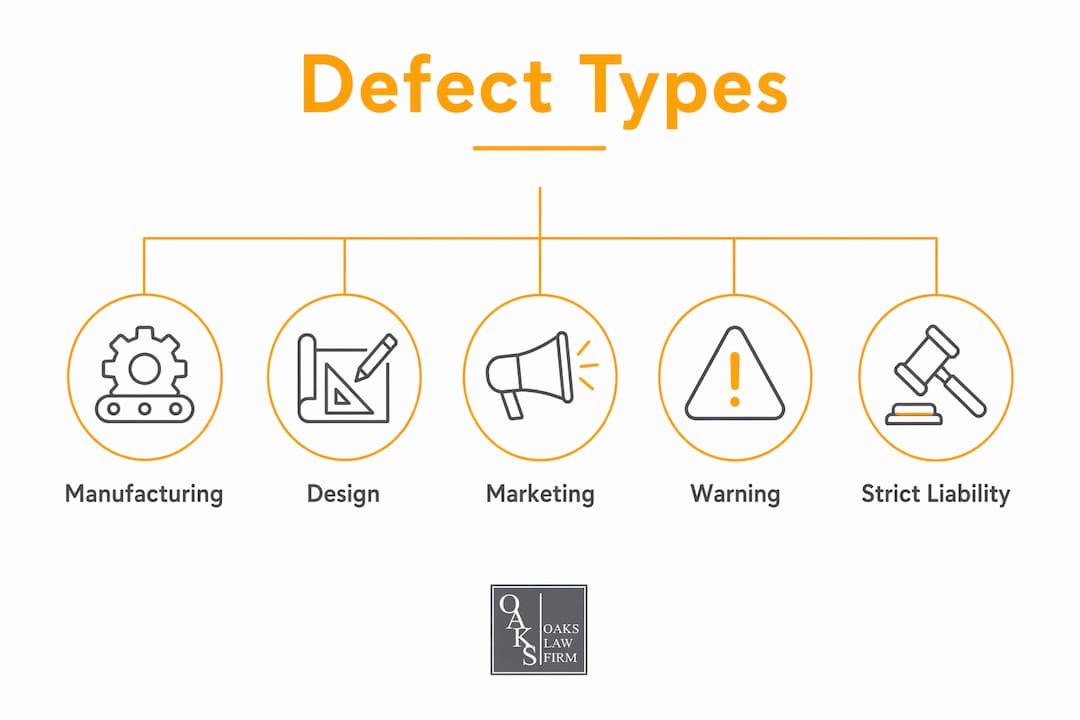
- The three types of defects that can give rise to a claim
- Who can you sue for a defective product injury?
- What elements and evidence do you need to prove your claim?
- What should you do immediately after a product injury?
- What compensation can you recover in a product liability case?
- What are the deadlines for filing a defective product claim in California?
- How do manufacturers defend against product liability claims?
- How does a defective product claim move from injury to resolution?
- Do you need a product liability attorney, and how do fees work?
- How Oaks Law Firm approaches product liability cases
- Key Takeaways
- Why acting fast on a product injury claim matters more than most people realize
- Free case evaluation for your product injury claim
- Useful sources
- FAQ
What is a defective product injury claim under U.S. law?
Product liability is the body of law that holds sellers and manufacturers responsible for injuries caused by defective products. Unlike a car accident claim, you do not always have to prove the company was careless. Three distinct legal theories can support a product liability claim, and a skilled attorney will often pursue more than one at once.
Strict liability is the most powerful theory for injured consumers. Under strict liability, the focus is whether the product was defective and caused injury — not whether the manufacturer was negligent. California courts apply this standard broadly, which means a company that exercised every precaution can still be held responsible if its product was unreasonably dangerous when it left their control.
Negligence requires showing the defendant failed to exercise reasonable care — in design, manufacturing, or warnings. It is harder to prove than strict liability but matters in cases where the defect stems from a specific failure in the company’s processes.
Breach of warranty applies when a product fails to live up to an express promise (written or verbal) or an implied guarantee of fitness. If a product is marketed as safe for a specific use and injures you during that use, a warranty claim may run alongside the others.
Who can bring a claim? The law is broader than most people realize:
- The person who purchased and used the product
- A bystander injured by someone else’s product
- A family member filing a wrongful death claim when a defective product kills a loved one
- Anyone who received the product as a gift or borrowed it
The three types of defects that can give rise to a claim
Understanding which defect category fits your situation shapes the evidence you need and the defendants you can name.
Manufacturing defects
A manufacturing defect occurs when a specific unit deviates from its intended design during production. The blueprint was fine; something went wrong on the assembly line. A classic example: a batch of bicycle helmets where the foam liner was not bonded correctly, leaving one helmet with no real impact protection even though every other helmet in the run was fine. The key proof is showing your unit differed from the design spec — serial numbers, batch records, and the product itself are central evidence.

Design defects
A design defect exists before a single unit is built. Every product off that line carries the same flaw. Courts in California apply either the consumer expectation test (would a reasonable consumer expect this danger?) or the risk-utility test (do the product’s risks outweigh its benefits?), sometimes both. A vehicle with a fuel tank positioned so that a moderate rear-end collision causes a fire is a textbook design defect — every vehicle in that model year shares the same vulnerability.
Marketing and warning defects
This category covers failures to warn or inadequate instructions. A power tool that can cause serious injury if used without eye protection, sold with no warning label, is a marketing defect case. So is a medication whose packaging omits a known drug interaction. The product itself may work exactly as designed; the failure is in the information provided to the user.
Why the distinction matters: Strict liability applies to all three types, but the evidence and experts differ. Design defect cases often require safety engineers; warning cases turn on what the company knew and when; manufacturing cases hinge on production records and the physical unit.
Pro Tip: Always preserve the original label, packaging insert, and any instruction manual. In a warning-defect case, the label is the evidence. Photographing it from multiple angles before it fades or tears can be decisive.
Who can you sue for a defective product injury?
Liability can extend across every link in the distribution chain. That is not a technicality — it is a strategic advantage for injured plaintiffs.
- Manufacturer: The company that designed and built the product. Usually the primary defendant.
- Component supplier: The maker of a part that caused the defect (e.g., a faulty battery cell inside a laptop).
- Assembler: A company that assembled components from multiple sources into a finished product.
- Distributor/wholesaler: Entities that moved the product from manufacturer to retailer.
- Retailer: The store that sold it to you. Under strict liability, a retailer who sold a defective product in the ordinary course of business can be held liable even if they had no knowledge of the defect.
Naming multiple defendants matters because it increases your recovery options and puts pressure on each party to cooperate or settle. If the manufacturer is overseas and difficult to serve, a domestic retailer or distributor may be your most accessible defendant.
What elements and evidence do you need to prove your claim?
Four core elements must be established to succeed in a product liability case:
- The product was defective when it left the defendant’s control.
- The defect existed at the time of sale — not caused by misuse afterward.
- The defect caused your injury (causation, both actual and proximate).
- You suffered damages — physical, financial, or both.
Evidence checklist:
- The product itself, preserved in its post-incident condition
- Photographs of the defect, injury, and scene taken as soon as possible
- Purchase receipt, order confirmation, serial number, and batch/lot number
- All medical records, bills, and treatment notes connecting your injury to the product
- Witness names and statements
- Expert reports (safety engineers, metallurgists, medical specialists)
- Maintenance logs showing the product was properly cared for
- Any prior complaints or recall notices about the same product
Expert testimony is often the difference between winning and losing. A safety engineer can explain why a design was unreasonably dangerous; a medical expert can link your specific injuries to the product failure rather than a pre-existing condition. During discovery, your attorney can compel the manufacturer to produce internal test results, complaint logs, and safety analyses — documents that frequently drive settlement value far higher than the initial demand.
Pro Tip: Seek medical care the same day, even if you feel only moderate pain. Medical records are the backbone of a damages claim, and gaps or delayed treatment give defendants leverage to argue your injuries were not serious or were caused by something else entirely.
What should you do immediately after a product injury?
Follow these steps in order. Each one protects a different piece of your claim.
- Get medical care. Your health comes first, and a same-day medical record creates an immediate link between the product and your injury.
- Photograph everything. The product, the defect, the scene, your injuries — before anything is moved or cleaned up.
- Secure the product and packaging. Put it somewhere safe. Do not let anyone repair, modify, or throw it away. Immediate evidence preservation includes saving the packaging, labels, and any inserts.
- Save your purchase records. Receipt, order confirmation, credit card statement — anything that proves you bought it and when.
- Record witness information. Full names and phone numbers of anyone who saw the incident or its aftermath.
- Report the injury. You can file a report with the manufacturer, the retailer, and the U.S. Consumer Product Safety Commission (CPSC). Reporting creates an official record and may reveal prior complaints about the same product.
- Contact a product liability attorney. An attorney can send preservation letters to the manufacturer, preventing them from destroying relevant records.
What not to do:
- Do not discard or repair the product under any circumstances.
- Do not give a recorded statement to the manufacturer’s insurer without counsel.
- Do not post detailed descriptions of the incident or your injuries on social media — those posts become evidence.
- For minor defective goods with no injury, the FTC recommends starting with the retailer for a refund or replacement. But once there is a serious injury, informal resolution is not enough.
Pro Tip: Never post photos of the product or the accident scene on social media before speaking with an attorney. Defense teams routinely monitor plaintiffs’ accounts, and a single post can be used to argue you were not as injured as claimed.
What compensation can you recover in a product liability case?
Damages in a defective product injury claim fall into three buckets.
Economic damages are the measurable financial losses:
- Past and future medical bills (surgery, hospitalization, physical therapy, medication)
- Lost wages and lost earning capacity if the injury affects your ability to work
- Property damage caused by the defective product
- Out-of-pocket costs directly tied to the injury
Document every expense with receipts, bills, and employer records. Future damages often require expert testimony from an economist or vocational specialist.
Non-economic damages compensate for losses that do not come with a price tag:
- Pain and suffering
- Emotional distress
- Loss of enjoyment of life
- Loss of consortium (impact on your relationship with a spouse or partner)
Juries evaluate these based on the severity and permanence of the injury, the plaintiff’s age, and how the injury has changed daily life. California does not cap non-economic damages in most product liability cases, though medical malpractice cases follow different rules.
Punitive damages are rare but available when a defendant’s conduct was malicious, oppressive, or fraudulent. If a manufacturer knew its product was dangerous and concealed that information, a court may award punitive damages on top of compensatory damages to punish the conduct and deter others. These are not available in every case and require a higher evidentiary standard.
For context on how settlement proceeds are treated after recovery, California has specific rules on taxation of personal injury settlements that are worth understanding before you finalize any agreement.
What are the deadlines for filing a defective product claim in California?
California’s statute of limitations for personal injury claims, including product liability, is generally two years from the date of injury under CCP §335.1. Miss that window and your claim is almost certainly barred, regardless of how strong the evidence is.
Key variations and tolling rules:
- Discovery rule: If you did not know and could not reasonably have known the product caused your injury, the clock may start from the date you discovered (or should have discovered) the connection. This matters in latent-injury cases like toxic exposure.
- Minors: The statute is generally tolled until the minor turns 18, giving them until age 20 to file.
- Government claims: Filing a lawsuit against a public entity requires a separate administrative claim first. The six-month deadline under Gov. Code §911.2 is strict and separate from the two-year civil deadline. Miss it and you lose the right to sue the government entity entirely. See the full breakdown of the California government tort claim process.
- Fraudulent concealment: If the manufacturer actively hid the defect, tolling may extend the filing window.
The California injury claim time limit has nuances that vary by case type. When in doubt, consult an attorney early — waiting costs you options.
How do manufacturers defend against product liability claims?
Knowing the defenses helps you anticipate what the other side will argue and why your evidence collection matters so much from day one.
Common defenses:
- Product misuse: The defendant argues you used the product in a way that was not intended or reasonably foreseeable. Counter this by showing your use was normal and consistent with the instructions.
- Alteration: If the product was modified after it left the manufacturer’s control, they may argue the modification caused the injury.
- Failure to follow a recall: If a recall was issued and you ignored it, that can affect your recovery.
- Intervening cause: The defendant argues something else (not the product) caused your injury.
- Lack of notice: In some warranty claims, the defendant argues they were not given a reasonable chance to fix the problem.
Comparative negligence in California operates under a pure comparative fault system. Even if you were partially at fault — say, 30% responsible for the accident — you can still recover 70% of your damages. Your recovery is reduced by your percentage of fault, but it is not eliminated. This is more favorable than states that bar recovery once you exceed a certain fault threshold.
Product recalls can cut both ways. A recall issued before your injury may show the manufacturer knew about the defect; a recall issued after can be evidence of the defect’s existence. Your attorney can use recall records as leverage in settlement negotiations.
How does a defective product claim move from injury to resolution?
Most product liability cases follow a predictable arc, though the timeline varies significantly by complexity.
The typical progression:
- Investigation and evidence preservation (weeks 1–8): Your attorney sends preservation letters, retains experts, and gathers medical records, purchase history, and product documentation.
- Demand and negotiation (months 2–6): A formal demand letter goes to the defendant and their insurer, outlining the defect, causation, and damages. Early settlement discussions begin.
- Discovery and expert work (months 6–18): Both sides exchange documents, take depositions, and retain experts. This is where internal manufacturer documents — test results, complaint logs, safety analyses — surface and often shift settlement leverage dramatically.
- Mediation or settlement conference (months 12–24): Most cases resolve here. A neutral mediator helps both sides reach a number.
- Trial (if no settlement): Full trials in complex product liability cases can take two to four years from filing to verdict.
Most product liability cases settle before trial because building a strong claim from day one gives plaintiffs real leverage. Insurers settle when the evidence is solid and the cost of trial exceeds the settlement value. Cases with clear internal documents showing the manufacturer knew about a defect tend to resolve faster and at higher values. For a detailed look at how settlement payouts work once a case resolves, that process has its own timeline and steps worth understanding.
For a broader look at personal injury lawsuit stages in California, the procedural steps apply to product liability cases as well.
Do you need a product liability attorney, and how do fees work?
For a minor defective product with no injury — a broken appliance, a faulty toy — you may resolve the matter directly with the retailer. For any claim involving serious injury, hospitalization, lost wages, or a complex supply chain, you need an attorney, and you need one early.
Why early matters: An attorney can issue evidence hold letters before the manufacturer destroys records, retain experts while the product is still in its post-incident condition, and identify every defendant in the supply chain before the statute runs.
Most personal injury firms operate on a contingency fee basis — you pay nothing up front, and the attorney’s fee comes as a percentage of the recovery. If there is no recovery, you owe no fee. This model gives injured consumers access to experienced counsel and expert witnesses they could not otherwise afford. Firms commonly front investigation and expert costs while pursuing the case.
What a strong product liability attorney does early:
- Sends preservation letters to prevent evidence destruction
- Retains technical and medical experts
- Identifies all potentially liable parties across the supply chain
- Calculates the full scope of economic and non-economic damages
- Evaluates the strength of strict liability, negligence, and warranty theories
How to choose counsel:
- Specific experience with product liability cases, not just general personal injury
- Resources to retain engineers and medical experts
- A track record of taking cases through discovery and to trial when necessary
- Clear communication about case strategy and realistic outcomes
- A no-fee guarantee unless they win
How Oaks Law Firm approaches product liability cases
Attorney Matthew Nezhad founded Oaks Law Firm in 2002 with one goal: maximum compensation for injured clients throughout California. With offices in Sherman Oaks and Woodland Hills, the firm serves clients across the and statewide. The team accepts a limited number of cases each year, which means every client gets focused attention from an experienced legal team.
For product liability clients, the firm’s work starts immediately:
- Early evidence preservation and hold letters to manufacturers
- Expert retention (engineers, medical specialists, economists)
- Full discovery to surface internal company documents
- Settlement negotiation backed by a complete damages picture
- Litigation when a fair settlement is not on the table
What to bring to a free consultation:
- Photos of the product, defect, and your injuries
- The product itself (or photos if storage is not possible)
- Purchase receipt, order confirmation, or any proof of purchase
- Medical records and bills related to the injury
- Any communications with the manufacturer or retailer
The consultation is free, and representation is on a contingency basis. You pay nothing unless Oaks Law Firm wins your case. If a defective product has injured you or a family member, contact Oaks Law Firm today for a case evaluation.
Key Takeaways
A defective product injury claim requires proving defect, causation, and damages — and California’s two-year deadline under CCP §335.1 means the clock starts the day you are hurt.
| Point | Details |
|---|---|
| Three defect types | Manufacturing, design, and marketing/warning defects each require different evidence and experts. |
| California deadline | Two years from injury under CCP §335.1; six months for government claims under Gov. Code §911.2. |
| Preserve evidence immediately | Save the product, packaging, receipts, and photos within the first 48 hours to keep your claim viable. |
| Multiple defendants possible | Manufacturer, distributor, and retailer can all be liable, increasing your recovery options. |
| Oaks Law Firm | Offers free case evaluations and contingency-fee representation for product liability claims throughout California. |
Why acting fast on a product injury claim matters more than most people realize
People often underestimate how quickly a product liability claim can erode. The product gets thrown away. The packaging is recycled. The injury is treated but the bills are not saved. By the time someone calls an attorney three months later, half the evidence is gone and the medical records have gaps that a defense team will exploit.
What most articles do not say plainly enough: the legal theory is almost never the hard part. Strict liability is a powerful tool, and California courts apply it broadly. The hard part is proving the product was defective when it left the manufacturer’s control — and that proof lives in the physical evidence, the batch records, and the medical documentation you either preserved or did not. A company’s internal documents, surfaced during discovery, can transform a modest claim into a significant one. But you only get to discovery if you filed in time, preserved the evidence, and retained counsel early enough to do the work properly.
The clients who recover the most are not necessarily the ones with the most severe injuries. They are the ones who acted quickly, documented everything, and worked with an attorney who knew how to build the case from day one.
Free case evaluation for your product injury claim
If a defective product has hurt you or someone in your family, Oaks Law Firm is ready to help you understand your options and fight for what you deserve.

Matthew Nezhad and the Oaks Law Firm team have spent more than two decades protecting injured Californians in the and throughout the state. The firm handles product liability cases on a contingency basis, meaning no fees unless you win. Whether you need guidance on filing a personal injury lawsuit in Los Angeles or representation for a wrongful death caused by a defective product, the team is ready to evaluate your case at no cost. Call or contact Oaks Law Firm today to schedule your free consultation.
Useful sources
The following statutes and references were used in preparing this article. Statutes and deadlines vary by state; consult a licensed attorney in your jurisdiction for advice specific to your situation.
- CCP §335.1 — California’s two-year statute of limitations for personal injury claims, including product liability.
- Gov. Code §911.2 — Six-month deadline for administrative claims against California government entities.
- Products Liability — Legal Information Institute (Cornell) — Plain-English overview of product liability law, defect categories, and legal theories.
- U.S. Consumer Product Safety Commission (CPSC) — Federal agency overseeing product safety standards and recall information; consumers can file injury reports at SaferProducts.gov.
- FindLaw — Defective Product Injury — Overview of distribution-chain liability and how to find legal help.
- FTC — Solving Problems With a Business — Guidance on informal consumer remedies for defective goods without injury.
- LegalClarity — Product Liability Lawsuit — Detailed explanation of defect proof, strict liability, and settlement dynamics.
FAQ
What are the three types of defects in a product liability claim?
The three types are manufacturing defects (a single unit built incorrectly), design defects (a flaw present in every unit), and marketing defects (inadequate warnings or instructions). Each requires different evidence to prove, and all three can support a strict liability claim.
What qualifies as a defective product under U.S. law?
A product is legally defective when it has a manufacturing flaw, an unreasonably dangerous design, or insufficient warnings, and that defect causes injury during reasonably foreseeable use. Not every malfunction is a legal defect — you must show the product failed while being used as intended or in a way the manufacturer could have anticipated.
How do you file a defective product injury claim in California?
Preserve the product and evidence, seek medical care, and contact a product liability attorney as soon as possible. Your attorney will send preservation letters, identify defendants across the supply chain, and file suit within California’s two-year deadline under CCP §335.1 (or six months for government claims under Gov. Code §911.2).
How do you win a product liability case?
Winning requires proving four elements: the product was defective, the defect existed when it left the defendant’s control, the defect caused your injury, and you suffered damages. Strong physical evidence, consistent medical records, and expert testimony are typically what separate successful claims from unsuccessful ones.
Do you need a lawyer for a defective product injury claim?
For serious injuries, yes. Product liability cases involve complex supply chains, expert witnesses, and discovery of internal company documents that most individuals cannot navigate alone. Most product liability attorneys work on contingency, so there is no upfront cost to get experienced representation.
This article is general information, not legal advice. Laws and deadlines vary by jurisdiction and individual circumstances. Consult a qualified attorney to evaluate your specific situation.
Legal Disclaimer: The information provided in this article is for general informational purposes only and does not constitute legal advice. Reading this article does not create an attorney-client relationship between you and Oaks Law Firm. Every case is unique, and the outcome of any legal matter depends on the specific facts and circumstances involved. Oaks Law Firm makes no guarantees regarding the outcome of any case. If you have been injured and believe you may have a legal claim, you should consult with a qualified attorney as soon as possible to protect your rights and meet applicable deadlines.
