
Attorney Advertising. This article was prepared with the assistance of artificial intelligence and reviewed by Oaks Law Firm prior to publication.
A public entity in California can be held liable for injuries caused by a dangerous condition of public property when you prove the property was dangerous, the entity created that danger or knew about it, and the danger caused your harm. If you were hurt on a city sidewalk, county road, or state-owned property, your first moves matter: photograph the scene, get witness names, and present a government tort claim within six months. Waiting even a few weeks can cost you the case. Talk to a California personal injury attorney before the clock runs out.
TL;DR:
- Most dangerous conditions involve substantial risks, like large tree-root lifts or deep potholes, which significantly increase injury likelihood and should be documented immediately.
- Constructive notice is challenging to prove and relies on evidence of long-standing, obvious hazards, complaint logs, or inspection records that public entities often contest.
- Filing a government claim within six months is mandatory; missing this deadline usually nullifies your chance for compensation, making early legal action crucial.
- Immunities such as design, natural condition, and weather-related protections can shield public agencies unless evidence shows gross negligence or willful misconduct.
- Accurate, prompt evidence collection at the scene, including photographs, witness contacts, and medical records, greatly influences the success of a dangerous-condition claim.
Table of Contents
- What Does “Dangerous Condition of Public Property” Mean Under California Law?
- How Do You Prove the City Knew About the Hazard?
- What Defenses Do Cities and Counties Use Against These Claims?
- What Do Real Dangerous Condition Cases Look Like?
- How Do You File a Government Claim, and What Are the Deadlines?
- What Evidence Should You Collect Right After the Injury?
- What Compensation Can You Recover in a Dangerous Condition Claim?
- Why Hiring a California Attorney for These Claims Matters
- Does It Matter Whether the City, County, or State Owns the Property?
- How Do You File a Government Claim Form Correctly?
- Can You Negotiate a Settlement Before Filing a Lawsuit?
- Are There Special Rules for Disabled or Senior Plaintiffs?
- A Word on Timing and Realistic Expectations
- What Happens When You Call Oaks Law Firm
- Sources
- FAQ
What Does “Dangerous Condition of Public Property” Mean Under California Law?
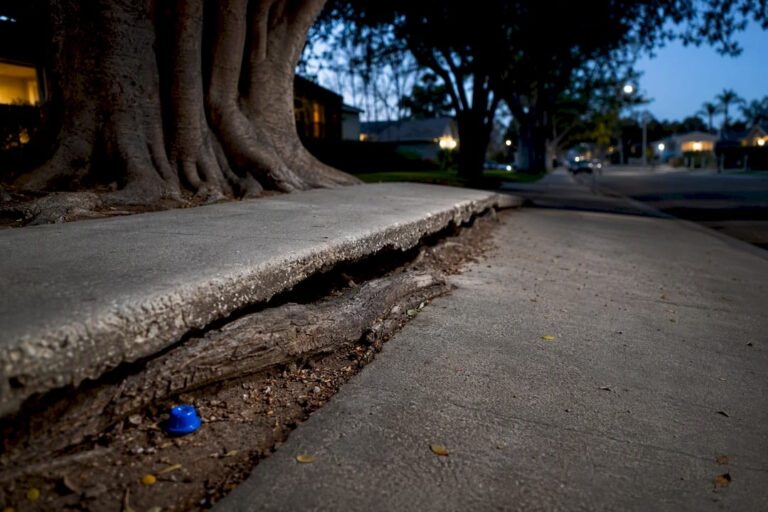
California doesn’t leave “dangerous condition” up to guesswork. Government Code §830 defines it as a condition of property that creates a substantial risk of injury when the property is used with due care in a way that’s reasonably foreseeable. That phrase “substantial risk” is doing a lot of work. A minor crack in a sidewalk usually isn’t enough. A two-inch vertical lift caused by a root system pushing up a slab, positioned where pedestrians can’t see it coming, often is.
Government Code §835 lays out what you actually have to prove, and it breaks into four parts:
- The property was in a dangerous condition at the time of your injury.
- The dangerous condition proximately caused your injury.
- The condition created a reasonably foreseeable risk of the kind of injury you suffered.
- The public entity either created the condition through a negligent or wrongful act, or had actual or constructive notice of it long enough before the injury to have fixed it or warned about it.
CACI No. 1100, the jury instruction judges read in these trials, restates these same four elements almost word for word. That consistency matters. It means the standard you’re building your case toward is fixed and well documented, not a moving target set by whichever judge you draw.
Picture a stretch of sidewalk in Woodland Hills lifted by a ficus tree root. A pedestrian trips at dusk, breaks a wrist. To win, the injured person has to show the city owned or controlled that stretch, the lift was substantial enough to be dangerous, a fall was foreseeable, and the city either caused the lift or should have caught it during routine inspection. Miss any one of those four elements and the claim fails, no matter how bad the injury.
How Do You Prove the City Knew About the Hazard?
Notice is where most dangerous-condition cases are won or lost. California recognizes two kinds, and they’re not equally easy to prove.
Actual notice means an employee of the public entity knew the specific condition existed and knew (or should have recognized) it was dangerous. A resident’s 311 complaint about a broken streetlight, a maintenance worker’s own inspection note, an email chain about a pothole. These are the easiest evidence to point to, when they exist.
Constructive notice is tougher and more common. Government Code §835.2 says a plaintiff can prove constructive notice by showing the condition existed for long enough, and was obvious enough, that a reasonably adequate inspection system would have found it. The statute explicitly allows evidence about whether the entity had an inspection system at all, and whether that system was actually followed.
Building a constructive-notice case usually means gathering:
- Prior complaint records from 311 systems, city council meeting minutes, or public works request logs.
- Photographs or dated records showing how long the defect existed, including any online street-view history.
- Repair and maintenance logs for the specific location, obtained through public records requests.
- Testimony from neighbors or business owners who noticed the hazard before you did.
Public entities defend these claims by producing their own inspection records, arguing their system was reasonable and they simply hadn’t gotten to that block yet. That’s exactly why an inspection system’s existence and follow-through become the central issue at trial far more often than the injury itself.
Pro Tip: File a California Public Records Act request for maintenance and complaint logs as early as possible. Municipal record retention schedules vary, and some agencies only keep inspection data for a limited window before it’s purged.
What Defenses Do Cities and Counties Use Against These Claims?
Public entities in California are not strictly liable just because someone got hurt on their property. Several statutory immunities exist precisely to shield government agencies from open-ended liability, and defense attorneys reach for them immediately.
- Design immunity protects a public entity when the dangerous condition results from a plan or design approved in advance by a legislative body or authorized employee exercising discretionary authority.
- Natural condition immunity generally shields entities from liability for injuries caused by natural conditions of unimproved public property, including many trails and open land.
- Recreational trail immunity limits liability for injuries on certain trails used for hiking, biking, or horseback riding.
- Weather-related immunity can apply to injuries caused by weather conditions affecting the use of streets and highways.
- Sign and signal immunity often protects entities from claims that a traffic signal or sign was defectively designed, as opposed to negligently maintained.
Beyond these named immunities, Government Code §835.4 gives entities a reasonableness defense. Courts weigh the probability and severity of the risk against the practicability and cost of taking action to fix or warn about it. A city that argues fixing every cracked sidewalk in Los Angeles would cost hundreds of millions of dollars is making exactly this kind of argument, and juries sometimes buy it.
Two more factors shape outcomes even when no immunity applies. California’s comparative fault rules mean your own carelessness, texting while walking, ignoring a barricade, can reduce your recovery proportionally. And the open and obvious defense argues that an unmissable hazard didn’t need a warning because any reasonable person would have seen and avoided it. Each of these defenses is fact-specific, which is exactly why early legal counsel changes outcomes.
What Do Real Dangerous Condition Cases Look Like?
Statutes read abstractly until you match them to an actual scene. A few recurring fact patterns show up again and again in California dangerous-condition litigation.
- Tree-root sidewalk lifts. A parkway tree’s roots push a concrete slab up an inch or more over years, and the city’s own tree-maintenance schedule becomes central evidence of whether the hazard should have been caught sooner.
- Potholes and roadway defects. A pothole deep enough to blow a tire or cause a motorcyclist to lose control raises questions about how recently that road segment was inspected or repaved.
- Intersection signal timing. Claims involving faulty or poorly timed signals often hinge on complaint histories and whether accident-hotspot data for that intersection was available to the responsible agency before the crash.
- Playground and park equipment. Rusted bolts, broken swing chains, or cracked rubber matting create claims that often turn on whether routine park inspections were actually documented, not just scheduled.
- Crowd-control failures at public events. Inadequate barricading or lighting at a city-permitted festival can support a claim when foreseeable crowd behavior wasn’t planned for.
A sidewalk case in the might settle once records show three prior complaints about the exact same slab. A pothole claim on a rarely-traveled county road might fail entirely if there’s no record anyone ever reported it. The fact pattern decides everything.
How Do You File a Government Claim, and What Are the Deadlines?
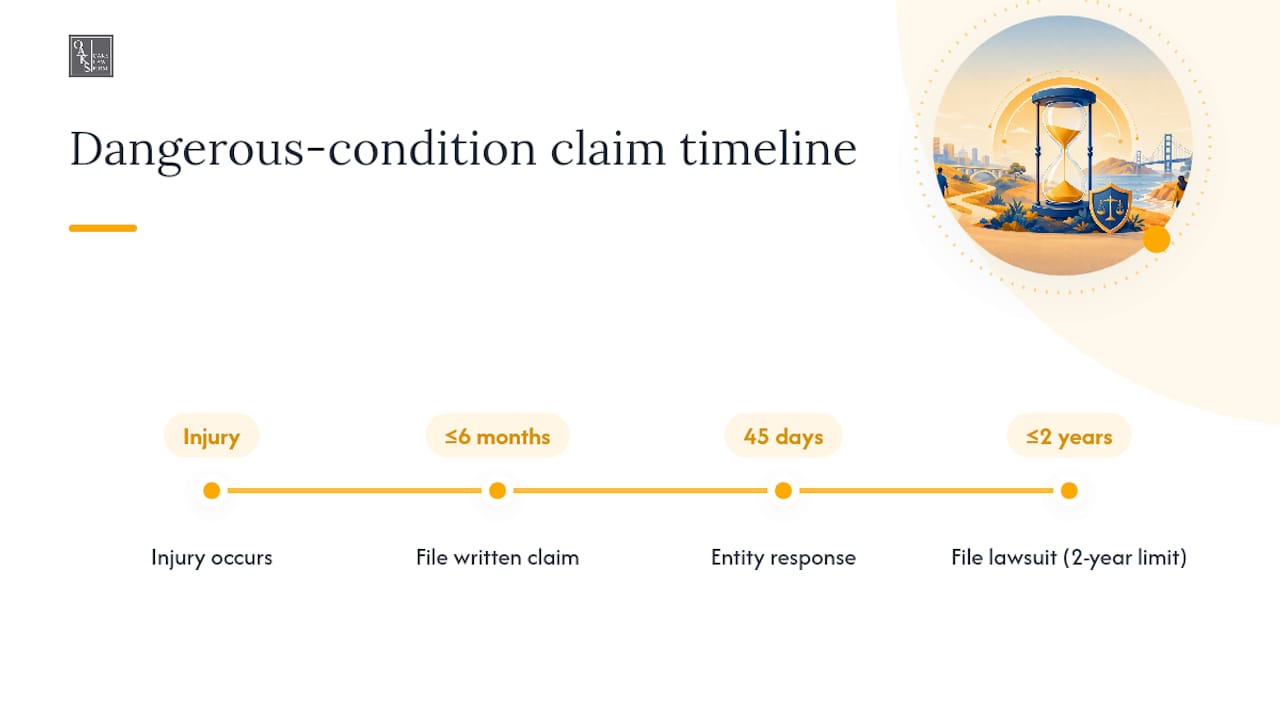
Miss this deadline and the strongest case in the world becomes worthless. Under Government Code §911.2, you generally must present a written government tort claim to the responsible public entity within six months of the injury for personal injury or property damage claims. This is separate from, and comes before, any lawsuit.
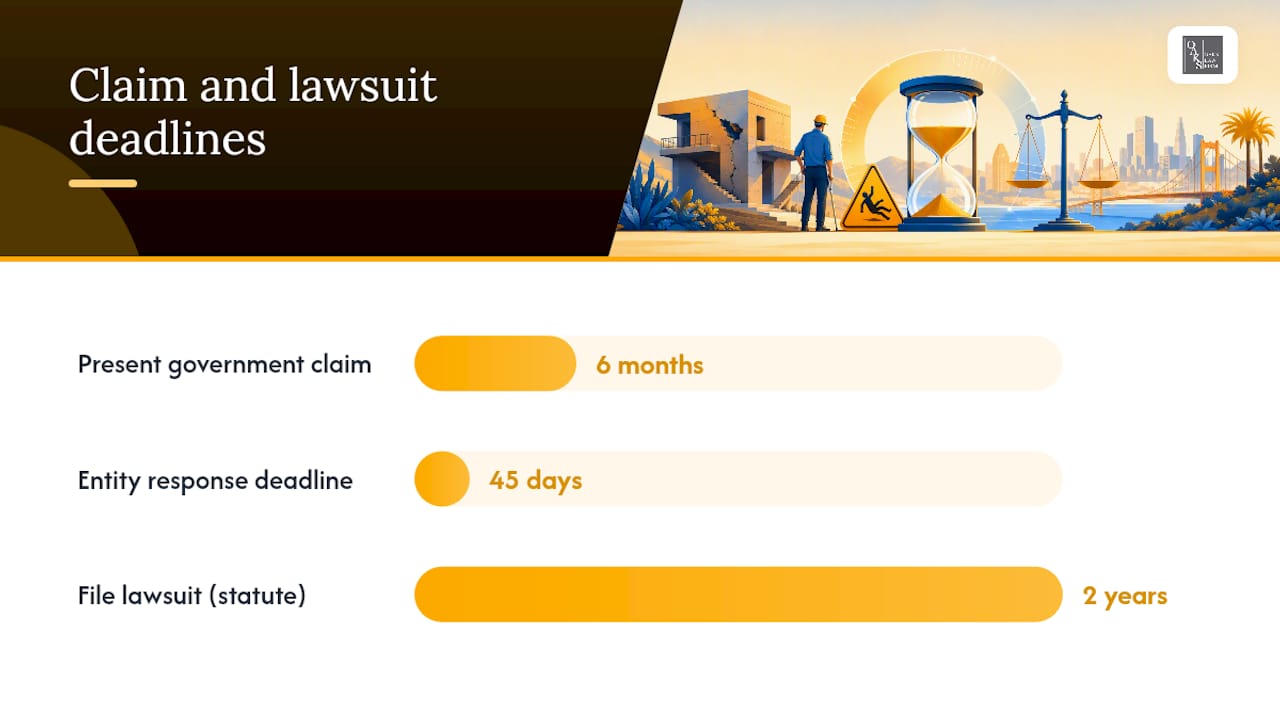
Once the government claim process concludes (the entity either denies the claim, doesn’t respond within 45 days, or you get a formal rejection notice), the general two-year civil statute of limitations under CCP §335.1 governs how long you have to file the actual lawsuit. Miss the six-month claim deadline, though, and the two-year clock rarely saves you, since courts require a valid claim presentation before a suit can proceed at all.
Practical steps for presenting a claim:
- Identify the correct entity (city, county, or state agency) that owns or controls the property, since claims go to different offices depending on jurisdiction.
- Complete the entity’s claim form, or a written claim meeting the content requirements in Government Code §910 (your name, the date and location of injury, a description of the injury, and the damages claimed).
- Submit the claim by mail with proof of delivery, or hand-deliver it to the clerk’s office, keeping a dated copy for your records.
- Track the response deadline. If the entity doesn’t act within 45 days, the claim is deemed rejected.
- Confirm any exceptions to the standard timelines apply to your situation, including delayed-discovery rules or extensions for minors, before assuming you’re out of time.
Some exceptions exist, including delayed discovery of an injury and tolling for plaintiffs who were minors at the time of the incident, but these exceptions are narrow and fact-dependent. Confirming which apply to your case is not something to guess at. A government tort claim guide can walk through the specifics, but a consultation with an attorney is the safer route when a deadline is close.
What Evidence Should You Collect Right After the Injury?
The strength of a dangerous-condition claim usually comes down to what you documented in the first 48 hours, not what a lawyer reconstructs six months later.
At the scene, take wide shots and close-ups of the hazard, using a coin, shoe, or tape measure for scale so the size of the defect is unmistakable later. Record a short video walking through the area to capture context a still photo misses, and get names and phone numbers from anyone who saw what happened. If a business or property manager filed an incident report, request a copy before you leave.
Medical documentation should start immediately, even for injuries that seem minor at first. A gap of several days between the incident and your first medical visit gives insurance adjusters an opening to argue the injury happened somewhere else. Follow through with any specialist referrals and keep every bill and report.
- Photograph the hazard from multiple angles with a scale reference.
- Collect witness names and contact information on the spot.
- Seek medical care the same day when possible and follow up consistently.
- Request maintenance logs, inspection reports, and prior complaint records through a public records request.
- Preserve your damaged clothing, shoes, or property involved in the incident.
Pro Tip: Send yourself a time-stamped email or text describing what happened while it’s fresh. Memory fades fast, and a contemporaneous account carries real weight if the case goes to litigation.
An attorney can go further than you can on your own, formalizing evidence through subpoenas for maintenance records and retaining structural or traffic engineers to reconstruct the timeline and evaluate whether repairs were practicable.
What Compensation Can You Recover in a Dangerous Condition Claim?
California law allows injured plaintiffs to pursue several categories of compensation when a dangerous condition claim succeeds.
- Medical expenses, both incurred and reasonably anticipated in the future.
- Lost wages and diminished future earning capacity.
- Pain and suffering and other non-economic losses.
- Wrongful death damages for surviving family members, when the dangerous condition caused a fatality.
Comparative fault reduces recovery proportionally to your share of responsibility. Causation and foreseeability drive the size of an award too. A well-documented, long-standing hazard that clearly caused a specific injury supports a stronger valuation than a claim with a murky timeline.
Most dangerous-condition claims against public entities settle before trial, often during or after the claim-presentation period, once the entity’s risk management office evaluates exposure. Cases with disputed notice or contested immunities are the ones most likely to proceed toward litigation.
Why Hiring a California Attorney for These Claims Matters
Dangerous-condition claims are unlike ordinary negligence cases. The claim-presentation deadline, the statutory immunities, and the notice requirements create procedural traps that catch people who try to handle this alone. Oaks Law Firm handles the parts that are hardest to do without legal training: filing public records requests for inspection and complaint logs, retaining engineering experts to establish foreseeability, drafting the government claim itself, and negotiating with a public entity’s risk management office before litigation becomes necessary.
Matthew Nezhad founded Oaks Law Firm (formerly Nezhad Law Firm) in 2002 and has built his career around representing injured Californians against negligent parties, including public entities. The firm takes a limited number of cases each year by design, which allows for closer attention to case strategy and evidence development. With offices in Sherman Oaks and Woodland Hills, the firm has earned referrals from past clients and other attorneys and has been mentioned in media coverage of notable cases.
Every case starts with a free evaluation, and clients pay nothing unless the firm recovers compensation on their behalf.
Does It Matter Whether the City, County, or State Owns the Property?
Yes, and this is one of the most overlooked parts of a dangerous-condition case. The entity that owns or controls the property determines which government office receives your claim, which set of maintenance records applies, and sometimes which immunities are even available.
A pothole on a city street usually falls under municipal jurisdiction, meaning your claim goes to the city clerk’s office. The same defect on an unincorporated county road goes to the county board of supervisors’ office instead. If the hazard sits on a state highway or Caltrans-maintained overpass, your claim goes to the California Victim Compensation Board’s Government Claims Program, a separate process with its own forms.
Ownership isn’t always obvious from the surface. A sidewalk that looks like it belongs to the city might actually be maintained under an agreement that shifts responsibility to an adjacent property owner in some municipalities, while intersection maintenance can be split between a city and a state transportation agency depending on which roads meet. Multi-agency intersections, like several notorious accident hotspots along the 101 Freeway corridor through the , sometimes involve overlapping jurisdiction between Caltrans and local municipalities, which can mean naming more than one entity in a single claim.
Getting this wrong doesn’t just slow things down. Filing with the wrong entity, or missing an entity that shares responsibility, can result in a claim being rejected on jurisdictional grounds entirely separate from the merits of your injury. This is one of the clearest reasons to have someone experienced review the ownership question before the six-month clock runs out.
How Do You File a Government Claim Form Correctly?
Most California cities and counties provide a standardized tort claim form, often available on the clerk’s office website, though a written claim meeting the statutory content requirements is also legally sufficient even without the official form.
Your claim needs to include your name and mailing address, the date, time, and specific location of the incident, a description of how the injury happened and why the public entity is responsible, a description of your injuries, and the dollar amount claimed (or a statement that the claim exceeds a certain jurisdictional threshold if applicable). Vague descriptions invite rejection or requests for clarification that eat into your six-month window.
Submission methods vary by entity. Some accept claims by mail only, others allow hand delivery to the clerk’s office, and a growing number offer online portals. Always keep proof of delivery, whether that’s a certified mail receipt, a stamped copy from the clerk’s office, or a confirmation email from an online system. If you can’t prove when a claim was submitted, an entity can dispute timeliness even when you filed on time.
After submission, the entity has 45 days to accept, reject, or request more information. Silence for 45 days is treated as a rejection, which then opens the door to filing a lawsuit under the two-year statute of limitations. Because the claim requirements are technical and unforgiving of small errors, many injured Californians have an attorney draft and file this document rather than risk a rejection on a technicality.
Can You Negotiate a Settlement Before Filing a Lawsuit?
Public entities frequently prefer to resolve dangerous-condition claims before litigation, and there’s a practical reason: lawsuits against government agencies are expensive, public, and unpredictable in front of a jury.
Negotiation typically begins once the entity’s risk management office reviews your claim. Strong pre-litigation negotiating position comes from the same evidence that would win at trial: documented prior complaints, inspection records showing gaps in the maintenance system, clear photographs establishing the defect’s size and duration, and medical records tying your injury directly to the incident.
A demand letter that lays out liability under the four §835 elements, cites the specific notice evidence you’ve gathered, and attaches medical documentation carries far more weight than a bare request for money. Entities are more likely to negotiate seriously when they see a claim that would survive a motion for summary judgment, because that signals real exposure at trial.
Timing matters too. Some entities negotiate more actively before the claim-denial deadline, hoping to avoid litigation costs altogether, while others wait until a lawsuit is actually filed before making a serious offer. Comparative fault often becomes the central negotiating point. If an entity can point to something you did that contributed to the incident, expect that argument to surface early and often. Having documented evidence that anticipates and counters this argument, rather than scrambling to respond to it later, tends to produce better settlement outcomes.
Are There Special Rules for Disabled or Senior Plaintiffs?
The core statutory framework, Gov. Code §§830 and 835, applies the same way regardless of age or ability. But a few practical and legal wrinkles matter for these plaintiffs specifically.
Foreseeability analysis can actually favor disabled or senior claimants in some situations. If a public entity knew or should have known that a location was regularly used by wheelchair users, people with mobility limitations, or seniors, a hazard that might seem minor to an able-bodied adult, a curb cut with an unexpected drop, an uneven transition at a crosswalk, can be argued as more clearly dangerous and more clearly foreseeable given that known use pattern.
The Americans with Disabilities Act and California’s own accessibility standards can also intersect with these claims. A curb ramp or crosswalk that fails to meet accessibility requirements may support an argument that the public entity had constructive notice of a hazard, since ADA compliance obligations put entities on notice that these features need to meet a specific safety standard.
On the procedural side, the government claim deadline and civil statute of limitations generally apply the same six-month and two-year framework to senior and disabled plaintiffs as anyone else, though delayed-discovery exceptions can sometimes apply if an injury’s connection to the incident wasn’t immediately apparent, which happens more often with degenerative injuries in older adults. Given how fact-specific these issues are, a case involving a senior or disabled plaintiff benefits even more from early legal review.
A Word on Timing and Realistic Expectations
Every week that passes after an injury on public property makes the case harder, not easier. Evidence disappears, memories fade, and that six-month claim deadline doesn’t bend for anyone. What frustrates me most about these cases is watching someone with a legitimate claim lose it entirely because they assumed they had “plenty of time.” Governmental immunities are real, and they’re designed to make these cases hard. That’s precisely why we take a limited number of cases each year and work them on contingency, so injured Californians never pay out of pocket to find out where they stand. If you were hurt on public property, call for a free case review before that clock runs further.
— Matthew Nezhad
What Happens When You Call Oaks Law Firm
Once you reach out, Oaks Law Firm moves quickly on the parts of a dangerous-condition claim that are easiest to get wrong on your own: drafting and filing the government claim correctly, submitting public records requests for inspection and maintenance logs before they’re purged, retaining engineering or maintenance experts to establish foreseeability, and negotiating directly with a public entity’s risk management office before litigation becomes the only option.

For readers facing a lawsuit after a rejected claim, the firm’s step-by-step lawsuit process explains what filing suit against a public entity actually looks like. For those trying to understand what a case might be worth, the compensation breakdown covers how damages get calculated in California. And because cost is often the biggest hesitation after an injury, Oaks Law Firm’s no-fee guarantee means you pay nothing unless the firm wins your case. The first case evaluation is free, and it costs you nothing to find out where you stand. Call today to start.
Sources
- California Government Code §830 — Definition of ‘dangerous condition’
- California Government Code §835 — Liability of public entities
- An overview of dangerous condition of public property liability in California — Burke, Williams & Sorensen, LLP
Each of these sources lets you check the exact statutory language behind the explanations above, rather than taking any summary at face value.
This article is general information, not a substitute for advice from a qualified lawyer. Consult a qualified legal professional about your own circumstances before acting on anything here.
FAQ
What constitutes a “dangerous condition” of public property?
A condition that creates a substantial risk of injury when the property is used with due care in a reasonably foreseeable way, as defined under Government Code §830. Minor defects generally don’t qualify; the risk has to be significant.
What are the four elements a plaintiff must prove?
Under Gov. Code §835 and CACI No. 1100: the property was dangerous at the time of injury, the condition caused the injury, the injury was a reasonably foreseeable result, and the entity either created the condition negligently or had actual or constructive notice of it.
How long do I have to file a claim against a California public entity?
You generally must present a written government tort claim within six months of the injury under Gov. Code §911.2, and after that process concludes, the general civil statute of limitations is two years under CCP §335.1, subject to exceptions like delayed discovery.
What’s the difference between actual and constructive notice?
Actual notice means an employee knew about the specific hazard. Constructive notice means the hazard existed long enough and was obvious enough that a reasonably adequate inspection system should have caught it.
Does comparative fault reduce what I can recover?
Yes. California’s comparative fault rules reduce your award by your percentage of responsibility for the incident, even in dangerous-condition claims against public entities.
Disclaimer: The information provided on this blog is for general informational purposes only and should not be considered legal advice. While every effort has been made to ensure the accuracy of the information presented, laws and regulations frequently change and can vary depending on jurisdiction, so we recommend that you consult with a qualified attorney to receive personalized legal advice tailored to your specific situation. Reading this blog does not create an attorney-client relationship between you and the author or publisher. We disclaim any liability for actions taken or not taken based on the content of this blog.
