

Car Accident Whiplash Injury Claims in California: A Complete Guide
Attorney Advertising. This article was prepared with the assistance of artificial intelligence and reviewed by Oaks Law Firm prior to publication.
A car accident whiplash injury claim is a legal request for compensation after neck or soft-tissue injuries caused by another driver’s negligence in a California collision. Whiplash is one of the most commonly reported injuries in rear-end crashes. If you were hurt on a freeway in Los Angeles, a surface street in the , or anywhere else in California, how you file, how thoroughly you document, and how you time your claim all play a major role in the strength of your case. This article is general information only. Your specific facts, the parties involved, and your circumstances will affect any outcome.

What is a car accident whiplash injury claim?
A whiplash injury claim is the formal legal and insurance process you use to seek compensation after a crash causes rapid, forceful movement of your head and neck. Medically, the condition is often classified as a Cervical Acceleration-Deceleration (CAD) injury, also called Whiplash Associated Disorder (WAD). Clinicians and insurers frequently reference the Quebec Task Force WAD grading system, which runs from Grade 1 through Grade 4, to describe injury severity.
How the WAD grading system works
Each grade reflects how serious the injury is, and severity is one of the factors that shapes a claim:
Grade 1: Neck pain, stiffness, or tenderness only, with no physical signs on examination.
Grade 2: Neck complaints plus musculoskeletal signs such as reduced range of motion or point tenderness.
Grade 3: Neck complaints plus neurological signs, including numbness, weakness, or diminished reflexes.
Grade 4: Neck complaints with fracture or dislocation confirmed by imaging.
A more severe grade generally corresponds to a more serious injury and a more complex claim. That is why an accurate medical diagnosis matters so much. It is the foundation of the entire claim, and severity is established through your medical records rather than through assumptions.
Why whiplash claims are harder to prove than they look
Soft-tissue injuries rarely show up on standard X-rays. That absence of visible imaging findings gives insurers room to argue that your pain is exaggerated or unrelated to the crash. The practical answer is a documented treatment history: emergency room records, follow-up visits, physical therapy notes, and specialist reports. Each appointment adds a layer of credibility that imaging alone cannot provide.
Legal and medical definitions of whiplash are also narrower than everyday usage. If your injury involves nerve damage, disc herniation, or fractures alongside soft-tissue damage, you may have a mixed injury claim, where the non-whiplash components are evaluated separately under different legal frameworks.
What should you do after a car accident in California?
The strength of a whiplash claim often takes shape in the first hours and days after a crash. The steps below help protect both your health and your potential claim.
Immediate steps after the crash
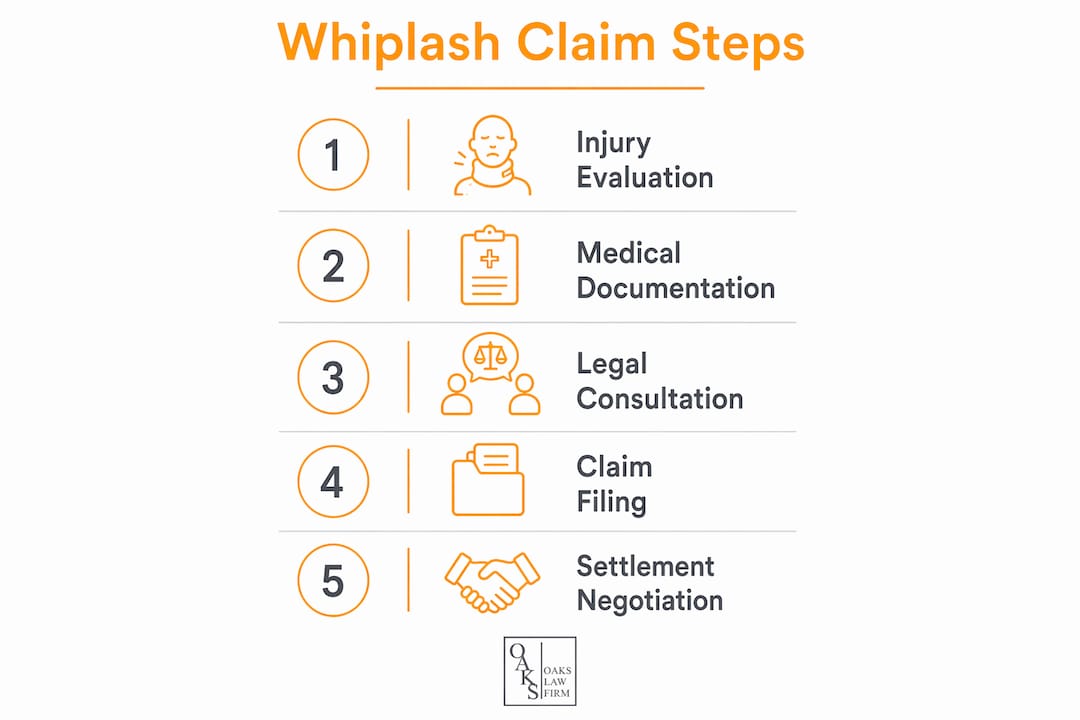
Call 911 and request a police report. The report documents the scene and helps establish how the crash happened. This step matters even in seemingly minor collisions.
Seek medical evaluation the same day. Whiplash symptoms often appear hours or days after impact. Delayed onset is normal. If you tell the other driver or the responding officer “I’m fine,” that statement can be used against you later. Instead, say that you intend to seek medical evaluation.
Photograph everything. Vehicle damage, road conditions, visible injuries, and the surrounding scene can all matter later.
Collect witness information. Names and phone numbers from bystanders can corroborate your account if the other driver disputes fault.
Notify your insurance company. Report the crash promptly, but be cautious about giving a recorded statement regarding your injuries before you have spoken with an attorney.
Essential documents for your claim
Whiplash claims are built on documentation. The core records to gather include the police report, emergency room records, specialist and therapy notes, medical bills and receipts, lost-wage documentation, photos, witness statements, and a personal injury journal. Each one supports a different part of your claim, from establishing fault to demonstrating the ongoing impact of your injuries.
Tracking non-economic losses is just as important as collecting bills. A personal injury journal, where you record daily pain levels, sleep disruption, and activities you can no longer perform, gives your attorney concrete material to discuss pain and suffering. Gaps in your treatment record, by contrast, give insurers an opening to argue that your injuries were not caused by the crash or were not as serious as claimed.
Pro tip: Ask your doctor about an orthopedic or neurological referral early in your treatment. Early specialist involvement can help document the nature and extent of a soft-tissue injury that a standard X-ray may not reveal.
How do you navigate the claims process in California?
Filing a whiplash claim tends to follow a predictable path, but the decisions you make at each stage matter.
Insurance claim vs. lawsuit
Most whiplash claims resolve through the at-fault driver’s liability insurance without ever reaching court. You submit a demand package to the insurer, they respond, and negotiation follows. If the insurer refuses to offer a fair settlement, filing a personal injury lawsuit may be the next step. California’s claims process follows specific procedural rules, and missing a filing deadline can end a case entirely, so timing is something to stay aware of throughout.
How insurers evaluate your claim
Settlement discussions are driven largely by medical prognosis and functional impairment rather than by how dramatic the collision looked. How your injury affects your daily activities, your ability to work, and your recovery timeline all factor in. A low-speed rear-end crash can still involve a serious injury if a victim suffers lasting nerve damage, while a more forceful collision with minimal documented injury may be evaluated quite differently.
Common insurer tactics and how to respond
Insurers routinely scrutinize soft-tissue claims because there is often no visible fracture or surgical finding to point to. Be aware of these common approaches:
Requesting a recorded statement early. Your own words can be used to minimize your injuries. It is reasonable to decline until you have legal counsel.
Offering a quick settlement. Early offers may not reflect your full medical picture, which is often not yet known soon after a crash.
Disputing causation. Adjusters may argue your neck pain predates the crash. Consistent medical records tied to the accident date help address this.
Pushing for a lower severity classification. An independent medical examination arranged through your attorney can help rebut an under-stated assessment.
The role of maximum medical improvement
Maximum Medical Improvement (MMI) is the point at which your doctor determines your condition has stabilized and further significant recovery is unlikely. Settling before MMI is one of the more common and consequential mistakes a claimant can make. Once you sign a release, you generally cannot reopen the claim if your symptoms worsen or new complications emerge. Many attorneys advise waiting until a treating physician formally documents MMI before accepting any final offer.
Working with an attorney can change how a claim unfolds. Counsel can preserve evidence, manage communications with the insurer, and advise on the appropriate time to settle. Whether representation makes sense for you depends on the specifics of your situation.
Pro tip: Keep every medical appointment and follow your treatment recommendations. Gaps in care give insurers grounds to argue you have recovered, which can affect how your claim is evaluated.
What are common mistakes in whiplash claims, and how do you avoid them?
Many whiplash claims that fall short share the same avoidable errors.
Saying “I’m fine” at the scene. Whiplash symptoms often emerge a day or more after impact. Stating you are uninjured creates a record that can contradict your later claim. Tell responding officers and the other driver that you intend to seek medical evaluation.
Relying only on initial ER imaging. Emergency rooms focus on ruling out fractures and life-threatening injuries. They may not order the MRI or nerve studies that document soft-tissue damage. A follow-up specialist can order more targeted imaging.
Settling before reaching MMI. Early settlements can leave future medical costs, ongoing therapy needs, and long-term limitations uncovered, because the full picture is not yet known.
Missing the statute of limitations. In California, the general statute of limitations for most personal injury claims is two years from the date of injury under Code of Civil Procedure § 335.1. This general rule has important exceptions. The most significant involves claims against a government entity, such as a city, county, state agency, public hospital, or school district. In those cases, a formal written claim must generally be presented within six months of the incident under the California Government Claims Act (Government Code § 911.2) before a lawsuit can even be filed. Because deadlines can vary depending on who is responsible for the injury, it is important to confirm your specific deadline with an attorney as soon as possible rather than rely on a general rule. Evidence can also be lost, overwritten, or destroyed quickly, so acting promptly matters independent of any filing deadline.
Failing to establish fault clearly. Compensation depends on showing the other driver was negligent. Weak liability evidence, such as no police report or no witnesses, gives insurers room to dispute fault.
Consulting an attorney early in the process can help address these risks together, from preserving evidence to managing insurer communications.
What types of whiplash injury claims exist?
Not every whiplash claim follows the same path. The shape of a claim depends on the injury, the damages involved, and the facts.
Claims by injury type
Lower-grade soft-tissue claims may rest largely on ER records, primary care notes, and therapy records. More serious presentations involving musculoskeletal or neurological findings typically draw on specialist reports, imaging, nerve studies, and documentation of lost income. Cases involving a fracture or dislocation generally require more extensive records, including surgical documentation and long-term care planning. Mixed injury claims combine whiplash with other injuries, such as a traumatic brain injury, disc herniation, or shoulder damage, and call for separate evaluation of each injury type. Timelines vary widely from case to case, and no two follow exactly the same course.
Special damages vs. general damages
In California, special damages cover economic losses such as medical bills, lost wages, future treatment costs, and out-of-pocket expenses. General damages cover non-economic losses such as pain, suffering, emotional distress, and loss of enjoyment of life. Both categories apply to most whiplash claims, and documenting each thoroughly is part of building a complete claim. California uses individualized valuation rather than a fixed schedule, which means the specific facts of each case carry significant weight.
Key takeaways
A car accident whiplash injury claim tends to be strongest when you document your injury thoroughly, wait for maximum medical improvement before deciding whether to settle, and seek experienced legal guidance before accepting any offer. Severity, established through your medical records, is one factor in how a claim is evaluated. Building a complete, consistent record from day one is within your control, and it matters. And the statute of limitations is firm: California generally allows two years to file most personal injury claims, with a much shorter six-month window for claims involving a government entity, so confirming your deadline early is essential.
Oaks Law Firm is ready to help with your whiplash claim
If you were injured in a car accident in the or anywhere in California, Oaks Law Firm is here to help you understand and pursue your options.
Attorney Matthew Nezhad and his team handle every stage of the whiplash injury claim process, from gathering medical records and building a demand package to communicating with insurers and, when necessary, taking a case to court. We work to give each client focused, personal attention.
Oaks Law Firm handles personal injury cases on a contingency basis, which means you do not pay attorney’s fees unless we recover compensation for you. Case costs and expenses may be handled separately, and we are glad to explain how that works during your consultation. Contact Oaks Law Firm today for a free, no-pressure case evaluation to discuss the specific facts of your situation.

This article is provided for general informational purposes only and does not constitute legal advice. The information presented may not reflect the most current legal developments and should not be relied upon as a substitute for consultation with a licensed attorney. Every personal injury case involves unique facts and circumstances, and the outcome of any case depends entirely on those specific facts. Any results, settlement amounts, or verdicts referenced in this content are specific to the individual cases described, are not typical, and do not guarantee, promise, or predict a similar outcome in your case. Reading this content does not create an attorney-client relationship with Oaks Law Firm. Contact us directly for a consultation specific to your situation.
Frequently asked questions
What is a whiplash injury claim?
A whiplash injury claim is a formal request for compensation after a car crash causes a soft-tissue neck injury from rapid head movement. It can be pursued through the at-fault driver’s insurance or, if necessary, as a personal injury lawsuit.
How is a whiplash claim evaluated?
Evaluation depends on factors such as your injury severity, medical prognosis, functional impairment, and how the injury affects your work and daily life. Because every case is different, the specific facts drive how a claim is assessed, and no two claims are evaluated identically.
How long do I have to file a whiplash claim in California?
The general deadline for most California personal injury claims is two years from the date of injury under Code of Civil Procedure § 335.1. Important exceptions exist, including a six-month deadline for claims involving a government entity under Government Code § 911.2. Because the right deadline depends on the facts, confirm yours with an attorney as soon as possible.
Should I accept the first settlement offer for my whiplash injury?
It is generally wise to be cautious. Early offers may not reflect your full medical picture, especially before you have reached maximum medical improvement. Many people wait until their condition has stabilized and their full medical costs are known before deciding whether to accept any offer.
Do I need a lawyer for a whiplash injury claim?
Legal representation is not legally required. Whether it makes sense for you depends on your situation. An attorney can manage insurer communications, help build your evidence file, and advise on the right time to consider settling.
