

Attorney Advertising. This article was prepared with the assistance of artificial intelligence and reviewed by Oaks Law Firm prior to publication.
A medical lien is a legal claim by a hospital, doctor, or insurer to be paid directly from your settlement before you see a dime. Here’s a quick example: a settlement, minus a typical attorney fee and case costs, leaves a portion remaining. A hospital lien then further cuts your net recovery.
- Liens get paid in a specific order, and government programs often go first.
- Medicare and Medicaid can claim priority over private hospital liens.
- California’s statute of limitations is generally two years under CCP §335.1, with a six-month government claims deadline under Gov. Code §911.2 for claims against public entities.
Pro Tip: If you’re covered by an employer health plan, check whether it’s governed by ERISA. Those plans can demand full reimbursement even where state law would otherwise cap or reduce a lien. Oaks Law Firm handles this lien math every day, and knowing the numbers before you sign anything protects what’s actually yours.
Key Takeaways
Medical liens reduce your net settlement in a fixed order, but government liens and private liens follow very different rules, and early legal management preserves far more of your recovery.
| Point | Details |
|---|---|
| Liens get paid before you do | Attorney fees and costs come out first, then liens, then whatever remains is yours. |
| Government liens rank higher | Medicare and Medicaid generally have priority over hospital or provider liens. |
| Negotiation works, mostly for private liens | Health-insurance subrogation claims are often reduced through negotiation, while government liens are less flexible. |
| State law varies significantly | Some states cap provider recovery, such as Illinois’ 40% limit on the award. |
| Oaks Law Firm manages liens from intake | The firm identifies lienholders, negotiates payoffs, and coordinates settlement holdbacks on a contingency basis. |
This article is general information, not a substitute for advice from a qualified lawyer. Consult a qualified legal professional about your own circumstances before acting on anything here.
Table of Contents
- What Is a Medical Lien After a Car Accident?
- Who Can File a Lien and Who Gets Paid First?
- How Liens Change Your Settlement: Two Worked Examples
- How a Lien Gets “Perfected” and Why Timing Matters
- Medicare and Medicaid Liens: Why They’re Different
- What a Personal Injury Lawyer Does With Your Liens
- Three Numeric Scenarios You Can Compare to Your Own
- Why Early Counsel Changes the Outcome
- Get Help Negotiating Your Medical Liens
- Sources
- FAQ
What Is a Medical Lien After a Car Accident?
A medical lien is a legal right to collect payment from your settlement, filed by whoever covered or provided your treatment. Some liens are statutory (created and governed by state law), while others are contractual, based on a private agreement you signed at intake.
- Provider or hospital lien: A doctor, clinic, or hospital treats you without upfront payment and files a claim against your future settlement.
- Health-insurer subrogation: Your insurer pays your medical bills, then asserts a right to be reimbursed from any settlement you win.
- Medicare conditional payment: Medicare pays your bills “conditionally,” expecting repayment once you recover money from the at-fault driver.
- Medicaid lien: Similar to Medicare, but administered at the state level with its own rules.
- Pre-settlement loan lien: A lawsuit funding company that advanced you cash also expects repayment, often with interest.
- Workers’ compensation lien: Applies if the crash happened on the job and comp benefits covered your care.
A lien is different from a simple unpaid bill. An unpaid bill is a debt you owe personally; a medical lien attaches directly to your settlement, and it typically must be resolved before you can distribute the money.
Who Can File a Lien and Who Gets Paid First?
Multiple parties can stake a claim on the same settlement, and they don’t all stand in line the same way. The usual cast of lienholders includes hospitals and treating providers, private health insurers pursuing subrogation, Medicare, Medicaid, workers’ comp carriers, and pre-settlement lenders.
- Government programs first. Medicare and Medicaid generally carry superior statutory priority over private liens, and they use automated tracking systems to flag injury-related payments.
- Private insurers and providers next. These liens are often more flexible and can be reduced through negotiation or the “made whole” doctrine, which argues you should be fully compensated before any lienholder collects.
- State caps vary widely. Some states cap what a provider can recover; Illinois limits providers to 40% of the award, for example, illustrating how much this varies by jurisdiction.
Statistic Callout: Health-insurance negotiated rates run 40 to 60% lower than billed charges in many cases, which is why the same injury can produce wildly different lien amounts depending on how it was treated. If your health plan is ERISA-governed, it may override state-law lien caps entirely and demand full reimbursement.
How Liens Change Your Settlement: Two Worked Examples
Settlement money doesn’t just land in your account. It flows through a specific sequence, and where liens fall in that sequence determines your final check.
- Gross settlement is negotiated or awarded.
- Attorney fees and case costs come out first, typically a contingency percentage plus reimbursed expenses.
- Lien payoffs are subtracted, sometimes calculated on the gross amount and sometimes on the amount remaining after fees, depending on the lienholder’s contract or your state’s law.
- You keep what’s left.
Example A: Uninsured patient treated on a medical lien.
Billed charges: $40,000. No insurance discount applies because the provider agreed to wait for settlement. Settlement amount and deductions for attorney fee and costs reduce the amount from which liens are paid. Lien negotiation can lower the owed amount, increasing the net client recovery.
Example B: Insured patient with health-insurance subrogation.
Billed charges: $40,000, but the insurer’s negotiated rate paid out only $18,000. Settlement: $120,000. Attorney fee and costs: $42,100. Remaining: $77,900. Net to client: $67,100.
- Higher billed charges can support a bigger settlement demand but also inflate a lien if you were treated without insurance.
- Statutory caps, proportional allocation, and “made whole” arguments can all shrink a lien further.
Pro Tip: Ask your provider up front whether you’re being billed under insurance rates or lien rates. The gap between those two numbers is often the single biggest factor in your final payout.
How a Lien Gets “Perfected” and Why Timing Matters
A lien isn’t automatically enforceable just because a provider says you owe them. Most states require the provider to “perfect” the lien through specific formal steps, and skipping them can make the lien invalid.
- Written notice must typically identify the injured party, treatment dates, provider name, and the party believed liable.
- Notice often has to go out by certified mail or be filed with a designated state office within a set window.
- Early attorney involvement changes how these notices get handled and tracked.
- Defective or late notice can weaken or void a lien’s enforceability entirely.
What to hand your lawyer immediately: every medical bill, any lien notice you’ve received, your health insurance card, and details about pre-settlement loans if you took one.
- Gather all medical bills and provider correspondence.
- Forward any lien notice the moment it arrives, unopened mail included.
- Share health insurance and government benefit information (Medicare, Medicaid) at intake.
Medicare and Medicaid Liens: Why They’re Different
Government-program liens play by their own rules, and those rules are less forgiving than a private hospital’s billing office. Medicare’s conditional payment process means the agency pays your bills up front on the condition that it gets reimbursed once you settle, and it tracks these payments through an automated recovery system.
- Medicare typically issues a conditional payment demand once it learns of your settlement, and that demand must be resolved before you finalize distribution.
- CMS provides formal guidance for attorneys handling these claims, including timelines for disputing inflated amounts.
- Medicaid liens work similarly but are administered state by state, so the rules where you live may differ from a neighboring state.
- Government liens are generally far less negotiable than private provider liens.
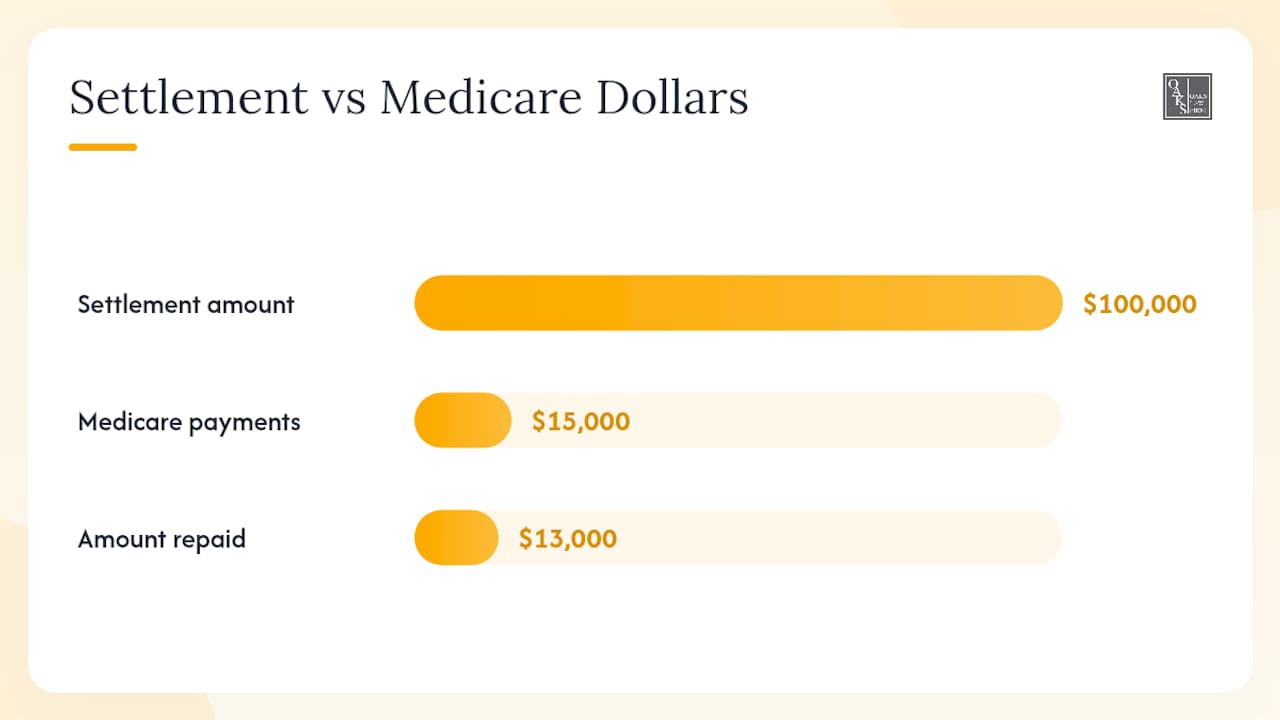
Simplified example: Medicare pays $15,000 in conditional payments. You settle for $100,000. After attorney fees and costs, Medicare’s demand is reduced slightly for procurement costs, and you repay roughly $13,000 from your net proceeds.
Statistic Callout: Because government recovery systems are automated and cross-referenced with settlement reporting, unresolved conditional payments can trigger interest, penalties, or offsets against future Medicare benefits.
Pro Tip: Notify Medicare and your attorney about a pending settlement as early as possible. Waiting until after you’ve received funds is the most common way clients end up facing federal collection action.
What a Personal Injury Lawyer Does With Your Liens
Lien negotiation is one of the least visible but most valuable things an attorney does on your case. It’s also where a skilled lawyer can add real dollars back into your pocket that you’d never recover on your own.
- Identify every lienholder tied to your treatment, including ones you may not know exist.
- Send formal notice and negotiate reductions using proportional allocation or “made whole” arguments.
- Obtain written payoff letters confirming the final amount each lienholder will accept.
- Coordinate an escrow or settlement holdback so funds aren’t released before liens are cleared.
- Handle any required reporting to Medicare or Medicaid.
- Intake and document collection.
- Lien identification and negotiation strategy.
- Settlement holdback while payoffs are finalized.
- Final distribution once every lien is resolved.
At Oaks Law Firm, this process starts the moment we take a case, not after a settlement offer arrives. The firm intentionally limits how many cases it accepts each year so lien negotiation gets real attention rather than a rushed phone call before closing.
Three Numeric Scenarios You Can Compare to Your Own
Seeing real numbers side by side helps more than any explanation of the rules. Here are three common situations, with the math laid out.
- Scenario A, uninsured on a lien: $35,000 billed, no insurance discount. Settlement of $90,000, attorney fee and costs of $32,200, remaining $57,800. Lien negotiated to $22,000. Net: $35,800.
- Scenario B, insured with subrogation: Insurer paid $16,000 for treatment. Settlement of $90,000, attorney fee and costs of $32,200, remaining $57,800. Insurer accepts a reduced subrogation claim of $9,600 after negotiation. Net: $48,200.
- Scenario C, Medicare beneficiary: Conditional payments of $12,000. Settlement of $90,000, attorney fee and costs of $32,200, remaining $57,800. CMS demand after procurement cost reduction: $10,500. Net: $47,300.
Statistic Callout: Uninsured patients treated on a lien basis are more likely to face full billed charges rather than insurer-negotiated rates, which is the main reason Scenario A nets less than the other two despite a similar gross settlement.
Why Early Counsel Changes the Outcome
What surprises most clients isn’t the existence of a lien. It’s how automated and rigid government recovery has become, and how much room there still is to negotiate private liens if someone starts early. Waiting until settlement day to sort out who’s owed what is how people lose thousands they didn’t have to.

Oaks Law Firm builds lien resolution into every case from day one, and we still take cases on contingency with a free evaluation, so there’s no cost to find out where you stand.
Get Help Negotiating Your Medical Liens
Working through hospital liens, insurance subrogation, and a possible Medicare demand at the same time is not something most people should sort out alone while recovering from an accident. Oaks Law Firm negotiates these claims as a routine part of every case, coordinating payoff letters and settlement holdbacks so clients keep more of what they’re owed instead of losing it to an unresolved lien.

If you’re dealing with mounting medical bills after a crash, understanding how compensation is calculated and distributed is the first step toward protecting your net recovery. Oaks Law Firm works on a contingency basis with no fee unless we win, and a free case evaluation costs you nothing. Reach out today to have your liens reviewed before you sign any settlement paperwork.
Sources
- What Is a Car Accident Settlement Lien?
- Medical Bills After a Car Accident: Who Pays and How Liens Affect Your Settlement | SetCalc
- PMC article discussing provider lien practice patterns
- Guide to Medical Liens in Illinois | Levin & Perconti
FAQ
How do you calculate a Medicare lien in a personal injury case?
Medicare totals its conditional payments related to your injury, reduces that figure for procurement costs like attorney fees, and issues a final demand you must repay from your settlement.
What counts as a medical lien?
A medical lien is any legal claim by a provider, insurer, or government program to be repaid directly from your settlement, rather than being paid by you out of pocket.
Do medical bills come out of a settlement automatically?
Yes, if a provider treated you on a lien basis or an insurer paid your bills through subrogation, those amounts are typically subtracted from your settlement before you receive your net recovery.
What’s considered a good settlement for pain and suffering?
There’s no fixed dollar figure, since pain and suffering awards depend heavily on injury severity, medical documentation, and jurisdiction; an attorney can help you gauge whether an offer reflects the value of your specific case and average outcomes in similar claims.
Can an attorney reduce a hospital lien?
Often, yes. Attorneys frequently negotiate hospital and provider liens down using proportional allocation or “made whole” arguments, though government liens like Medicare and Medicaid are usually harder to reduce.
This article provides general information about California personal injury law and is not legal advice. Every case is different, and past results do not guarantee future outcomes. For guidance specific to your situation, contact Oaks Law Firm for a free case evaluation.
