

Following the correct car accident insurance claim steps is the single most important action you can take to protect your compensation after a crash. Most people know to call 911, but the claim process extends far beyond that first call. From the moment the collision happens to the final settlement check, every decision you make shapes what you receive. This guide walks you through each phase of the car accident claim process, including how to document a car accident, file your claim, work with adjusters, and handle uninsured motorist situations that most guides skip entirely.
1. what to do immediately after a car accident
The first minutes after a crash set the foundation for your entire claim. Your priority is safety. Move vehicles out of active traffic if possible, check everyone for injuries, and call 911 immediately. A police report is not just a formality. It becomes one of the most critical documents in your claim file, and reading your accident report carefully later will help you catch errors before they cause problems.
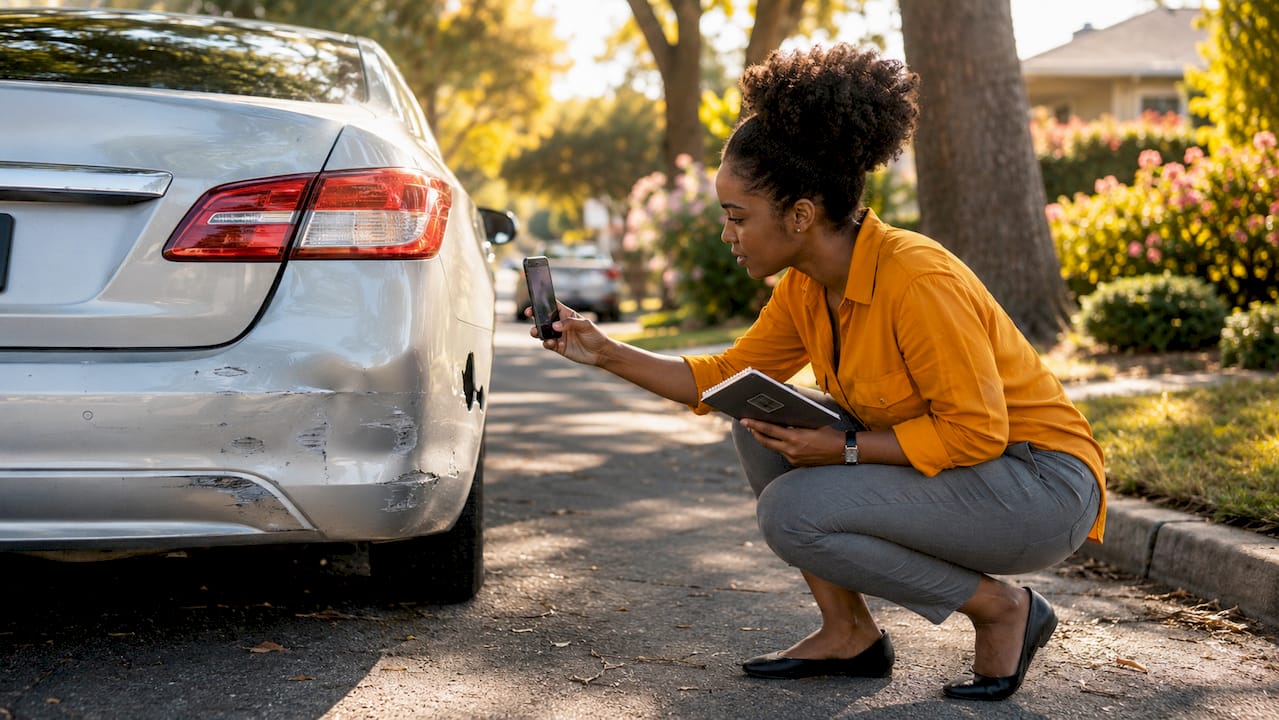
Once you confirm everyone is safe, start gathering information. GEICO advises taking photos of all vehicles, visible damage, license plates, and the surrounding accident scene. Do not stop at one or two shots. Photograph skid marks, traffic signals, road conditions, and any debris. These details become evidence that no one can dispute later.
Exchange the following with every other driver involved:
- Full legal name and contact information
- Driver’s license number and state
- Insurance company name and policy number
- Vehicle make, model, year, and license plate
Also collect contact information from any witnesses. A bystander’s account carries weight with adjusters precisely because they have no financial stake in the outcome. Note the time, exact location, and weather conditions before you leave the scene.
Pro Tip: Set your phone to record a short voice memo at the scene. Describe what happened in your own words while your memory is fresh. This recording can anchor your written statement later and keep your account consistent.
2. how to file a car accident insurance claim
Filing a car accident insurance claim means formally notifying your insurer that a loss has occurred and requesting coverage under your policy. Contact your insurance company as soon as possible, either by phone, through their mobile app, or on their website. Waiting too long creates gaps that adjusters will question.
American Family Insurance specifies the information insurers commonly request when you file:
- Date, time, and exact location of the accident
- A detailed description of how the collision occurred
- The other driver’s insurance company name and policy number
- The police department name and report number
- Contact information for all parties and witnesses
- Photos and any video footage from the scene
Complete every claim form accurately and keep a copy of everything you submit. Insurers use these documents to build their fact pattern, and inconsistencies between your form and your later statements can slow or reduce your payout. If the other driver was at fault, you may file with their insurer directly. However, your own insurer can also pursue the claim on your behalf through a process called subrogation.
Pro Tip: Do not assume the other driver’s insurer will treat you fairly. Their adjuster works for their client, not for you. Filing with your own insurer first often gives you a stronger advocate in the process.
Understanding the California injury claim time limit is also critical at this stage. Missing a deadline can bar your right to compensation entirely, regardless of how strong your evidence is.
3. how to document a car accident for your claim
Documentation quality directly determines how fast your claim moves. American Family Insurance confirms that well-organized evidence reduces repeated document requests from adjusters and speeds up verification. Think of your claim file as a case you are building, not a form you are filling out.
Start a dedicated folder, physical or digital, the day of the accident. Include:
- All photos and videos from the scene
- The police report number and a copy once it is available
- Medical records and bills related to any injuries
- Proof of lost wages if you missed work due to the crash
- Repair estimates and receipts for vehicle damage
Injuries deserve special attention in your documentation. Back pain after a car accident often appears days after the crash, not immediately. Seek medical evaluation even if you feel fine at the scene. A gap between the accident and your first medical visit gives adjusters a reason to argue your injuries were unrelated. Detailed guidance on documenting injuries after a car accident in Los Angeles can help you build a complete medical record that supports your claim.
4. what happens during the insurance claim evaluation
Once you file, a claims adjuster takes over the investigation. Adjusters follow a structured sequence: they review the police report first, then interview you and any witnesses, inspect damage photos, and examine medical records and wage loss documentation when injuries are involved. Social media checks may also occur. That means posts about your physical activity after the crash can surface as counter-evidence.
Here is what to expect during the evaluation phase:
- The adjuster will contact you to schedule a recorded or written statement
- They may request a medical authorization form to access your health records directly
- An independent vehicle inspection or appraisal may be ordered
- The adjuster will calculate liability percentages if fault is shared
Be cautious with early recorded statements. Initial statements to adjusters can become part of the insurer’s fact pattern. Keeping early communications factual and brief protects you from having an offhand remark used to minimize your injury claim later.
The adjuster’s goal is accurate settlement, but their employer’s goal is cost control. Those two objectives do not always align. Staying organized, responding to requests promptly, and keeping your own records of every communication gives you leverage throughout this phase.
5. uninsured motorist claim steps after a hit-and-run
Uninsured motorist (UM) claims follow a different set of rules than standard claims, and the timeline is tighter. UM coverage applies when the at-fault driver has no insurance or flees the scene entirely. Your own policy’s UM limits govern the payout. You cannot rely on the other driver’s insurer in these situations because there is no other insurer to contact.
Follow these steps immediately after a hit-and-run or uninsured driver accident:
- Call 911 and report the incident to police right away
- Document the scene thoroughly, including any partial plate numbers, vehicle descriptions, and witness accounts
- Notify your own insurer within 24–48 hours, as UM claims require prompt notification and specific claim forms
- Complete the notice of claim and proof-of-loss statement your insurer provides
- Obtain the police report and submit the report number with your UM claim forms
Many UM claims require a police report filed within 24–72 hours. Late reporting is the leading cause of UM claim denials. That statistic matters because most people do not realize the clock starts at the moment of the accident, not when they feel ready to deal with paperwork.
One important legal nuance: a missed deadline does not automatically kill your UM claim. The West Virginia Supreme Court ruled that insurers must prove prejudice from late reporting before denying a UM claim on that basis alone. Policy language and state law both factor into this analysis. California courts apply similar scrutiny. If your UM claim was denied due to a reporting delay, consult an attorney before accepting that denial as final.
6. common mistakes that hurt your insurance claim
The car accident claim process rewards preparation and punishes carelessness. These are the mistakes that most often reduce or kill a valid claim:
- Delaying your report. Every insurer sets its own deadline for reporting accidents. Missing it gives the company grounds to deny coverage outright.
- Incomplete documentation. Blurry photos, missing witness names, and no police report all create gaps that adjusters exploit.
- Admitting fault at the scene. Saying “I’m sorry” to the other driver is natural, but it can be recorded and used as a liability admission. Stick to exchanging information only.
- Skipping medical care. Treating your injuries as minor without a doctor’s evaluation is one of the most common and costly mistakes. Adjusters use the absence of early medical records to argue you were not seriously hurt.
- Ignoring follow-up requests. When an adjuster asks for additional documents, respond within the timeframe they provide. Silence reads as non-cooperation and can stall your claim indefinitely.
- Relying only on the other driver’s insurer. If the other driver is underinsured or uninsured, their policy will not cover your full losses. Your own UM coverage exists precisely for this situation.
Pro Tip: Keep a running log of every phone call, email, and letter related to your claim. Note the date, the name of the person you spoke with, and a summary of what was discussed. This log becomes your paper trail if a dispute arises.
Key takeaways
Successful car accident insurance claims depend on fast action, thorough documentation, and cautious communication with adjusters at every stage.
| Point | Details |
|---|---|
| Document the scene immediately | Photograph vehicles, damage, license plates, and road conditions before leaving the accident site. |
| File your claim promptly | Contact your insurer within 24–48 hours and provide all required information including the police report number. |
| Be careful with recorded statements | Keep early adjuster communications factual and brief to avoid statements that could reduce your settlement. |
| Know your UM coverage | If the other driver is uninsured or flees, your own policy’s uninsured motorist limits govern your payout. |
| Organize all evidence in one place | A complete, well-organized claim file reduces delays and repeat document requests from adjusters. |
What 20 years of accident cases taught me about the claims process
Most people walk into the insurance claim process assuming the system is designed to help them. It is not. It is designed to be efficient for the insurer. That distinction changes everything about how you should approach each step.
The single biggest mistake I see is people giving detailed recorded statements before they have compiled their own documentation. Adjusters are trained interviewers. They ask open-ended questions early, when your memory is still fragmented and your injuries may not have fully presented. An offhand comment about feeling “okay” at the scene has been used to dispute serious injury claims. My advice: be cooperative, be factual, and be brief until you have your own records in order.
The second thing I have learned is that UM coverage is the most underused protection on most policies. Clients are often shocked to discover they have it. When a hit-and-run driver destroys your car and injures your family, your own policy is your lifeline. Read your declarations page before you need it.
Finally, a denied claim is not always the end of the road. Insurers deny claims for procedural reasons that courts sometimes overturn, particularly on UM reporting deadlines. If your claim was denied and you believe the denial was wrong, get a legal opinion before you accept it. The benefits of working with a car accident attorney become most visible exactly at that moment.
— Matthew Nezhad
How Oakslawfirm can help you through the claim process
Oakslawfirm has spent over two decades protecting injured victims in the and throughout California. When your insurance claim stalls, gets denied, or the settlement offer falls short of your actual losses, attorney Matthew Nezhad and his team step in to fight for what you are owed. The firm handles everything from car accident compensation disputes to full personal injury lawsuits when insurers refuse to pay fairly. If you need to understand your options after a crash, contact Oakslawfirm today for a free case evaluation. You pay nothing unless they win.
FAQ
How soon should i file a car accident insurance claim?
Contact your insurer within 24–48 hours of the accident. Most policies require prompt reporting, and delays give insurers grounds to question or deny your claim.
What information do i need to file a car insurance claim?
You need the date, time, and location of the accident, the other driver’s insurance and contact details, the police report number, and photos of the damage. American Family Insurance lists these as the standard required items.
Can i refuse a recorded statement to the insurance adjuster?
You can decline or delay a recorded statement to the other driver’s insurer. With your own insurer, your policy may require cooperation, but you have the right to consult an attorney before giving a detailed account.
What happens if the other driver has no insurance?
File a claim under your own uninsured motorist coverage immediately. Your policy’s UM limits govern the payout, and you must notify your insurer within 24–48 hours and file a police report as soon as possible.
Does a late police report automatically kill a UM claim?
Not necessarily. Courts, including the West Virginia Supreme Court, have ruled that insurers must prove prejudice from a reporting delay before denying a UM claim. Consult an attorney if your claim was denied on this basis.
This article is provided for general informational purposes only and does not constitute legal advice. The information presented may not reflect the most current legal developments and should not be relied upon as a substitute for consultation with a licensed attorney. Every personal injury case involves unique facts and circumstances, and the outcome of any case depends entirely on those specific facts. Any results, settlement amounts, or verdicts referenced in this content are specific to the individual cases described, are not typical, and do not guarantee, promise, or predict a similar outcome in your case. Reading this content does not create an attorney-client relationship with Oaks Law Firm. Contact us directly for a consultation specific to your situation.
