

Attorney Advertising. This article was prepared with the assistance of artificial intelligence and reviewed by Oaks Law Firm prior to publication.
Yes, you can pursue a car accident emotional distress claim in California. Emotional distress damages are recoverable as part of a personal injury case or, in some situations, as a standalone claim under negligent infliction of emotional distress (NIED) or intentional infliction of emotional distress (IIED). The key is acting fast and building a documented record from day one.
California deadlines you must know:
- General statute of limitations: Two years from the date of injury under California Code of Civil Procedure §335.1. Miss it and your claim is barred.
- Government entity claims: If a government employee or agency caused the crash, you have only six months to file a government tort claim under California Government Code §911.2. Exceptions exist for minors and claimants with delayed discovery of injury, but do not count on them.
Your first five steps right now:
- Seek medical evaluation as soon as possible, even if physical injuries seem minor. A physician’s intake note creates a dated record linking the crash to your condition.
- Schedule a mental-health intake with a licensed therapist or psychologist as soon as possible. Courts and insurers treat early treatment as evidence of genuine harm.
- Start a contemporaneous symptom journal today. Write the date, time, and specific symptoms in your own words.
- Preserve all evidence: police report, photos, dashcam footage, witness contact information, and any communications with the other driver or insurer.
- Consult a personal injury attorney before giving a recorded statement to any insurance company.
Pro Tip: Date and timestamp every journal entry and write it by hand or in a notes app with automatic timestamps. Courts give more weight to entries made within hours of symptoms than to summaries written weeks later. Describe the symptom specifically (“woke at 2 AM with racing heart, could not return to sleep”) rather than generally (“felt anxious”).
Table of Contents
- What does “emotional distress” mean legally, and what is the difference between NIED and IIED?
- How does state law change what you can recover?
- What evidence convinces insurers and courts?
- What are emotional distress damages worth, and how do courts value them?
- When should you hire a personal injury attorney?
- What should you collect right now? A documentation checklist
- Oaks Law Firm helps California claimants pursue emotional distress damages
- Key Takeaways
- What the insurance company won’t tell you about emotional distress claims
- Authoritative sources and further reading
- FAQ
What does “emotional distress” mean legally, and what is the difference between NIED and IIED?
Emotional distress in tort law covers psychological harm caused by another party’s conduct. It is not a vague concept. Courts look for diagnosable conditions, documented symptoms, and a clear causal link to the defendant’s actions. In car-accident cases, that typically means PTSD, generalized anxiety disorder, major depression, or acute stress disorder confirmed by a licensed mental-health professional.
Negligent infliction of emotional distress (NIED)
NIED is the more common route after a crash. The defendant does not have to have intended to hurt you. You must show:
- The defendant owed you a duty of care and breached it (standard negligence).
- That breach caused your emotional harm.
- Your distress is serious, not a fleeting upset.
California recognizes two NIED theories. The direct victim theory applies when you were in the crash itself. The bystander theory applies when you witnessed a close family member seriously injured or killed. Bystander claims require that you were present at the scene, perceived the event, and suffered serious distress as a result.
Intentional infliction of emotional distress (IIED)
IIED carries a higher bar. You must prove the defendant’s conduct was outrageous, meaning it went beyond ordinary negligence and would be considered intolerable by a reasonable person. You also need to show the defendant acted with intent to cause distress or with reckless disregard for the probability of causing it. In a typical car accident, IIED is rarely the right theory unless the other driver deliberately rammed your vehicle or engaged in extreme road rage.
A medical diagnosis transforms subjective suffering into admissible evidence. Without a DSM-5 or ICD-10 diagnosis from a treating clinician, an insurer or jury has only your word. With one, you have a professional opinion linking the crash to a recognized condition, which is the foundation every successful emotional-distress claim is built on. Expert testimony from a psychologist or psychiatrist then explains causation, severity, and prognosis in terms a jury can evaluate.
How does state law change what you can recover?
Not every state handles emotional-distress claims the same way, and the differences are significant. Three main legal standards govern whether you can sue at all.
The impact rule requires that you suffered some physical impact in the crash before you can recover for emotional distress. A handful of states still use this approach, which effectively bars pure psychological-injury claims with no accompanying physical contact.
The zone-of-danger rule is more permissive. You do not need a physical impact, but you must have been in the immediate zone of physical danger created by the defendant’s negligence. If you were close enough that you could have been physically hurt, you can claim emotional distress even if you were not actually struck.
The foreseeability standard is the most claimant-friendly approach. It asks whether a reasonable person in the defendant’s position should have foreseen that their negligence would cause emotional harm. California generally follows this approach in direct-victim cases, which means you do not need a physical impact to recover, though courts still require serious and credible harm.
No-fault states and verbal/monetary thresholds
If your crash happened in a no-fault state, the analysis changes entirely. No-fault systems require drivers to collect from their own insurance first, and many states impose a verbal threshold (you must have suffered a “serious injury” as defined by statute) or a monetary threshold before you can step outside the no-fault system and sue the at-fault driver. Standalone emotional-distress claims often cannot clear those thresholds. This is one of the most common traps for California residents injured in out-of-state crashes.
Damage caps
Some states cap non-economic damages, which is the category that includes emotional distress, pain and suffering, and loss of enjoyment of life. California does not impose a general cap on non-economic damages in personal injury cases, though medical malpractice claims are subject to separate rules. If your crash occurred in a state with a cap, your attorney needs to factor that ceiling into any settlement calculation.
| Dimension | Impact rule | Zone-of-danger | Foreseeability |
|---|---|---|---|
| Physical contact required? | Yes | No, but proximity required | No |
| Who can sue | Direct victims with physical impact | Those in immediate danger zone | Direct victims; bystanders under separate rules |
| Evidence threshold | Physical injury plus emotional harm | Proximity plus serious distress | Serious, credible emotional harm |
| Typical barriers | Bars pure psychological claims | Limits bystander recovery | Requires credible diagnosis; no physical-impact bar |
| California approach | Not used | Limited bystander application | Primary standard for direct victims |
California claimants benefit from the foreseeability standard and the absence of a general non-economic damages cap. The practical implication: a well-documented PTSD diagnosis supported by expert testimony can support a substantial non-economic damages claim here, where the same case might be capped or blocked in another state.
What evidence convinces insurers and courts?
The single biggest mistake claimants make is waiting. Contemporaneous documentation, meaning records created at or near the time of symptoms, carries far more weight than retrospective accounts. An insurer reviewing a claim eighteen months after the crash will scrutinize a journal that was started six months in. One started the week of the accident is much harder to attack.
Medical and mental-health records
Your treating physician’s intake notes should document your reported psychological symptoms alongside any physical injuries. When you see a therapist or psychiatrist, their records should include a DSM-5 or ICD-10 diagnosis, a treatment plan, medication prescribed, and session notes that track your progress or deterioration over time. These records form the clinical backbone of your claim.
Research on PTSD after car accidents identifies the most commonly documented symptoms: intrusive memories, nightmares, hypervigilance, avoidance of driving or roads, emotional numbing, and sleep disruption. Document every one of these in your journal and report them to your provider at each visit.
Witness statements and employer records
A coworker, supervisor, or family member who observed your behavioral changes after the crash can provide a statement describing what they saw: you stopped driving, you had panic attacks before work, your performance declined. Employer records showing missed days, reduced hours, or a formal leave of absence translate psychological harm into economic terms that insurers understand.
Expert witnesses
A treating psychologist or psychiatrist can testify about your diagnosis, the causal link to the crash, and your prognosis. An independent medical examiner retained by your attorney can provide a formal causation opinion. Studies on PTSD following severe vehicular crashes show that risk factors including prior trauma, female gender, and crash severity are well-established in the clinical literature, which means a qualified expert can place your case in a broader scientific context that juries find credible.
Evidence checklist:
- Police report and crash photos
- Emergency room or urgent care records from the day of the crash
- Primary care physician records documenting psychological symptoms
- Mental-health intake notes and all subsequent therapy records
- DSM-5 or ICD-10 diagnosis from a licensed clinician
- Medication records and pharmacy receipts
- Contemporaneous symptom journal (dated entries, specific symptoms)
- Witness statements from people who observed your behavioral changes
- Employer records: missed work, reduced hours, leave of absence, performance reviews
- Expert report from a retained psychologist or psychiatrist addressing diagnosis, causation, and prognosis
Pro Tip: Mental-health records are protected by therapist-patient privilege, but you will likely need to waive that privilege to use them as evidence. Discuss the scope of any waiver with your attorney before authorizing release. A targeted waiver covering only the records relevant to your claim protects your broader privacy while preserving the evidence you need.
What are emotional distress damages worth, and how do courts value them?
Emotional distress damages fall into two buckets. Economic damages cover out-of-pocket costs: therapy sessions, psychiatric medication, lost wages from missed work, and any future treatment costs your expert projects. Non-economic damages cover the subjective harm: pain and suffering, loss of enjoyment of life, and the distress itself. Understanding how these categories interact is the starting point for any realistic valuation.
How insurers and attorneys calculate value
No formula produces an exact number, but two methods dominate in practice.
The multiplier method takes your total economic damages and multiplies them by a factor, typically between 1.5 and 5, depending on severity. A PTSD diagnosis with documented treatment history, job loss, and a credible expert opinion pushes the multiplier toward the higher end. A brief anxiety reaction with no formal diagnosis and minimal treatment stays near the bottom.
The per diem method assigns a daily dollar value to your suffering and multiplies it by the number of days you have experienced it. Attorneys sometimes use this approach when the injury is chronic and ongoing, because it makes the accumulation of harm concrete for a jury.
Comparable verdicts from similar California cases also inform settlement negotiations, though no two cases are identical.
What raises or lowers the value
A formal PTSD diagnosis is the single strongest value driver. Chronic symptoms that persist beyond six months, a documented treatment history, prior good mental health, significant job impact, and a severe crash all push value upward. Gaps in treatment, inconsistent symptom reporting, or a pre-existing mental health condition the defense can point to will reduce it.
PTSD prevalence after car accidents: A systematic review published in PubMed found that PTSD affects between 20% and 45% of crash survivors at six weeks, with 17.9%–29.8% continuing to meet diagnostic criteria one year post-accident. A separate systematic review in the International Journal of Environmental Research and Public Health confirmed these ranges and identified cognitive behavioral therapy (CBT) as an evidence-based treatment. These figures matter in litigation because they establish that post-crash psychological injury is not rare or implausible.
California does not cap non-economic damages in standard personal injury cases, which means a well-documented emotional distress claim here can reach figures that would be legally impossible in states with caps. That said, the strength of your evidence, not the absence of a cap, determines what you actually recover.
When should you hire a personal injury attorney?
The short answer: before you talk to the other driver’s insurer. The longer answer involves recognizing the specific signals that make legal representation not just helpful but necessary.
You should consult an attorney if you have persistent psychological symptoms lasting more than a few weeks, a formal PTSD or anxiety diagnosis, mounting therapy costs, any job impact, a denial from the insurer, or a settlement offer that does not account for non-economic damages. Research published in PubMed found that the claims process itself can increase psychological distress in accident survivors. Delegating the administrative burden of a claim to an attorney is not just a legal strategy; it protects your recovery.
What a personal injury attorney does on an emotional distress claim
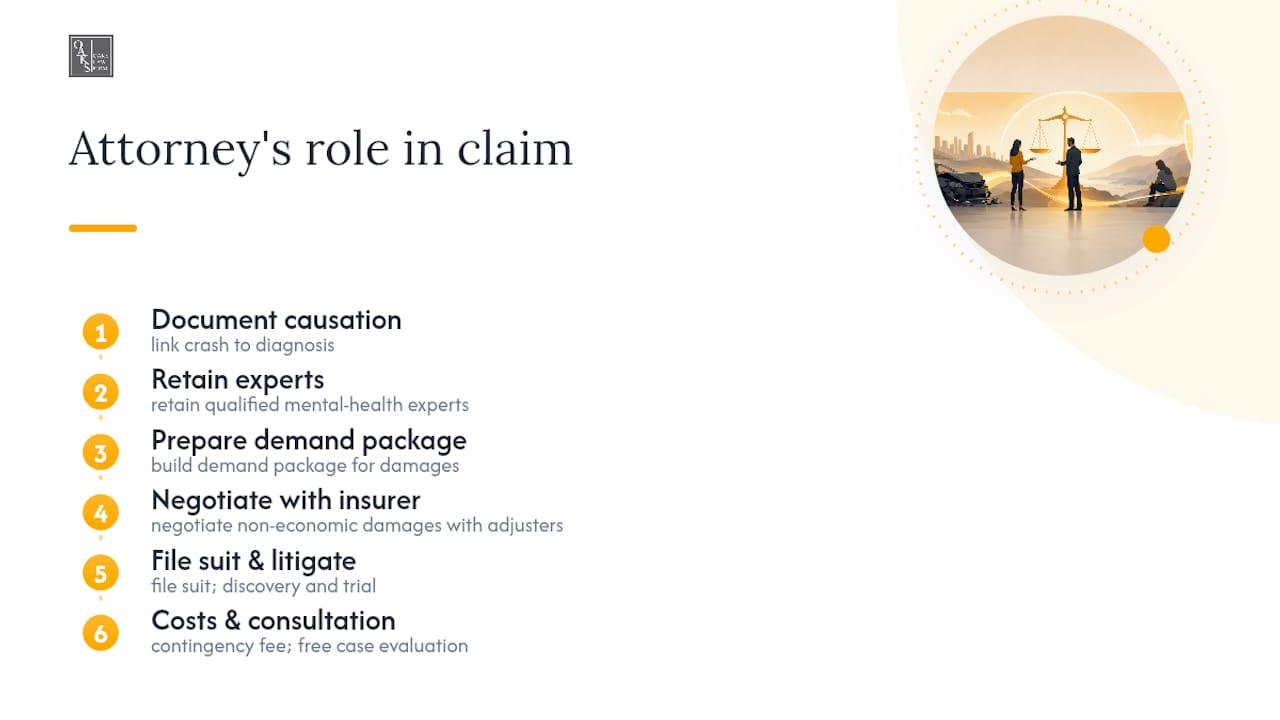
An experienced PI attorney documents the causal chain between the crash and your diagnosis, retains qualified mental-health experts, builds the demand package, and negotiates non-economic damages with the insurer’s adjusters. If negotiations fail, they file suit and take the case through discovery and trial. On emotional-distress claims specifically, the attorney’s ability to retain a credible expert and present that expert’s opinion persuasively is often the difference between a fair settlement and a lowball offer.
Most personal injury attorneys, including Oaks Law Firm, work on a contingency fee. You pay nothing upfront. The attorney’s fee comes as a percentage of the settlement or verdict, and only if you win. A free case evaluation costs you nothing and tells you whether your claim has merit.
Pro Tip: At your first consultation, ask these specific questions: What evidence is currently missing from my claim? What is a realistic timeline from now to resolution? Will you retain a mental-health expert, and who covers that cost? What percentage of your cases involve emotional distress claims? The answers tell you whether the attorney has real experience with this type of claim or is treating it as a standard fender-bender.
Understanding the full range of benefits an attorney brings to a car accident claim goes beyond negotiation. Attorneys also identify evidence you would not know to collect and prevent you from making statements that undercut your own case.
What should you collect right now? A documentation checklist
The first two weeks after a crash are the most important documentation window you have. Here is exactly what to do.
Step-by-step documentation checklist:
- Obtain the police report number and request a copy within 5–7 days.
- Photograph all vehicle damage, road conditions, and any visible injuries.
- Get medical records from every provider you see, starting with the ER or urgent care visit.
- Schedule a mental-health intake appointment and keep every subsequent appointment.
- Request therapy notes and treatment records from your provider (with your attorney’s guidance on privilege waiver scope).
- Start your symptom journal the day of the crash or the day after.
- Contact witnesses and collect written statements while memories are fresh.
- Request a letter from your employer documenting any missed work, reduced hours, or performance impact.
- Preserve all electronic evidence: dashcam footage, text messages about the crash, any social media posts from the day of the accident.
- Do not post about your symptoms or recovery on social media. Defense attorneys routinely use social media to challenge the severity of claimed injuries.
How to write a contemporaneous symptom journal
Your journal does not need to be formal. It needs to be specific, dated, and consistent. Write an entry at least every other day for the first month, then weekly as your condition stabilizes or evolves.
First two weeks — sample entry format:
“[Date, time]. Woke at 3 AM after nightmare about the crash. Could not return to sleep. Drove to work but had to pull over twice because of panic. Arrived 45 minutes late. Supervisor noticed. Headache all day. Avoided the intersection where the accident happened by taking a longer route.”
First three months — sample entry format:
“[Date]. Third week of therapy. Dr. [first name only] says I am showing improvement in sleep but avoidance behavior is still significant. Declined invitation to carpool with coworker. Still not comfortable on the freeway. Missed one day of work this week.”
Requesting medical and mental-health records
Use a written HIPAA authorization form to request records from each provider. Your attorney can provide the correct form and advise on the scope of the release. For mental-health records specifically, California law provides additional privacy protections under the Confidentiality of Medical Information Act (CMIA). Request records in writing, keep a copy of every authorization you sign, and log the date you sent each request.
For electronic evidence, back up dashcam footage to a hard drive or cloud storage immediately. Text messages and emails relevant to the crash should be screenshotted and saved. Do not delete anything.
Oaks Law Firm helps California claimants pursue emotional distress damages
If you have been injured in a crash in the or anywhere in California, Oaks Law Firm handles the full scope of your claim, including the psychological harm that often goes uncompensated when victims navigate the process alone.

Founded by Matthew Nezhad in 2002, Oaks Law Firm has spent more than two decades representing injured Californians from offices in Sherman Oaks and Woodland Hills. The firm accepts a limited number of cases each year, which means every client gets direct attention from an experienced legal team, not a case manager. On emotional distress claims, that means retaining qualified mental-health experts, building a complete causation record, and negotiating non-economic damages with the persistence insurers rarely encounter from unrepresented claimants.
The firm works on a contingency fee basis with no upfront cost. You pay nothing unless Oaks Law Firm wins your case. A free case evaluation is the first step. During that conversation, the team reviews your evidence, identifies what is missing, and gives you a realistic picture of your claim’s value and timeline.
No outcome is guaranteed. Every case depends on its specific facts, evidence, and applicable law. To request your free evaluation and speak directly with the Oaks Law Firm team, visit how to file a personal injury lawsuit in Los Angeles or call the office directly.
Key Takeaways
A successful car accident emotional distress claim in California requires a formal diagnosis, contemporaneous documentation, and action before the two-year statute of limitations under CCP §335.1 expires.
| Point | Details |
|---|---|
| Recoverability in California | Emotional distress damages are recoverable under NIED, IIED, or as part of a personal injury claim. |
| Critical deadlines | Two years under CCP §335.1; six months for government-entity claims under Gov. Code §911.2. |
| PTSD prevalence | Between 20% and 45% of crash survivors meet PTSD criteria at six weeks; 17.9%–29.8% continue to meet criteria one year post-accident. |
| Evidence priority | A DSM-5 or ICD-10 diagnosis, contemporaneous journal, and expert testimony are the three strongest evidence pillars. |
| Oaks Law Firm | Offers free case evaluations and contingency-fee representation for California emotional distress claims from offices in Sherman Oaks and Woodland Hills. |
What the insurance company won’t tell you about emotional distress claims
Most people who call an insurer after a crash get a version of the same script: report the damage, get a repair estimate, and settle quickly. Emotional distress rarely comes up in that conversation, and that silence is not accidental.
Insurers know that psychological injuries are harder to quantify than a broken arm, and they count on claimants not knowing how to document them. The standard playbook is to offer a that covers medical bills and property damage, get a signed release, and close the file before the claimant realizes their PTSD diagnosis or anxiety disorder is also compensable. Once you sign that release, you cannot go back.
What I have seen over more than two decades of representing injured Californians is that the claimants who fare worst are the ones who assumed their emotional suffering was either not real enough to claim or too hard to prove. Both assumptions are wrong. Courts have accepted PTSD as serious compensable harm for decades. The clinical literature is unambiguous about how common it is after crashes. The challenge is not proving that psychological injury exists; it is building the specific, dated, documented record that connects your injury to this crash and this defendant.
The other thing insurers count on is time pressure. The longer you wait to start mental-health treatment, the easier it is for a defense attorney to argue the injury was not serious or was caused by something else. Early treatment is not just good for your health. It is the single most protective step you can take for your claim.

Authoritative sources and further reading
This article is informational only and does not constitute legal advice. Consult a licensed California attorney about the specific facts of your case.
Key statutes:
- Prevalence of PTSD after motor vehicle accidents — systematic review (PubMed)
- Post-Traumatic Stress Disorder (PTSD) Resulting from Road Traffic Accidents (RTA): A Systematic Literature Review (International Journal of Environmental Research and Public Health)
- PTSD After Severe Vehicular Crashes – PMC
- Emotional distress — Cornell Law School Wex
- Intentional infliction of emotional distress — Cornell Law School Wex
- Can I Sue for Emotional Distress After a Car Accident? — Legal Clarity
- PTSD after car accident — Medical News Today
- Compensation seeking and psychological distress — PubMed (2018)
Clinical and legal sources:
- Prevalence of PTSD after motor vehicle accidents — systematic review (PubMed)
- PTSD Resulting from Road Traffic Accidents — systematic review (IJERPH)
- PTSD After Severe Vehicular Crashes (PMC)
- Emotional distress — Cornell Law School Wex
- Intentional infliction of emotional distress — Cornell Law School Wex
- Can I Sue for Emotional Distress After a Car Accident? — Legal Clarity
- PTSD after car accident — Medical News Today
- Compensation seeking and psychological distress — PubMed (2018)
PTSD prevalence data from major studies:
| Study | Timepoint | PTSD prevalence |
|---|---|---|
| PubMed systematic review | 6 weeks post-crash | 20%–45% |
| PubMed systematic review | 1 year post-crash | 17.9%–29.8% |
| PMC cohort study | 6 months post-crash | — |
This article provides general legal information about California personal injury law. It is not legal advice and does not create an attorney-client relationship. Laws and deadlines change; confirm current rules with a licensed California attorney before taking action.
FAQ
What is the average payout for emotional distress after a car accident?
There is no fixed average because payouts depend on diagnosis severity, treatment history, economic losses, and jurisdiction. California does not cap non-economic damages in personal injury cases, so well-documented claims with a PTSD diagnosis and significant job impact can reach substantial figures.
How do you prove emotional distress after a car accident?
Proof rests on a formal DSM-5 or ICD-10 diagnosis from a licensed clinician, contemporaneous journal entries documenting symptoms, medical and therapy records, witness or employer statements showing functional decline, and expert testimony linking the diagnosis to the crash.
Is it worth suing for emotional distress after a car accident?
It often is, particularly when you have a documented diagnosis, ongoing treatment costs, or job impact. A free case evaluation with a personal injury attorney, like those offered by Oaks Law Firm, costs nothing and gives you a realistic picture of your claim’s value before you decide.
How much time do you have to file an emotional distress claim in California?
California’s general statute of limitations is two years from the date of injury under CCP §335.1. If a government entity was involved, you have only six months to file a government tort claim under Gov. Code §911.2. Both deadlines are strict, and missing them typically bars your claim entirely.
Legal Disclaimer: This article is for general informational purposes only and does not constitute legal advice or create an attorney-client relationship. The information provided may not apply to your specific situation. Laws and regulations are subject to change. Always consult with a qualified California personal injury attorney regarding your particular circumstances. Results in prior cases do not guarantee similar outcomes in future matters. Oaks Law Firm is located in Sherman Oaks and Woodland Hills, California.
