

Losing someone you love because of another person’s negligence is devastating. The grief is real, and the last thing you want to think about is a legal process. But filing a wrongful death claim in California may be the most important step you can take to hold the responsible party accountable and secure financial stability for your family. This wrongful death claim California guide walks you through who can file, what the process looks like, what compensation you can recover, and the deadlines you cannot afford to miss.
Table of Contents
- Key takeaways
- Who can file a wrongful death claim in California
- Steps to filing a wrongful death claim in California
- Understanding wrongful death damages in California
- Deadlines you must know before filing
- Common mistakes that can hurt your claim
- My perspective on wrongful death cases
- How Oaks Law Firm can help your family
- FAQ
Key takeaways
| Point | Details |
|---|---|
| Know who can file | California law limits who has legal standing to file a wrongful death claim under CCP Section 377.60. |
| Act before the deadline | The standard filing window is two years from the date of death, with shorter deadlines for government claims. |
| Pursue all damages | Both economic and noneconomic losses are recoverable, and noneconomic damages are not capped in most cases. |
| Include every eligible heir | All qualifying family members must join a single lawsuit or risk losing their right to compensation. |
| Get legal help early | Early evidence collection and experienced legal counsel significantly strengthen your claim. |
Who can file a wrongful death claim in California
California law is specific about who has the legal right to file a wrongful death claim. California CCP Section 377.60 defines standing in two tiers, and understanding where you fall determines whether you can pursue a case at all.
The first tier covers immediate family members with clear standing:
- Surviving spouses or registered domestic partners
- Children of the deceased, including adopted children
- Grandchildren, if the deceased’s children have also passed away
- Surviving parents, if the deceased had no spouse or children
The second tier covers dependent relatives who may also qualify under CCP Section 377.60(b):
- Putative spouses (someone who believed in good faith they were legally married)
- Stepchildren who were financially dependent on the deceased
- Parents who were financially dependent on the deceased
- Dependent minors who lived with the deceased for at least 180 days before the death and relied on them financially
One rule catches many families off guard. California law requires that all eligible heirs join together in a single wrongful death action. You cannot have one sibling file separately from another. This “one action” rule protects defendants from facing multiple lawsuits for the same death, but it also means that omitting an eligible heir can create serious legal problems for your case.
Pro Tip: Before filing, work with an attorney to identify every person who may qualify as an heir. Missing even one eligible family member can complicate or invalidate your claim.
Steps to filing a wrongful death claim in California
Filing a wrongful death claim is not a single event. It is a process that unfolds over months, sometimes years. Here is how it works in practice.
- Consult a wrongful death attorney immediately. The first call you make after losing a loved one to negligence should be to an experienced lawyer. An attorney can assess your case, identify liable parties, and begin preserving evidence before it disappears. Filing early and retaining legal counsel swiftly after a wrongful death improves evidence preservation and strengthens claims significantly.
- Gather and preserve evidence. This includes police reports, medical records, witness contact information, photographs, surveillance footage, and any documentation related to the circumstances of the death. Evidence degrades fast. Witnesses forget details. Surveillance footage gets overwritten.
- Identify all liable parties. In many cases, more than one party shares responsibility. A truck accident may involve the driver, the trucking company, and a parts manufacturer. A medical malpractice case may involve a physician, a hospital, and a pharmaceutical company. Your attorney will investigate every angle.
- File the claim in the appropriate court. In California, wrongful death claims are civil lawsuits filed in Superior Court. Your attorney will draft and file the complaint, naming all defendants and stating the basis for liability.
- Include all eligible heirs in the filing. Because of the one action rule, every qualifying family member must be part of the lawsuit from the start. This is not optional.
- Consider filing a survival action alongside your wrongful death claim. A survival action is a separate but related claim that recovers damages the deceased person suffered before death, such as pain and suffering or lost wages from the time of injury to the time of death. California allows families to pursue both claims simultaneously, which can significantly increase total recovery.
Pro Tip: Do not wait for a criminal investigation or prosecution to conclude before filing your civil claim. Criminal and civil cases run on separate tracks, and waiting can cost you your right to sue.
Understanding wrongful death damages in California
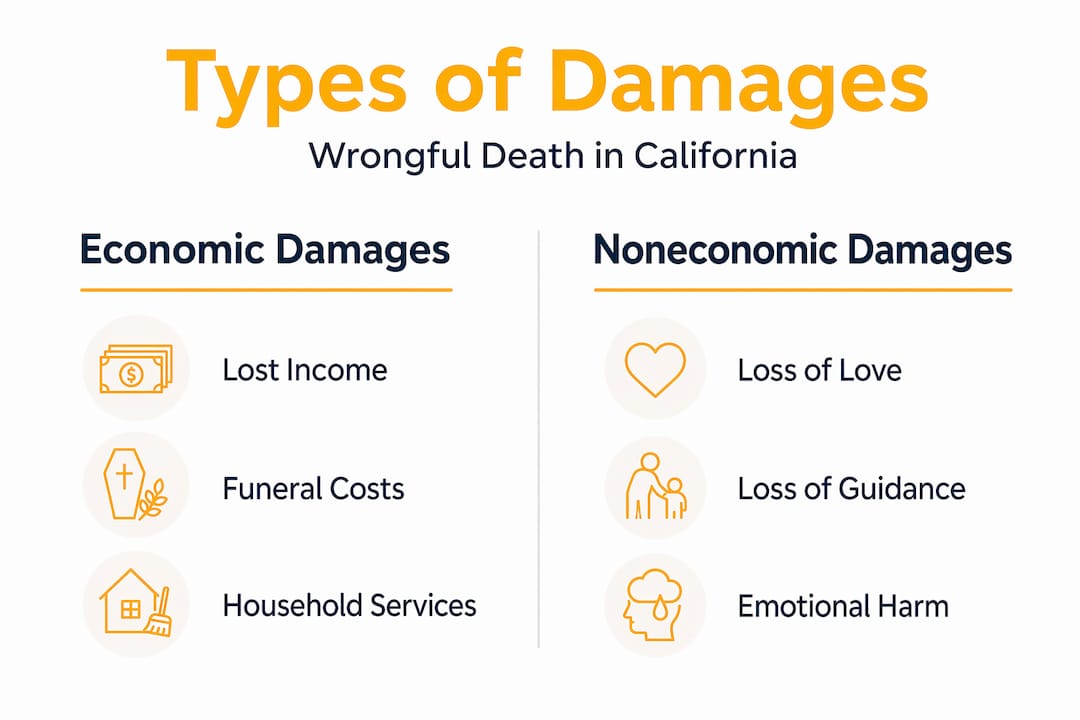
Compensation in a wrongful death case falls into two broad categories: economic and noneconomic damages. Understanding both is critical because families often leave significant money on the table by focusing only on the obvious financial losses.
Economic damages
These are the measurable financial losses your family suffers because of the death:
| Damage Type | What It Covers |
|---|---|
| Lost financial support | Income the deceased would have earned and contributed to the household |
| Funeral and burial costs | Reasonable expenses for the funeral and burial |
| Household services | The value of services the deceased provided, like childcare or home maintenance |
| Medical expenses | Bills incurred for care related to the fatal injury before death |
Life expectancy tables and vocational experts help juries determine appropriate compensation periods for lost income. If the deceased was a 40-year-old with 25 more working years ahead, the economic loss calculation is substantial. You can learn more about how attorneys approach future lost wages in California injury cases.

Noneconomic damages
These are harder to quantify but often represent the largest portion of a wrongful death award. California jury instructions specifically recognize the following noneconomic losses:
- Loss of love and companionship
- Loss of comfort and moral support
- Loss of guidance and training
- Loss of the deceased’s society and protection
Families often undervalue noneconomic damages, but these can be substantial and are not capped in most wrongful death cases. The one exception is medical malpractice, where California law does impose limits on noneconomic damages. Understanding how courts approach pain and suffering calculations can give you a clearer picture of what your family’s noneconomic losses may be worth.
Deadlines you must know before filing
Missing a filing deadline in California does not just weaken your case. It eliminates it entirely. The court will dismiss your lawsuit, and you lose the right to any compensation.
| Claim Type | Deadline |
|---|---|
| Standard wrongful death | Two years from the date of death |
| Medical malpractice | Three years from injury, or one year from discovery of negligence |
| Government entity claim | Six-month administrative filing deadline before lawsuit |
| Claims involving minors | Two years after the minor’s 18th birthday |
The standard two-year deadline applies to most wrongful death cases in California under CCP Section 335.1. But there are critical exceptions. If the death involved a government employee or agency, such as a city bus driver or a county hospital, you must file an administrative claim with the government entity within six months of the death before you can file a lawsuit. Miss that six-month window and your case is gone.
Medical malpractice claims follow a different timeline. You have three years from the date of the negligent act or one year from when you discovered the negligence, whichever comes first.
Pro Tip: If a minor child is one of the heirs, their individual deadline extends to two years after they turn 18. But this does not pause the deadline for adult heirs, so the family should still file as soon as possible.
Common mistakes that can hurt your claim
Even strong wrongful death cases can unravel because of avoidable errors. Here are the most common pitfalls families face:
- Waiting too long to contact an attorney. Evidence disappears, witnesses become unreachable, and deadlines pass. The sooner you act, the stronger your case.
- Failing to include all eligible heirs. Leaving out a qualifying family member violates the one action rule and can jeopardize the entire lawsuit.
- Settling too quickly with insurance companies. Insurance companies often undervalue wrongful death claims, and a quick settlement offer almost never reflects the full value of your losses. Never sign anything without legal review.
- Underestimating noneconomic damages. The loss of a parent’s guidance or a spouse’s companionship has real monetary value in California courts. Do not let anyone tell you otherwise.
- Missing the government claims deadline. The six-month window for filing against a government entity is one of the most commonly missed deadlines in California death claims.
My perspective on wrongful death cases
I have spent my entire career representing injured victims and grieving families throughout the San Fernando Valley and California. Wrongful death cases are the most emotionally charged work I do, and they are also the ones where I see the most costly mistakes made by families who tried to navigate the process alone.
The single biggest mistake I see is waiting. Families are grieving, which is completely understandable. But while they wait, critical surveillance footage gets deleted, witnesses move on, and insurance adjusters are already building a defense. Early evidence collection is not just helpful. It is often the difference between winning and losing.
I also see families accept the first settlement offer because they are exhausted and want it to be over. Insurance companies count on that. What looks like a significant check rarely covers even the economic losses, let alone the noneconomic ones. My team fights those negotiations hard because families deserve full accountability, not a convenient number that closes a file.
What I have learned from years of handling these cases is that thoroughness wins. Identifying every liable party, calculating every category of damages, and refusing to back down from a fight is what gets families the compensation they actually deserve.
How Oaks Law Firm can help your family
When your family is dealing with the loss of a loved one due to someone else’s negligence, you should not have to figure out California’s legal system on your own. At Oaks Law Firm, attorney Matthew Nezhad and his team have spent decades fighting for families throughout the San Fernando Valley and across California. The firm handles a limited number of cases each year, which means every client gets focused, aggressive representation.
From the moment you call, the team begins investigating liability, identifying all responsible parties, and calculating the full scope of your damages, including noneconomic losses that other firms overlook. If you need to pursue both a wrongful death and a survival action, the team handles both. Visit the firm’s wrongful death attorneys page to learn more about how Oaks Law Firm approaches these cases. The consultation is free, and you pay nothing unless the firm wins your case.
Who is eligible to file a wrongful death claim in California?
Immediate family members including spouses, children, and parents have clear standing under CCP Section 377.60. Dependent relatives, putative spouses, and financially dependent stepchildren or minors may also qualify.
What is the deadline for filing a wrongful death claim in California?
The standard deadline is two years from the date of death under CCP Section 335.1. Claims against government entities require an administrative filing within six months, and medical malpractice claims follow a separate timeline.
What damages can families recover in a California wrongful death case?
Families can recover economic damages like lost income, funeral costs, and household services, as well as noneconomic damages including loss of companionship and guidance. Noneconomic damages are not capped except in medical malpractice cases.
What is the one action rule in California wrongful death cases?
California law requires all eligible heirs to join together in a single wrongful death lawsuit. Separate lawsuits by different family members for the same death are not permitted.
Do I need an attorney to file a wrongful death claim in California?
You are not legally required to hire an attorney, but wrongful death cases involve complex liability investigations, damage calculations, and strict deadlines. Experienced legal counsel significantly improves the likelihood of recovering full compensation.
Recommended

