

The truck accident claim process in California is the legal and administrative sequence you must follow to recover compensation for injuries, vehicle damage, and related losses after a collision involving a commercial truck. Most people assume filing an insurance claim is the only step. The reality is that California law requires multiple parallel actions, including a DMV report, insurer notification, and strict deadline compliance, all of which must happen simultaneously to protect your rights. Miss one step, and you risk losing your license, your claim, or both.
What mandatory reports and documentation must you file after a California truck accident?
California law treats accident reporting as a non-negotiable obligation, not a suggestion. Three separate documents must be filed after a serious truck accident, and confusing them is one of the most common and costly mistakes claimants make.
The first is the police report, filed at the scene by responding officers or by you at a local CHP or police station if no officer responds. The second is your insurance company notification, which your policy almost certainly requires within a specific window. The third, and most overlooked, is the SR-1 form filed directly with the California DMV.

What the SR-1 form requires
California requires filing an SR-1 within 10 days after any traffic accident that causes bodily injury or more than $1,000 in property damage. That $1,000 threshold is lower than most people expect. A cracked bumper on a modern truck easily clears it. The SR-1 is filed by each driver involved, independently, regardless of fault. It is not the same as a police report, and your insurer does not file it on your behalf.
Missing the SR-1 deadline can trigger a license suspension by the DMV, which creates a separate legal problem on top of your injury claim. It also signals to insurers that you were not compliant with state law, which can complicate negotiations later.
Here is what you need to gather at the scene to support both your SR-1 filing and your personal injury claim:
- Full name, address, driver’s license number, and insurance information for the truck driver
- The trucking company’s name, DOT number, and contact information
- License plate numbers for all vehicles involved
- Names and phone numbers of all witnesses
- Photographs of vehicle damage, road conditions, skid marks, and any visible injuries
- The responding officer’s name and badge number, plus the police report number
Pro Tip: Take a video walkthrough of the entire accident scene before any vehicles are moved. A 60-second video captures spatial relationships between vehicles, debris fields, and road markings that photographs alone cannot replicate.
You can also review your accident report to understand exactly what the DMV and insurers will see when they evaluate your case.
How do you file an insurance claim after a truck accident in California?
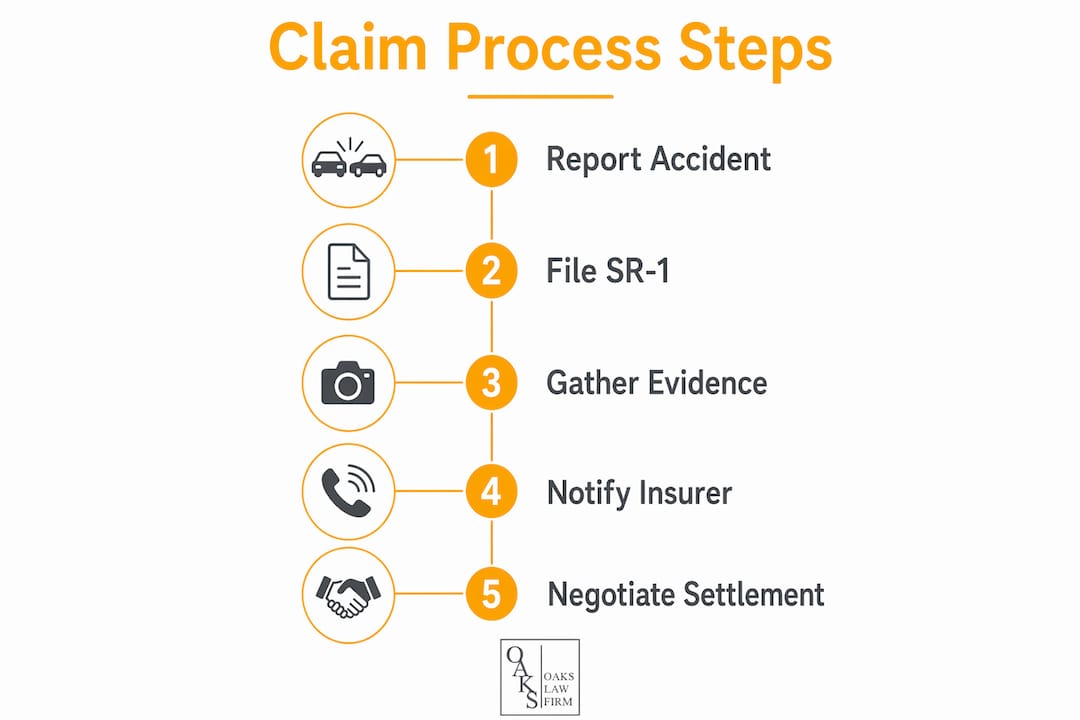
Filing an insurance claim after a truck accident follows a defined sequence. Skipping steps or doing them out of order gives adjusters grounds to delay or reduce your payout.
- Notify your insurer immediately. Call your insurance company the same day as the accident if possible. Provide the basic facts: date, location, parties involved, and a brief description of what happened. Do not speculate about fault or describe your injuries in detail at this stage.
- File a third-party claim against the truck driver’s insurer. If the truck driver is at fault, you file a liability claim against their policy. Provide the trucking company’s insurer with the same factual information and your documentation package.
- Cooperate with the liability investigation. Insurance companies investigate liability and damages after claim filing, and the process can extend weeks or months depending on injury severity and fault complexity. Cases with clear liability resolve faster. Disputed fault cases, which are common in truck accidents involving multiple parties like the driver, the trucking company, and a cargo loader, take considerably longer.
- Submit a demand letter. Once your medical treatment reaches maximum medical improvement (MMI), your attorney or you compile a demand package. This includes all medical records, bills, lost wage documentation, and a written demand for a specific dollar amount.
- Negotiate the settlement. The adjuster will respond with a counteroffer. This is where most claimants lose money by accepting the first offer. The first offer is almost never the final or fair number.
Handling uninsured or underinsured truck drivers
If the at-fault truck driver lacks adequate insurance, the uninsured motorist claim process in California activates your own UM/UIM coverage. UM/UIM claims in California require timely notice to your insurer and may involve arbitration instead of a court trial, depending on your policy language. A written arbitration demand must typically be submitted within two years. This is a separate track from a standard liability claim, with its own rules and deadlines.
Claims involving uninsured or underinsured truck drivers often settle through negotiation, but disputed cases go to binding arbitration, where a neutral arbitrator decides the outcome instead of a jury.
Pro Tip: Never give a recorded statement to the opposing insurer without consulting an attorney first. Adjusters are trained to ask questions that elicit answers that minimize your payout. You are not legally required to provide one.
What are the key deadlines and statute of limitations for truck accident claims in California?
Deadlines in California personal injury law are hard stops, not suggestions. Missing one does not delay your claim. It eliminates it.
The California personal injury statute of limitations is generally two years from the date of the accident. Property damage claims carry the same two-year window. This means you have two years to file a lawsuit in civil court, not just to notify the insurer. If you miss this deadline, courts will almost certainly dismiss your case regardless of how strong your evidence is.
The timeline compresses significantly when a government entity is involved. If the truck was operated by a city, county, or state agency, you must file a government tort claim within six months of the accident before you can file a lawsuit. That six-month window catches many claimants off guard, particularly when injuries take time to fully manifest.
| Deadline | Timeframe | Consequence of Missing |
|---|---|---|
| SR-1 DMV report | 10 days from accident | License suspension, claim complications |
| Government tort claim | 6 months from accident | Bars lawsuit against public entity |
| Personal injury lawsuit | 2 years from accident | Case permanently dismissed |
| Property damage lawsuit | 2 years from accident | Case permanently dismissed |
| UM/UIM arbitration demand | 2 years from accident | Loss of arbitration rights under policy |
The discovery rule can extend the two-year personal injury deadline in limited circumstances. If you did not know and could not reasonably have known about your injury at the time of the accident, the clock starts when you discovered or should have discovered the injury. Spinal injuries and traumatic brain injuries sometimes fall into this category, but courts apply the discovery rule narrowly.
For a detailed breakdown of truck accident filing deadlines specific to California, the timeline differences between claim types matter more than most claimants realize until it is too late.
What are effective strategies and common pitfalls in handling a California truck accident claim?
The difference between a fair settlement and a low one often comes down to what you do in the first two weeks after the accident, not what happens at the negotiating table months later.
Strategies that strengthen your claim
Documenting injuries thoroughly and preserving all accident evidence improves claim validity and settlement outcomes. Photographs, medical records, and witness information are the three pillars of a strong claim. See every recommended specialist, follow your treatment plan without gaps, and keep every receipt related to your accident, including transportation to medical appointments and over-the-counter medications.
- Photograph your injuries every few days during recovery. Bruising and swelling evolve over time, and a photo series tells a more compelling story than a single image taken at the hospital.
- Request the truck driver’s logbooks, maintenance records, and the trucking company’s safety inspection history. Federal Motor Carrier Safety Administration (FMCSA) regulations require trucking companies to maintain these records, and they frequently reveal violations that establish negligence.
- Get an independent medical examination if the insurer’s doctor disputes your injuries. Their doctor works for them. Your treating physician’s records carry more weight when supported by a second independent opinion.
- Track every financial loss: missed workdays, reduced earning capacity, home care costs, and any modifications to your home or vehicle required by your injuries.
Common pitfalls that reduce or kill claims
“The single most damaging thing a claimant can do is post about the accident or their recovery on social media. Insurance defense teams routinely monitor public profiles. One photograph of you at a family event can be used to argue your injuries are not as serious as claimed.”
Delays in seeking medical treatment are the second most damaging mistake. Insurers treat a gap between the accident and your first doctor visit as evidence that your injuries were not serious or were caused by something else. See a doctor within 24 hours, even if you feel relatively fine. Adrenaline masks pain, and conditions like whiplash and internal injuries often surface days later.
Accepting the first settlement offer without consulting an attorney is the third major pitfall. Early, well-documented claims with accurate evidence generally improve chances of faster, fairer settlements, but “faster” does not mean you should rush to accept an inadequate number. California’s Proposition 103 prohibits premium increases for non-fault accidents, so your concern about rate hikes should not push you into a low settlement.
If the at-fault driver was uninsured, understanding your options for an uninsured driver accident in California is critical before you accept any offer from your own insurer.
Key takeaways
Successfully navigating the California truck accident claim process requires filing the SR-1 form within 10 days, meeting the two-year lawsuit deadline, and documenting injuries and damages from day one.
| Point | Details |
|---|---|
| SR-1 filing is mandatory | File with the California DMV within 10 days or risk license suspension and claim complications. |
| Three reports, not one | The SR-1, police report, and insurance notification are separate obligations, each with different recipients and deadlines. |
| Two-year lawsuit deadline | You have two years from the accident date to file a personal injury lawsuit in California civil court. |
| Government claims compress to 6 months | If a public entity operated the truck, a government tort claim must be filed within six months. |
| Documentation drives settlement value | Medical records, photographs, and financial loss records are the primary factors adjusters use to calculate offers. |
What I’ve learned after two decades of truck accident cases in California
After more than 20 years handling personal injury cases in the and throughout California, I can tell you that the clients who get the best outcomes are not always the ones with the most severe injuries. They are the ones who took the process seriously from day one.
The SR-1 form is the step I see ignored most often. People assume the police report covers everything, or that their insurer handles it. Neither is true. That 10-day window closes fast, especially when you are dealing with hospital visits, vehicle repairs, and missed work. I have seen clients face DMV complications that could have been avoided entirely with a single form filed on time.
The other pattern I see repeatedly is clients who wait to seek legal help because they think their case is straightforward. Truck accident cases are almost never straightforward. You are typically dealing with a commercial carrier, a trucking company with its own legal team, FMCSA regulations, and potentially multiple liable parties. The trucking company’s insurer has handled thousands of these claims. You have handled one.
My honest advice: treat the first 10 days after a truck accident as a legal compliance sprint. File the SR-1, see a doctor, photograph everything, and do not give recorded statements to opposing insurers. Everything after that is negotiation, and negotiation favors the prepared.
— Matthew Nezhad
How Oakslawfirm can help with your California truck accident claim

Oakslawfirm has spent more than two decades fighting for injured victims in the and throughout California, including clients involved in serious truck accidents on the 405, the 101, and local roads across Los Angeles County. Attorney Matthew Nezhad and his team know how to build claims that hold trucking companies and their insurers accountable. Oakslawfirm accepts a limited number of cases each year, which means every client gets focused attention, not a case number. The firm operates on a no fee guarantee, meaning you pay nothing unless your case wins. If you are ready to understand your options, learn how to file a personal injury lawsuit in Los Angeles or contact Oakslawfirm today for a free case evaluation.
FAQ
What is the SR-1 form and do I have to file it?
The SR-1 is a California DMV report required within 10 days of any accident involving bodily injury or more than $1,000 in property damage. It is separate from the police report and your insurance claim, and failing to file can result in license suspension.
How long do I have to file a truck accident lawsuit in California?
California’s personal injury statute of limitations gives you two years from the accident date to file a lawsuit. If a government entity was involved, you must file a government tort claim within six months before any lawsuit can proceed.
What happens if the truck driver had no insurance?
You file a UM/UIM claim through your own insurer. UM/UIM claims in California follow specific notice and arbitration rules, and a written arbitration demand must typically be submitted within two years of the accident.
Should I accept the first settlement offer from the insurance company?
No. The first offer from an insurer is almost never the fair value of your claim. Submit a complete demand package after reaching maximum medical improvement, and negotiate from a position supported by full documentation of your injuries and financial losses.
Do I need a lawyer for a California truck accident claim?
Truck accident cases involve commercial carriers, FMCSA regulations, and insurers with experienced legal teams. Consulting a personal injury attorney early in the process significantly improves your ability to meet deadlines, preserve evidence, and negotiate a fair settlement.
This article is provided for general informational purposes only and does not constitute legal advice. The information presented may not reflect the most current legal developments and should not be relied upon as a substitute for consultation with a licensed attorney. Every personal injury case involves unique facts and circumstances, and the outcome of any case depends entirely on those specific facts. Any results, settlement amounts, or verdicts referenced in this content are specific to the individual cases described, are not typical, and do not guarantee, promise, or predict a similar outcome in your case. Reading this content does not create an attorney-client relationship with Oaks Law Firm. Contact us directly for a consultation specific to your situation.
