

Missing the California injury claim time limit isn’t a technicality that lawyers argue over. It’s a permanent, court-enforced loss of your right to compensation. Most people assume every injury claim works on the same two-year clock, but that assumption has cost countless injured Californians their cases before they ever walked into a courtroom. The actual picture is more nuanced. Different types of claims carry different deadlines, and certain situations can shorten the window dramatically. This article breaks down every deadline you need to understand, the exceptions that genuinely apply, and the steps you should take right now to protect your claim.
Table of Contents
- Key takeaways
- California injury claim time limit: the general 2-year rule
- Deadlines that differ by claim type
- When does the statute of limitations clock actually start?
- What happens when you miss the deadline
- Practical steps to file your claim on time
- My take on deadlines as a personal injury attorney
- How Oaks Law Firm protects your claim and your deadline
- FAQ
Key takeaways
| Point | Details |
|---|---|
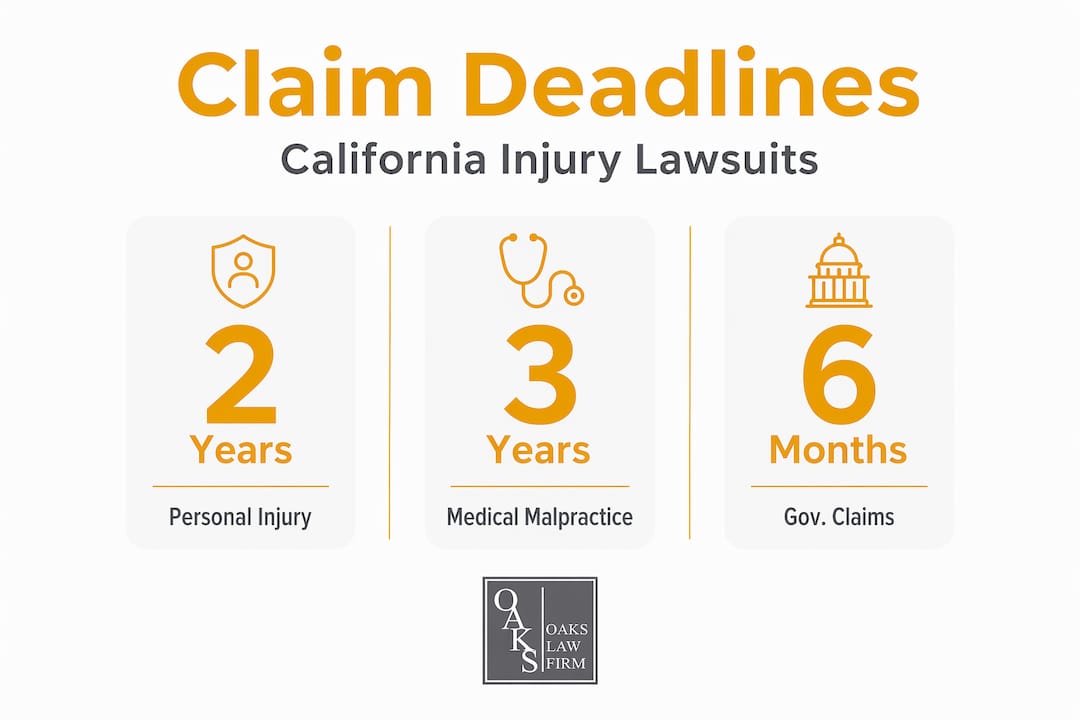
| Standard 2-year deadline | Most personal injury claims in California must be filed within 2 years of the injury date. |
| Government claims move faster | Injuries involving a government entity require a tort claim filed within just 6 months of the incident. |
| Medical malpractice is different | Malpractice claims follow a 3-year or 1-year-from-discovery limit, whichever comes first. |
| Negotiations don’t stop the clock | Filing an insurance claim or negotiating with an adjuster does not pause your lawsuit deadline. |
| Minors get extended time | California tolls the statute of limitations for minors until they turn 18, giving them until their 20th birthday to file. |
California injury claim time limit: the general 2-year rule
The foundation of the California injury claim time limit is Code of Civil Procedure § 335.1, which sets a two-year statute of limitations for most personal injury claims. That deadline runs from the date the injury occurred. If you were hurt on March 15, 2024, you have until March 15, 2026, to file your lawsuit in court.
This rule covers the most common injury scenarios Californians face every day:
- Car and truck accidents on the 405 or local roads
- Slip and fall accidents at grocery stores, restaurants, or private property
- Dog bite injuries from a neighbor’s or stranger’s pet
- Workplace injuries not covered by workers’ compensation
- Assault and battery claims when a civil suit is pursued separately from criminal charges
Two years sounds like a lot of time. It rarely feels that way once you factor in recovery, medical appointments, insurance negotiations, and the time it takes to find and retain a qualified attorney. The personal injury claim timeline shrinks faster than most people expect.
Pro Tip: Mark the exact date of your injury immediately after seeking medical care. Write it down, put it in your phone, and share it with any attorney you consult. This single date controls your entire filing window.
The court treats the two-year deadline as a hard cutoff. If you file on day 731, a defendant’s attorney will file a motion to dismiss, the court will grant it, and the case ends there. No extensions. No second chances. No hearing on the merits of your claim.
Deadlines that differ by claim type
Not every injury claim follows the same calendar. The personal injury claim timeline shifts considerably depending on who caused the injury and how it happened.
| Claim Type | Deadline | Key Law |
|---|---|---|
| General personal injury | 2 years from injury date | CCP § 335.1 |
| Medical malpractice | 3 years from injury OR 1 year from discovery, whichever is earlier | CCP § 340.5 |
| Government entity injury | 6 months to file government tort claim, then 6 months after denial to sue | Gov. Code § 945.4 |
| Property damage | 3 years from damage date | CCP § 338 |
| Breach of written contract | 4 years from breach | CCP § 337 |
Medical malpractice: the trickier math
Medical malpractice deadlines work on a two-track system under Code of Civil Procedure § 340.5. You have three years from the date of the negligent act or one year from the date you discovered the injury, whichever deadline arrives first. So if a surgeon leaves a foreign object in your body and you discover it 18 months later, your one-year discovery clock has already started running. Waiting another full year after discovery would likely put you past the three-year wall.
Government entity claims: the shortest window
This is where people get blindsided most often. If your injury was caused by a city bus, a pothole the city failed to repair, or a government employee acting in their official capacity, the California claim filing deadline shrinks sharply. Government Code § 945.4 requires that you file a formal government tort claim within six months of the incident. That is not six months to file a lawsuit. It is six months to complete a separate administrative process before you can even think about suing. After the government denies your claim, you have another six months to file the actual lawsuit.

Miss the six-month tort claim deadline, and you are legally barred from pursuing the lawsuit entirely.
Minors and the tolling rule
California tolls the statute of limitations for minors until the child turns 18. A child injured in an accident has until their 20th birthday to file a personal injury claim. This sounds protective, but it creates a practical problem: memories fade, witnesses move away, and evidence deteriorates over years. Earlier action almost always leads to better outcomes, even when tolling technically allows more time.
When does the statute of limitations clock actually start?
For most acute trauma cases, like a car crash or a slip and fall, the clock starts on the injury date itself. You do not get extra time because you were in the hospital, or because you did not realize how serious the injury was until weeks later. The law assumes you knew you were injured at the moment of impact.
The significant exception to this rule is the discovery rule.
How the discovery rule works
The discovery rule delays the start of the clock to the date when you knew or reasonably should have known about both the injury and its cause. This doctrine exists because some injuries are genuinely invisible at first. Common applications include:
- Toxic exposure cases where symptoms develop over months or years
- Medical malpractice involving internal surgical errors that produce no immediate symptoms
- Latent occupational diseases caused by prolonged exposure to harmful substances
- Cases where a healthcare provider actively concealed a negligent act
The discovery rule is a real and meaningful protection. However, it is also frequently misunderstood. Courts do not simply take your word that you did not know about the injury. They ask what a reasonable person in your situation would have discovered through ordinary diligence. If your symptoms were visible and a reasonable person would have connected them to a cause, the clock may have started running even if you personally did not make that connection.
Pro Tip: If you believe the discovery rule applies to your case because your injury was not immediately apparent, consult an attorney as soon as you suspect a connection between your condition and a potential cause. Do not wait for a medical confirmation before calling.
Tolling is not automatic in most situations. It depends on specific, provable facts. Minority status triggers tolling by law. Other circumstances, like fraud or deliberate concealment by the defendant, require you to demonstrate those facts in court. You cannot simply assert that you did not know and expect the court to extend your deadline without evidence.
Waiting for medical test results, waiting to see how your injuries develop, or waiting until you feel ready to pursue a claim do not pause the statute of limitations clock. That clock runs on the calendar, not on your recovery.
What happens when you miss the deadline
Missing the California injury claim time limit produces a single, predictable outcome: the court dismisses your case. The defendant’s attorney files a motion based on the statute of limitations, the judge grants it, and you walk away with nothing. No settlement. No trial. No compensation for your medical bills, lost income, or pain and suffering.
Missing the deadline typically results in permanent dismissal, with exceptions only in rare fraud or concealment cases that require specific and substantial proof. California courts do not grant general good cause extensions just because you were still negotiating with an insurance company or waiting on a settlement offer.
Here is the part that surprises most people: filing an insurance claim, negotiating with an adjuster, or hiring an attorney does not pause or stop the statute of limitations. This is one of the most dangerous assumptions injured people make. You can be deep in active settlement negotiations, exchanging offers with an insurer, and believe your claim is being handled. Then the two-year deadline passes, the insurer discovers the lapse, and your leverage evaporates overnight.
Here is how to protect yourself:
- Write down your injury date the day it happens. This is the anchor point for your entire legal timeline.
- Do not mistake insurance activity for legal protection. An open insurance claim does not toll the statute of limitations. Only filing a lawsuit or a valid tolling circumstance stops the clock.
- Consult a personal injury attorney well before your deadline. Attorneys need time to investigate, gather records, and build your case before filing. Calling two weeks before your deadline leaves almost no room for proper preparation.
- If in doubt, file the lawsuit. A filed complaint preserves your rights even if settlement talks are ongoing. You can still settle after filing.
- Track your deadline in writing. Put a calendar reminder 90 days before your deadline and another at 30 days as a final warning.
The injury lawsuit time restrictions in California exist to protect both sides. Courts expect claimants to act promptly while evidence is fresh and witnesses are available. The system is not designed to accommodate delays rooted in hope that a settlement will materialize.
Practical steps to file your claim on time
Taking the right steps early makes the difference between a strong case and a forfeited one. Here is a straightforward path from injury to filed lawsuit:
- Seek medical care immediately. Medical records are your claim’s foundation. Gaps in treatment create gaps in your case.
- Document everything. Photograph your injuries, the accident scene, any hazards, and property damage. Collect contact information from witnesses before they disappear.
- Report the incident. File a police report for accidents. Notify a property owner for a premises liability incident. Report to your employer for workplace injuries.
- Identify who caused the harm. This affects your deadline. If a government vehicle hit you, your six-month window started the day of the crash.
- Consult a personal injury attorney early. An attorney can tell you precisely how long to file your injury claim, identify which deadlines apply, and start building your case while evidence is still available.
- Send a demand letter before filing. This opens formal settlement negotiations and signals seriousness to the other party.
- File the complaint in the appropriate court. This is the step that legally protects your claim. Everything before this point is preparation. Understand the full lawsuit filing process so you know what to expect at each stage.
The earlier you start this process, the better positioned you are to negotiate from strength. An injured person who retains counsel six months after an accident typically achieves far better results than one who calls two weeks before the filing deadline.
My take on deadlines as a personal injury attorney
In more than two decades of handling personal injury cases in the and throughout California, I have seen the same mistake repeated more times than I can count. A person gets hurt, does everything right in terms of medical care, and even contacts an insurer right away. Then they wait. They wait because the insurance company is “working on it.” They wait because they do not want to seem aggressive. They wait because they genuinely believe the process is moving forward.
Then the deadline passes. I have had calls from people with strong cases, real injuries, and clear liability who simply ran out of time. Courts do not care how reasonable your delay seemed to you. The California personal injury statute does not include a provision for “I thought the adjuster was handling it.”
What I have learned after handling hundreds of cases is that the discovery rule and tolling exceptions are far narrower than people hope. They are real legal doctrines with real applications, but courts apply them strictly. Counting on an exception to save a late claim is a gamble you are very likely to lose.
My advice is to treat the statute of limitations as if it were non-negotiable. File first and negotiate second. You can always settle a filed case. You cannot un-miss a deadline. The cost of filing a complaint is nothing compared to the cost of losing your right to compensation entirely. If you are even considering whether your injury gives you a claim, call an attorney now. Not when you feel better. Not after the insurance company responds. Now.
— Matthew Nezhad
How Oaks Law Firm protects your claim and your deadline

At Oaks Law Firm, one of the first things we do when we take on a case is identify every applicable deadline and lock it into our case management system. Attorney Matthew Nezhad and his team have spent decades helping injured people in the and throughout California avoid the one mistake that cannot be undone: missing the filing window.
Whether you were hurt in a car accident, a slip and fall, or a workplace incident, our team can assess your situation quickly and tell you exactly where you stand on the California injury claim duration. We also walk you through the full car accident compensation process so you understand what you may be entitled to recover. If you have been injured and are unsure how much time you have left to act, do not guess. Contact Oaks Law Firm today for a free case evaluation and let us make sure your right to compensation is protected before the clock runs out.
FAQ
What is the general time limit for injury claims in California?
Most personal injury claims in California must be filed within two years of the injury date under Code of Civil Procedure § 335.1. If you miss this deadline, the court will dismiss your case.
Does filing an insurance claim stop the statute of limitations?
No. Filing an insurance claim or negotiating with an adjuster does not pause or stop the California injury claim time limit. Only filing a lawsuit or a valid tolling circumstance protects your legal rights.
How long do I have to file a claim against a government entity?
You must file a government tort claim within six months of the incident under Government Code § 945.4. After the government denies your claim, you have another six months to file the actual lawsuit.
What is the discovery rule and when does it apply?
The discovery rule delays the start of the statute of limitations to the date you knew or reasonably should have known about your injury and its cause. It applies mainly in cases involving toxic exposure, latent injuries, or concealed medical malpractice.
Can a minor file a personal injury claim after they turn 18?
Yes. California tolls the statute of limitations during minority, so an injured minor has until their 20th birthday to file a personal injury claim.
