

Attorney Advertising. This article was prepared with the assistance of artificial intelligence and reviewed by Oaks Law Firm prior to publication.
Before you can sue a California government agency or public employee for injuries or property damage, you must first file a formal government tort claim. This prerequisite comes from the California Government Claims Act (Gov. Code §§ 810–996.6), and skipping it almost always ends your case before it begins. Under Gov. Code §911.2, you have six months from the date of injury or property damage to file, and one year for most other claim types. Miss that window, and your right to sue is gone unless a court grants a rare exception.
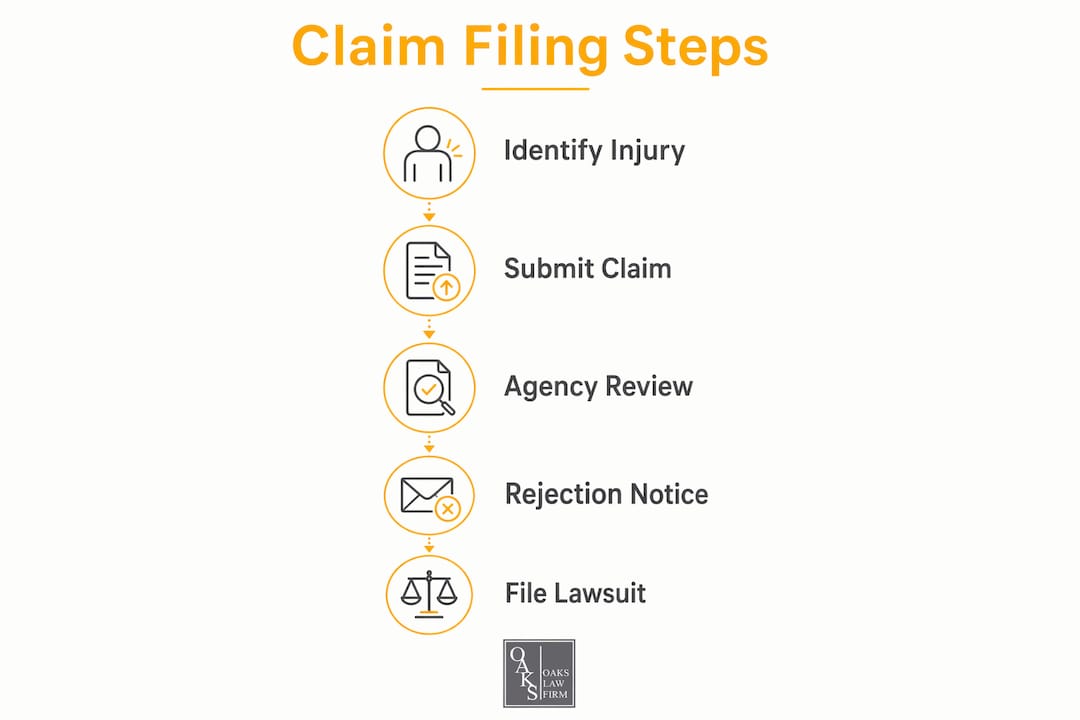
Here is what the process looks like at a glance:
- Identify the government agency responsible for your harm (state, county, city, school district, or public employee’s employer).
- Obtain the correct claim form from that agency or the California Department of General Services for state claims.
- Complete the form with all required information under Gov. Code §910: your name and address, the incident date and location, a description of what happened, and the amount of damages.
- Submit the claim by the applicable deadline, keeping proof of timely filing.
- Wait for the agency’s response, then decide whether to settle or file a lawsuit.
The general two-year statute of limitations under CCP §335.1 applies to personal injury lawsuits, but the six-month government claim deadline under Gov. Code §911.2 cuts that window dramatically when a public entity is involved. Oakslawfirm has guided injured Californians through this process for more than two decades, and the attorneys there will tell you the same thing every time: file early, file completely, and do not assume you have more time than you do.
What the California Government Claims Act actually covers
The law most people still call the “California Tort Claims Act” is now officially the Government Claims Act, a name the California Supreme Court adopted in City of Stockton v. Super. Ct. (2007) to reflect its broader application beyond tort claims alone.
Covered entities include:
- State agencies and departments
- Cities, counties, and special districts
- School districts and community college districts
- Public employees acting within the scope of their employment
Types of claims covered:
- Personal injury (car accidents on public roads, slip-and-falls on government property, police misconduct)
- Property damage
- Wrongful death
- Breach of contract with a public entity (when the contract does not specify its own claim procedure)
Claims generally exempt from the filing requirement:
- Actions seeking injunctions or other non-monetary relief
- Federal civil rights claims under 42 U.S.C. §1983
- Certain tax refund actions
The Act’s core purpose is to give agencies an early chance to evaluate claims and settle legitimate ones before litigation costs mount for both sides. A claim that does not substantially comply with the statutory requirements can be returned as insufficient, which is why getting the details right from the start matters so much.
What are the deadlines for filing a California government tort claim?
The deadlines are strict, and courts rarely bend them.
Under Gov. Code §911.2:
- 6 months from the date the cause of action accrues for personal injury, property damage, wrongful death, and damage to growing crops.
- 1 year from accrual for all other claims, including most contract disputes.
Missing the six-month deadline does not automatically end everything, but it comes close. Under Gov. Code §911.4, you can apply for leave to file a late claim, but that application must be submitted within one year of the incident and must explain the reason for the delay. Agencies deny most late-claim applications, and courts uphold those denials regularly.
After the agency acts on your claim, a second deadline kicks in:
Under Gov. Code §945.6, you have 6 months from the date of a written rejection notice to file a lawsuit. If the agency never responds and the claim is deemed rejected by operation of law after 45 days, you generally have 2 years from the incident date to sue.

Pro Tip: Do not confuse the government claim deadline with the general personal injury statute of limitations. The six-month government claim window is a separate, earlier hurdle that you must clear first.
How to properly file a government tort claim in California
Getting the filing right the first time saves you from scrambling to amend a deficient claim under a ticking clock.
-
Identify the correct agency. If a city bus hit your car, file with the city. If a state highway pothole caused the accident, file with the California Department of Transportation (Caltrans). Filing with the wrong agency does not stop the clock.
-
Obtain the right form. For state claims, use the online Government Claim Form through the Department of General Services (DGS) Office of Risk and Insurance Management. For local agencies, contact the city clerk or the agency’s risk management office. Many smaller local agencies lack online portals, so call ahead.
-
Complete every required field. Under Gov. Code §910, your claim must include:
- Your name, address, and contact information
- The date, time, and location of the incident
- A clear description of the circumstances and how the agency is responsible
- A description of your injuries or property damage
- The dollar amount claimed (if under $10,000, state the exact amount; if over $10,000, indicate whether it would be a limited civil case)
- Your signature
-
Pay the filing fee or request a waiver. State claims submitted to the DGS require a $25 filing fee, which can be waived by submitting a fee waiver affidavit. Local agencies set their own fee structures.
-
Submit and document everything. File by certified mail, in person, or through an online portal where available. Keep your certified mail receipt, the portal confirmation screenshot, or a date-stamped copy of the in-person submission. That proof of timely filing can be the difference between a valid claim and a dismissed lawsuit.
-
Verify agency-specific requirements. Some agencies require original signed paper forms; others accept electronic submissions. Always confirm with the agency before submitting, because a mismatch in format can cause your claim to be returned.
Pro Tip: If your claim is returned as insufficient, the agency must notify you in writing within 20 days and specify the defects. Act immediately to correct and resubmit. Waiting even a few days can push you past the original deadline.
What happens after you file your California government claim
Filing the claim is not the finish line. It is the starting gun for a defined review period.
Under Gov. Code §912.4, the agency has 45 days to respond. Within that window, it can:
- Accept the claim in full and offer payment.
- Reject the claim outright with a written notice.
- Offer a compromise for a reduced amount.
- Return the claim as insufficient with a written notice of defects (must be done within 20 days of receipt).
If the agency does nothing within 45 days, the claim is deemed rejected by operation of law. That automatic rejection is not a technicality to celebrate. It simply means you can now file a lawsuit, but you must track that 45-day window carefully because the subsequent lawsuit deadlines depend on it.
Keep a file of every piece of correspondence from the agency, dated and organized. If the agency sends a rejection notice, note the exact date it was mailed, not the date you received it, since the six-month lawsuit window runs from the date of mailing. Typical outcomes range from a settlement offer (more common for clear-cut property damage claims) to a flat denial (more common for personal injury claims where liability is disputed).
How government immunities affect your claim
Government agencies do not face the same liability exposure as private defendants. California law grants public entities broad immunity from many tort claims, and understanding those immunities helps you assess your claim realistically before investing time and money.
Common immunity defenses agencies raise:
- Discretionary act immunity (Gov. Code §820.2): Public employees are immune for acts involving policy-level judgment and discretion, such as decisions about where to place a traffic signal.
- Design immunity (Gov. Code §830.6): Agencies are immune for injuries caused by a road or property design that was approved in advance by a public official with authority to approve it.
- Recreational use immunity (Gov. Code §831.2): No liability for injuries on unimproved public land open to recreational use.
- Weather condition immunity (Gov. Code §831.5): Agencies are generally not liable for natural conditions like ice or mud on unpaved roads.
Immunity is not absolute. Agencies can be held liable when a dangerous condition of public property caused the injury and the agency had actual or constructive notice of it (Gov. Code §835). They can also be liable for ministerial acts, meaning routine tasks that do not involve policy discretion, and for the negligent acts of public employees in many circumstances.
Knowing which immunities apply to your situation shapes how you draft your claim statement and what evidence you gather. A claim that ignores the likely immunity defense is a claim that gets denied quickly.
Guide to required claim forms for California state and local agencies
The form you use and where you send it depends entirely on which agency you are filing against.
| Agency Type | Where to Get the Form | Filing Method | Fee |
|---|---|---|---|
| State of California (general) | DGS Office of Risk and Insurance Management | Online portal or paper by mail | $25 (waivable) |
| Caltrans (highway damage) | Caltrans District Office | Mail or in person | Varies |
| City agencies | City Clerk or Risk Management Office | Mail, in person, or online (if available) | Varies by city |
| County agencies | County Clerk or Risk Management Office | Mail or in person | Varies by county |
| School districts | District office | Mail or in person | Typically none |
When no official form exists for a local agency, you can submit a written letter that contains all the information required by Gov. Code §910. That letter must be as complete as any printed form. Missing a required element gives the agency grounds to return it as insufficient, which costs you time you may not have.
For state claims, the DGS also offers a paper form for claimants who cannot file online, along with a separate fee waiver request form. Both are available on the DGS website. Always verify the current mailing address with the agency before sending anything, since offices relocate and outdated addresses on legal filings create unnecessary disputes.
Expert legal insight on navigating the California government claims process
The attorneys at Oakslawfirm have handled government tort claims across the and throughout California, and the same patterns come up repeatedly in cases that go sideways.
The most common mistakes claimants make:
- Filing with the wrong agency and losing weeks before realizing the error.
- Leaving the damages section vague, which gives the agency a reason to return the claim as insufficient.
- Waiting until the fifth month to start gathering evidence, then rushing a claim that is missing key details.
- Assuming the six-month deadline is flexible. It is not. Courts have dismissed cases where claimants missed the deadline by a matter of days.
How to build a strong claim from day one:
- Photograph the scene, your injuries, and any property damage immediately after the incident.
- Obtain the police report, incident report, or any government agency report related to the event.
- Collect medical records and bills as they accumulate, and keep a written log of how your injuries affect your daily life.
- Identify any witnesses and get their contact information before memories fade.
- Draft your claim statement with enough factual detail to support every legal theory you might later pursue in court. Facts in the claim must correspond to facts in any subsequent complaint.
The Government Claims Act was designed to give agencies a fair chance to settle legitimate claims early. That same design means a well-documented, clearly written claim puts you in a stronger negotiating position before you ever file a lawsuit. When you are dealing with a government entity, understanding your compensation options from the start shapes how you frame the claim and what you ask for.
Oakslawfirm takes a limited number of cases each year, which means every client gets direct attention from attorney Matthew Nezhad and his team. If you have been injured by a government agency or public employee in the Los Angeles area, a free case evaluation can tell you quickly whether you have a viable claim and how much time you have left to file it.

Injured by a government agency in California? The clock on your claim is already running. Oakslawfirm offers free case evaluations with no obligation, and we handle government tort claims on a contingency basis. Learn more about how car accident compensation works in California, or contact us today to speak with attorney Matthew Nezhad directly.
Key Takeaways
Filing a California government tort claim within the six-month deadline under Gov. Code §911.2 is the mandatory first step before you can sue any public entity for personal injury, property damage, or wrongful death.
| Point | Details |
|---|---|
| Six-month filing deadline | Personal injury, property damage, and wrongful death claims must be filed within 6 months of the incident under Gov. Code §911.2. |
| One-year deadline for other claims | Contract and other non-injury claims against public entities must be filed within 1 year of accrual. |
| Agency response window | The government agency has 45 days to respond; no response means the claim is deemed rejected by operation of law. |
| Lawsuit deadline after rejection | You have 6 months from a written rejection notice, or 2 years from the incident if the claim is deemed rejected, to file suit under Gov. Code §945.6. |
| Complete claims prevent delays | A claim missing required information under Gov. Code §910 can be returned as insufficient, costing you time you cannot afford to lose. |
FAQ
What is a California government tort claim?
A California government tort claim is a formal written notice you must file with a public agency before you can sue it for money damages. It is required under the California Government Claims Act (Gov. Code §§ 810–996.6) for personal injury, property damage, wrongful death, and most contract disputes involving public entities.
How long do you have to file a government tort claim in California?
Under Gov. Code §911.2, you have 6 months from the date of injury or property damage, and 1 year for most other claim types. Missing the deadline generally ends your right to sue.
What happens if you miss the six-month government claim deadline?
You can apply for leave to file a late claim under Gov. Code §911.4, but the application must be submitted within 1 year of the incident and requires a valid reason for the delay. Most late-claim applications are denied, making early filing critical.
Where do you file a government tort claim in California?
For state agencies, file through the California Department of General Services online portal or by mail with a $25 filing fee. For cities, counties, and school districts, file with the agency’s city clerk or risk management office, since each local entity has its own procedure.
Do you need a lawyer to file a California government tort claim?
You are not legally required to have an attorney, but the strict deadlines, completeness requirements, and government immunity defenses make legal guidance highly advisable. An attorney can identify the correct agency, draft a complete claim statement, and protect your right to sue if the claim is denied.
The information in this article is for general informational purposes only and does not constitute legal advice. Reading this article does not create an attorney-client relationship with Oaks Law Firm. Every case is different, and outcomes depend on the specific facts and applicable law. Contact a licensed California attorney for advice about your individual situation. Oaks Law Firm is located in Sherman Oaks and Woodland Hills, California, and serves clients throughout the and the state of California.
