

A bicycle accident claim is a formal legal process that allows injured cyclists to seek financial compensation for injuries and property damage caused by another party’s negligence. Whether the at-fault party is a distracted driver, a government agency responsible for a dangerous road defect, or a bicycle manufacturer, the claim process follows defined legal rules that determine what you can recover, how long you have to act, and what evidence you need to succeed. In California, filing deadlines are strict: two years for private parties and just six months for government entities. Missing those windows ends your right to compensation entirely, regardless of how strong your case is.
What is a bicycle accident claim and what does it cover?
A bicycle accident claim is a demand for compensation filed against the party whose negligence caused your crash and injuries. The legal term used in personal injury law is a negligence-based tort claim, and it requires proving four elements: duty of care, breach of that duty, causation, and damages. Most cyclists think only of the driver’s insurance when they hear “claim,” but the reality is far broader.
Claims can be directed at a driver’s auto insurer, your own uninsured or underinsured motorist (UM/UIM) policy, a city or county responsible for a pothole or missing signage, or even a bike manufacturer if a defective component caused the crash. Multiple insurance layers often apply to a single incident, including the cyclist’s own homeowners or renters policy. That complexity is exactly why many injured cyclists leave money on the table by settling too early or filing against only one party.
California law governs most claims in the and greater Los Angeles area. The California statute of limitations gives you two years from the date of injury to file against a private party and only six months to file a government tort claim. If your crash involved a city-maintained road defect, that six-month clock starts the day of the accident, not when you discover the defect.
What damages and compensation can you recover?
Bicycle accident compensation divides into two categories: economic damages and non-economic damages. Understanding both is critical before you accept any settlement offer.
Economic damages are the measurable financial losses tied directly to the crash:
- Medical expenses, including emergency room visits, surgery, physical therapy, and future treatment costs
- Lost wages for time missed from work, plus reduced earning capacity if your injuries are permanent
- Property damage covering your bicycle, helmet, cycling gear, and any personal items destroyed in the crash
- Out-of-pocket costs like transportation to medical appointments
Non-economic damages compensate for harms that don’t come with a receipt:
- Pain and suffering, both physical and emotional
- Loss of enjoyment of life if you can no longer ride, exercise, or participate in activities you valued
- Emotional distress, anxiety, and post-traumatic stress
- Permanent disfigurement or scarring
One detail most cyclists overlook: a cracked helmet is not just damaged gear. It is physical evidence that directly supports the severity of a head injury claim. Never discard or repair it before your attorney photographs and documents it.
Compensation amounts vary based on injury severity, your share of fault under California’s comparative negligence rules, and the insurance policy limits in play. A driver carrying only California’s minimum liability coverage may not have enough to cover a serious injury, which is where your own UM/UIM policy becomes critical. Nearly one in three bicycle crashes involved a hit-and-run in 2025, meaning the at-fault driver was never identified. Without UM coverage, those victims had no source of compensation at all.
Pro Tip: Before any settlement discussion, get a written projection of your future medical costs from your treating physician. Insurers calculate offers based on current bills. Your attorney calculates them based on lifetime costs.
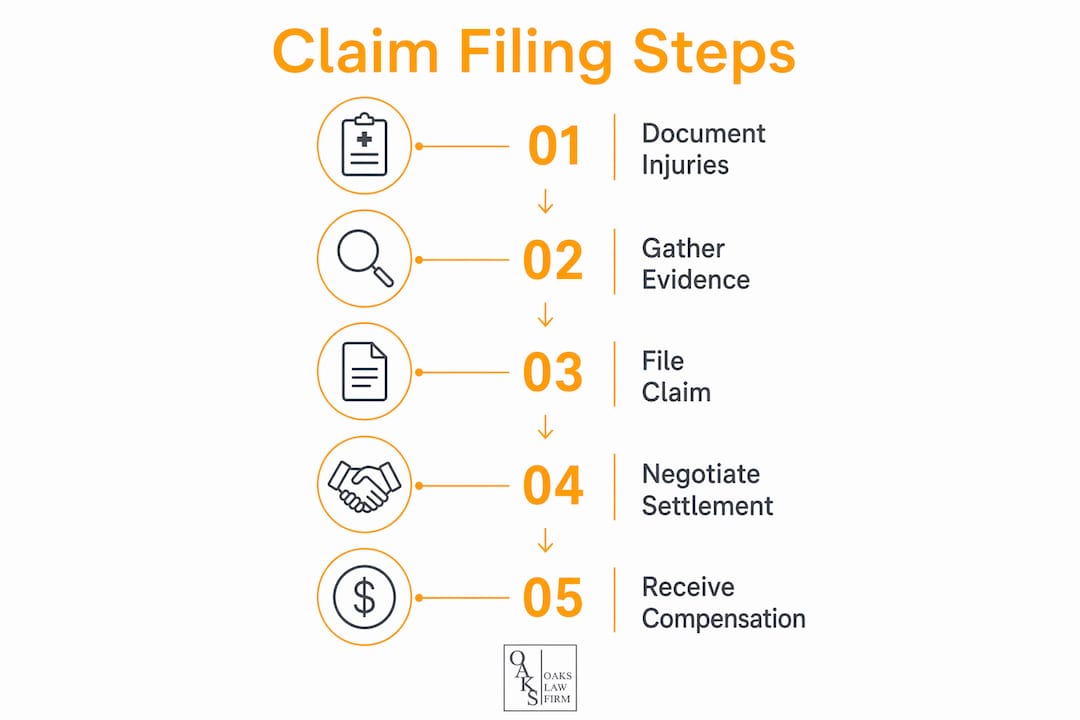
How to file a bicycle accident claim: step-by-step
The claim process for bike accidents follows a predictable sequence, but each step has consequences if handled incorrectly.
Seek medical care immediately. Go to an emergency room or urgent care the same day, even if you feel fine. Gaps between injury and treatment give insurers grounds to argue your injuries were not caused by the crash or were not serious.
Report the accident to police. A police report creates an official record of the incident, documents the scene, and often includes a preliminary fault determination. Request a copy as soon as it is available.
Document everything at the scene. Photograph your bike, your injuries, the road conditions, skid marks, traffic signals, and any vehicle involved. Collect names and contact information from every witness.
File the DMV SR-1 form if required. California law requires filing an SR-1 form with the DMV within 10 days if the crash caused $1,000 or more in property damage or any injury. Missing this deadline can complicate your claim.
Notify your own insurance company. Report the accident to your insurer promptly, even if the other driver was at fault. Failure to notify can void coverage you may need later.
File the claim against the at-fault party’s insurer. Submit a formal demand letter with your documented damages, medical records, and evidence of fault. This opens the negotiation process.
Negotiate or litigate. Between 90% and 95% of personal injury cases settle before trial. Most bicycle accident claims resolve through negotiation, but you need to be prepared to file a lawsuit if the insurer refuses a fair offer.
Consult a personal injury attorney early. An attorney can identify all liable parties, calculate full damages, and handle insurer communications so you do not inadvertently damage your claim.
Pro Tip: Do not give a recorded statement to the at-fault driver’s insurance company. You are not legally required to, and recorded statements are routinely used to minimize or deny claims.
What evidence is needed to prove fault in a bicycle accident claim?
Proving fault in a cyclist injury claim requires building a documented record that connects the other party’s negligence directly to your injuries. The stronger your evidence, the stronger your negotiating position.

The police report is your foundation. It contains the officer’s observations, diagrams of the crash scene, citations issued, and sometimes a direct fault determination. Insurers and courts treat it as an authoritative starting point.
Medical records are equally non-negotiable. They establish the nature and severity of your injuries, link those injuries to the crash date, and document the treatment required. Any gap between the accident and your first medical visit creates an opening for the insurer to dispute causation.
Physical evidence from the scene includes:
- Photographs and video of the crash location, road defects, skid marks, and vehicle damage
- Your damaged bicycle, helmet, and gear preserved exactly as they were after the crash
- Traffic camera or dashcam footage, which must be requested quickly before it is overwritten
- Witness statements with full contact information
“A cracked helmet is one of the most powerful pieces of physical evidence in a bicycle accident claim. It shows the force of impact in a way that words and medical reports cannot replicate.”
Traffic law violations matter too. Dooring (a driver opening a car door into a cyclist’s path), failure to yield, and unsafe lane changes are all violations that directly establish driver negligence under California Vehicle Code. Document which law was broken and how it caused the crash.
One warning that most cyclists do not anticipate: social media posts can destroy a claim. Insurance adjusters actively monitor claimants’ accounts for photos or posts that suggest the injuries are less severe than claimed. A single photo of you at a social event after the crash can be used to argue you are not suffering as you described.
If your crash involved a road defect, expert testimony from a civil engineer or road safety specialist may be needed to prove the government entity knew about the hazard and failed to fix it.
Common challenges and pitfalls in bicycle accident claims
Most claims do not fail because the cyclist lacked a valid case. They fail because of avoidable mistakes made in the days and weeks after the crash.
The most common pitfalls include:
- Accepting the first settlement offer. Initial insurer offers rarely reflect the full compensation you are owed. Insurers open low because many claimants accept without consulting an attorney.
- Giving a recorded statement. As noted above, insurers use these statements to find inconsistencies that reduce or deny claims. Decline politely and direct them to your attorney.
- Delaying medical treatment. Every day between the crash and your first doctor visit is a day the insurer will use to question whether the crash caused your injuries.
- Posting on social media. Lock down your accounts immediately after an accident. Even innocent posts can be misrepresented.
- Settling before reaching maximum medical improvement (MMI). MMI is the point at which your doctor determines your condition has stabilized. Settling before MMI means you may not know the full extent of your injuries or future treatment costs.
- Missing the statute of limitations. Two years sounds like a long time. It is not, especially when gathering evidence, negotiating with insurers, and managing recovery simultaneously.
California also applies comparative negligence rules, meaning your compensation is reduced by your percentage of fault. If you were found 20% at fault for riding without lights at night, your total award is reduced by 20%. This makes it critical to build the strongest possible case for the other party’s fault before any settlement is reached.
Pro Tip: Do not settle any bicycle accident claim until your treating physician has confirmed you have reached maximum medical improvement. Settling earlier locks in a number that may not cover ongoing treatment, surgery, or long-term disability.
Key takeaways
A bicycle accident claim succeeds when you act quickly, document thoroughly, and refuse to settle before understanding the full scope of your injuries and damages.
| Point | Details |
|---|---|
| File within strict deadlines | Two years for private parties, six months for government entities under California law. |
| Preserve all physical evidence | Keep your damaged helmet and gear intact. They are critical proof of crash severity. |
| Avoid recorded statements | Never give a recorded statement to the at-fault driver’s insurer. It will be used against you. |
| Wait for maximum medical improvement | Do not accept any settlement until your doctor confirms your condition has stabilized. |
| Explore all insurance layers | Claims may involve UM/UIM coverage, homeowners policies, and multiple liable parties beyond the driver. |
What I have learned after years of bicycle accident cases
By Matthew Nezhad, Oaks Law Firm
The single biggest mistake I see injured cyclists make is treating their claim like a simple insurance transaction. They call the at-fault driver’s insurer, describe what happened, accept a check, and move on. Six months later, they are back in surgery with no legal recourse because they signed a release.
What most people do not realize is that bicycle accident claims are often more legally complex than car accident claims. Cyclists have fewer physical protections, which means injuries are typically more severe. More severe injuries mean higher damages, which means insurers fight harder to minimize payouts. The same adjuster who sounds sympathetic on the phone is simultaneously building a file to reduce your claim.
I have also seen how the multiple insurance layers in these cases catch people off guard. A cyclist hit by an uninsured driver in Los Angeles may have coverage through their own auto policy, their homeowners policy, and potentially a separate umbrella policy. Most people do not know to look for those layers, and insurers certainly will not volunteer the information.
The evidence piece is where I have seen the most preventable losses. Cyclists who photograph everything, preserve their gear, and get to a doctor the same day give us far more to work with than those who wait. A cracked helmet sitting in your garage is worth more to your case than a dozen written statements. Physical evidence does not get challenged the way testimony does.
My honest advice: consult a personal injury attorney before you speak to any insurance company other than your own. That consultation costs you nothing and protects everything.
— Matthew Nezhad
How Oaks Law Firm can help with your bicycle accident claim

Oaks Law Firm has spent decades protecting injured cyclists throughout the and greater Los Angeles area. Lead attorney Matthew Nezhad and his team handle every stage of the bicycle accident claims process, from initial injury evaluation and evidence preservation to insurance negotiation and litigation when necessary. The firm accepts a limited number of cases each year, which means every client receives direct, focused attention rather than being passed to a junior associate.
If your crash involved a driver with no insurance or insufficient coverage, the firm’s uninsured motorist legal team has specific experience recovering compensation through UM/UIM claims. There are no upfront fees and no cost unless you win. Contact Oaks Law Firm today for a free case evaluation before the clock runs out on your claim.
FAQ
What is a bicycle accident claim?
A bicycle accident claim is a formal legal demand for compensation filed against the party whose negligence caused a cyclist’s injuries or property damage. It can target a driver’s insurer, a government entity, or a product manufacturer depending on the cause of the crash.
How long do I have to file a bicycle accident claim in California?
California law gives you two years from the date of injury to file against a private party and only six months to file against a government entity. Missing either deadline permanently bars your claim.
Do most bicycle accident claims go to trial?
No. Between 90% and 95% of personal injury cases settle before trial. Most bicycle accident claims resolve through negotiation with the insurer, though having an attorney prepared to litigate significantly strengthens your negotiating position.
Can I claim if the driver who hit me fled the scene?
Yes. If the at-fault driver cannot be identified, you can file a claim through your own uninsured motorist coverage. Nearly one in three bicycle crashes in 2025 involved a hit-and-run, making UM coverage one of the most important protections a cyclist can carry.
Should I accept the first settlement offer from the insurance company?
No. Initial offers from insurers rarely reflect the full value of your claim. Accept only after reaching maximum medical improvement and after consulting a personal injury attorney who can calculate your complete economic and non-economic damages.
This article is provided for general informational purposes only and does not constitute legal advice. The information presented may not reflect the most current legal developments and should not be relied upon as a substitute for consultation with a licensed attorney. Every personal injury case involves unique facts and circumstances, and the outcome of any case depends entirely on those specific facts. Any results, settlement amounts, or verdicts referenced in this content are specific to the individual cases described, are not typical, and do not guarantee, promise, or predict a similar outcome in your case. Reading this content does not create an attorney-client relationship with Oaks Law Firm. Contact us directly for a consultation specific to your situation.
