Two Killed in Five-Vehicle Crash at Inglewood Intersection: What California Law Says About Multi-Car Accidents
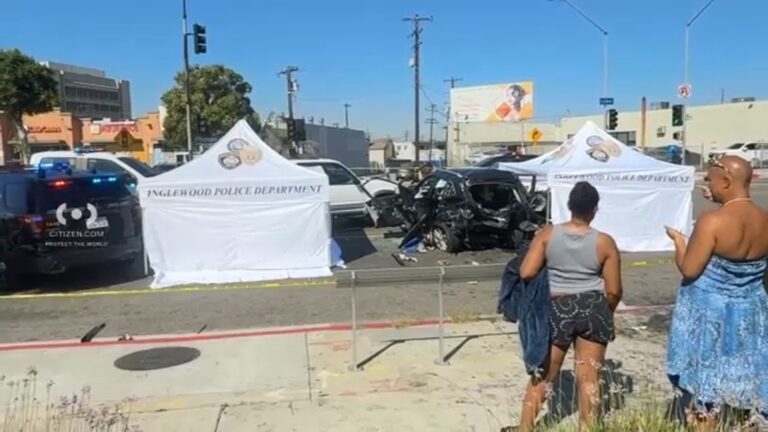
Two people were killed and two others were injured in a violent five-vehicle crash at a busy Inglewood intersection Saturday morning. As reported by ABC7, the collision was reported around 8:45 a.m. at La Brea and Beach avenues, and Los Angeles County firefighters arrived to find at least one person trapped in a car. Two people died at the scene and two others were taken to the hospital, one with critical injuries. A witness described a Tesla traveling at high speed and losing control before striking a pickup truck and then a third vehicle. For the families of those who were killed or hurt, a chaotic multi-car crash raises difficult questions about what happened and who is responsible. This article explains how California law approaches serious and fatal intersection crashes involving multiple vehicles.
Why Are Multi-Vehicle Intersection Crashes So Complex?
A crash involving several vehicles is often far harder to untangle than a two-car collision. When one vehicle loses control and strikes others in quick succession, as a witness described in the Inglewood crash, the sequence of impacts, the speed of each vehicle, and the position of everyone involved all become important, and often disputed, questions. Multiple drivers, multiple insurers, and multiple potential injuries mean there can be several overlapping claims arising from a single event.
Intersection accidents are among the most common sites of serious collisions because they are where paths cross, turning movements happen, and a single error, or a single vehicle traveling too fast, can affect many people at once. When speed is involved, the consequences tend to be far more severe.
Who Can Be Held Responsible in a Multi-Car Crash?
Responsibility depends entirely on the specific facts, and in a multi-vehicle crash it is not unusual for more than one party to bear some share. Depending on what an investigation reveals, potentially responsible parties can include a driver who was traveling at an unsafe speed or lost control, a driver who failed to yield or ran a signal, or, in some circumstances, a party responsible for a vehicle defect or a dangerous condition at the intersection. A witness account of a vehicle traveling well above the speed limit, as described in this crash, can be significant, but it is a starting point for investigation rather than a final conclusion, because physical evidence and vehicle data often tell the fuller story.
Establishing what actually happened usually requires reconstructing the crash from skid marks, vehicle damage, any available video, and data recorded by the vehicles themselves. A car accident lawyer familiar with California law can help sort through these questions.
How Does Speeding Affect Fault in a California Crash?
Driving faster than is safe is one of the clearest forms of negligence under California law. A driver traveling at high speed has less time to react, needs far more distance to stop, and causes much greater harm in any resulting collision. When a speed-related crash injures or kills others, evidence that a driver was traveling at an unsafe speed can be central to establishing responsibility.
That said, fault in a multi-car crash is often shared. California follows a pure comparative negligence rule, which means responsibility can be divided among multiple parties according to each one’s share, and an injured person’s recovery is reduced by their own percentage of fault rather than barred outright. This is one reason it is unwise to accept an early assumption about who was to blame before a full investigation is complete.
What Is a Wrongful Death Claim in California?
When someone dies because of another party’s negligence or wrongful conduct, California law allows certain surviving family members to bring a wrongful death claim. Under California Code of Civil Procedure § 377.60, eligible claimants typically include a spouse or domestic partner, children, and, in some circumstances, other family members who were financially dependent on the person who died. A wrongful death claim addresses the family’s losses, including the loss of financial support, the loss of love, companionship, and guidance, and funeral and related expenses.
California also recognizes a separate survival action, brought on behalf of the decedent’s estate, for certain losses the person experienced before death. Because a crash that kills two people and injures others can give rise to several claims against one or more drivers and insurers, families and injured survivors alike often benefit from speaking with a wrongful death attorney about how these pieces fit together.
How Long Do I Have to File a Claim After a Fatal Crash in California?
For most California personal injury and wrongful death claims, the general statute of limitations is two years from the date of injury or death under California Code of Civil Procedure § 335.1. Missing this deadline can mean losing the right to pursue a claim entirely, so it helps to understand how filing a lawsuit works in California and how the deadline may apply to your circumstances.
There is a significant exception when a claim involves a government entity, for example if a dangerous condition of the intersection, such as a signal malfunction or a visibility hazard, may have contributed. In those cases, the California Government Claims Act (Government Code § 911.2) generally requires a formal written claim to be presented to the public entity within six months of the incident, before any lawsuit can be filed. Because deadlines vary depending on who is responsible and other case-specific factors, it is important to act promptly and confirm your specific deadline with an attorney as soon as possible.
Why Does the Investigation Need to Begin Quickly?
Evidence from a multi-car crash disappears fast. Vehicles are towed and may be repaired or salvaged before they can be examined; skid marks and debris at the intersection are cleared; nearby surveillance or traffic-camera footage may be overwritten within days; and witnesses’ memories fade. In a crash where speed and the exact sequence of impacts are in question, the data recorded by the vehicles and the physical evidence at the scene can be decisive, but only if they are preserved in time. Obtaining the official accident report is often one of the first practical steps, and it becomes even more important when multiple drivers and insurers may point at one another.
What Should Families and Injured Survivors Do After a Crash Like This?
In the immediate aftermath, the priority is medical care and recovery, and, for families, caring for one another and cooperating with the official investigation. When they feel ready, families and injured survivors often find it helpful to keep everything they receive, including the report number, medical records, correspondence from insurers, and records of expenses, and to be cautious when dealing with insurance companies before the facts are established, especially in a multi-vehicle crash where several insurers are involved. Speaking with an attorney early does not commit anyone to litigation; it simply allows them to understand their options before evidence or deadlines slip away.
How Oaks Law Firm Can Help
At Oaks Law Firm, we help injured people and grieving families across Inglewood, Los Angeles, and throughout California understand their rights after serious and fatal crashes, including multi-vehicle intersection collisions. Every situation is different, and the right path depends on the specific facts, including how the crash unfolded and which parties may share responsibility. Contingency fee arrangements, which relate to attorney’s fees, may be available and can be discussed during a consultation; case costs and expenses may be handled separately.
To speak with us about your situation, request a free case evaluation or contact Oaks Law Firm for a consultation specific to your circumstances.
Oaks Law Firm — Office Locations
This article is provided for general informational purposes only and does not constitute legal advice. The information presented may not reflect the most current legal developments and should not be relied upon as a substitute for consultation with a licensed attorney. Every personal injury case involves unique facts and circumstances, and the outcome of any case depends entirely on those specific facts. Any results, settlement amounts, or verdicts referenced in this content are specific to the individual cases described, are not typical, and do not guarantee, promise, or predict a similar outcome in your case. Reading this content does not create an attorney-client relationship with Oaks Law Firm. Contact us directly for a consultation specific to your situation.
