
Pomona Police Pursuit Ends in Fatal Crash: What California Law Says About Injuries and Damage From Police Chases
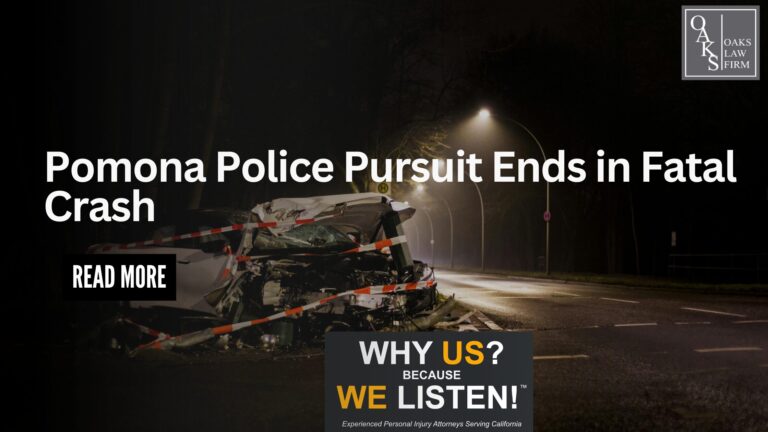
In the early morning hours of Wednesday, July 29, 2026, a high-speed pursuit that began in Victorville came to a devastating end in Pomona. According to reporting by KTLA and statements from the California Highway Patrol, officers began following a sedan that was traveling without headlights, and the driver fled at speeds that at times exceeded 120 miles per hour, crossing from the High Desert into eastern Los Angeles County over a distance of more than 50 miles. The chase ended on Towne Avenue in Pomona, where the driver reportedly lost control after crossing railroad tracks at high speed and struck a tree beside an apartment building. The driver, believed to be a man in his thirties, did not survive. Residents of the building were jolted awake in the middle of the night, and some found themselves unable to move their vehicles afterward.
This was, first and foremost, a tragedy — a person lost his life, and a neighborhood was shaken. Incidents like this one also leave many people in our communities with practical questions: What happens when a police chase causes injuries or property damage to people who had nothing to do with it? Who is responsible? And what deadlines apply under California law? This article addresses those questions generally, for anyone in Pomona, the Inland Empire, Los Angeles County, or elsewhere in Southern California trying to understand their options after a pursuit-related crash.
Who can be harmed when a police pursuit ends in a crash?
High-speed pursuits create risk for far more people than the fleeing driver. Bystanders and other motorists can be struck by a vehicle traveling at extreme speed in a speed-related accident. Pedestrians and cyclists on surface streets are especially vulnerable. Passengers in a fleeing vehicle — who may not have had any control over the driver’s decisions — can be seriously hurt. And, as the Pomona crash illustrates, people who are simply at home can wake up to find a vehicle has crashed into or near their building, damaging cars, fences, landscaping, or the structure itself.
Each of these situations raises different legal questions, and California law treats them differently depending on who was harmed and how. When a pursuit crash results in a death, surviving family members may also have questions about wrongful death claims under California law, which follow their own rules and deadlines.
Can a bystander injured in a California police chase file a claim?
Generally, yes — an innocent bystander, motorist, or pedestrian injured by a fleeing driver may pursue a personal injury claim, most directly against the fleeing driver or that driver’s estate and insurance. A driver who flees from law enforcement at extreme speed is engaging in conduct that California law treats as seriously wrongful, and injured third parties are entitled to seek compensation for their medical expenses, lost income, pain and suffering, and other harms.
There are practical complications, however. Drivers who flee from police are sometimes uninsured or underinsured, and a claim against an individual driver or estate may face real limits on what can actually be recovered. In some situations, an injured person’s own uninsured or underinsured motorist coverage can become an important part of the picture. Sorting out which sources of recovery genuinely exist is one of the areas where an experienced car accident lawyer can make the situation clearer.
Can you sue the police or the CHP for a pursuit crash in California?
This is one of the most fact-dependent questions in California personal injury law, and the honest answer is: it depends heavily on the circumstances. California law gives public agencies significant legal protection in pursuit cases. Under California Vehicle Code section 17004.7, a public agency that has adopted a qualifying vehicle pursuit policy and provides regular training on it is generally immune from liability for injuries caused by a fleeing suspect during a pursuit. Most major law enforcement agencies in California, including the CHP, maintain such policies.
That immunity is powerful, but it is not a blanket rule for every scenario. Whether it applies in a given case can depend on details such as which agency was involved, whether the required policy and training standards were actually met, and exactly how the injuries occurred. These are not questions anyone can answer from a news report. If a government agency’s conduct may be part of a potential claim, the analysis needs to be done carefully — and quickly, for reasons explained below.
What about property damage from a pursuit crash?
Residents whose vehicles, homes, or other property are damaged when a pursuit ends in their neighborhood may also have claims — typically against the fleeing driver or that driver’s insurance, and in some circumstances through their own auto or homeowners coverage. Property damage claims can feel secondary after a fatal crash, but for a family whose only car was crushed in an apartment parking lot, the disruption is real and immediate. Documenting the damage promptly, with photographs and repair estimates, helps preserve the claim regardless of which path it ultimately takes.
How long do I have to file a claim after a police pursuit crash in California?
For most California personal injury claims, the general statute of limitations is two years from the date of injury under Code of Civil Procedure section 335.1. But that general rule has significant exceptions — and the most important one is directly relevant to pursuit cases.
If a claim involves a government entity — such as a city, a county, the CHP or another state agency, a public hospital, or a school district — California’s Government Claims Act generally requires that a formal written claim be presented to that entity within six months of the incident under Government Code section 911.2, before any lawsuit can even be filed. Missing that six-month window can end an otherwise valid claim before it begins. Because pursuit crashes so often involve at least the possibility of a claim touching a public agency, the shorter deadline should be treated as the operating assumption until an attorney confirms otherwise.
Time matters for another reason, too. Evidence in pursuit cases — dashcam and bodycam footage, patrol vehicle data, dispatch recordings, nearby surveillance video, and physical evidence at the scene — can be lost, overwritten, or destroyed quickly. Preserving it promptly matters independent of any filing deadline. No article can tell you your specific deadline; the only reliable way to know how much time you have is to speak with a licensed attorney about your particular situation as soon as possible.
What should I do if I was injured or my property was damaged in a police chase?
A few general steps tend to protect people in this situation. Get medical attention for any injury, even one that seems minor at first — some injuries reveal themselves days later. Photograph damage to vehicles and property before repairs begin. Keep copies of any incident or police report numbers. Write down what you saw and heard while it is fresh. And avoid giving recorded statements to any insurance company before you understand your rights, since early statements to insurers can affect a claim later.
Talk to a California personal injury lawyer about your situation
If you or someone in your family was injured, or your property was damaged, in a pursuit-related crash in Pomona, the Inland Empire, Los Angeles County, or anywhere in Southern California, Oaks Law Firm is available to discuss your situation. A consultation lets you ask questions, understand the deadlines that may apply to your specific circumstances, and decide — without pressure — whether moving forward makes sense for you. Contact Oaks Law Firm to schedule a consultation specific to your situation.
This article is provided for general informational purposes only and does not constitute legal advice. The information presented may not reflect the most current legal developments and should not be relied upon as a substitute for consultation with a licensed attorney. Every personal injury case involves unique facts and circumstances, and the outcome of any case depends entirely on those specific facts. Any results, settlement amounts, or verdicts referenced in this content are specific to the individual cases described, are not typical, and do not guarantee, promise, or predict a similar outcome in your case. Reading this content does not create an attorney-client relationship with Oaks Law Firm. Contact us directly for a consultation specific to your situation.
