Four Killed in Fiery Head-On Crash on Highway 58 Near Edison: How California Law Approaches Cross-Median Crashes and Post-Collision Fires
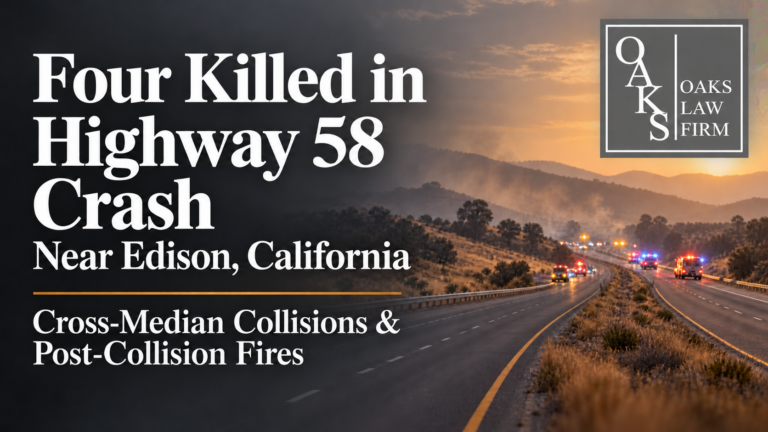
Four people were killed Monday morning in a head-on collision on Highway 58 east of Edison Road, near Bakersfield, when both vehicles caught fire after impact. As reported by KBAK/KBFX, the California Highway Patrol said its preliminary investigation found that the driver of an eastbound Hyundai Tucson veered left, crossed the center divider, and collided head-on with a westbound Toyota Corolla carrying a driver and two passengers. Both vehicles became fully engulfed in flames with all occupants trapped inside; all four people were pronounced dead at the scene. The CHP said the reason the Hyundai crossed over remains under investigation, and it is unknown whether alcohol or drugs were factors. The Kern County Coroner’s Office has begun identifying the victims, and the CHP has asked anyone with information to contact its Bakersfield Area office.
For four families, this is a devastating loss, and the legal questions will matter far less than the grief for a long while. When those questions do come, two features of this crash raise issues that California law treats with particular care: a vehicle crossing a center divider into oncoming traffic, and fire following the collision. This article explains both.
What Does a Cross-Median Crash Mean Legally?
When a vehicle crosses into oncoming lanes, the first question is why — a medical emergency, impairment, fatigue, distraction, a tire or mechanical failure, or an evasive maneuver forced by another vehicle each point in different legal directions, and the CHP has not yet answered that question here. The second question is one many families never think to ask: what stood between the two directions of travel? California’s highways are designed and maintained by public agencies, and where a crossover crash occurs, the presence, type, and adequacy of the median barrier for that stretch of highway can be a legitimate part of the investigation. Highway 58 through this corridor carries heavy traffic, including substantial truck traffic, and whether a divider was reasonably designed for foreseeable crossover risk is a fact question that has been central in other California cross-median cases. If a dangerous condition of public property is alleged, the California Government Claims Act (Government Code § 911.2) generally requires a formal written claim within six months of the crash — a much shorter window than the two-year statute of limitations that governs most California wrongful death claims under Code of Civil Procedure § 335.1.
None of this presumes the roadway played any role here. It means only that in a crossover fatality, the roadway is among the things a thorough investigation examines, and the deadline attached to that possibility is the shortest one running.
Why Does Post-Collision Fire Matter to the Legal Analysis?
Fire after a crash is not always just a consequence of impact severity. California product liability law recognizes claims based on crashworthiness — the principle that vehicles must be reasonably designed not only to avoid crashes but to protect occupants when crashes happen, including against fuel-fed fires and doors or structures that trap occupants. Whether a post-collision fire reflects a design or manufacturing defect, or simply the physics of a severe head-on impact, is an engineering question that can only be answered by examining the vehicles. That is why preservation matters so much in a fire case: the burned vehicles themselves are the evidence, and once they are salvaged or destroyed, the question usually can never be answered. Families weighing their options benefit from acting on preservation early — well before the CHP’s completed accident report arrives — and from understanding how filing a lawsuit works so the parallel deadlines stay visible. As in any multi-fatality crash, claims may also proceed against a deceased driver’s estate through applicable insurance, and early conversations with insurers deserve the caution our guidance on dealing with insurance companies describes.
What Should the Families Know Right Now?
Only what keeps their options open. The CHP investigation and the coroner’s process will take time, and nothing requires families to have answers — about impairment, about the crossover, about the fire — before preserving the right to seek them. The steps are few: obtain the report when it issues, keep every record, request preservation of the vehicles before disposition, and confirm which deadlines apply to their circumstances, since the six-month government claim window, the two-year wrongful death period, and estate claim timelines can all run at once from a single crash.
Our deepest condolences to the families and loved ones of the four people who lost their lives on Highway 58.
Oaks Law Firm | Attorney: Matthew Nezhad | Main Office: 15233 Ventura Blvd, 5th Floor, Sherman Oaks, CA 91403 | (877) 539-5366 | OaksLawFirm.com
Why Us? Because We Listen!™
This article is provided for general informational purposes only and does not constitute legal advice. The information presented may not reflect the most current legal developments and should not be relied upon as a substitute for consultation with a licensed attorney. Every personal injury case involves unique facts and circumstances, and the outcome of any case depends entirely on those specific facts. Any results, settlement amounts, or verdicts referenced in this content are specific to the individual cases described, are not typical, and do not guarantee, promise, or predict a similar outcome in your case. Reading this content does not create an attorney-client relationship with Oaks Law Firm. Contact us directly for a consultation specific to your situation.
