Attorney Advertising. This article was prepared with the assistance of artificial intelligence and reviewed by Oaks Law Firm prior to publication.
No, in most cases you cannot sue a bar, restaurant, or party host for injuries an intoxicated adult caused you in California. State law shields alcohol servers and social hosts from civil liability, with two narrow exceptions involving minors. If you were injured, you generally have two years to file suit under Civil Code section 335.1, or six months to file a claim against a government entity under Government Code section 911.2.
TL;DR:
- Most alcohol servers and social hosts in California cannot be sued for injuries caused by intoxicated adults unless a minor was served alcohol while visibly intoxicated.
- The only legal exceptions involve serving a visibly intoxicated minor at a licensed establishment or knowingly furnishing alcohol to a minor at a private party.
- Proving causation is challenging, especially outside these narrow exceptions, since courts treat alcohol consumption, not serving, as the legal cause of harm.
- Evidence preservation is critical, as surveillance footage and witness statements can disappear quickly and influence whether claims succeed.
- Time limits are strict, with two years to file most claims and only six months to submit a government claim for injuries involving public venues.
Table of Contents
- What California’s Dram Shop Liability Laws Actually Say
- Criminal Charges, ABC Discipline, and Civil Lawsuits Are Three Different Things
- The Two Real Exceptions: When Minors Are Involved
- Why Proving Proximate Cause Is the Hardest Part
- What to Do Right Now if You Were Hurt
- How Oaks Law Firm Screens Dram Shop Claims
- Why Realistic Expectations Matter Here
- Talk to Oaks Law Firm Before Evidence Disappears
- Sources
- FAQ
What California’s Dram Shop Liability Laws Actually Say
Most states hold bars and restaurants financially responsible when they overserve a customer who later hurts someone. California went the opposite direction. In 1978, the legislature rewrote Civil Code section 1714 and Business and Professions Code §25602 specifically to reverse a string of California Supreme Court rulings, including Vesely v. Sager and Bernhard v. Harrah’s Club, that had allowed injury victims to sue alcohol servers.
Lawmakers decided that drinking the alcohol, not serving it, is the legal cause of any resulting harm. That single policy choice is why California dram shop liability looks so different from states like Texas or New Jersey, where dram shop statutes impose broad server responsibility.
The statutory framework breaks down into three pieces:
- Civil Code §1714(b) and ©: No server, whether a licensed business or a private individual, is civilly liable for furnishing alcohol to someone who then causes injury, because the legislature treats consumption as the sole proximate cause.
- Business and Professions Code §25602: Makes it a criminal misdemeanor to serve an obviously intoxicated person, but the statute explicitly states this criminal provision does not create civil liability on its own.
- Business and Professions Code §25602.1: Carves out the one real exception. It lets an injured party sue a licensed seller, or a person authorized to sell alcohol on a military base, who serves an obviously intoxicated minor.
Civil Code §1714(d) extends a parallel, narrower duty to private hosts who knowingly give alcohol to someone under 21. Outside those two carve outs, the general rule of immunity controls.
Criminal Charges, ABC Discipline, and Civil Lawsuits Are Three Different Things
A bartender who keeps pouring drinks for a visibly drunk customer can face real consequences, just not necessarily a lawsuit from the person that customer later injures. It helps to separate three tracks that often get lumped together.
Criminal exposure comes from Business and Professions Code §25602 (serving an obviously intoxicated person) and §25658 (serving a minor). Both are misdemeanors that can carry fines, up to six months in county jail, community service, and mandatory alcohol server training.
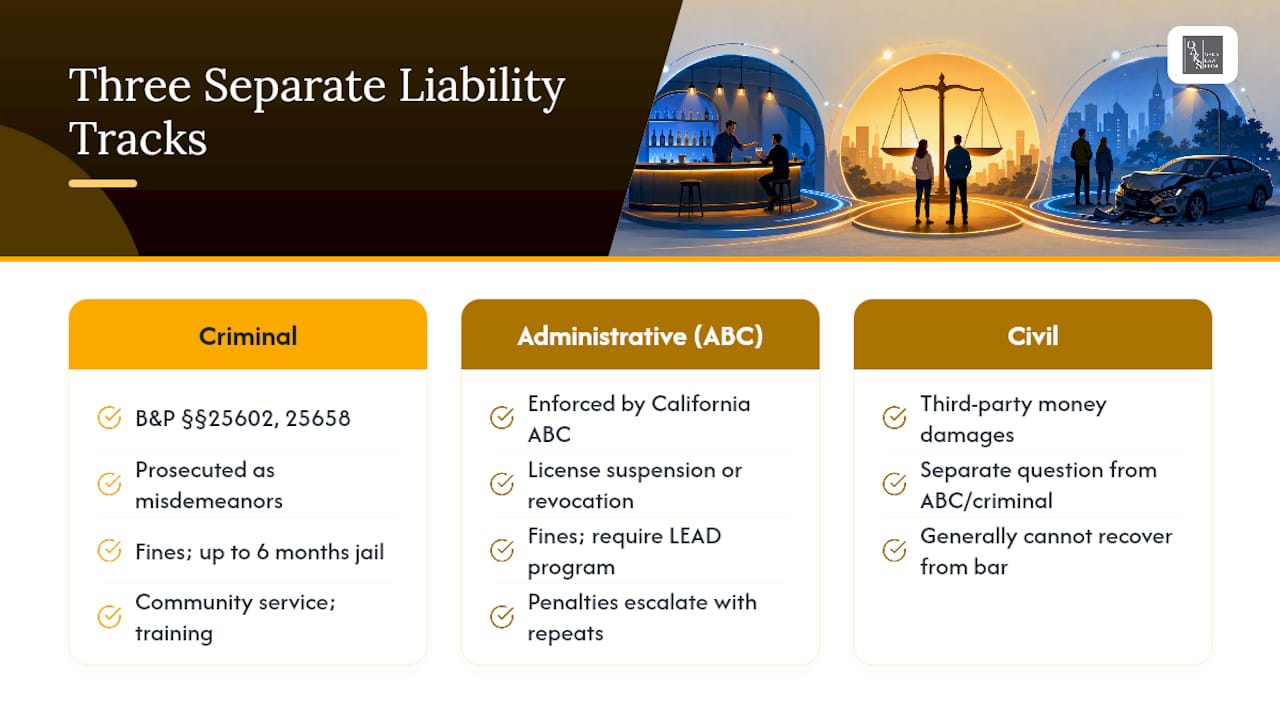
Administrative discipline runs through the California Department of Alcoholic Beverage Control. The ABC can suspend or revoke a liquor license, impose fines, or require a licensee to complete a Licensee Education on Alcohol and Drugs (LEAD) program after violations.
Civil liability is the separate question of whether an injured third party can collect money damages. Here’s the practical disconnect: a bar can get cited criminally and lose its license temporarily for serving an obviously intoxicated adult, and the person that customer later hits with a car still generally cannot sue the bar. The ABC’s disciplinary authority exists independently of civil recovery.
A licensee found serving an obviously intoxicated patron faces license suspension periods that typically escalate with repeat violations, according to ABC enforcement guidance, regardless of whether any civil suit ever gets filed.
The Two Real Exceptions: When Minors Are Involved
Nearly every viable dram shop claim in California traces back to one of two statutory carve outs, and both hinge on the person served being under 21.
-
A licensed seller serves an obviously intoxicated minor (Bus. & Prof. Code §25602.1). To win, you need to show three things: the defendant held a liquor license or sold alcohol on a military installation, the person served was both a minor and visibly intoxicated at the time of service, and that furnishing was a proximate cause of the injury or death. “Obviously intoxicated” is an objective standard: slurred speech, stumbling, bloodshot eyes, or an inability to stand steady, not a subjective guess about how much someone had to drink.
-
A private host knowingly furnishes alcohol to a minor (Civil Code §1714(d)). This applies to someone hosting a party at their home, not a licensed business. The key word is “knowingly.” Prosecutors and plaintiffs’ attorneys look for direct evidence that the host knew the guest’s age, such as checking an ID and serving anyway, or being told outright that a guest was 17.
Both exceptions live or die on evidence gathered close to the time of the incident. Surveillance footage from the bar’s entrance or point-of-sale system, itemized drink receipts tied to a specific patron, text messages between party guests referencing someone’s age, server or bartender testimony, police reports from the scene, and statements from other witnesses at the bar or party all matter here.
Pro Tip: If you believe a minor was served at a licensed establishment, request that the venue preserve its surveillance footage in writing as soon as possible. Many systems overwrite recordings within days, and a spoliation letter from an attorney can be the difference between having proof and having none.
Why Proving Proximate Cause Is the Hardest Part
Even inside the narrow §25602.1 exception, plaintiffs still have to connect the dots between the serving and the specific harm, and that link is where most claims fall apart.
The 1978 amendments didn’t just limit who can be sued. They also reshaped how courts think about causation. In Strang v. Cabrol, the California Supreme Court applied the post-1978 statutory scheme narrowly, reinforcing that consumption of alcohol, not the act of furnishing it, is treated as the legal cause of resulting harm in cases outside the minor exceptions. Courts have followed similar reasoning in cases like Cory v. Shierloh, consistently rejecting broader foreseeability arguments that plaintiffs try to raise, such as claiming a bar “should have known” a patron would drive drunk.
That’s why “the bartender kept serving someone who was obviously drunk” usually isn’t enough on its own, even when it’s true and even when it violates §25602 criminally. The plaintiff still needs the minor-specific facts §25602.1 requires, or private-host knowledge under §1714(d), plus a fairly direct chain from the service to the injury.
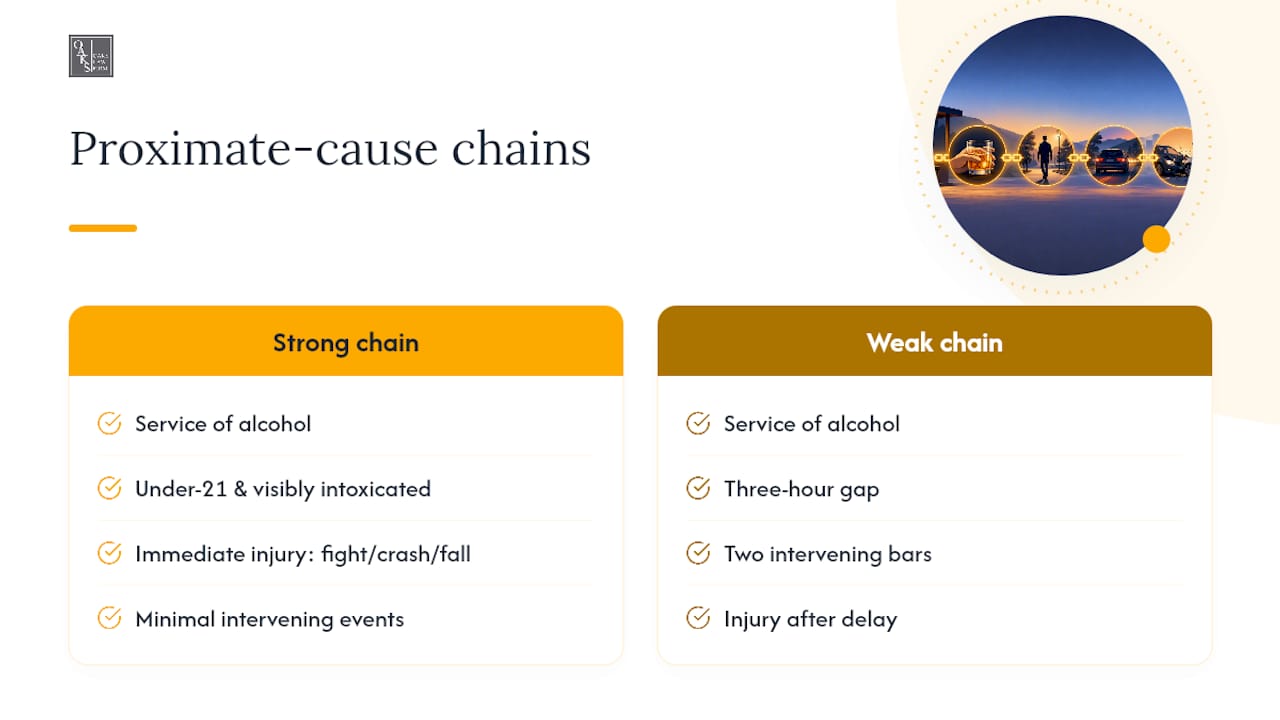
Claims tend to succeed when there’s clear proof the person served was under 21 and visibly intoxicated at the moment of service, and when the injurious act, a fight, a car crash, a fall, happened close in time to that service with minimal intervening events. A three-hour gap and two more bars in between makes that chain much harder to prove.
What to Do Right Now if You Were Hurt
Time works against you in these cases twice over: evidence disappears fast, and legal deadlines are unforgiving.
- Know your deadlines. California’s general personal injury statute of limitations gives you two years from the date of injury to file suit under CCP §335.1. If a government entity is potentially involved, such as a municipally owned venue, you must file a government claim within six months under Government Code §911.2, a much shorter window with its own exceptions for minors and incapacity.
- Preserve evidence immediately. Call the police to create an official report, photograph your injuries and the scene, get names and phone numbers from witnesses, and request that any bar or venue preserve surveillance video before it’s automatically deleted.
- Understand who gets sued first. In nearly every case, the intoxicated individual who caused the harm is the primary defendant. A bar, restaurant, or private host only gets added to the suit when the facts clearly support one of the two minor-related exceptions.
Pro Tip: Don’t wait to see if you “have a real case” before preserving evidence. Send a preservation request to the venue and file the police report within days, not weeks. The legal analysis of whether §25602.1 applies can happen later; the surveillance footage cannot be recovered once it’s overwritten.
How Oaks Law Firm Screens Dram Shop Claims
Because California’s civil exceptions are so narrow, an initial consultation typically starts with a few pointed questions: How severe is the injury? Was the person served under 21, and were there visible signs of intoxication at the time? Was the defendant a licensed seller, a military base vendor, or a private host, and what evidence exists to prove knowledge or obvious intoxication?
At intake, gathering the police report, medical records, any available surveillance footage, and witness contact information early matters, since these details often determine whether a claim fits within §25602.1 or Civil Code §1714(d). Oaks Law Firm works on a contingency-fee basis, meaning there’s no upfront cost and no fee unless the case results in a settlement or award, and offers a free case evaluation for California residents, with offices in Sherman Oaks and Woodland Hills.
Why Realistic Expectations Matter Here
California’s alcohol liability laws are stricter on plaintiffs than most people assume. Immunity is the rule, and the minor-related exceptions under §25602.1 and Civil Code §1714(d) are genuinely narrow. That doesn’t mean a claim is hopeless. It means the facts, and how fast evidence gets preserved, decide everything. Reach out before assuming you have no options, but expect an honest answer, not a promised outcome.
Talk to Oaks Law Firm Before Evidence Disappears
If you were hurt by an intoxicated driver or in an incident tied to alcohol service in California, figuring out who can actually be held responsible takes a careful look at the specific facts, not a guess. Oaks Law Firm reviews these cases at no cost and works on contingency, so you pay nothing upfront and owe a fee only if your case results in a settlement or verdict.
Bring what you have to your free consultation: the police report, photos of the scene and your injuries, medical records, contact information for any witnesses, and any receipts or documentation tied to where the alcohol was served. If your injury involved a drunk driver, our drunk driving accident attorneys can also walk you through how liability and compensation typically work in those cases. Criminal charges sometimes run alongside a civil claim, and if you’re navigating a DUI with injury charge and its bail implications, understanding that parallel process can help you make sense of the bigger picture. Ready to find out where you stand? Visit our guide on how to file a personal injury lawsuit in Los Angeles and schedule your free case evaluation today.
This article is general information, not a substitute for advice from a qualified lawyer. Consult a qualified legal professional about your own circumstances before acting on anything here.
Sources
- Civil Code section 1714
- Business and Professions Code section 25602.1
- ABC: Laws and liability / licensee education
- Strang v. Cabrol (California Supreme Court opinion)
FAQ
What states have dram shop liability?
Most states, including Texas, New Jersey, and Florida, allow broader civil suits against alcohol servers. California is more restrictive, limiting civil claims to cases involving minors under §25602.1 and Civil Code §1714(d).
What does dram shop liability cover in California?
It covers a narrow scenario: a licensed seller or military base vendor who furnishes alcohol to an obviously intoxicated minor, where that service is a proximate cause of injury or death. It does not cover most claims involving intoxicated adults.
Who can sue under California’s dram shop statute?
Anyone injured or the family of someone killed as a result of a minor being served alcohol while obviously intoxicated by a licensed seller can potentially sue under §25602.1, provided they can prove the statutory elements.
Who is the third party in a dram shop liability lawsuit?
The third party is the injured person, someone other than the intoxicated individual and the seller or host, such as a pedestrian, passenger, or bystander harmed by the intoxicated minor’s actions after being served.
Can I sue a private host for a party injury in California?
Only if the host knowingly furnished alcohol to a minor under Civil Code §1714(d). Adult social hosts generally have the same broad immunity as licensed businesses under the state’s general rule.
This article provides general information about California law and does not constitute legal advice. Reading this article does not create an attorney-client relationship with Oaks Law Firm. Laws change, and outcomes depend on the specific facts of each case. For advice about your situation, contact Oaks Law Firm for a free case evaluation.
