

Attorney Advertising. This article was prepared with the assistance of artificial intelligence and reviewed by Oaks Law Firm prior to publication.
Total loss and diminished value are not the same claim, and you usually cannot pursue both on the same car. If your insurer totals the vehicle, they pay its actual cash value and take ownership of the wreck, so your job is making sure that payout is fair. If they repair the car and you keep it, you may have a separate diminished value claim for the resale value that repair history costs you. State rules and the strength of your evidence decide how far either claim goes.
TL;DR:
- Insurers may undervalue your car through comparison data from distant markets, which can lower your actual cash value below the car’s true market worth.
- Diminished value claims are limited mainly to cars that are repaired and kept; they are generally unavailable if your car is declared a total loss.
- State rules on total loss thresholds and diminished value claims vary widely, making local regulations and policy language crucial to understanding your options.
- Challenging low offers involves documenting damage and repairs, gathering local sale comparables, and obtaining independent appraisals to support higher valuations.
- Legal help is most beneficial when disparities are large, liability is contested, or insurance companies delay, with contingency-based attorneys like Oaks Law Firm providing free initial evaluations.
Table of Contents
- Diminished Value vs Total Loss: What’s the Real Difference?
- What Is Diminished Value and How Is It Calculated?
- Which Situations Qualify for Which Claim?
- How Do State Rules Change Your Claim?
- How to Challenge a Low ACV Offer or File a Diminished Value Claim
- Is Pursuing Diminished Value Worth the Cost?
- What California Law Says About These Claims
- What Actually Moves the Needle in These Disputes
- When to Bring in Oaks Law Firm for a Disputed Claim
- Sources
- FAQ
Diminished Value vs Total Loss: What’s the Real Difference?
A total loss happens when repair costs approach or exceed what the car was worth right before the crash. Actual cash value, or ACV, is that pre accident market value, and it’s what the insurer pays out once they declare the vehicle a total loss and take the salvage.
Here’s where a lot of drivers get burned: insurers often lean on vendor databases and “comparable” listings pulled from wherever, not necessarily your neighborhood, to land on a lower ACV number. Those comparables can skip options your car actually had, overstate mileage, or pull from a soft market three states away.
Once a total loss is confirmed, a few things happen fast:
- The insurer takes the salvage title and the wrecked vehicle.
- You receive ACV minus your deductible, unless the collision payment already reflects that.
- If you owed more on the car than it was worth, gap coverage (if you carry it) covers the difference.
- Your claim closes once payment clears. There’s no vehicle left to file a diminished value claim on.
Before you sign anything, photograph the car from every angle, save your last service records, and write down the exact trim, mileage, and options. That paperwork becomes your leverage if the ACV number looks light.
What Is Diminished Value and How Is It Calculated?
Diminished value is the drop in resale value your car suffers after an accident and repair, even when the repair is done well. A car with a collision on its history report sells for less than an identical car with a clean one. That gap is the claim.
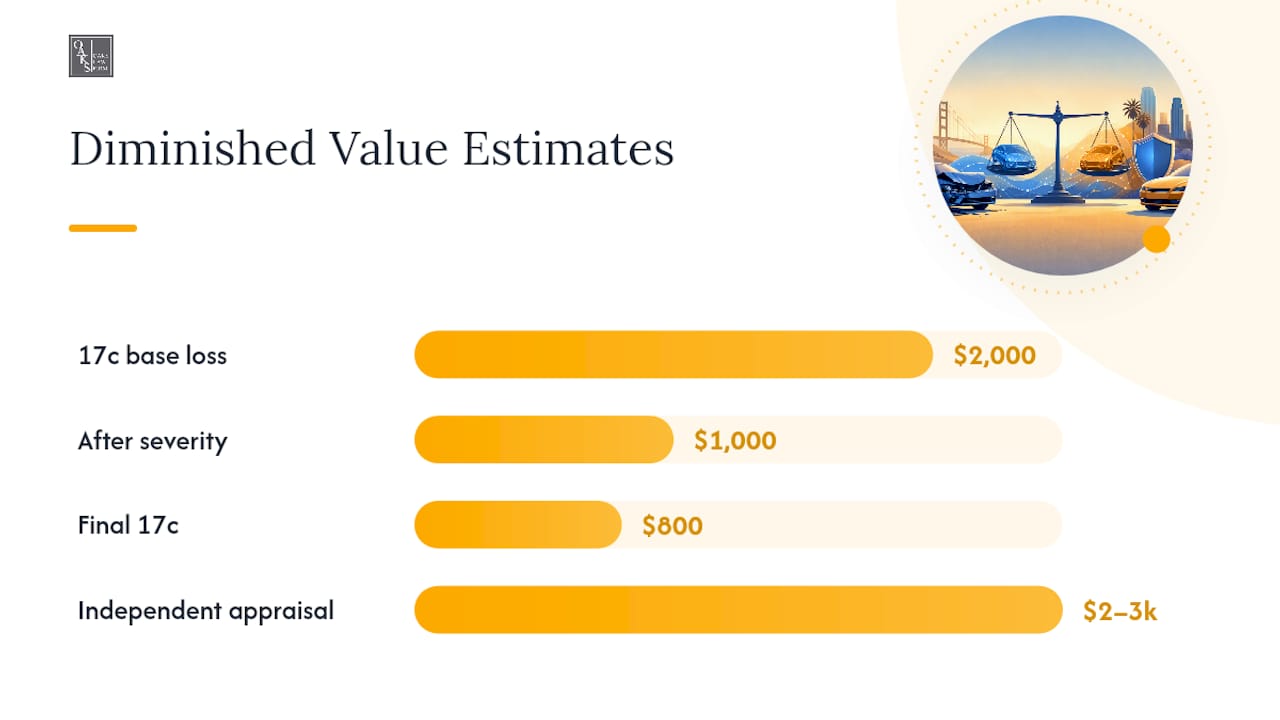
Insurers frequently size that gap using a formula nicknamed “17c.” It starts with the car’s base value, applies a flat percentage (often around 10%), then knocks that number down further with multipliers tied to damage severity and mileage. The result: a payout that’s frequently smaller than what an independent appraisal would support, because 17c isn’t a legal requirement. It comes from a Georgia court case, and insurers use it internally as a conservative guideline, not a rule you’re bound to accept.
A rough worked example shows the gap:
- Car’s pre-accident value: $20,000.
- 17c base loss (10%): $2,000.
- Damage severity multiplier (moderate damage, say 0.5): reduces the base to $1,000.
- Mileage multiplier (moderate mileage, say 0.8): final 17c estimate around $800.
- An independent appraisal using actual local sale comparables might put the real loss closer to $2,000 to $3,000.
Who can file depends on fault. If another driver hit you, you generally file a third-party diminished value claim against their insurer. If you’re at fault, most states, California included, don’t require your own insurer to pay your diminished value under your own policy. Rules vary enough by state that it’s worth checking your specific policy language before assuming either way.
Which Situations Qualify for Which Claim?
The dividing line is simple: did you keep the car?
- Repaired and kept: you may have a diminished value claim, since the car’s resale value took a hit even after quality repairs.
- Totaled: you get an ACV settlement instead, and diminished value generally isn’t available because there’s no vehicle left to devalue.
- Salvage buyback or rebuilt title: if you buy back your totaled car and repair it yourself, you’re now dealing with a branded title, which tanks resale value on its own and complicates any future diminished value argument.
- A second accident: prior damage history, whether from this crash or an earlier one, gets factored into any future ACV or diminished value calculation, often lowering both.
Documentation differs by path too. A diminished value claim leans on repair invoices, before and after condition, and market comparables. An ACV dispute leans on the vehicle’s condition and options right before the crash, not after.
How Do State Rules Change Your Claim?
Total loss thresholds are not uniform across the country. Some states use a flat percentage commonly somewhere around 70% to 75% of ACV, while others apply a total loss formula that weighs repair cost against fair market value minus salvage value. A car that gets repaired in a percentage-threshold state might get totaled in a formula state, or vice versa, for the exact same damage.
Diminished value access varies just as much:
- Some states allow first-party diminished value claims against your own insurer; California generally does not require this under standard policies.
- Third-party diminished value claims, filed against an at-fault driver’s insurer, are more widely recognized, including in California.
- A handful of states bar diminished value claims almost entirely.
Your state’s Department of Insurance is the most reliable place to confirm local rules, and most publish consumer guidance on exactly this issue. Texas’s Department of Insurance, for example, tells drivers to ask their insurer what valuation source they used and to gather their own comparables before accepting an offer, advice that holds up in California disputes too.
Pro Tip: Pull your state’s specific total loss threshold and reread your policy’s collision and liability sections before you call your adjuster back. Knowing the number they’re working from changes the whole conversation.
How to Challenge a Low ACV Offer or File a Diminished Value Claim
- Document everything immediately. Photograph all damage, save every repair estimate and invoice, and record your VIN, trim level, options, and mileage before anything gets fixed or scrapped.
- Build your own comparables. Search local listings, not national averages, for the same year, make, model, and trim within a reasonable radius. A comparable pulled from your actual market carries more weight than a generic database entry.
- Get an independent appraisal. A solid appraisal documents the car’s pre-loss condition, the repair quality, and a market-based value loss estimate, something Kelley Blue Book and other trade sources point to as the strongest counter to a lowball insurer number.
- Use the appraisal in negotiation. Submit it directly to the adjuster and ask them to justify their own number against it. Insurers often revise offers once they see real market evidence.
- Escalate if you’re stuck. Options include an internal appeal, invoking your policy’s appraisal clause if it has one, filing a complaint with your state DOI, or pursuing the property damage claim with legal help if the gap is significant.
Is Pursuing Diminished Value Worth the Cost?
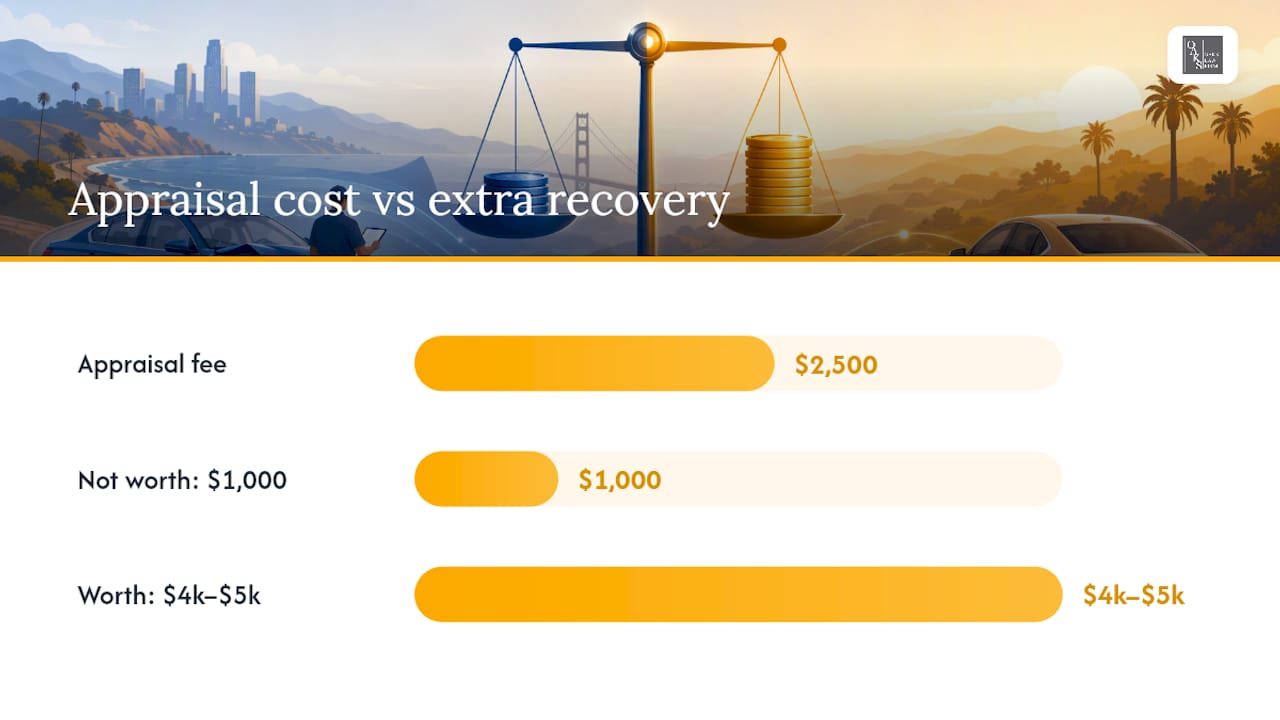
Diminished value claims often make the most sense on newer cars with clean history, low mileage, and a meaningful gap between the insurer’s 17c-style number and what an appraisal would show. On an older, high-mileage car, the expected recovery may not cover appraisal fees or the time spent negotiating.
A simple gut check: if a $2,500 appraisal fee only stands to recover $1,000 more than the insurer already offered, it’s not worth pursuing. If the gap looks closer to $4,000 or $5,000, on a car worth pursuing, it usually is.
What California Law Says About These Claims
California drivers dealing with a disputed ACV or a diminished value claim against another driver’s insurer are still bound by standard personal injury and property damage deadlines. The general statute of limitations for most injury and property claims in California is two years from the date of the incident under CCP §335.1. If a government entity is involved, such as a city vehicle or a defective roadway contributing to the crash, a separate six-month claims deadline applies under Gov. Code §911.2. Both deadlines carry exceptions, so timing should be confirmed early, not assumed.
California’s DOI and small claims courts see plenty of ACV disputes where the difference between the insurer’s offer and a fair number came down entirely to whether the owner had real comparables and a written appraisal on hand.
Legal representation tends to matter most when the dollar gap is large, liability is contested, or the insurer stops responding to reasonable evidence. Oaks Law Firm’s attorneys, led by founder Matthew Nezhad, work directly with clients on these disputes as part of broader car accident property damage claims.
What Actually Moves the Needle in These Disputes
Most explainers on this topic stop at definitions. What they miss is that the fight over ACV and the fight over diminished value are won or lost on the same thing: whose comparables the adjuster believes. Insurers count on drivers accepting the first number because gathering local sales data feels like too much work for what looks like a small gap.
It usually isn’t small. A few hundred dollars in appraisal costs regularly uncovers a few thousand in undervaluation, especially on newer vehicles or ones with upgrades the insurer’s database never caught. The conventional advice, “get a second opinion,” undersells how mechanical this process actually is. You’re not arguing feelings with an adjuster. You’re substituting their data source for a better one.
My take: don’t wait for the insurer to explain their number. Ask for the valuation source in writing on day one, then decide whether to fight it. That single step separates drivers who recover a fair amount from drivers who quietly accept whatever the database spit out.
— Matthew Nezhad
When to Bring in Oaks Law Firm for a Disputed Claim
A free case evaluation makes sense when your insurer’s ACV offer looks significantly below market, when out-of-pocket losses are piling up, or when liability itself is contested and the insurance company is dragging things out. Those are exactly the situations where an attorney’s involvement changes an adjuster’s tone.

Oaks Law Firm handles these disputes on contingency, meaning there’s no upfront cost and you pay nothing unless the firm recovers compensation for you. The initial consultation is free, and it’s the fastest way to find out whether your ACV offer or diminished value claim is worth pushing further. If you’re dealing with a lowball total loss settlement or a contested diminished value case tied to a California accident, see how compensation works and reach out for a free case evaluation before you accept anything from the insurer.
This article is general information, not a substitute for advice from a qualified lawyer. Consult a qualified legal professional about your own circumstances before acting on anything here.
Sources
- When Is a Car Considered Totaled? Total Loss Thresholds by State in 2026 | SoFi
- Totaled Car: What It Means and How Insurance Companies Determine It | GEICO
- Autoinsurance
- My car was totaled! Now what? | Texas Department of Insurance
FAQ
Can I get diminished value if my car is totaled?
Generally, no. Once your insurer pays actual cash value and takes the salvage, there’s no vehicle left to file a diminished value claim on, so your focus should shift to making sure the ACV offer itself is fair.
What shouldn’t I tell my insurance company after an accident?
Avoid guessing about fault, speculating on injuries, or agreeing to a recorded statement before you understand your claim’s full value. Stick to factual details and let documentation, not assumptions, carry the conversation.
Is actual cash value or total loss coverage better?
They’re not competing options. Actual cash value is the number your total loss coverage pays out, so the real question is whether that ACV figure reflects your car’s true pre-accident market value.
At what percentage is a car considered a total loss?
It depends on your state. Many use a threshold around 70% to 75% of ACV, while others apply a total loss formula comparing repair costs to fair market value minus salvage, so check your specific state’s rule before assuming.
Disclaimer: This article is provided for general informational purposes only and does not constitute legal advice. No attorney-client relationship is created by reading this content. Laws and deadlines change, and outcomes depend on the specific facts of each case. For advice about your specific situation, contact Oaks Law Firm directly for a free consultation. Prior results do not guarantee a similar outcome.
