

Attorney Advertising. This article was prepared with the assistance of artificial intelligence and reviewed by Oaks Law Firm prior to publication.
A personal injury contingency fee means your lawyer gets paid a percentage of whatever you recover, and nothing if you recover nothing. In most of the United States that percentage runs a typical range running from about one-quarter to two-fifths, with 33% showing up so often it’s basically the industry default, according to Cornell Law School’s Wex. California adds a wrinkle: for medical malpractice claims, state law actually caps what an attorney can charge, and every agreement has to spell out the math in writing before you sign anything.
- Typical range: a typical range running from about one-quarter to two-fifths of your settlement or verdict
- Most common figure: 33% (often called “one-third”)
- California exception: Statutory fee caps apply to professional negligence claims under Business and Professions Code §§6146–6147
TL;DR:
- Most personal injury contingency fees range from 25% to 40%, with 33% being the industry standard for settled cases before litigation.
- California caps contingency fees only in medical malpractice cases, with tiered percentages decreasing as recovery increases, leaving other claims negotiable.
- Whether fees are calculated before or after deducting case costs can alter your net settlement by several thousand dollars.
- Cases that go to trial typically involve higher attorney percentages, often 40% or more, due to extensive litigation expenses.
- Always obtain written disclosure of fee and cost terms before signing, and ask how costs are deducted to ensure clarity on final compensation.
Table of Contents
- What Is a Contingency Fee and How Does It Work?
- What Percentage Do Lawyers Actually Charge?
- How Do Case Costs Affect Your Final Check?
- What California Law Requires for Contingency Fee Agreements
- How Do You Negotiate a Contingency Fee?
- Sample Math: What Do You Keep From a $50,000 Settlement?
- What Protections Does Oaks Law Firm Offer Injured Clients?
- Key Takeaways
- The Fee Percentage Isn’t the Number That Matters Most
- Get a Free Case Evaluation Before You Sign Anything
- Sources
- FAQ
What Is a Contingency Fee and How Does It Work?
You pay nothing upfront. No retainer check, no hourly invoices piling up while your case drags on for a year. Your attorney only gets paid if you get paid, and their fee comes out of the settlement or jury award, not your pocket. That’s the entire appeal of contingency billing over the hourly model most other legal work uses, and it’s a big reason injured people who couldn’t otherwise afford a lawyer end up with real representation.
The arrangement has to be in writing. The State Bar of California and the American Bar Association’s Model Rule 1.5 both require the fee percentage and expense terms to be documented before work begins, not negotiated after the fact.
Not every case gets taken. Firms weigh:
- Strength of liability evidence
- Extent and permanence of injuries
- Whether the defendant has insurance or assets to actually collect from
- Cost of litigating versus likely recovery
What Percentage Do Lawyers Actually Charge?
The typical range running from about one-quarter to two-fifths isn’t a marketing number, it’s what shows up repeatedly across bar association guidance and consumer legal resources. Cases that require filing suit, or that go all the way to trial, often climb higher.
- Pre-litigation settlement: commonly 33⅓%
- After a lawsuit is filed: often 35% to 40%
- If the case goes to trial: frequently 40%, sometimes higher in complex litigation
Why the jump? Trial work means expert witnesses, depositions, motion practice, and months of preparation your attorney might never get paid for if the verdict goes wrong. Forbes Advisor’s breakdown of accident lawyer fees confirms this stage-based structure is standard practice, not an upsell. Cases with multiple defendants, disputed liability, or the need for specialized medical experts also tend to push the percentage toward the higher end of the range.
How Do Case Costs Affect Your Final Check?
Your contingency percentage is only half the math. Case costs, sometimes called disbursements, get deducted separately, and depending on how your retainer is written, that deduction happens before or after the attorney’s fee is calculated. That order changes what you walk away with by real money.
Common costs include:
- Expert witness fees (medical, accident reconstruction, economic)
- Medical record retrieval
- Court filing fees
- Deposition transcripts
- Lien resolution with health insurers or hospitals
If your case is unsuccessful, whether you owe these costs anyway depends entirely on what your agreement says. The State Bar of California specifically advises clients to get a cost estimate before signing, because some agreements shift that risk to the client and some don’t.
Pro Tip: Ask your attorney directly whether fees are calculated before or after costs are deducted, and get the answer in writing. It’s a two-second question that can be worth thousands.
What California Law Requires for Contingency Fee Agreements
California doesn’t let contingency agreements float on handshake terms. State statute governs disclosure, and in one specific category of case, it governs the percentage itself.
- BPC §6147 requires every contingency fee agreement to state the fee percentage, how costs are handled, and the client’s right to a copy of the signed agreement.
- BPC §6146 caps contingency fees in medical malpractice cases under California’s Medical Injury Compensation Reform Act (MICRA), with tiered percentages that decrease as recovery amounts increase, according to the California Business and Professions Code.
- Fee agreements outside malpractice are generally negotiable, and the State Bar allows clients to challenge fees they believe are unreasonable through fee arbitration.
- California’s general two-year statute of limitations for personal injury claims runs from the date of injury under CCP §335.1, though claims against a government agency require a government claim filed within six months under Gov. Code §911.2. Miss either deadline and the strongest fee agreement in the world won’t matter, because you’ll have no case left to collect on.
How Do You Negotiate a Contingency Fee?
Almost every term in a contingency agreement is negotiable except where California statute fixes it. Percentage, cost handling, and what happens if you fire the attorney mid-case are all fair questions to raise at your first meeting.
Ask these at your consultation:
- What percentage applies before a lawsuit is filed, and what changes after?
- Are costs deducted before or after your fee is calculated?
- Am I responsible for costs if we don’t win?
- Does the percentage increase if the case goes to trial?
- What happens to fees owed if I switch attorneys later?
Bring documentation to your free consultation so the attorney can give you a realistic answer instead of a generic one. Watch for agreements that don’t specify a cost-deduction order at all. That vagueness usually favors the firm, not you.
Pro Tip: If a fee ever feels excessive after the fact, you can request fee arbitration through the State Bar rather than simply accepting the final bill.

Sample Math: What Do You Keep From a $50,000 Settlement?
Numbers make this concrete faster than percentages alone. Here’s how three common structures play out on a $50,000 settlement with $8,000 in case costs.
- Fee-first method: 33% of $50,000 = $16,500 fee. Remaining $33,500 minus $8,000 in costs = $25,500 to you.
- Cost-first method: $50,000 minus $8,000 in costs = $42,000. 33% of $42,000 = $13,860 fee. $28,140 to you.
- Tiered rate example: If the case required filing suit and the rate rose to 40%, fee-first math gives you $16,800 fee on $50,000, minus $8,000 costs = $25,200 to you.
That’s a difference of over $2,600 between fee-first and cost-first calculations on the same settlement, according to consumer fee guides like Forbes Advisor. Negotiated reductions on medical liens can add meaningfully more back to your check. Verify the exact method in your written retainer before you sign, not after the settlement lands.
What Protections Does Oaks Law Firm Offer Injured Clients?
Oaks Law Firm operates on a straightforward promise: you owe nothing unless we recover money for you. That’s our No Fee Guarantee Unless We Win, paired with a free case evaluation before you commit to anything.
We spell out the fee percentage and cost-handling terms in writing, and we actively negotiate medical liens down wherever possible so more of the settlement ends up in your hands, not a hospital’s collections department.
Founder Matthew Nezhad has practiced California personal injury law since 2002, with offices in Sherman Oaks and Woodland Hills serving clients across the state.
- Written fee disclosure before you sign
- Active lien negotiation to protect net recovery
- Free initial case evaluation, no obligation
Key Takeaways
A personal injury contingency fee typically runs a typical range running from about one-quarter to two-fifths of your recovery, with California imposing statutory caps specifically on medical malpractice agreements.
| Point | Details |
|---|---|
| Typical fee range | Most personal injury contingency fees fall between 25% and 40%, with 33% most common. |
| California caps apply narrowly | BPC §6146 limits fees only in medical malpractice cases, not standard accident claims. |
| Cost order changes your check | Fee-first versus cost-first calculation can shift net recovery by thousands on the same settlement. |
| Deadlines still control everything | California’s two-year statute of limitations and six-month government claim deadline apply regardless of fee terms. |
| Oaks Law Firm’s approach | Offers a No Fee Guarantee Unless We Win, written disclosure, and active lien negotiation for California clients. |
The Fee Percentage Isn’t the Number That Matters Most
Everyone fixates on the percentage. It’s the easiest number to compare and the first thing people ask about, but it’s often the least useful data point for predicting what actually lands in your bank account. Two attorneys quoting 33% can produce wildly different net outcomes depending on how costs get deducted and how aggressively they negotiate your medical liens afterward.
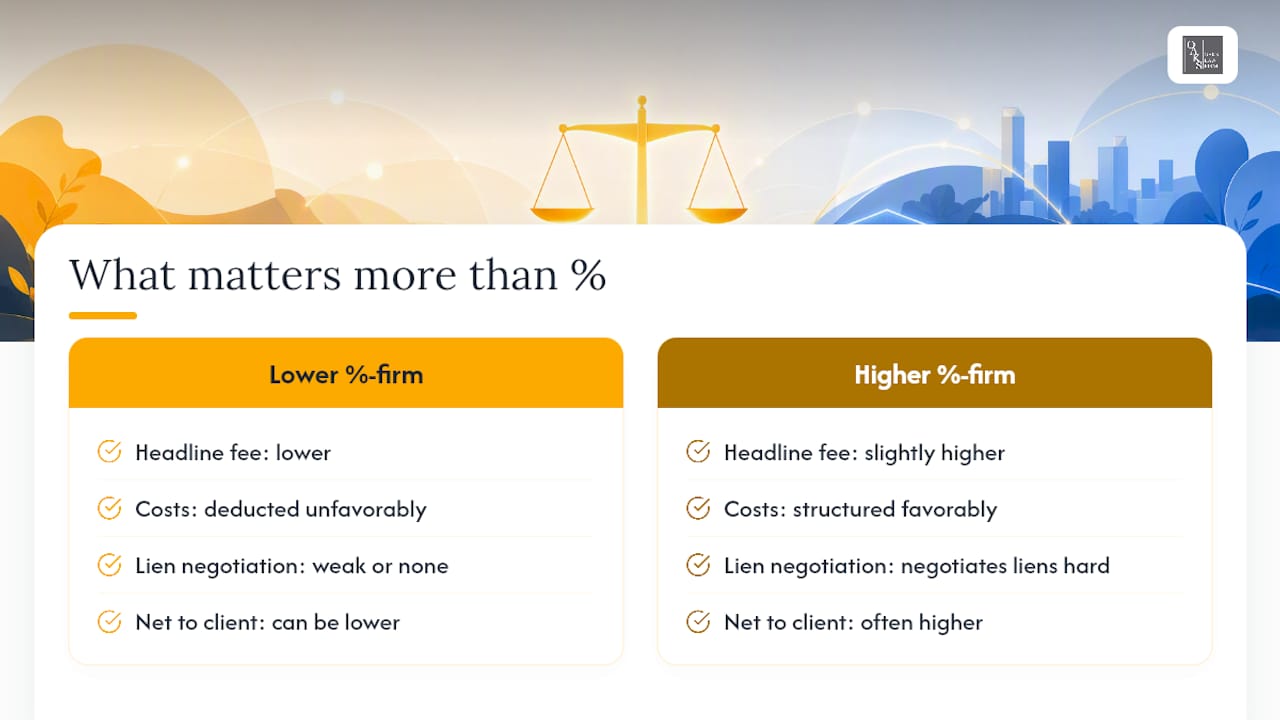
The conventional advice tells people to shop around for the lowest percentage. That’s backwards. A slightly higher percentage from an attorney who negotiates liens hard and structures costs favorably will almost always beat a lower headline rate from a firm that doesn’t.
California’s malpractice fee caps exist because lawmakers recognized the percentage alone can be exploited. Outside malpractice, that same scrutiny falls on you, the client, to ask the right questions before signing. Read your retainer’s cost section twice. That’s where the real number lives.
— Matthew Nezhad
Get a Free Case Evaluation Before You Sign Anything
Oaks Law Firm is the option for California accident victims who want fee terms explained plainly before they commit to anything, not buried in fine print after a settlement arrives.

We take a limited number of cases each year, which means the attorneys reviewing your claim have the bandwidth to negotiate your medical liens aggressively rather than rushing you toward a quick settlement. If you were hurt in a car accident and want to understand your compensation options in California, or if you’re ready to explore filing a lawsuit in Los Angeles, a free case evaluation gets you specific answers about your fee structure and expected costs, not a generic percentage. Contact Oaks Law Firm today to schedule your no-cost consultation.
This article is general information, not a substitute for advice from a qualified lawyer. Consult a qualified legal professional about your own circumstances before acting on anything here.
Sources
- contingency fee | Wex | US Law | LII / Legal Information Institute
- California Business and Professions Code — Fee Agreements (selected sections)
- What to Expect Regarding Fees and Billing | The State Bar of California
- Car accident lawyer fees guide | Forbes Advisor
FAQ
What percentage do most lawyers take as a contingency fee?
Most personal injury attorneys charge between 25% and 40%, with 33% being the most common figure for cases that settle before a lawsuit is filed.
How much of a $50,000 settlement will I get?
It depends on the fee method: under a fee-first calculation with $8,000 in costs, you’d net roughly $25,500; under a cost-first method, closer to $28,140.
What is a reasonable contingency fee?
A reasonable fee typically falls within the a typical range running from about one-quarter to two-fifths range depending on case complexity and stage, and California’s State Bar allows clients to dispute fees they believe are excessive through fee arbitration.
How much is a good settlement for pain and suffering?
There’s no fixed formula, since pain and suffering values depend on injury severity, medical documentation, and impact on daily life, which is why a free case evaluation with a firm like Oaks Law Firm is useful for getting a case-specific estimate.
Are contingency fees negotiable in California?
Yes, outside of the statutory caps on medical malpractice cases under BPC §6146, most contingency fee terms including percentage and cost handling can be discussed and negotiated with your attorney.
This information is provided for general educational purposes only and does not constitute legal advice. No result is guaranteed, and past outcomes do not predict future results. Contact Oaks Law Firm for a free consultation regarding your specific legal matter.
