

Attorney Advertising. This article was prepared with the assistance of artificial intelligence and reviewed by Oaks Law Firm prior to its publication.
The strongest lost-wages claim pairs two things: medical evidence proving you couldn’t work, and income records proving what you normally earn. Insurers won’t take your word for either one. Building solid car accident lost wages documentation starts the moment you’re hurt, not weeks later when you’re negotiating a settlement.
Here’s your must-have list before anything else:
- A signed employer wage verification letter or completed attestation form
- Pay stubs, W-2s, 1099s, or tax returns from the months before the crash
- Timesheets or schedules showing your normal hours
- Invoices, contracts, or bank deposits if you’re self-employed
- Dated medical notes stating you were unable to work and for how long
Start a single wage-loss folder today, digital and printed, and date-stamp everything you add.
Pro Tip: Notify your insurer as soon as you know you’ll miss work. Some no-fault policies require notice within days, and late filing can forfeit benefits you’d otherwise get.
Key Takeaways
A lost-wages claim succeeds when medical restrictions, income records, and a clear day-by-day calculation all point to the same numbers.
| Point | Details |
|---|---|
| Build a wage folder immediately | Collect employer letters, pay stubs, and medical notes as soon as you’re hurt, not weeks later. |
| Match documents to employment type | Employees need payroll verification; self-employed workers need invoices, contracts, and bank deposits. |
| Use the right formula | Hourly, salaried, and self-employed workers each require a different calculation method with worked examples. |
| Watch California deadlines | The general statute of limitations is two years (CCP §335.1); government-entity claims require notice within six months (Gov. Code §911.2). |
| Get help when the math gets complex | Oaks Law Firm offers free consultations and contingency billing to help assemble and strengthen wage-loss packets. |
Table of Contents
- What Counts as Lost Wages in a Car Accident Claim
- Who Can Claim Lost Wages: Employees, Contractors, and Business Owners
- How to Calculate Lost Wages: Formulas and Worked Examples
- The Complete Documentation Checklist to Prove Lost Wages
- Medical Evidence That Links Your Injury to Missed Work
- Who Pays: PIP, At-Fault Liability, and Uninsured Motorist Coverage
- Deadlines That Protect Your Lost-Wages Claim
- When to Hire an Attorney for a Lost Wages Claim
- Sources
- FAQ
What Counts as Lost Wages in a Car Accident Claim
Lost wages cover two different things. Past lost wages are the hours or days you actually missed. Lost earning capacity is the harder-to-prove future loss when an injury limits what kind of work you can do going forward, and it usually requires projections built from your current earnings.
Several income types belong in your claim, not just your base pay:
- Hourly wages or salary for missed shifts
- Overtime you would have worked
- Regular bonuses, commissions, or tips
- Shift differentials
- PTO, sick days, or vacation time you had to use instead of banking
- Self-employment revenue or profit you lost
Picture three scenarios: a warehouse worker misses one 8-hour shift at $22 an hour, an office employee burns four vacation days instead of taking them unpaid, and a freelance photographer loses a $1,200 wedding contract because she couldn’t stand for six hours. All three are recoverable, but each needs different proof.
Who Can Claim Lost Wages: Employees, Contractors, and Business Owners
Your job status determines what paperwork actually convinces an adjuster.
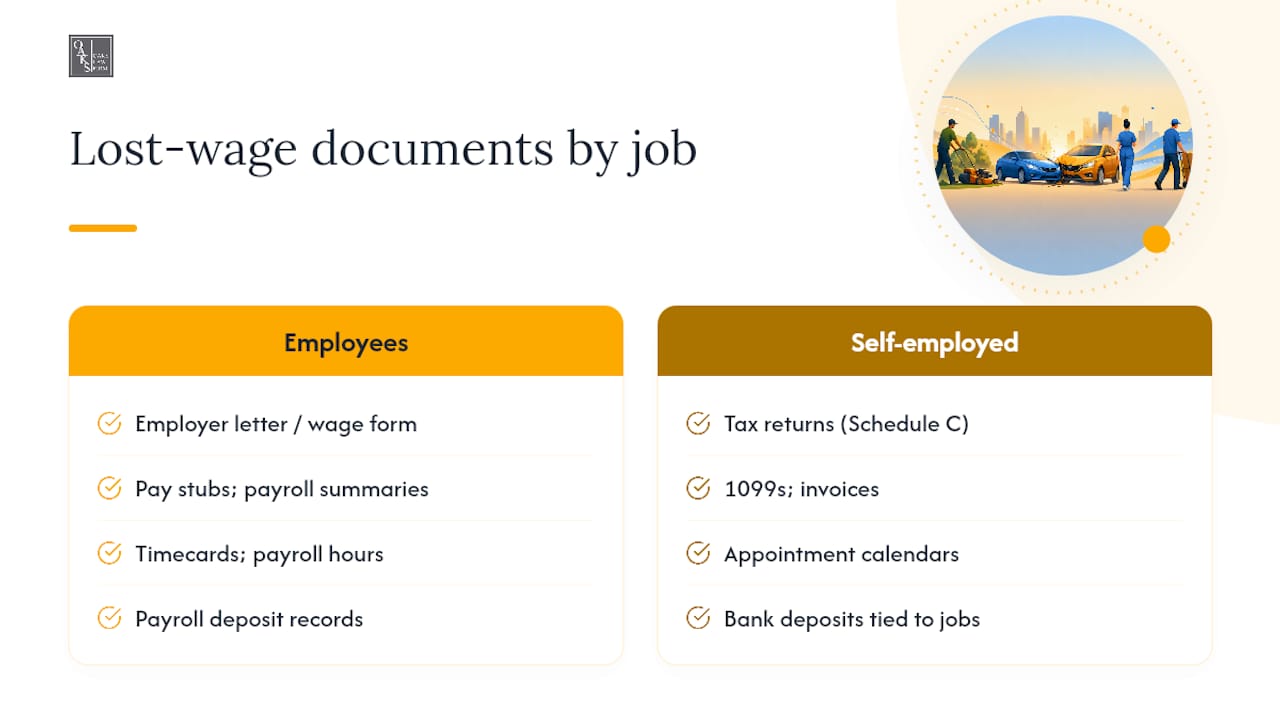
Employees need an employer letter or wage verification form, recent pay stubs, payroll summaries, timecards, and often an HR-signed verification form. If you’re salaried, convert your annual pay to an hourly or daily rate so the math matches your missed time. Payroll records showing consistent hours add weight here.
Self-employed and gig workers face a tougher road because there’s no HR department vouching for their income. You’ll lean on tax returns (particularly Schedule C), 1099s, invoices, appointment calendars, bank deposits, and canceled contracts. A rideshare driver might submit weekly earnings summaries from the app plus bank statements showing the deposits stopped. A consultant might submit an email chain where a client canceled a project after learning about the accident.

An hourly retail employee typically needs four or five documents. A sole proprietor often needs eight or nine, because proving specific lost jobs takes more than a tax return alone.
How to Calculate Lost Wages: Formulas and Worked Examples
Insurers expect math they can verify against your paperwork, not a round number pulled from memory. FindLaw’s guidance on lost wage calculations breaks the formulas down by employment type, and each one is straightforward once you have the right documents.
- Hourly workers: Multiply your hourly rate by hours missed. A worker who missed 32 hours over four days lost an amount equivalent to their hourly rate multiplied by those hours in base wages.
- Salaried workers: Divide annual salary by 2,080 (the standard work-year hours) to get an hourly equivalent, then multiply by hours missed. A salaried worker’s annual salary can be divided by 2,080 to estimate an hourly rate; missing full workdays results in a loss calculated by multiplying that rate by hours missed.
- Self-employed workers: Average your net profit over the last two to three years, divide by 12 for a monthly figure, then by your typical workdays that month. For self-employed workers, average net profits reported over recent years can be converted into daily figures and multiplied by days missed to estimate lost income; canceled contracts provide especially strong evidence.
Don’t forget the extras. If you had a scheduled overtime shift, add that hourly rate times hours. If you used two vacation days instead of taking unpaid leave, calculate their dollar value and include it as a loss, since you’re out that benefit even though your paycheck looked normal.
Pro Tip: Use gross income for your calculation unless your state’s rules or your attorney direct otherwise. Courts generally want your pre-tax loss shown with reasonable certainty, not exact precision to the penny.
The Complete Documentation Checklist to Prove Lost Wages
A claim-ready packet does more than list documents. It organizes them so an adjuster can move from claim to proof in seconds.
Gather these items:
- Employer wage verification letter on company letterhead
- Pay stubs covering at least two to six months before the crash
- W-2s, 1099s, or tax returns
- Bank statements or direct deposit records
- Timesheets and work schedules
- Any employer emails or texts about missed shifts
- PTO usage records
- Invoices, contracts, and booking calendars for self-employed claimants
Pair every wage document with the medical record that explains why you missed the time: doctor’s notes with dates and restrictions, ER records, follow-up visit summaries, and physical therapy logs.
When you ask your employer for a wage verification letter, give HR a template. Here’s what to request:
Employee name, job title, and hire date. Regular pay rate and normal weekly schedule. Exact dates and hours missed due to the accident. Any PTO used in lieu of unpaid leave. A signature from a supervisor or HR representative, with a phone number for follow-up questions.
LegalClarity’s breakdown of wage-loss proof notes that HR delays in returning this form are one of the most common bottlenecks in the entire claims process, so request it early.
Order your documents to mirror your calculation page: medical restriction first, then the pay record for that same period, then the dollar amount. A one-page summary tying each missed date to a dollar figure lets an adjuster verify your math without digging. If you’re submitting through an online portal, save the confirmation receipt. If you’re mailing anything, send it with tracking.
Medical Evidence That Links Your Injury to Missed Work
Wage records prove what you earn. Medical records prove why you couldn’t earn it, and insurers weigh the two together. Missing one usually sinks the other.
Collect ER records, provider visit notes, imaging reports, physical therapy logs, and surgical reports if applicable. The strongest notes state specifics, something like “patient restricted from lifting over 15 pounds and prohibited from driving through March 14” rather than a vague “advised to rest.”
If your file has gaps, go back to your provider and ask them to add exact dates and restrictions retroactively. A written disability slip carries more weight than a verbal instruction you remember from an appointment. Document every visit and treatment that affected your ability to work, even follow-ups that felt routine.
Insurers sometimes request an independent medical examination (IME) to challenge your treating doctor’s findings. Keeping your own file complete and consistent is your best defense against a skeptical IME report.
Who Pays: PIP, At-Fault Liability, and Uninsured Motorist Coverage
Where your documentation goes depends on which insurance system applies to your accident.
- No-fault/PIP route: In no-fault states, you file with your own insurer first. PIP typically reimburses a percentage of lost wages up to a policy cap, and filing windows are often tight, sometimes just days after the accident.
- At-fault liability route: In fault-based systems, your wage loss becomes part of a bodily-injury liability claim against the at-fault driver’s insurer, negotiated alongside medical bills and pain and suffering.
- Uninsured/underinsured motorist coverage (UIM): If the at-fault driver carries minimal or no insurance, your own UIM coverage can bridge the gap once other coverage is exhausted.
A common flow looks like this: file PIP first if you’re in a no-fault state, and if those benefits run out, pursue the at-fault driver’s liability carrier or your own UIM. In fault-based states, your wage claim usually goes straight to the other driver’s insurer.
Deadlines That Protect Your Lost-Wages Claim
Documentation only matters if you preserve it and act within the deadlines that apply to your case.
Start immediately: notify your insurer, save every receipt and pay stub, and log missed shifts as they happen rather than reconstructing them from memory later.
In California, personal injury claims generally carry a two-year statute of limitations under CCP §335.1, while claims against a government entity, like a crash involving a city vehicle, require a claim within six months under Gov. Code §911.2. Exceptions exist for minors, delayed injury discovery, and certain other circumstances, so speak with an attorney early if your case might fall outside the standard timeline.
A practical timeline: days 0 to 7, see a doctor and notify your insurer. Days 0 to 30, gather pay records and request your employer letter. Ongoing, update your packet every pay period. Before the two-year mark, consult an attorney if you’re pursuing a third-party claim.
When to Hire an Attorney for a Lost Wages Claim
Call an attorney when the insurer’s offer doesn’t match your documented loss, when policy limits look too low to cover your full claim, when your medical causation is disputed, or when you’re self-employed and need to reconstruct irregular income.
A lawyer typically assembles your full claim packet, pushes employers who are slow to return verification forms, and retains forensic economists or vocational experts when future earning capacity is on the table. From there, they negotiate directly with insurers and file suit if a fair settlement doesn’t materialize.
- Low settlement offer relative to documented wage loss
- Future earning capacity affected by permanent restrictions
- Self-employment income that’s hard to reconstruct alone
- Disputes over whether the injury actually caused the missed work
Oaks Law Firm’s guidance on proving future lost wages walks through exactly what kind of expert support strengthens these harder, forward-looking claims.
A Note From Matthew Nezhad
I’ve watched too many claims stall because a client waited weeks to ask their employer for a wage letter, or assumed a stack of pay stubs would speak for itself. At our offices in Sherman Oaks and Woodland Hills, we walk clients through building a documentation file from day one, not after an adjuster pushes back. We take on a limited number of cases each year because that kind of attention doesn’t scale, and it shouldn’t.
How Oaks Law Firm Helps With Your Wage-Loss Packet
Oaks Law Firm reviews your assembled wage folder at no cost and tells you plainly whether it’s strong enough to support your claim or where it needs work. Consultations are free, and our fee structure means you owe nothing upfront. We only get paid if we recover compensation for you.

If you’re self-employed or your income doesn’t fit neatly into a pay stub, we can help reconstruct your losses using bank records, contracts, and, when needed, a forensic economist. Bring whatever you’ve gathered so far, even if it’s incomplete. If your claim involves significant future earning loss or a lowball offer, our guide on how car accident compensation works in California explains where wage losses fit into a full damages demand. Contact us today for a free case evaluation and bring your wage folder with you.
Sources
FAQ
How do I get proof of lost wages after a car accident?
Ask your employer for a signed wage verification letter and gather pay stubs, W-2s or 1099s, and timesheets, then pair them with medical notes documenting your work restrictions.
What do you need to prove loss of earnings?
You need income records showing your normal pay, medical documentation explaining why you couldn’t work, and a clear calculation tying missed dates to dollar amounts.
How long does it take to get lost wages from a car accident?
Timelines vary by insurer and claim type. PIP claims can process in a few weeks if your paperwork is complete, while liability claims through an at-fault driver’s insurer often take longer, especially if you hire an attorney to negotiate a fuller settlement.
What is a wage loss verification form?
It’s a document, usually completed by your employer, confirming your job title, pay rate, normal schedule, and the exact dates and hours you missed due to the accident.
When should I hire an attorney for a lost wages claim?
Consider hiring an attorney when the insurer’s offer falls short of your documented loss, when your future earning capacity is affected, or when you’re self-employed and need help reconstructing irregular income; Oaks Law Firm offers free consultations to review your case.
This information is provided for general educational purposes only and is not a substitute for individualized legal advice. Every case is different, and prior results do not guarantee a similar outcome. Contact Oaks Law Firm for a free consultation to discuss the specific facts of your situation.
