

Attorney Advertising. This article was prepared with the assistance of artificial intelligence and reviewed by Oaks Law Firm prior to publication.
A strong personal injury demand letter names a specific, evidence-backed settlement amount and attaches a clear package of exhibits proving every dollar. That single move, anchoring the negotiation with a number the adjuster can verify in minutes, is what separates a letter that gets a fast offer from one that sits in a claims queue for months.
Here is the shortest version you will find anywhere:
Dear [Adjuster Name],
This letter demands $[Amount] to resolve the claim of [Client Name] arising from the [date] collision caused by your insured’s failure to [specific negligent act]. Supporting medical records, bills, and wage documentation are enclosed as Exhibits A through [X]. We require a response within 30 days of the date of this letter.
That’s the skeleton. Everything else in this guide is about how to build the muscle around it: the California statute of limitations gives most injury victims two years from the date of injury to file suit under Code of Civil Procedure §335.1, and if a government entity is involved, Government Code §911.2 cuts that window down to six months for filing an administrative claim, but both deadlines have exceptions for minors, delayed discovery of an injury, and other narrow circumstances, so treat them as a floor, not a finish line. Oaks Law Firm reviews demand packages against both deadlines before anything goes out the door, and this guide walks through the same template and checklist our team uses internally.
Key Takeaways
A defensible personal injury demand letter pairs one specific dollar figure with an exhibit-backed damages breakdown and a firm 30-day response deadline.
| Point | Details |
|---|---|
| Anchor with one number | State a specific total, not a range, and back it with an itemized damages table. |
| Attach every exhibit | Medical chronology, bills, wage verification, and police reports should all be labeled and included. |
| Use clinical, specific language | Tie every injury and pain-and-suffering claim to a documented diagnosis or restriction. |
| Set and track the deadline | Give a firm 30-day window and document all follow-up communication in writing. |
| Know your legal clock | CCP §335.1 gives two years to file suit; Gov. Code §911.2 cuts that to six months against government defendants. |
Table of Contents
- Example of a Personal Injury Demand Letter: Full Template You Can Reuse
- Annotated Sample Demand Letter for a Car Accident Claim
- Annotated Sample Demand Letter for a Slip-and-Fall Case
- How to Calculate Damages and Word the Pain-and-Suffering Ask
- Demand-Package Checklist: What to Attach and How to Label It
- What Not to Say: Common Mistakes That Weaken a Demand
- Sending the Demand: Delivery, Timeline, and Follow-Up
- When to Bring in an Attorney
- Our Approach to Demand Letters at Oaks Law Firm
- Sources
- FAQ
Example of a Personal Injury Demand Letter: Full Template You Can Reuse
A demand letter isn’t a form. It’s an argument, built in a specific order so an adjuster can move from liability to damages to number without having to hunt for anything. The structure below mirrors what attorneys use across thousands of personal injury demand letters, and it works whether you’re negotiating a fender-bender or a catastrophic injury claim.
1. Header and representation line
Include the claim number, the insured’s name, the claimant’s name, the date of loss, and the adjuster’s mailing address. If an attorney is involved, this line states representation plainly: “This office represents [Client Name] in connection with injuries sustained on [Date].”
2. Factual narrative
Two or three tight paragraphs describing what happened, where, and when. Skip editorializing. Adjusters read hundreds of these; specificity reads as credibility.
3. Liability statement
State plainly why the other party is at fault, citing the police report, traffic code section, or premises violation. Don’t bury this in the middle of a paragraph. Give it its own short section.
4. Injuries and clinical diagnoses
List each diagnosis using the language from the medical records: “cervical strain (ICD-10 S13.4XXA),” not “hurt my neck.” Clinical terminology signals the file has substance behind it.
5. Treatment chronology with exhibit references
A timeline: date of ER visit, date of first orthopedic consult, physical therapy start and end dates, each tied to an exhibit letter (Exhibit C, Exhibit D). This is the section adjusters actually cross-check.

6. Itemized economic damages
Every medical bill, every day of missed work, every out-of-pocket cost, added up and shown, not just stated.
7. Projected future costs
If a doctor has documented ongoing treatment needs, cite that record directly rather than guessing at a number.
8. Pain-and-suffering argument
This is where most demand letters fall flat. Here is a language block built to translate clinical findings into lived impact:
Since the collision, [Client Name] has been unable to lift her [X]-month-old son without pain radiating down her left arm, a limitation her orthopedist attributes directly to the C5-C6 disc herniation documented in Exhibit F. She has missed eleven of her son’s daycare drop-offs because standing longer than fifteen minutes triggers muscle spasms noted in her physical therapy records (Exhibit G).
Notice what that block does: it names a specific activity, ties it to a specific medical exhibit, and never uses the word “significant” or “severe” without backing it up.
9. Specific demand and policy-limits note
State the number. If you have reason to believe the demand approaches or exceeds the insured’s policy limits, say so directly: “This demand is made with the understanding that it may exceed your insured’s available coverage.”
10. Response deadline and closing
A firm, professional 30-day window with instructions for where to send the response.
Pro Tip: Build your exhibit list before you write a single sentence of narrative. Knowing what evidence you actually have will keep you from making claims the file can’t support, which is the single fastest way to lose credibility with an adjuster.
A summary-of-damages table at the close of the letter does a lot of quiet work. It gives the adjuster one place to verify your math without flipping through fifteen pages.
Structured demands that pair a narrative with an exhibit index and itemized table make verification easy for the adjuster, and EvenUp reports that demands built this way are more likely to reach a policy-limit settlement than demands without that structure.
Annotated Sample Demand Letter for a Car Accident Claim
Here’s how the template above looks once it’s filled in for a real fact pattern, a rear-end collision with a documented cervical injury. Annotations follow each section explaining why the phrasing was chosen.
Re: Claim No. 88291-JK / Your Insured: Robert Alvarez / Date of Loss: March 3, 2026
Dear Ms. Chen,
This office represents Maria Delgado regarding injuries sustained on March 3, 2026, when your insured, Robert Alvarez, rear-ended Ms. Delgado’s vehicle while she was stopped at a red light on Ventura Boulevard. The responding officer’s report (Exhibit A) cites Mr. Alvarez for violating California Vehicle Code §22350 (unsafe speed for conditions).
Ms. Delgado was transported by ambulance to Providence Saint Joseph Medical Center and diagnosed with a cervical strain and a C5-C6 disc bulge, confirmed by MRI on March 10, 2026 (Exhibit C). She completed fourteen physical therapy sessions between March and May, documented in Exhibit D.
Ms. Delgado’s medical expenses total $9,240 (Exhibit E), and her employer has verified $3,800 in lost wages for four weeks of missed work as a dental hygienist, a role requiring repeated neck flexion that her treating physician has restricted (Exhibit F).
Given the objective imaging findings, the documented treatment course, and the ongoing restriction on Ms. Delgado’s ability to perform her job duties without pain, we demand $52,000 to resolve this claim. This figure reflects the severity of the diagnosis and may approach your insured’s policy limits.
Please respond within 30 days of this letter’s date.
Why this works: the officer’s citation removes any liability argument in the first paragraph. The MRI finding, not just a subjective complaint, drives the injury description. Lost wages come with employer verification attached, not just a claimant’s estimate. And the number at the end isn’t pulled from nowhere. It’s the direct sum of the exhibits already listed. A sample demand for a serious car accident follows this same logic: specificity first, number second.
Annotated Sample Demand Letter for a Slip-and-Fall Case
Premises liability cases run on different evidence than car accidents. There’s no police report doing the heavy lifting on fault, so hazard proof carries the letter.
- Hazard documentation: photos of the wet floor, missing warning signs, or broken step, dated and timestamped, form the backbone of the liability argument.
- Maintenance logs and prior complaints: if the property has a history of similar hazards or skipped inspections, that pattern belongs early in the letter, not buried in an exhibit list.
- Surveillance footage: many retail and commercial properties record continuously. Request preservation of footage in writing, ideally within days of the incident, and reference it as an exhibit even if you haven’t received a copy yet.
- Witness statements: organize these as separate, labeled exhibits (Exhibit G-1, G-2) rather than summarizing them secondhand in your narrative.
Here’s a shortened example built for an elderly claimant injured in a grocery store:
On February 14, 2026, Eleanor Whitfield slipped on an unmarked wet floor near the produce section of your insured’s store, fracturing her left wrist. Store surveillance footage, which we have requested your client preserve, shows the spill was present for at least eleven minutes before the fall (Exhibit B). Two customers who witnessed the fall have provided written statements (Exhibits C-1 and C-2).
Since the fracture, Ms. Whitfield, age 74, has been unable to prepare her own meals or drive herself to her weekly dialysis appointments, requiring her daughter to take unpaid leave twice weekly for the past six weeks (Exhibit E, daughter’s employer verification).
Notice the lifestyle-impact language leans on the claimant’s actual daily routine, meal prep, dialysis, driving, rather than a generic “loss of enjoyment of life” phrase. That specificity is what makes the pain-and-suffering ask defensible.
One proportion note worth remembering: a $12,000 slip-and-fall claim with a resolved fracture doesn’t need six pages. A tightly evidenced two-page letter often signals more competence than an overstuffed one. Save the long-form treatment for cases where the injury severity and damages actually justify it.
How to Calculate Damages and Word the Pain-and-Suffering Ask
Start with the numbers you can prove, then build the number you’re arguing for.
Economic damages are a straightforward add: every medical bill by provider, every co-pay, any liens from health insurers, and documented lost wages backed by an employer letter or pay stubs. If the injury affects future earning capacity, that calculation gets more complex and usually benefits from projecting future lost wages with input from a treating physician or vocational expert rather than guessing at a multiplier.
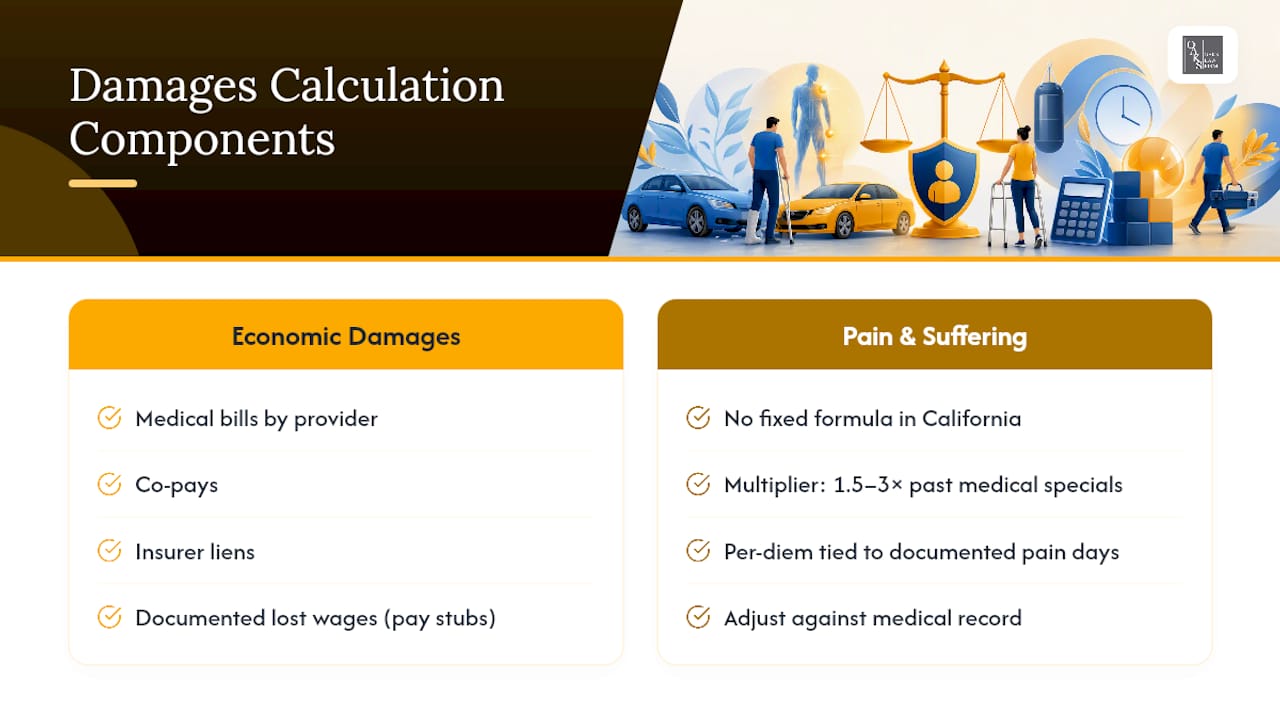
Pain and suffering doesn’t have a fixed formula in California, but many practitioners start from a conservative multiplier of past medical specials (commonly 1.5 to 3 times, depending on injury permanence and documentation strength) or a per-diem approach tied to the number of days the claimant experienced documented pain. Neither method is a rule; both are starting points to be adjusted against the actual medical record. A soft-tissue injury with six weeks of full recovery earns a very different multiplier than a herniated disc with permanent restrictions.
Here’s how that math looks laid out for a mid-severity case:
The pain-and-suffering line only holds up if it’s tied to something in the file, a physician’s restriction, a documented flare-up, a specific missed activity. Attorneys who work with medical records regularly note that translating clinical findings into a daily-life narrative, rather than leaning on adjectives like “severe” or “significant,” is one of the biggest drivers of how adjusters value a claim. Explore how pain and suffering gets calculated in California for more detail on multiplier ranges and per-diem approaches.
Demand-Package Checklist: What to Attach and How to Label It
An adjuster who has to chase down missing documentation will slow-walk your file. Send everything up front, labeled clearly, so there’s no excuse for delay.
- Medical chronology: a one-page timeline listing every provider, visit date, and diagnosis, cross-referenced to exhibit letters.
- Complete medical records: ER notes, imaging reports, specialist consultations, and physical therapy notes, organized by provider.
- Itemized bills: every invoice, with any liens or health-insurer reimbursement claims flagged separately (relevant if a settlement later triggers questions about how injury settlements are taxed).
- Wage verification: an employer letter or pay stubs confirming missed work and lost income.
- Police report or incident report: the official record establishing fault or the circumstances of the incident.
- Photographs: of the scene, the hazard, the vehicle damage, and visible injuries.
- Surveillance footage: requested and referenced even if not yet received.
- Repair estimates: for property damage claims running alongside the injury claim.
- Lien letters: from health insurers or medical providers asserting a right to reimbursement from the settlement.
- Expert reports: if a vocational expert, economist, or life-care planner has weighed in.
Label exhibits sequentially (Exhibit A, B, C) in the order they’re referenced in the letter, not the order you received them. For emailed demands, name PDF files clearly: “Exhibit_C_MRI_Report_03.10.26.pdf” beats “scan001.pdf” every time.
| Point | Details |
|---|---|
| Label exhibits in narrative order | Match exhibit letters to the sequence they appear in your letter, not the order received. |
| Name digital files descriptively | Use “Exhibit_D_PT_Records” instead of generic scan filenames for emailed demand packages. |
| Flag liens early | Note any health-insurer or provider liens in the package so they don’t surprise the adjuster later. |
What Not to Say: Common Mistakes That Weaken a Demand
Adjusters are trained to spot boilerplate. Vague, unsupported language is the fastest way to get your letter deprioritized or countered with a lowball offer.
| Weak phrasing | Stronger alternative |
|---|---|
| “My client has suffered greatly.” | “Ms. Delgado has been unable to lift objects over 10 pounds, per her orthopedist’s restriction dated March 15 (Exhibit F).” |
| “This injury will likely require future treatment.” | “Dr. Ramirez’s report projects two additional years of physical therapy at $150 per session (Exhibit H).” |
| “The defendant was clearly negligent.” | “The police report cites the defendant for violating Vehicle Code §22350 (Exhibit A).” |
| “We demand a fair and reasonable settlement.” | “We demand $45,150, itemized in the summary table above.” |
| No mention of exhibits | “Supporting documentation is attached as Exhibits A through H.” |
Beyond weak phrasing, a few structural mistakes come up again and again: burying the liability argument three paragraphs deep instead of stating it plainly, inflating facts the medical record doesn’t support (which torches your credibility the moment the adjuster cross-checks it), and sending a demand with no exhibits at all, essentially inviting the insurer to ask for more time. Every one of those gives the adjuster an easy, low-risk reason to delay.
Pro Tip: If a sentence in your draft could apply to literally any injury case, cut it. Specificity is what separates a demand letter from a form letter, and adjusters can tell the difference in the first paragraph.
Sending the Demand: Delivery, Timeline, and Follow-Up
Delivery: send the letter via certified mail with return receipt requested to the adjuster’s mailing address, and simultaneously email a PDF copy to the adjuster and any general claims inbox listed on the file. This creates two independent records of transmission, which matters if a dispute later arises over whether the insurer received your demand in time.
Timeline: most insurers take two to four weeks to substantively respond, even with a firm 30-day deadline stated. Standard closing language reads: “We require a written response within 30 days of the date of this letter. If we do not hear from you within that time, we will assume you have declined to negotiate and will proceed accordingly.” Document every phone call and email exchange with a date and summary; that record matters if the case eventually heads toward litigation.
If the insurer ignores you:
- Send one written follow-up at the 30-day mark referencing the original letter and deadline.
- If there’s still no substantive response after a second follow-up, that’s typically the point to consider escalating toward litigation.
- Keep the CCP §335.1 two-year filing deadline in view throughout this process. Silence from an adjuster doesn’t pause that clock, and if a government entity is a defendant, the Gov. Code §911.2 six-month administrative claim deadline is even less forgiving.
When to Bring in an Attorney
You can write your own demand letter, and for a minor claim with clear liability and modest medical bills, plenty of people do it successfully. But there’s a point where the math changes.
- Stronger anchoring: attorneys who negotiate claims regularly know what number a given injury and jurisdiction typically supports, which keeps your demand credible instead of either lowballing yourself or triggering an automatic rejection for overreach.
- Expert damages projection: cases involving permanent impairment or long-term care often need input from economists or life-care planners to build a defensible future-cost figure.
- Negotiation leverage: insurers respond differently when they know a case is litigation-ready, backed by counsel prepared to file suit if the demand goes unanswered.
- Litigation readiness: if a demand is ignored or lowballed, an attorney can move directly toward filing suit without losing time re-learning the file.
Consider a consult if any of the following apply: medical bills exceed a few thousand dollars, liability is disputed, an injury is permanent or requires ongoing care, a health insurer has asserted a large lien, or the insurer has gone quiet past your deadline. San Fernando Valley attorney Matthew Nezhad founded Oaks Law Firm in 2002 specifically to represent injured people against insurers with far more resources and experience negotiating claims. The firm takes a limited number of cases each year and works on contingency, meaning there’s no fee unless the case results in a settlement or verdict.
Our Approach to Demand Letters at Oaks Law Firm
When we sit down to build a demand letter, the goal is never to send something impressive. It’s to send something an adjuster can’t easily argue with, because every number traces back to a record they can pull and verify themselves. That’s the standard our team holds every file to, whether it’s a straightforward rear-end collision or a case with years of ongoing care ahead.
If you’re weighing whether to send your own letter or bring in help, know that a free case evaluation costs you nothing, and our fee structure means we only get paid if you do. We’ll also flag your deadlines early: the two-year window under CCP §335.1, or the much tighter six-month window under Gov. Code §911.2 if a government entity is involved. No attorney can guarantee a specific outcome, and we won’t pretend otherwise, but we can tell you honestly whether your draft demand is strong enough to send as-is or needs more behind it.
Sources
- Personal Injury Demand Letter Template for Attorneys
- Sample Demand Letter For Serious Car Accidents Injuries
- Sample Demand Letter (Free Template + Example) | EvenUp
These are resources to consult while drafting, not a substitute for legal advice on your specific case. This article is attorney advertising, prepared with the assistance of artificial intelligence and reviewed by Oaks Law Firm prior to publication. If you’re unsure whether your claim needs an attorney, a free consultation is the fastest way to find out.
FAQ
What should you avoid saying in a demand letter?
Avoid vague pain descriptions unsupported by medical records, unverified future-cost estimates, exaggerated facts, and any statement your exhibits can’t back up. Adjusters routinely discount boilerplate language and generic claims of “severe” or “significant” pain that lack a clinical citation.
Can you write your own personal injury demand letter?
Yes, and for smaller claims with clear liability and modest medical bills, many people do it successfully using a template and their own medical records. Cases involving disputed liability, permanent injury, or high medical bills usually benefit from an attorney’s involvement in anchoring the number and countering insurer pushback.
How do you write a strong demand letter?
State the facts and liability clearly, list injuries using clinical terminology, walk through your treatment chronology with exhibits, itemize every economic loss, and close with one specific demand figure and a firm 30-day deadline. Attach every supporting document as a labeled exhibit so the adjuster can verify your numbers without asking for more.
How much is a good settlement for pain and suffering?
There’s no fixed dollar figure since it depends entirely on injury severity, documentation strength, and jurisdiction, but many practitioners start from a multiplier of 1.5 to 3 times past medical specials for moderate injuries, adjusted based on permanence and lifestyle impact. A defensible figure always ties back to specific, documented restrictions in the medical record rather than an arbitrary number.
