

Attorney Advertising. This article was prepared with the assistance of artificial intelligence and reviewed by Oaks Law Firm prior to publication.
California uses a pure comparative fault rule: you can recover damages even if you were partly responsible for your own injury, but your award is reduced by your percentage of fault. That math applies no matter how the fault splits, which is why understanding it matters before you negotiate a single dollar with an insurer.
The legal foundation is California Civil Code §1714 and the landmark California Supreme Court decision in Li v. Yellow Cab Co., 13 Cal.3d 804 (1975), which replaced the old all-or-nothing contributory negligence rule with proportional recovery. Three things every injured person should know immediately:
- You can recover compensation even if you were mostly at fault — only 100% fault on your part bars recovery entirely.
- The defendant must raise comparative fault as an affirmative defense; you do not have to prove you were blameless.
- Every percentage point of fault assigned to you directly reduces the dollars you receive.
Key Takeaways
California’s pure comparative fault rule means your recoverable amount equals your total damages multiplied by the percentage of fault that belongs to the other party, not to you.
| Point | Details |
|---|---|
| Pure comparative fault rule | California reduces your award by your fault percentage; even 99% fault still allows 1% recovery. |
| Proposition 51 split | Economic damages are jointly collectible from any defendant; non-economic damages are several only, paid by each defendant’s share. |
| Jury assigns percentages | The trier of fact allocates fault to all parties, including absent nonparties, using CACI No. 405 and CACI No. 406. |
| Statute of limitations | Most claims must be filed within two years (CCP §335.1); government-entity claims require a six-month notice (Gov. Code §911.2). |
| Oaks Law Firm | Provides free case evaluations and contingency-fee representation to help injured Californians challenge inflated fault assignments and maximize recovery. |
Table of Contents
- What pure comparative fault means — and why California’s rule is different
- The legal foundation: Li v. Yellow Cab, Civil Code §1714, and the jury instructions courts use
- How to calculate your reduced recovery, step by step
- Who decides fault percentages and how the process actually works
- How comparative fault plays out in common California injury scenarios
- How comparative fault shapes settlement offers and insurance negotiations
- When to hire an attorney and what Oaks Law Firm does in comparative-fault cases
- What people often get wrong about comparative fault
- Oaks Law Firm is ready to evaluate your comparative-fault case
- Sources
- FAQ
What pure comparative fault means — and why California’s rule is different
Comparative negligence, in plain terms, is a legal doctrine that splits responsibility for an accident among everyone who contributed to it. California follows the pure version, which means there is no threshold that cuts off your right to recover.
That is a meaningful distinction from what most other states do. Here is how the three main systems compare:
| Fault Rule | Threshold | Practical Effect on Recovery |
|---|---|---|
| Pure comparative negligence (California) | None | Plaintiff recovers regardless of fault percentage; award reduced proportionally |
| Modified comparative negligence (50% bar) | Plaintiff must be less than 50% at fault | Plaintiff at 50% or more recovers nothing |
| Contributory negligence | Any fault | Any plaintiff fault bars all recovery |
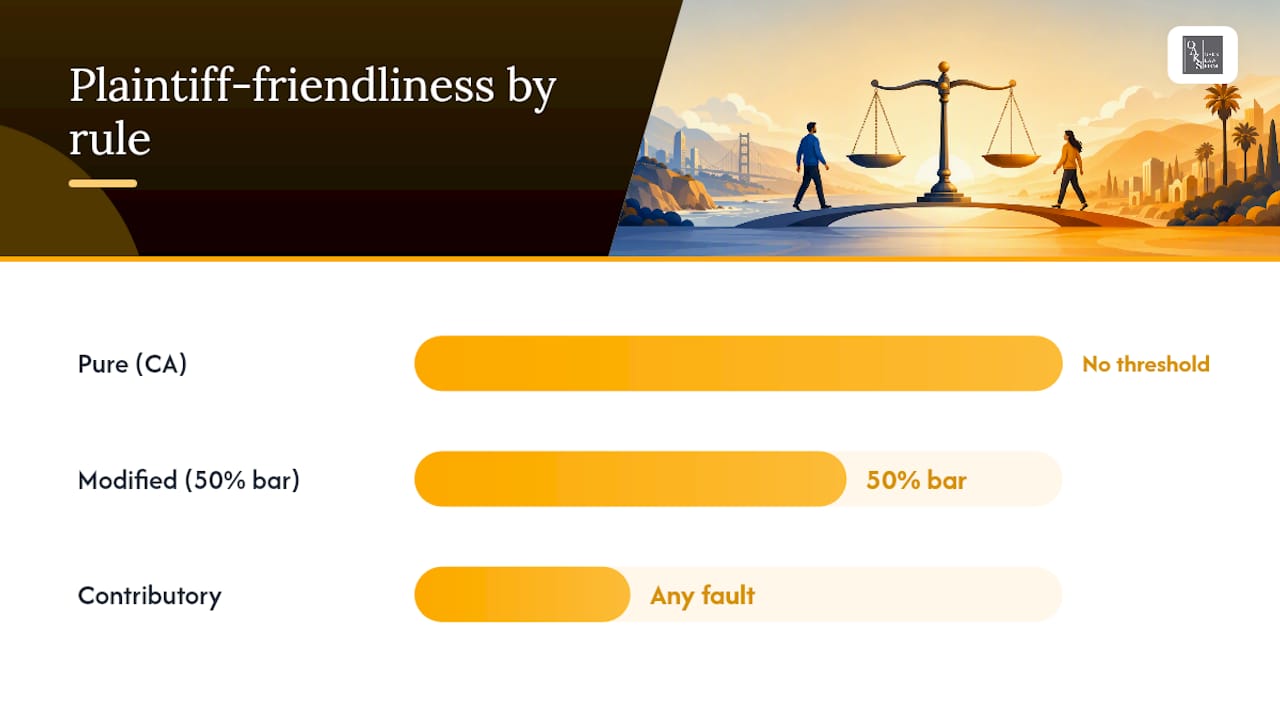
California’s pure rule is the most plaintiff-friendly of the three. That difference can mean tens of thousands of dollars in a serious injury case.
The legal foundation: Li v. Yellow Cab, Civil Code §1714, and the jury instructions courts use
Li v. Yellow Cab Co. (1975)
Before 1975, California followed contributory negligence: any fault on the plaintiff’s part wiped out the entire claim. The California Supreme Court ended that in Li v. Yellow Cab Co., 13 Cal.3d 804, adopting pure comparative negligence as a matter of fairness and judicial policy. The court reasoned that a rule stripping an injured person of all recovery because of minor fault produced results that were neither just nor logical.
Civil Code §1714 and Proposition 51
Civil Code §1714 establishes the baseline: everyone is responsible for their own negligence and for the harm it causes others. Proposition 51, codified at Civil Code §1431.2, adds an important wrinkle in multi-defendant cases. Economic damages (medical bills, lost wages, property damage) remain jointly and severally liable, meaning you can collect the full amount from any solvent defendant. Non-economic damages (pain and suffering, emotional distress) are several only, so each defendant pays only its proportionate share. That split matters enormously when one defendant has deep pockets and another is judgment-proof.
CACI No. 405 and CACI No. 406
California courts use the Judicial Council of California Civil Jury Instructions (CACI) to guide jurors through comparative fault. CACI No. 405 — Comparative Fault of Plaintiff — tells jurors to decide whether the plaintiff’s own negligence was a substantial factor in causing the harm, and if so, to reduce the damages award by the plaintiff’s assigned percentage.
CACI No. 406 handles apportionment among multiple defendants and nonparties, directing jurors to assign percentages to all responsible persons so the total reaches 100%. The Judicial Council’s official CACI materials are the authoritative source courts rely on when giving these instructions.
How to calculate your reduced recovery, step by step
The math itself is straightforward. The strategy around it is not.
Step 1: Determine total damages — every category of loss, including medical expenses, future care costs, lost earnings, and non-economic harm.
Step 2: Assign a percentage of fault to each party whose conduct contributed to the accident.
Step 3: Reduce the plaintiff’s recovery by the plaintiff’s own percentage. The California court system’s small-claims guidance describes exactly this three-step process.
Three examples show how the numbers play out:
Total damages: $200,000.
Total damages: $200,000.
This is the scenario that surprises people most.
Example 3 — Multiple defendants
Total damages: $300,000.
For economic damages, the plaintiff can pursue the full $240,000 from either defendant (joint and several). For non-economic damages within that $240,000, Defendant A owes its 50% share and Defendant B owes its 30% share — neither is on the hook for the other’s portion under Proposition 51.
Pro Tip: *Each piece of evidence you preserve — a police report, traffic-camera footage, a witness statement, accident reconstruction data — can shift the jury’s fault percentage by several points.
Who decides fault percentages and how the process actually works
The trier of fact assigns the percentages. In a jury trial, that is the jury. In a bench trial, the judge does it. Either way, the decision is based on the totality of evidence presented, not a formula.
Comparative fault is an affirmative defense. The defendant must plead it and carry the burden of proving that the plaintiff’s own negligence was a substantial factor in causing the harm. If the defendant fails to produce convincing evidence, jurors typically assign zero percent to the plaintiff — because the burden never shifted to the plaintiff to prove innocence.
Nonparty and empty-chair allocations
Courts can also ask juries to assign fault to parties who are not in the courtroom — a defendant who settled before trial, an immune employer, or an unjoined third party. Under CACI No. 406, jurors allocate percentages to all persons whose conduct was a substantial factor, and those percentages must total 100%. This “empty-chair” allocation can reduce the percentage assigned to remaining defendants, which affects how much each pays on non-economic damages.
Evidence courts weigh when assigning percentages includes police and traffic-collision reports, accident reconstruction expert testimony, witness credibility, medical records establishing the mechanism of injury, surveillance or dashcam footage, and physical evidence from the scene.
How comparative fault plays out in common California injury scenarios
Most California injury cases settle before a jury ever assigns percentages — the apportionment fight happens at the negotiating table. But knowing realistic percentage ranges for common fact patterns gives you leverage in those negotiations.
Auto collisions
A rear-end collision typically assigns minimal fault to the trailing driver’s victim, but not always zero. If the front driver made an abrupt, unforeseeable lane change, a jury might assign some fault to the front driver. A left-turn collision where the turning driver failed to yield usually places most fault on the turning driver, with the through-traffic driver potentially carrying a smaller share if speeding.
Evidence that moves the number: dashcam footage, traffic-signal data, rear-end accident fault rules.
Pedestrian and bicycle collisions
A pedestrian who crossed mid-block against traffic might be assigned a moderate share of fault. A cyclist riding without lights at night could be assigned some fault as well. The driver’s speed and attentiveness remain the dominant factors.
Evidence that moves the number: intersection surveillance video, crosswalk signal data, witness accounts of vehicle speed.
Slip-and-fall injuries
Property owners have a duty to maintain safe premises, but plaintiffs who ignored obvious hazards or wore inappropriate footwear may be assigned some fault. A wet floor with no warning sign typically places most fault on the property owner.
Evidence that moves the number: maintenance logs, prior incident reports, security footage showing how long the hazard existed.
Motorcycle accidents
Motorcyclists may face higher baseline fault assignments because jurors sometimes carry bias about riding risk. A motorcyclist lane-splitting at excessive speed might be assigned a significant share of fault even when a car made an unsafe lane change. Helmet use (or non-use) can affect non-economic damage arguments.
Evidence that moves the number: accident reconstruction, speed-analysis data, witness statements about lane positions.
How comparative fault shapes settlement offers and insurance negotiations
Insurers do not wait for a jury to assign percentages. Adjusters run their own internal fault analysis the moment a claim comes in, and that preliminary number anchors their opening offer.
Your documented damages total $200,000. You may simply receive a number that feels low without knowing why.
Practical responses when an insurer assigns you a high fault percentage:
- Gather and preserve all physical evidence immediately: photos, video, police reports, and witness contact information.
- Obtain your medical records and a physician’s narrative linking your injuries to the accident mechanism.
- Request the insurer’s written basis for the fault percentage they assigned.
- Counter with your own evidence-based fault analysis — a dispute-fault strategy built on documentation, not just assertion.
On a $200,000 case, that is $50,000 gone permanently once you sign a release.
When to hire an attorney and what Oaks Law Firm does in comparative-fault cases
Certain situations make legal representation not just helpful but close to necessary. You should strongly consider hiring counsel when:
- The insurer is blaming you for a significant share of the accident.
- Multiple parties are involved and fault is genuinely disputed.
- Your medical bills are substantial and future care is likely.
- One or more defendants may be uninsured or underinsured — collectibility becomes as important as the percentage assigned.
- The accident involved a government entity, which triggers a six-month government claims deadline under Government Code §911.2 rather than the standard two-year period under CCP §335.1.
Oaks Law Firm handles comparative-fault cases by starting with a thorough fault analysis: reviewing police reports, preserving physical evidence, retaining accident reconstruction experts when the facts warrant it, and building a documented counter-narrative to the insurer’s preliminary fault assignment. The firm’s approach to negotiation is grounded in evidence, not just demand letters. When cases do not settle on fair terms, the team prepares for trial — which itself changes how insurers value the claim.
Matthew Nezhad founded Oaks Law Firm in 2002 specifically to fight for injured Californians in the San Fernando Valley and throughout the state. The firm’s reputation for finding the facts and holding negligent parties accountable is what drives referrals from past clients and other attorneys alike.
What to bring to your free case evaluation:
- Photos and video from the accident scene
- The police or traffic-collision report
- All medical records and bills related to your injuries
- Contact information for any witnesses
- Correspondence from the insurer, including any written fault determinations
The personal injury lawsuit filing process can feel complex, but the consultation itself is straightforward: you describe what happened, the team assesses the fault picture, and you leave with a clear sense of what your case is worth and what it would take to pursue it.
What people often get wrong about comparative fault
Most injured people assume that being partly at fault means they have no case. That assumption costs them real money. California’s pure comparative negligence rule was designed precisely to prevent that outcome — the legislature and courts recognized that accidents rarely have a single cause, and that stripping a seriously injured person of all recovery because of minor fault is unjust.
The subtler mistake is treating the fault percentage as fixed. It is not. It is a number that evidence builds or erodes. A well-documented counter-argument backed by photos, reconstruction data, and medical records routinely moves that number.
Percentages also interact with collectibility in ways that matter as much as the math. Understanding both the percentage and the defendant’s ability to pay is what separates a theoretical recovery from an actual one.
Oaks Law Firm is ready to evaluate your comparative-fault case
When fault is disputed and your recovery is on the line, you need an attorney who understands how to build the evidence that moves percentage points. Oaks Law Firm offers a free case evaluation with no obligation — you pay nothing unless the firm wins your case.

The initial consultation covers your fault picture, your documented damages, the applicable deadlines (two years under CCP §335.1 for most claims; six months under Gov. Code §911.2 for government-entity claims), and a realistic assessment of what your case could recover. If you were injured in a car accident, you can learn more about how compensation is calculated before you call. If an uninsured or underinsured driver was involved, the firm’s uninsured and underinsured driver practice addresses exactly the collectibility issues that make those cases harder. Contact Oaks Law Firm today to schedule your free evaluation and find out what your claim is actually worth.
Sources
FAQ
Does California follow comparative fault?
Yes. California follows the pure comparative negligence rule, established in Li v. Yellow Cab Co., 13 Cal.3d 804 (1975), which allows an injured plaintiff to recover damages regardless of their percentage of fault, reduced proportionally.
What is the 50% comparative negligence rule, and does California use it?
California does not use it — California’s pure rule imposes no such threshold.
What is an example of comparative fault in a California injury case?
A driver runs a red light and hits a pedestrian who was crossing slightly outside the crosswalk. The pedestrian recovers damages reduced by their fault percentage.
How does comparative fault affect a settlement with an insurance company?
Insurers apply their own preliminary fault percentage to reduce settlement offers before any lawsuit is filed. Challenging that percentage with documented evidence — police reports, photos, medical records — is often the most direct way to increase the settlement amount.
When should I hire an attorney for a comparative-fault injury case?
Hire an attorney when the insurer is assigning you significant fault, when multiple defendants are involved, when your injuries are serious, or when a defendant may be uninsured. An attorney can dispute inflated fault percentages and preserve evidence before it disappears.
This article provides general legal information about California personal injury law and is not a substitute for advice from a licensed attorney about your specific situation. Laws and deadlines can change; confirm current rules with a qualified California personal injury attorney before making legal decisions.
Oaks Law Firm — Protecting the rights of the injured in the San Fernando Valley and throughout California.
