Investigators Say Utility Equipment Caused the 2025 Eaton Fire: What This Means for California Wildfire Victims
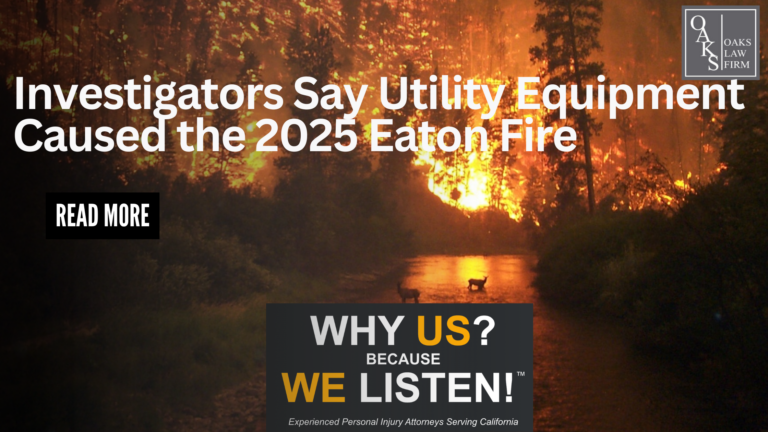
Los Angeles County fire officials have determined that the 2025 Eaton Fire, which killed 19 people and destroyed more than 9,400 homes and businesses in the Altadena area, was caused by electrical arcing on an idle Southern California Edison transmission tower. As reported by the Associated Press, the investigation, conducted jointly by the Los Angeles County Arson Fire Investigation Unit and Cal Fire, found that two electrical arcing events occurred in quick succession atop a ridge covered in dry fuel, sending burning material to the ground below during extreme fire weather. For the thousands of families who lost homes, loved ones, or livelihoods, the report answers a long-standing question about how the fire began, and it sharpens the next one: what are their legal options? This article explains how California law treats wildfire claims against utilities.
What Did the Eaton Fire Investigation Find?
According to the report described by the Associated Press, sparks from an out-of-service Edison tower ignited the blaze when uninsulated wires arced, meaning electricity jumped through the air and produced sparks, on a ridge blanketed with dry vegetation. The report stated that the utility was responsible for maintaining and operating its equipment in a way that would minimize the risk of catastrophic wildfire. Residents interviewed by investigators described seeing a blue arc and a circle of orange sparks at the base of the transmission towers before flames spread rapidly in heavy winds.
Edison has said it is reviewing the report and has acknowledged its equipment may have been involved, while also arguing that a fire of this magnitude involves many factors and drawing a distinction between how a fire ignites and how it spreads. That distinction, ignition versus spread, is likely to be a central point of dispute in the litigation ahead.
Can Wildfire Victims Sue a Utility in California?
Yes, and many already have. When a utility’s equipment starts a fire, California law provides several avenues for holding it accountable, and the utility is facing hundreds of lawsuits from fire victims, insurers, and government entities in connection with the Eaton Fire. California has a long history of utility-caused wildfire litigation; the Associated Press notes that Edison previously paid billions to settle claims from the 2018 Woolsey Fire, and that another utility, PG&E, faced criminal and financial consequences after its equipment ignited deadly fires elsewhere in the state.
One feature of California law that is especially important in these cases is the doctrine of inverse condemnation, which can hold a utility responsible for property damage its equipment causes even without a finding of negligence. Alongside that, victims may pursue negligence and other claims. Because the available theories and the parties involved can be complex, wildfire cases are typically handled differently from an ordinary personal injury claim.
What Kinds of Losses Can Wildfire Victims Recover?
The losses from a fire like this reach far beyond a destroyed structure. Depending on the specific facts, wildfire victims may be able to seek recovery for damage to or loss of a home and personal property, the costs of evacuation and temporary housing, business interruption and lost income, and the physical and emotional harm caused by the fire. Where smoke and ash have damaged a home that did not burn, those losses may also be part of a claim, a reality for many households on the edges of the burn area.
When a fire causes a death, California law allows certain surviving family members to bring a wrongful death claim under California Code of Civil Procedure § 377.60, which can address the loss of financial support, companionship, and guidance, along with related expenses. Given that 19 people died in the Eaton Fire, these claims are a significant part of the litigation.
How Long Do Eaton Fire Victims Have to File a Claim?
For most California personal injury and wrongful death claims, including many wildfire claims against a private utility, the general statute of limitations is two years from the date of injury under California Code of Civil Procedure § 335.1. Property damage claims can carry their own deadlines. Because a single wildfire can give rise to several different types of claims, each potentially governed by a different deadline, it is important not to assume that one date applies to everything.
A separate and much shorter deadline can apply if a claim involves a government entity. The Associated Press reports that Edison has itself brought claims against Los Angeles County agencies over evacuation warnings, and that federal and other government litigation is underway. Where a public entity may share responsibility, the California Government Claims Act (Government Code § 911.2) generally requires a formal written claim to be presented within six months of the incident before a lawsuit can be filed. Because deadlines vary depending on who is responsible and other case-specific factors, and because some fire-related deadlines may be affected by ongoing proceedings, it is important to confirm your specific deadline with an attorney as soon as possible rather than relying on a general rule.
Does a Fire Victim Need to Prove the Utility Was at Fault?
Not necessarily in the same way as a typical negligence case. Under inverse condemnation, a utility can be held liable for property damage its equipment causes regardless of whether it acted carelessly, which is one reason these cases proceed differently from an ordinary accident claim. For other categories of harm, such as personal injury or wrongful death, the analysis can involve questions of negligence and the utility’s maintenance of its equipment, exactly the issue the county’s report addressed. The interplay of these theories is one of the main reasons wildfire victims often seek experienced legal guidance rather than navigating the process alone.
What Should Eaton Fire Victims Do Now?
If you were affected by the Eaton Fire, there are practical steps that can protect your options while you focus on rebuilding your life. Keeping thorough records helps: documentation of what was lost, photographs, insurance correspondence, receipts for evacuation and temporary living costs, and any medical records related to injuries or smoke exposure. It also helps to be thoughtful in your dealings with insurers before the full scope of your losses is understood. Speaking with an attorney does not commit you to litigation; it allows you to understand how the various claims, deadlines, and proceedings, including the large body of existing Eaton Fire litigation, may affect your particular situation.
How Oaks Law Firm Can Help
At Oaks Law Firm, we help injured people and grieving families across Los Angeles and throughout California understand their rights after catastrophic events, including wildfires. Every situation is different, and the right path depends on the specific facts, including the nature of your losses and which claims and deadlines apply to you. If you or your family were harmed by the Eaton Fire, we welcome the opportunity to listen and explain the options that may be available for your particular circumstances. You can learn more about our work on the Los Angeles fires. Contingency fee arrangements, which relate to attorney’s fees, may be available and can be discussed during a consultation; case costs and expenses may be handled separately.
To speak with us about your situation, request a free case evaluation or contact Oaks Law Firm for a consultation specific to your circumstances.
Oaks Law Firm — Office Locations — Sherman Oaks, California
This article is provided for general informational purposes only and does not constitute legal advice. The information presented may not reflect the most current legal developments and should not be relied upon as a substitute for consultation with a licensed attorney. Every personal injury case involves unique facts and circumstances, and the outcome of any case depends entirely on those specific facts. Any results, settlement amounts, or verdicts referenced in this content are specific to the individual cases described, are not typical, and do not guarantee, promise, or predict a similar outcome in your case. Reading this content does not create an attorney-client relationship with Oaks Law Firm. Contact us directly for a consultation specific to your situation.
